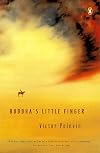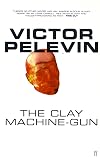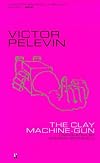
Buddha's Little Finger
by Viktor Pelevin
On This Page
Description
A manic satire of psychiatry, crime and corruption in Russia. Peter Null is undergoing treatment in Moscow's Psychiatric Clinic number 17, where his consultant believes the way to treat his condition is to humour his delusive personality until it achieves reintegration with the rest of his psyche.Tags
Recommendations










Member Recommendations
Member Reviews
Despite the revolting ugliness of each of its component parts, viewed as a whole the city looked extremely beautiful, but the source of this beauty was beyond all understanding. That's always the way with Russia, thought Maria, as she ran her hands up and down the cold steel - when you see it from afar, it's so beautiful it's enough to make you cry, but when you take a closer look, you just want to puke.
What is real? Is it Pyotr's experiences as an intellectual masquerading as an officer in the Red Army just after the Russian revolution? Or is he really an amnesiac patient in a mental hospital after the fall of communism, who can’t cope with the stresses of the new regime? Or is nothing real, as Chapaev and the Black Baron claim? show more Characters and events from one reality bleed into another, the stories of Pyotr's fellow patients fit into the jigsaw somehow, and although you may think you have it all sorted out in your mind, the last words of the book may make you think again.
I had never heard of this author before picking this book up for 30p in a library sale, but after reading this one I will be definitely be adding his other books to my wish list. When I looked Victor Pelevin up, I discovered that Chapaev is a revolutionary folk-hero, and that he and his comrades Anka and Petka are the subjects of numerous Russian jokes. I've just lent "The Clay Machine-Gun" to my father who is interested in Buddhism, and used to learn Russian at evening classes.
'My dear Pyotr', said the Baron, 'there are quite incredible numbers of invisible elephants wandering around us all the time, please take my word for it. They are more common in Russian than crows.' show less
What is real? Is it Pyotr's experiences as an intellectual masquerading as an officer in the Red Army just after the Russian revolution? Or is he really an amnesiac patient in a mental hospital after the fall of communism, who can’t cope with the stresses of the new regime? Or is nothing real, as Chapaev and the Black Baron claim? show more Characters and events from one reality bleed into another, the stories of Pyotr's fellow patients fit into the jigsaw somehow, and although you may think you have it all sorted out in your mind, the last words of the book may make you think again.
I had never heard of this author before picking this book up for 30p in a library sale, but after reading this one I will be definitely be adding his other books to my wish list. When I looked Victor Pelevin up, I discovered that Chapaev is a revolutionary folk-hero, and that he and his comrades Anka and Petka are the subjects of numerous Russian jokes. I've just lent "The Clay Machine-Gun" to my father who is interested in Buddhism, and used to learn Russian at evening classes.
'My dear Pyotr', said the Baron, 'there are quite incredible numbers of invisible elephants wandering around us all the time, please take my word for it. They are more common in Russian than crows.' show less
Weird, deeply weird. Multiple storylines, interludes from other points of view, philosophy and history all rolled into one. The main character, Pyotr Voyd (the name is no accident), is in a present-day mental hospital, but he's also living a life in early-20th century Russia as an associate of Chapaev (an actual historical figure). Or is that just Pyotr's delusion? Does he need to be cured or does the rest of the world?
I'm not much for philosophy, and I admit that my knowledge of Russian history is spotty, but I enjoyed this book immensely. It prompted me to read a little about the Russian sense of humor and their liking for jokes in the form of anecdotes. Not something I would have expected to end up learning about! This one isn't show more really for linear thinkers, but if you're willing to give yourself up and go for the ride even when it gets absurd, I think you'll find it rewarding.
Recommended for: Buddhists, amateur philosophers, fans of stories within stories.
Quote: "As I grew older, I came to understand that the words 'to come round' actually mean 'to come round to other people's point of view,' because no sooner is one born than these other people begin explaining just how hard one must try to force oneself to assume a form which they find acceptable." show less
I'm not much for philosophy, and I admit that my knowledge of Russian history is spotty, but I enjoyed this book immensely. It prompted me to read a little about the Russian sense of humor and their liking for jokes in the form of anecdotes. Not something I would have expected to end up learning about! This one isn't show more really for linear thinkers, but if you're willing to give yourself up and go for the ride even when it gets absurd, I think you'll find it rewarding.
Recommended for: Buddhists, amateur philosophers, fans of stories within stories.
Quote: "As I grew older, I came to understand that the words 'to come round' actually mean 'to come round to other people's point of view,' because no sooner is one born than these other people begin explaining just how hard one must try to force oneself to assume a form which they find acceptable." show less
Buddha’s Little Finger grabs you at the outset, with the first chapter set in 1918 or so, right after the Russian Revolution. It’s a time of turbulence, corruption, and citizens switching their allegiances out of self-preservation, and the narrator finds himself betrayed by an old friend. He escapes arrest by killing him and assuming his identity. Don’t worry, that’s not much of a spoiler. It’s incidental to what quickly becomes a non-linear plot, but does foreshadow a larger theme in the book: is the identity we perceive for ourselves real? Are any of the things around us real?
Chapter two opens in a Moscow psychiatric hospital, and it soon becomes apparent that the same narrator is suddenly in the present. When Arnold show more Schwarzenegger makes a prolonged appearance in an action/adventure semi-erotic dream fantasy the reader realizes, hmm, we’re not in Kansas anymore! I won’t attempt to describe the rest. The book flits back and forth between past and present and with a mixture of fantasy and allegory.
I loved the link of modern Russian feeling to its often tortured past, to the long reach of history, the Revolution, and Stalin, and what that’s all meant to the culture. I also loved the touches of Buddhism in the book. The main message seems to be that overcoming the poor conditions in Russia and the absurd madhouse of reality in general must start within, that one must realize that all of the things we see as hard and cold and real are really illusions, whispery vapors that disappear. It’s a multi-faceted book from a writer who is clearly very smart; there are a lot of nice touches, and great quotes.
I was less keen when the Buddhist touches of oneness and enlightenment started migrating into observer-dependent reality, and what I call philoso-babble. Here’s an example: “If the entire world exists within me, then where do I exist? And if I exist within this world, then where, in what place in the world, is my consciousness located? One might say, I thought, that on the one hand the world exists in me and on the other hand I exist in the world, and these are simply the poles of a single semantic magnet, but the tricky thing was there was no peg on which to hang this magnet, the dialectical dyad. There was nowhere for it to exist! Because its existence required an individual in whose consciousness it could come into being. And that individual had nowhere to exist, because any ‘where’ could only arise in a consciousness for which there was simply no place other than one created by itself … But then where was it before it created this place for itself? If within itself, then where?”
Ugh. Sorry for all that. I think the Chuang-Tzu ‘butterfly dreaming it was a man’ parable is nice as a short parable, but not when it’s magnified and expanded. When this is combined with the psychedelic and trippy nature of the plot, well, it’s a bit much and it begins to feel like you need to be smoking weed to enjoy it. Overall the book is certainly worth reading but I took my rating down a little bit because of that.
Quotes:
On beauty:
“’In ancient times,’ said Kawabata, ‘in our country officials were appointed to important posts after examinations in which they wrote an essay on beauty. And this was a very wise principal, for if a man has an understanding of that which is immeasurably higher than bureaucratic procedures, then he will certainly be able to cope with such lower matters.”
On children:
“…while idiot adults were busy trying to rearrange a world which they had invented for themselves, the children were still living in reality – among mountains of snow and sunlight, on the black mirrors of frozen ponds and in the mystic night silence of icy yards. …their clear eyes still shone with the memory of something which I had long ago forgotten; perhaps it was some unconscious reminiscence of the great source of all existence from which they had not yet been too far distanced in their descent into this life of shame and desolation.”
On being genuine:
“…a human personality is like a wardrobe filled with sets of clothes which are taken out by turns, and the less real the person actually is, the more sets there are in the wardrobe.”
On God:
“I could never understand why God should manifest himself to people in the ugly form of a human body. It has always seemed to me that the perfection of a melody would have been far more appropriate – a melody that one could listen to on and on for ever.”
On the human condition; the act of uncoupling the train linked to enlightenment:
“…man is rather like this train. In exactly the same way is he doomed for all eternity to drag after him out of the past a string of dark and terrible carriages inherited from goodness knows whom. And hec calls the meaningless rumbling of this accidental coupling of hopes, opinions, and fears his life. And there is no way to avoid this fate.”
On the intelligentsia:
“Every member of the intelligentsia … especially in Russia, where he can only survive if someone else supports him, possesses one revoltingly infantile character trait. He is never afraid to attack that which subconsciously he feels to be right and lawful. Like a child who is not afraid to do his parents harm, because he knows that they may put him in the corner, but they won’t throw him out. He is more afraid of strangers. And it’s the same with this vile class.”
On love:
“In essence, love arises in solitude, when its object is absent, and it is directed less at the person whom one loves than at an image constructed by the mind which has only a weak connection with that original. The appearance of true love requires the ability to create chimeras; in kissing me Anna was really kissing the man behind the poems which had affected her so strongly, a man who had never existed.”
On nature:
“I don’t write poems. I don’t even like them very much. And who needs words with the stars up in the sky?”
On Nabokov, who as some know I dislike; this made me smile:
“Take Nabokov. His endless musings on the early years of his life are a classic example of what I’m talking about. And the classic example of recovery … he achieved in such a masterly fashion by transforming his longing for an unattainable paradise which may never have existed at all into a simple, earthly and somewhat illegitimate passion for a little girl, a child.”
On oneness, and enlightenment; I found this profound:
“’If one of those lumps of wax believes that it is the form which it has assumed, then it is mortal, because that form will be destroyed – but if it understands that it wax, then what can happen to it?’
“Nothing,’ I replied.
‘Precisely,’ said Kotovsky. ‘In that case it is immortal. But the tricky part is, it’s very difficult for the wax to understand that it is wax – it’s almost impossible to grasp one’s own primordial nature. How can you notice what has been there right in front of you since the beginning of time? And so the only thing that the wax does notice is its temporary form. But the form is arbitrary every time it arises, influenced by thousands and thousands of different circumstances.’
…
‘The conclusion is that the only route to immortality for a drop of wax is to stop thinking of itself as a drop and to realize that it is wax. But since our drop is capable only of noticing its own form, all its brief life it prays to the Wax God to preserve this form, although, if one thinks about it, this form possesses absolutely no inherent relation to the wax.”
On Russia:
“…for a moment Barbolin’s face reflected one of those feelings that nineteenth-century Russian artists loved to depict when they were creating national types – the feeling that somewhere out there is a wide and wonderful world, filled with amazing and attractive things, and though you can never seriously hope to reach it yourself, you cannot help sometimes dreaming impossible dreams.”
“…by nature the Russian is not inclined to a search for metaphysical meaning and makes do with a cocktail of atheism and alcoholism which, if the truth be told, is our major spiritual tradition.”
“…if history teaches us anything, then it is that everybody who has tried to sort things out in Russia has ended up being sorted out by Russia instead.”
On transience:
“And I felt that all of us are nothing more than sounds drifting through the air from the fingers of some unknown pianist, nothing more than short thirds, smooth sixths and dissonant sevenths in a mighty symphony which none of us can ever hear in its entirety.”
On writing:
“…I had never understood my own poetry particularly well, and had long suspected that authorship is a dubious concept, and all that is required from a person who takes a pen in hand is to line up the various keyholes scattered about his soul so that a ray of sunlight can shine through on to the paper set out in front of him.” show less
Chapter two opens in a Moscow psychiatric hospital, and it soon becomes apparent that the same narrator is suddenly in the present. When Arnold show more Schwarzenegger makes a prolonged appearance in an action/adventure semi-erotic dream fantasy the reader realizes, hmm, we’re not in Kansas anymore! I won’t attempt to describe the rest. The book flits back and forth between past and present and with a mixture of fantasy and allegory.
I loved the link of modern Russian feeling to its often tortured past, to the long reach of history, the Revolution, and Stalin, and what that’s all meant to the culture. I also loved the touches of Buddhism in the book. The main message seems to be that overcoming the poor conditions in Russia and the absurd madhouse of reality in general must start within, that one must realize that all of the things we see as hard and cold and real are really illusions, whispery vapors that disappear. It’s a multi-faceted book from a writer who is clearly very smart; there are a lot of nice touches, and great quotes.
I was less keen when the Buddhist touches of oneness and enlightenment started migrating into observer-dependent reality, and what I call philoso-babble. Here’s an example: “If the entire world exists within me, then where do I exist? And if I exist within this world, then where, in what place in the world, is my consciousness located? One might say, I thought, that on the one hand the world exists in me and on the other hand I exist in the world, and these are simply the poles of a single semantic magnet, but the tricky thing was there was no peg on which to hang this magnet, the dialectical dyad. There was nowhere for it to exist! Because its existence required an individual in whose consciousness it could come into being. And that individual had nowhere to exist, because any ‘where’ could only arise in a consciousness for which there was simply no place other than one created by itself … But then where was it before it created this place for itself? If within itself, then where?”
Ugh. Sorry for all that. I think the Chuang-Tzu ‘butterfly dreaming it was a man’ parable is nice as a short parable, but not when it’s magnified and expanded. When this is combined with the psychedelic and trippy nature of the plot, well, it’s a bit much and it begins to feel like you need to be smoking weed to enjoy it. Overall the book is certainly worth reading but I took my rating down a little bit because of that.
Quotes:
On beauty:
“’In ancient times,’ said Kawabata, ‘in our country officials were appointed to important posts after examinations in which they wrote an essay on beauty. And this was a very wise principal, for if a man has an understanding of that which is immeasurably higher than bureaucratic procedures, then he will certainly be able to cope with such lower matters.”
On children:
“…while idiot adults were busy trying to rearrange a world which they had invented for themselves, the children were still living in reality – among mountains of snow and sunlight, on the black mirrors of frozen ponds and in the mystic night silence of icy yards. …their clear eyes still shone with the memory of something which I had long ago forgotten; perhaps it was some unconscious reminiscence of the great source of all existence from which they had not yet been too far distanced in their descent into this life of shame and desolation.”
On being genuine:
“…a human personality is like a wardrobe filled with sets of clothes which are taken out by turns, and the less real the person actually is, the more sets there are in the wardrobe.”
On God:
“I could never understand why God should manifest himself to people in the ugly form of a human body. It has always seemed to me that the perfection of a melody would have been far more appropriate – a melody that one could listen to on and on for ever.”
On the human condition; the act of uncoupling the train linked to enlightenment:
“…man is rather like this train. In exactly the same way is he doomed for all eternity to drag after him out of the past a string of dark and terrible carriages inherited from goodness knows whom. And hec calls the meaningless rumbling of this accidental coupling of hopes, opinions, and fears his life. And there is no way to avoid this fate.”
On the intelligentsia:
“Every member of the intelligentsia … especially in Russia, where he can only survive if someone else supports him, possesses one revoltingly infantile character trait. He is never afraid to attack that which subconsciously he feels to be right and lawful. Like a child who is not afraid to do his parents harm, because he knows that they may put him in the corner, but they won’t throw him out. He is more afraid of strangers. And it’s the same with this vile class.”
On love:
“In essence, love arises in solitude, when its object is absent, and it is directed less at the person whom one loves than at an image constructed by the mind which has only a weak connection with that original. The appearance of true love requires the ability to create chimeras; in kissing me Anna was really kissing the man behind the poems which had affected her so strongly, a man who had never existed.”
On nature:
“I don’t write poems. I don’t even like them very much. And who needs words with the stars up in the sky?”
On Nabokov, who as some know I dislike; this made me smile:
“Take Nabokov. His endless musings on the early years of his life are a classic example of what I’m talking about. And the classic example of recovery … he achieved in such a masterly fashion by transforming his longing for an unattainable paradise which may never have existed at all into a simple, earthly and somewhat illegitimate passion for a little girl, a child.”
On oneness, and enlightenment; I found this profound:
“’If one of those lumps of wax believes that it is the form which it has assumed, then it is mortal, because that form will be destroyed – but if it understands that it wax, then what can happen to it?’
“Nothing,’ I replied.
‘Precisely,’ said Kotovsky. ‘In that case it is immortal. But the tricky part is, it’s very difficult for the wax to understand that it is wax – it’s almost impossible to grasp one’s own primordial nature. How can you notice what has been there right in front of you since the beginning of time? And so the only thing that the wax does notice is its temporary form. But the form is arbitrary every time it arises, influenced by thousands and thousands of different circumstances.’
…
‘The conclusion is that the only route to immortality for a drop of wax is to stop thinking of itself as a drop and to realize that it is wax. But since our drop is capable only of noticing its own form, all its brief life it prays to the Wax God to preserve this form, although, if one thinks about it, this form possesses absolutely no inherent relation to the wax.”
On Russia:
“…for a moment Barbolin’s face reflected one of those feelings that nineteenth-century Russian artists loved to depict when they were creating national types – the feeling that somewhere out there is a wide and wonderful world, filled with amazing and attractive things, and though you can never seriously hope to reach it yourself, you cannot help sometimes dreaming impossible dreams.”
“…by nature the Russian is not inclined to a search for metaphysical meaning and makes do with a cocktail of atheism and alcoholism which, if the truth be told, is our major spiritual tradition.”
“…if history teaches us anything, then it is that everybody who has tried to sort things out in Russia has ended up being sorted out by Russia instead.”
On transience:
“And I felt that all of us are nothing more than sounds drifting through the air from the fingers of some unknown pianist, nothing more than short thirds, smooth sixths and dissonant sevenths in a mighty symphony which none of us can ever hear in its entirety.”
On writing:
“…I had never understood my own poetry particularly well, and had long suspected that authorship is a dubious concept, and all that is required from a person who takes a pen in hand is to line up the various keyholes scattered about his soul so that a ray of sunlight can shine through on to the paper set out in front of him.” show less
Wow. This is one messed up book. It’s not typical messed up. It is screw-with your-head messed up. And it’s messing-with-novelistic-conventions (which I typically love) messed up.
When I started writing my first novel, Death by Zamboni, I had only one original intention in mind. To break every single convention of fiction writing that I could think of. I approached it from a comedic perspective and had fun with it. It’s also a satire, of course, of commercialism and “entertainment,” as it turned out and as such is often intentionally didactic. That’s about all I can claim in common with Buddha’s Little Finger, which is also often didactic, but in quite grim and oddly fascinating ways.
BLF (not to be confused with your BFF) show more is a tale split between two realities, both featuring the same main character. In one case, our hero, Pyotr Voyd (note the name, as in Void) kills a man who is about to turn him in as an anti-red during the 1919 Russian Civil War and then finds himself accidentally mistaken for the man he killed. He continues the ruse in order to escape detection and ends up becoming a heroic soldier with the Bolshevik army on the front lines. The other reality features our hero as a schizophrenic in a mental hospital in 1990’s Moscow. He slips from one reality to the other as in a dream, and he is unable to distinguish which is “real.” This dialogue between the two halves is a rather didactic demonstration of the Buddhist dictum that life is but a dream.*
The problem with this structure is, of course, that it doesn’t “prove” anything. It’s a literary technique. And as such has no greater weight than, say, Twilight proves the existence of vampires. It does make for an intriguing story, however, and the time travel effect allows for interesting symbolic juxtaposition of the communist war and the present decadence and poverty of Russian society.
Another didactic element used throughout the book is the Socratic dialogue. Many conversations in the book come across as debates about the nature of reality rather than as believable conversation. The most common sentence in the book is, “What do you mean?” (in various forms) in order to allow some character or another to expound a philosophical belief. Fortunately, the writing is solid, and the philosophy is fascinating so he manages to get away with it to my mind. And I appreciate his bravado at breaking the rules. Did I love it, though? No. The Buddhist philosophy strewn throughout this book was not very comforting. In fact, I found this to be a deeply sad and lonely book. It portrays a cold existence for our narrator. Some critics seem to find humor in the story, but for me, except for a brief moment or two, it was primarily bleak.
But the novel has stayed with me. BLF has a surreality to it that lingers in disturbing and creepy ways. It managed to get under my skin. Despite feeling forced at times, despite being didactic and in some ways misrepresentative of Buddhism, Pelevin captures the underlying sadness and absurdity of life. For that, along with the outstanding writing, I salute you.
*I note here that I have strong Buddhist leanings myself. There are many sects within Buddhism. Some of which are purely philosophy-focused, others being somewhat more religious in nature. And each variant has a different focus and or approach to what Buddhism means. Life being “a dream” is not necessarily a global Buddhist belief. Some Buddhist’s would say that there is nothing to believe at all. Other Buddhist beliefs discussed herein are even less accepted globally, such as the existence of limbo and reincarnation. Although Tibetan Buddhists believe in reincarnation, most Buddhists do not. show less
When I started writing my first novel, Death by Zamboni, I had only one original intention in mind. To break every single convention of fiction writing that I could think of. I approached it from a comedic perspective and had fun with it. It’s also a satire, of course, of commercialism and “entertainment,” as it turned out and as such is often intentionally didactic. That’s about all I can claim in common with Buddha’s Little Finger, which is also often didactic, but in quite grim and oddly fascinating ways.
BLF (not to be confused with your BFF) show more is a tale split between two realities, both featuring the same main character. In one case, our hero, Pyotr Voyd (note the name, as in Void) kills a man who is about to turn him in as an anti-red during the 1919 Russian Civil War and then finds himself accidentally mistaken for the man he killed. He continues the ruse in order to escape detection and ends up becoming a heroic soldier with the Bolshevik army on the front lines. The other reality features our hero as a schizophrenic in a mental hospital in 1990’s Moscow. He slips from one reality to the other as in a dream, and he is unable to distinguish which is “real.” This dialogue between the two halves is a rather didactic demonstration of the Buddhist dictum that life is but a dream.*
The problem with this structure is, of course, that it doesn’t “prove” anything. It’s a literary technique. And as such has no greater weight than, say, Twilight proves the existence of vampires. It does make for an intriguing story, however, and the time travel effect allows for interesting symbolic juxtaposition of the communist war and the present decadence and poverty of Russian society.
Another didactic element used throughout the book is the Socratic dialogue. Many conversations in the book come across as debates about the nature of reality rather than as believable conversation. The most common sentence in the book is, “What do you mean?” (in various forms) in order to allow some character or another to expound a philosophical belief. Fortunately, the writing is solid, and the philosophy is fascinating so he manages to get away with it to my mind. And I appreciate his bravado at breaking the rules. Did I love it, though? No. The Buddhist philosophy strewn throughout this book was not very comforting. In fact, I found this to be a deeply sad and lonely book. It portrays a cold existence for our narrator. Some critics seem to find humor in the story, but for me, except for a brief moment or two, it was primarily bleak.
But the novel has stayed with me. BLF has a surreality to it that lingers in disturbing and creepy ways. It managed to get under my skin. Despite feeling forced at times, despite being didactic and in some ways misrepresentative of Buddhism, Pelevin captures the underlying sadness and absurdity of life. For that, along with the outstanding writing, I salute you.
*I note here that I have strong Buddhist leanings myself. There are many sects within Buddhism. Some of which are purely philosophy-focused, others being somewhat more religious in nature. And each variant has a different focus and or approach to what Buddhism means. Life being “a dream” is not necessarily a global Buddhist belief. Some Buddhist’s would say that there is nothing to believe at all. Other Buddhist beliefs discussed herein are even less accepted globally, such as the existence of limbo and reincarnation. Although Tibetan Buddhists believe in reincarnation, most Buddhists do not. show less
Ярко, сюрно, философски.
"- Кстати, не объясните ли вы, что такое зарука?
- Как? — наморщился Чапаев.
- Зарука, — повторил я.
- Где это вы услыхали?
- Если я не ошибаюсь, вы сами только что говорили с трибуны о своей командирской заруке.
- А, — улыбнулся Чапаев, — вот вы о чем. Знаете, Петр, когда приходится говорить с массой, совершенно не важно, понимаешь ли сам произносимые слова. Важно, чтобы их понимали другие. Нужно show more просто отразить ожидания толпы. Некоторые достигают этого, изучая язык, на котором говорит масса, а я предпочитаю действовать напрямую. Так что если вы хотите узнать, что такое «зарука», вам надо спрашивать не у меня, а у тех, кто стоит сейчас на площади."
Вот так и эта книга. show less
"- Кстати, не объясните ли вы, что такое зарука?
- Как? — наморщился Чапаев.
- Зарука, — повторил я.
- Где это вы услыхали?
- Если я не ошибаюсь, вы сами только что говорили с трибуны о своей командирской заруке.
- А, — улыбнулся Чапаев, — вот вы о чем. Знаете, Петр, когда приходится говорить с массой, совершенно не важно, понимаешь ли сам произносимые слова. Важно, чтобы их понимали другие. Нужно show more просто отразить ожидания толпы. Некоторые достигают этого, изучая язык, на котором говорит масса, а я предпочитаю действовать напрямую. Так что если вы хотите узнать, что такое «зарука», вам надо спрашивать не у меня, а у тех, кто стоит сейчас на площади."
Вот так и эта книга. show less
I don't know any novel in fiction better then this one... there are only few at the same level, but not higher.
Unfortunately also Pelevin did not write anything better or even close to Chapaev.
Unfortunately also Pelevin did not write anything better or even close to Chapaev.
Bonkers and brilliant.
Members
- Recently Added By
Lists

Russian Literature
184 works; 35 members

International IMPAC Dublin Literary Award
179 works; 6 members

1,001 BYMRBYD Concensus
723 works; 27 members
Author Information

Some Editions
Awards and Honors
Awards
Distinctions
Common Knowledge
- Canonical title
- Buddha's Little Finger
- Original title
- Чапаев и Пустота; Capaev i Pustotà
- Alternate titles
- The Clay Machine-Gun
- Original publication date
- 1996
- People/Characters
- Vasily Ivanovich Chapaev; Serdyuk; Pyotr Voyd; Kawabata
- Important places
- Moscow, Russia
- Important events
- Russian Revolution (1917)
- Related movies
- Buddha's Little Finger (2012 | IMDb)
- Epigraph*
- Глядя на лошадиные морды и лица людей,
на безбрежный живой поток, поднятый
моей волей и мчащийся в никуда по багроÐ... (show all)²ой
закатной степи, я часто думаю:
где Я в этом потоке?
Чингиз Хан - First words
- For numerous reasons the name of the true author of this manuscript, written during the early 1920s in one of the monasteries of Inner Mongolia, cannot be mentioned, and it is published her under the name of the editor who pr... (show all)epared it for publication.
- Quotations*
- Все прекрасное, что может быть в человеке, недоступно другим, потому что по-настоящему оно недоступно даже тому, в ком оно еÑ... (show all)�ть.
Что же ждет поэзию? Ей совсем не останется места в новом мире — или, точнее, место будет, но стихи станут интересны только в Ñ... (show all)‚ом случае, если будет известно и документально заверено, что у их автора два хуя или что он, на худой конец, способен прочитать их жопой.
Ум — это лошадь, впряжённая в коляску тела…
- Красота? - переспросил он задумчиво. - А что такое красота?- Ну как, - сказал я. - Красота - это совершеннейшая объективация воÐ... (show all)»и на высшей ступени её познаваемости. - Last words
- (Click to show. Warning: May contain spoilers.)I nodded, turned towards the door and set my eye against the spy-hole. At first all I could see through it were the blue spots of the street lamps slicing through the frosty air, but we kept moving faster and faster, and soon, very soon. we were surrounded by the whispering sands and roaring waterfalls of my dear and so beloved Inner Mongolia.
Kafka-Yurt
1923-1925 - Original language
- Russian
*Some information comes from Common Knowledge in other languages. Click "Edit" for more information.
Classifications
- Genres
- General Fiction, Fiction and Literature
- DDC/MDS
- 813 — Literature & rhetoric American literature in English American fiction in English
- LCC
- PG3485 .E38 .C4813 — Language and Literature Slavic languages and literatures. Baltic languages. Albanian language Slavic. Baltic. Albanian Russian literature Individual authors and works 1961-2000
- BISAC
Statistics
- Members
- 757
- Popularity
- 37,115
- Reviews
- 11
- Rating
- (4.00)
- Languages
- 12 — English, Estonian, French, German, Hungarian, Italian, Japanese, Lithuanian, Polish, Russian, Spanish, Turkish
- Media
- Paper, Ebook
- ISBNs
- 37
- ASINs
- 3