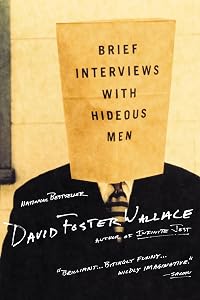
Brief Interviews with Hideous Men
by David Foster Wallace 
On This Page
Description
In this thought-provoking and playful short story collection, David Foster Wallace nudges at the boundaries of fiction with inimitable wit and seductive intelligence. Wallace's stories present a world where the bizarre and the banal are interwoven and where hideous men appear in many guises. Among the stories are 'The Depressed Person,' a dazzling and blackly humorous portrayal of a woman's mental state; 'Adult World,' which reveals a woman's agonized consideration of her confusing sexual show more relationship with her husband; and 'Brief Interviews with Hideous Men,' a dark, hilarious series of imagined interviews with men on the subject of their relations with women. Wallace delights in leftfield observation, mining the absurd, the surprising, and the illuminating from every situation. This collection will enthrall DFW fans, and provides a perfect introduction for new readers. show lessTags
Recommendations









Member Recommendations
Sandydog1 Equally nasty and disturbing and beautifully written
Member Reviews
This (along with "Good People") is probably the best introduction to DFW's fiction that I've found, featuring pretty-short stories in a bunch of different styles and voices. You're pretty much guaranteed to find one that you'll fall in love with, like one of the titular interviews or his second-person voice in "Forever Overhead":
DFW can flip into this poetic-prose mode when he wants to, but rarely does. Instead, he tries to carve at the truth using words as people speak them, and only occasionally as they don't. One essay is written as if a greek myth transplanted to late-90s Los Angeles, which takes a few pages to get used to. Most of the essays don't require such deciphering, and the ones that do try to pay off such effort through laughs or revelation.
Most of the pieces - especially the interviews - are utterly magnetic and horrifying in a way. They're all interviews with "hideous men," something that becomes clear in the telling of each. But what you don't expect is how each essay manages to hit close to home. I can recognize parts of myself in some of these writings, parts that weren't fully elucidated or realized until after they're read.
That makes them troubling, but it's what they describe that makes them horrific. They're full of moral traps, attempts at being Good that end up tragically backfiring in a way that's often masked by their intended aims. You're left with somewhat of confusion, a mixture of feelings that have to be worked out by yourself. But it's a good confusion - if that makes any kind of sense - in that you feel for once as if you're striking the motherload, uncovering the disease that produces all the aches and pains and symptoms that is the human condition.
This sounds all kind of overwrought and melodramatic and it probably is. But reading these stories, especially in close succession, is one hell of a trip. You end up looking at yourself (literally "your self") differently.
I can't recommend it enough. show less
show more
Happy Birthday. Your thirteenth is important. Maybe your first really public day. Your thirteenth is the chance for people to recognize that important things are happening to you.
Things have been happening to you for the past half year. You have seven hairs in your left armpit now. Twelve in your right. Hard dangerous spirals of brittle black hair. Crunchy, animal hair. There are now more of the hard curled
hairs around your privates than you can count without losing track. Other things. Your voice is rich and scratchy and moves between octaves without any warning. Your face has begun to get shiny when you don't wash it. And two weeks of a deep and frightening ache this past spring left you with something dropped down from inside: your sack is now full and vulnerable, a commodity to be protected. Hefted and strapped in tight supporters that stripe your buttocks red. You have grown into a new fragility.
DFW can flip into this poetic-prose mode when he wants to, but rarely does. Instead, he tries to carve at the truth using words as people speak them, and only occasionally as they don't. One essay is written as if a greek myth transplanted to late-90s Los Angeles, which takes a few pages to get used to. Most of the essays don't require such deciphering, and the ones that do try to pay off such effort through laughs or revelation.
Most of the pieces - especially the interviews - are utterly magnetic and horrifying in a way. They're all interviews with "hideous men," something that becomes clear in the telling of each. But what you don't expect is how each essay manages to hit close to home. I can recognize parts of myself in some of these writings, parts that weren't fully elucidated or realized until after they're read.
That makes them troubling, but it's what they describe that makes them horrific. They're full of moral traps, attempts at being Good that end up tragically backfiring in a way that's often masked by their intended aims. You're left with somewhat of confusion, a mixture of feelings that have to be worked out by yourself. But it's a good confusion - if that makes any kind of sense - in that you feel for once as if you're striking the motherload, uncovering the disease that produces all the aches and pains and symptoms that is the human condition.
This sounds all kind of overwrought and melodramatic and it probably is. But reading these stories, especially in close succession, is one hell of a trip. You end up looking at yourself (literally "your self") differently.
I can't recommend it enough. show less
What to say? This is vile, horrible, as hideous as advertised. It seeks to normalize the most horrific behaviors of men (eta - it also dehumanizes women), to imply that decency is only possible through performance that it is unnatural. Do not read this for enjoyment, though parts are laugh-out-loud funny. But. This is some of the most impactful, surprising, evocative, fully communicative writing I have ever read. The impact is like being hit by a truck, the surprises all painful reckonings, the things evoked things I prefer stay buried, the communications ones I sort of wish I had closed my ears and eyes to. That doesn't negate the art, the craft, the ugly perfection. It is hateful; he makes Philip Roth seem like a feminist and Bret show more Easton Ellis seem like a humanitarian. (DFW is not smug in the way of BEE, so I can get through his work in a way I cannot with BEE.) As a reader, perhaps a 3, as a writer I give this an 11. I am in awe. I have to 5-star that which repels me. I am so confused. show less
Some of the 23 stories in Wallace's bold, uneven, bitterly satirical second collection seem bound for best-of-the-year anthologies; a few others will leave even devoted Wallace fans befuddled. The rest of the stories fall between perplexing and brilliant, but what is most striking about this volume as a whole are the gloomy moral obsessions at the heart of Wallace's new work. Like his recent essays, these stories (many of which have been serialized in Harper's, Esquire and the Paris Review) are largely an attack on the sexual heroics of mainstream postwar fiction, an almost religious attempt to rescue (when not exposing as a fraud) the idea of romantic love. In the "interviews," that make up the title story, one man after show more another--speaking to a woman whose voice we never hear--reveals the pathetic creepiness of his romantic conquests and fantasies. These hideous men aren't the collection's only monsters of isolation. In "Adult World," Wallace writes of a young wife obsessed with fears that her husband is secretly, compulsively masturbating; in "The Depressed Person," one of Wallace's (rare) female narcissists whines that she is a "solipsistic, self-consumed, endless emotional vacuum"--this, to a dying friend. Yet these stories, at their best, show an erotic savagery and intellectual depth that will confound, fascinate and disturb the most unsuspecting reader as well as devoted fans of this talented writer. The review states it all. It is a moving book overall and Wallace wit and love of language is on display. The message and impact of the understandable stories are immense, provoking further introspection and thought. A portion of the stories are impenetrable, their purpose and direction completely unknown. Maybe hardcore fans would be better equipped to analyze the book as a whole. It was enjoyed and lamented, alternating with my ability to grasp the individual stories direction. It is uneven at times but unlike anything else out there that suffers from that descriptor, enjoyable. show less
This book is five stars, and more. It's a whole galaxy. And not because I enjoyed every moment. On the contrary, it was tedious, painfully detailed, demanding, repetitive. Virtuoso. In other words, not the 'sweetness of forgetting.'
It's not a book that can be measured with stars. This is the authentic experience of life through the eyes of an uncompromising virtuoso artist who doesn't know or want anything else. He makes no assumptions, neither to himself nor to his readers. He is total in what he does, and that is what I am looking for when reading a literary work.
It's not a book that can be measured with stars. This is the authentic experience of life through the eyes of an uncompromising virtuoso artist who doesn't know or want anything else. He makes no assumptions, neither to himself nor to his readers. He is total in what he does, and that is what I am looking for when reading a literary work.
My favorite DFW fiction so far, though that only includes IJ and Girl With Curious Hair. This collection has a much better balance between stories I just want to read, and stories I only want to write criticism about, and (best of all) stories that make me want to do both. GWCH had too many criticism-only pieces. IJ... I mean, the more I think about it, the more I think it's a tragic failure. Nothing wrong with that.
That said, there are some truly awful pieces here. I approve of experimentation, strongly approve, but sometimes experiments fail, and even if you can get them accepted by a journal, you shouldn't publish them in books. You'll know which ones they are. They can be skipped entirely.
One that you shouldn't skip, failed though show more it is, is 'Octet.' DFW tries to write a piece comprising eight pieces, fails, and then writes a kind of essay-fiction about why he failed and what he wanted to do. It's interesting and moving, unlike the fiction it's describing, and it's nice to see the author just say what he wishes his work would do. Compare 'Adult World,' which comes in halves: the first is okay. The second is a set of notes and drafts for how the story could have been completed. That's not interesting.
The showpieces, of course, are the brief (and sometimes not brief) interviews, and you can't imagine a better, more pitiless skewering of men. God, we are horrible, horrible creatures, and the interviews make it clear that fixing our horribleness is going to be very, very difficult. show less
That said, there are some truly awful pieces here. I approve of experimentation, strongly approve, but sometimes experiments fail, and even if you can get them accepted by a journal, you shouldn't publish them in books. You'll know which ones they are. They can be skipped entirely.
One that you shouldn't skip, failed though show more it is, is 'Octet.' DFW tries to write a piece comprising eight pieces, fails, and then writes a kind of essay-fiction about why he failed and what he wanted to do. It's interesting and moving, unlike the fiction it's describing, and it's nice to see the author just say what he wishes his work would do. Compare 'Adult World,' which comes in halves: the first is okay. The second is a set of notes and drafts for how the story could have been completed. That's not interesting.
The showpieces, of course, are the brief (and sometimes not brief) interviews, and you can't imagine a better, more pitiless skewering of men. God, we are horrible, horrible creatures, and the interviews make it clear that fixing our horribleness is going to be very, very difficult. show less
You don't read much like this - every story is an experiment in style and overflowing with brilliantly marshalled ideas. It doesn't always work - one story, written in Clockwork Orange-esque language didn't work for me at all - but most of the time it does and it is always challenging and surprising, and often very funny. One story in particular, 'The Depressed Person', goes straight into my personal list of favourite short stories.
The title stories (the Brief Interviews) did not really do it for me, but there are some gems in this collection of short stories. Octet is incredibly well-executed and entertaining to the point that it left me feeling a kind of "reader's high". I think it's a result of DFW's success in actually speaking to the reader and making it feel real, or as real as the meta-narrative can.
Adult World is another favorite of mine. DFW does so well with developing characters and so selectively revealing these characters to his readers. I am always feeling like he has so much more in his mind or in his notes that is simply left "on the cutting room floor", so to speak. The depth of his characters is great, and the way he chooses to develop them show more before our eyes highlights the depth, but it also creates an exciting feeling that there is always more and no, you do not get to see it.
The footnotes are frustrating at times, and at other times I feel like some of the best parts of his stories are in the footnotes. This, I think, is not unintentional (nothing in the structure of a DFW story could possibly be unintentional). The writing at times does feel pedantic, but knowing what we do about DFW, it seems he was probably always struggling to push toward a more natural-feeling style, as opposed to lapsing into pedantic masturbation.
I'll definitely be re-reading some of these stories. show less
Adult World is another favorite of mine. DFW does so well with developing characters and so selectively revealing these characters to his readers. I am always feeling like he has so much more in his mind or in his notes that is simply left "on the cutting room floor", so to speak. The depth of his characters is great, and the way he chooses to develop them show more before our eyes highlights the depth, but it also creates an exciting feeling that there is always more and no, you do not get to see it.
The footnotes are frustrating at times, and at other times I feel like some of the best parts of his stories are in the footnotes. This, I think, is not unintentional (nothing in the structure of a DFW story could possibly be unintentional). The writing at times does feel pedantic, but knowing what we do about DFW, it seems he was probably always struggling to push toward a more natural-feeling style, as opposed to lapsing into pedantic masturbation.
I'll definitely be re-reading some of these stories. show less
Members
- Recently Added By
Lists

Five star books
1,767 works; 110 members

Read in 2021
25 works; 1 member

Books worth rereading
21 works; 1 member

To Read
617 works; 7 members

Books Read in 2022
5,218 works; 114 members
Author Information

89+ Works 47,718 Members
Writer David Foster Wallace was born in Ithaca, New York on February 21, 1962. He received a B.A. from Amherst College in Massachusetts. He was working on his master's degree in creative writing at the University of Arizona when he published his debut novel The Broom of the System (1987). Wallace published his second novel Infinite Jest (1996) show more which introduced a cast of characters that included recovering alcoholics, foreign statesmen, residents of a halfway house, and high-school tennis stars. He spent four years researching and writing this novel. His first collection of short stories was Girl with Curious Hair (1989). He also published a nonfiction work titled Signifying Rappers: Rap and Race in the Urban Present. He committed suicide on September 12, 2008 at the age of 46 after suffering with bouts of depression for 20 years. (Bowker Author Biography) show less
David Foster Wallace has a Legacy Library. Legacy libraries are the personal libraries of famous readers, entered by LibraryThing members from the Legacy Libraries group.
Some Editions
Awards and Honors
Awards
Common Knowledge
- Canonical title*
- Entrevistas breves con hombres repulsivos
- Original title
- Brief Interviews with Hideous Men
- Original publication date
- 1999
- Related movies
- Brief Interviews with Hideous Men (2009 | IMDb)
- First words
- The fifty-six-year-old American poet, a Nobel Laureate, a poet known in American literary circles as "the poet's poet" or sometimes simply "the Poet," lay outside on the deck, bare-chested, moderately overweight, in a partial... (show all)ly reclined deck chair, in the sun, reading, half supine, moderately but not severely overweight, winner of two National Book Awards, a National Book Critics Circle Award, a Lamont Prize, two grants from the National Endowment for the Ars, a Prix de Rome, a Lannan Foundation Fellowship, a MacDowell Medal, and a Mildred and Harold Strauss Living Award from the American Academy and Institute of Arts and Letters, a president emeritus of PEN, a poet two separate American generations have hailed as the voice of their generation, now fifty-sex, lying in an unwet XL Speedo-brand swimsuit in an incrementally reclinable canvas deck chair on the tile deck beside the home's pool, a poet who was among the first ten Americans to receive a "Genius Grant" from the prestigious John D. and Catherine T. MacArthur Foundation, one of only three American recipients of the Nobel Prize for Literature now loving, 5'8", 181 lbs., brown/brown, hairline unevenly recessed because of the inconsistent acceptance/rejection of various Hair Augmentation Systems--brand transplants, he say, or lay -- or perhaps most accurately just 'reclined' -- in a black Speedo swimsuit by the home's kidney-shaped pool, on the pool's tile deck...
- Publisher's editor
- Pietsch, Michael
*Some information comes from Common Knowledge in other languages. Click "Edit" for more information.
Classifications
Statistics
- Members
- 3,917
- Popularity
- 4,026
- Reviews
- 57
- Rating
- (3.74)
- Languages
- 11 — Czech, Dutch, English, Finnish, French, German, Italian, Polish, Portuguese, Spanish, Turkish
- Media
- Paper, Audiobook, Ebook
- ISBNs
- 42
- UPCs
- 2
- ASINs
- 14