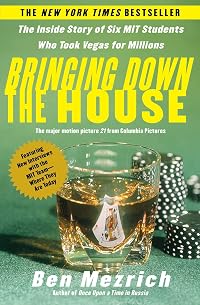
Bringing Down the House: The Inside Story of Six M.I.T. Students Who Took Vegas for Millions
by Ben Mezrich
On This Page
Description
When M.I.T. student Kevin Lewis meets classmates Jason Fisher and Andre Martinez, he is intrigued. Although neither seems to have any real responsibilities, they always have plenty of cash. One evening, they tell Kevin why. Using card-tracking calculations, they have devised a way to beat blackjack. Once he learns the system, Kevin joins Jason and Andre at the casinos. There to the growing dismay of gambling kingpins, they make a fortune--all perfectly legal.Tags
Recommendations
















Member Reviews
Casinos deserve whatever anyone can get from them. Card-counting is using your noodle, it is by no means a criminal activity, yet the casinos which say that gambling is a good sport we should all enjoy, don't act like good sports when others are enjoying winning (regularly). Nope, they then act like very bad sports indeed by getting these winners banned from each and every casino in the world.
Gambling in general and casinos in particular were very much in the grip of the Mafia until times not so long gone by. They might as well still be with their ways of ensuring that only they can win the big pot. They employ teams of people to spot the winners. No matter how many different casinos in any country in the world these winners are playing show more in, they will be identified, their descriptions circulated and eventually they will be stopped. Maybe they will merely be banned, first by one casino and then the next (sometimes before they can cash in their last-won chips), or maybe they will be taken into the 'back room' and various intimidating tactics used. This is legal. This is not the Mafia, this is not organised crime, it's organised gambling defending its right to make sure that only people who lose or at least don't win big bucks too often are allowed to play.
The M.I.T. students were all members of a professional gambling ring set up as a business. It was financed by investors, used computer programs to identify the most propitious card sequences and professors who coached the students who did the actually 'grunt work' (flying to exotic locations, staying in luxurious suites and gambling with the investors money) and who were paid a salary and commission. All they did was count the cards that had been dealt in Blackjack and then when it seemed the sequences were on their side, place a big bet. This is completely legal, there is not even a whiff of card-sharping or cheating, and what's more it isn't an infallible science, they might have won in the millions, but they lost more than a million too.
What the hell is wrong with that?
It seems to me that the casinos are bad sports. They only want losers and people who come on the occasional big weekend to see a Star Performer and win big so they can tell all their friends that they must come to Vegas and have a Good Time and Win Big. If you are a real winner, they will hunt you down and ban you. It's only for fun you see, you must only play for fun, just the luck of the draw and not win too much too often, it can't be a business, nor a career, nor a way to make money, nope, only the casinos are allowed to take gambling that seriously.
What is the difference between this slick and sleazy modus operandi and the Mafia? No concrete overcoats (I hope) is one? I can't really think of another.
Recommended for those who think that playing fair ought to be multi-lateral, not enforced uni-laterally by those who think it is only a slogan. show less
Gambling in general and casinos in particular were very much in the grip of the Mafia until times not so long gone by. They might as well still be with their ways of ensuring that only they can win the big pot. They employ teams of people to spot the winners. No matter how many different casinos in any country in the world these winners are playing show more in, they will be identified, their descriptions circulated and eventually they will be stopped. Maybe they will merely be banned, first by one casino and then the next (sometimes before they can cash in their last-won chips), or maybe they will be taken into the 'back room' and various intimidating tactics used. This is legal. This is not the Mafia, this is not organised crime, it's organised gambling defending its right to make sure that only people who lose or at least don't win big bucks too often are allowed to play.
The M.I.T. students were all members of a professional gambling ring set up as a business. It was financed by investors, used computer programs to identify the most propitious card sequences and professors who coached the students who did the actually 'grunt work' (flying to exotic locations, staying in luxurious suites and gambling with the investors money) and who were paid a salary and commission. All they did was count the cards that had been dealt in Blackjack and then when it seemed the sequences were on their side, place a big bet. This is completely legal, there is not even a whiff of card-sharping or cheating, and what's more it isn't an infallible science, they might have won in the millions, but they lost more than a million too.
What the hell is wrong with that?
It seems to me that the casinos are bad sports. They only want losers and people who come on the occasional big weekend to see a Star Performer and win big so they can tell all their friends that they must come to Vegas and have a Good Time and Win Big. If you are a real winner, they will hunt you down and ban you. It's only for fun you see, you must only play for fun, just the luck of the draw and not win too much too often, it can't be a business, nor a career, nor a way to make money, nope, only the casinos are allowed to take gambling that seriously.
What is the difference between this slick and sleazy modus operandi and the Mafia? No concrete overcoats (I hope) is one? I can't really think of another.
Recommended for those who think that playing fair ought to be multi-lateral, not enforced uni-laterally by those who think it is only a slogan. show less
By now this is a well known story, a bunch of students from MIT with the help of a lecturer and some secret bankers take on the Vegas casinos. They do so using a deceptively simple method of card counting which although simple in theory takes a lot of concentration to pull off in the casinos. There remains the threat of being caught by security and black balled from ever casino on the strip.
Mezrich relays this story in a simple but effective manner keeping the story trotting along at a fast pace. I'm very glad that I read the book before watching the movie. There are a few changes in the movie and it misses out on aspect of the story. Although the fear is solidly there the book mentions that card counting in not illegal and casino show more security no longer smash offenders hands with hammers as punishment.
They say that fact is stranger than fiction and in this case it certainly is. show less
Mezrich relays this story in a simple but effective manner keeping the story trotting along at a fast pace. I'm very glad that I read the book before watching the movie. There are a few changes in the movie and it misses out on aspect of the story. Although the fear is solidly there the book mentions that card counting in not illegal and casino show more security no longer smash offenders hands with hammers as punishment.
They say that fact is stranger than fiction and in this case it certainly is. show less
This book focuses on Kevin Lewis, one of six students at the Massachusetts Institute of Technology, who form a team to count cards in casinos, playing the mathematical odds to win at blackjack. Though it is not illegal, the casinos are not keen on any activity that gives an advantage to the player, and they can ban them from their establishments.
I live in Nevada and have been to Las Vegas many times, so I was easily able to picture the scenes. As with many people who live here, I am not a gambler. But this book is more about calculating occasions when the odds will favor the player, so it is not exactly the same as true gambling, which always favors the house. The events of this book took place in the 1990s and many casinos have since show more taken measures to prevent card counting.
The story is filled with the ostentation and spectacle of the Las Vegas strip. It occasionally ventures into sexist territory, especially in descriptions of women. The writing is passable, but one does not read this type of book for its literary merit. It is marketed as non-fiction, but the copyright page states that “the names of many of the characters and locations in this book have been changed, as have certain physical characteristics and other descriptive details. Some of the events and characters are also composites of several individual events or persons.” Overall, I found it a fast-paced entertaining read. show less
I live in Nevada and have been to Las Vegas many times, so I was easily able to picture the scenes. As with many people who live here, I am not a gambler. But this book is more about calculating occasions when the odds will favor the player, so it is not exactly the same as true gambling, which always favors the house. The events of this book took place in the 1990s and many casinos have since show more taken measures to prevent card counting.
The story is filled with the ostentation and spectacle of the Las Vegas strip. It occasionally ventures into sexist territory, especially in descriptions of women. The writing is passable, but one does not read this type of book for its literary merit. It is marketed as non-fiction, but the copyright page states that “the names of many of the characters and locations in this book have been changed, as have certain physical characteristics and other descriptive details. Some of the events and characters are also composites of several individual events or persons.” Overall, I found it a fast-paced entertaining read. show less
This book focuses on Kevin Lewis, one of six students at the Massachusetts Institute of Technology, who form a team to count cards in casinos, playing the mathematical odds to win at blackjack. Though it is not illegal, the casinos are not keen on any activity that gives an advantage to the player, and they can ban them from their establishments.
I live in Nevada and have been to Las Vegas many times, so I was easily able to picture the scenes. As with many people who live here, I am not a gambler. But this book is more about calculating occasions when the odds will favor the player, so it is not exactly the same as true gambling, which always favors the house. The events of this book took place in the 1990s and many casinos have since show more taken measures to prevent card counting.
The story is filled with the ostentation and spectacle of the Las Vegas strip. It occasionally ventures into sexist territory, especially in descriptions of women. The writing is passable, but one does not read this type of book for its literary merit. It is marketed as non-fiction, but the copyright page states that “the names of many of the characters and locations in this book have been changed, as have certain physical characteristics and other descriptive details. Some of the events and characters are also composites of several individual events or persons.” Overall, I found it a fast-paced entertaining read. show less
I live in Nevada and have been to Las Vegas many times, so I was easily able to picture the scenes. As with many people who live here, I am not a gambler. But this book is more about calculating occasions when the odds will favor the player, so it is not exactly the same as true gambling, which always favors the house. The events of this book took place in the 1990s and many casinos have since show more taken measures to prevent card counting.
The story is filled with the ostentation and spectacle of the Las Vegas strip. It occasionally ventures into sexist territory, especially in descriptions of women. The writing is passable, but one does not read this type of book for its literary merit. It is marketed as non-fiction, but the copyright page states that “the names of many of the characters and locations in this book have been changed, as have certain physical characteristics and other descriptive details. Some of the events and characters are also composites of several individual events or persons.” Overall, I found it a fast-paced entertaining read. show less
Casinos have always fed on the greed of people who don't understand statistics, but black jack is the one game that can be beaten. Basic card counting a la Rain Man won't cut it. Most people lose money, and the distinctive changes in bets draws attention from the pit bosses. But a group of MIT students figured out how to combine statistical wizardry with team work, signalling a Big Player to sweep in on a hot table and bet the bank. Kevin Lewis and his friends had a good run, raking in close to $100,000 in a weekend. But nothing lasts forever, and the most important lesson for any card counter is knowing when to walk away. Enjoyable light non-fiction of the true thriller variety, Bringing Down the House is exactly what it says on the cover.
I enjoyed this based-on-the-true story read of the MIT students who card-counted their way through casinos in the early 1990s, winning millions of dollars at games of chance that usually favor the house. It couldn't be done successfully the same way today with the change in technology over the last 2 decades, but a few brilliant minds beating the rigged system of Vegas is pretty impressive. These guys should teach acting classes just based on the personalities they created for themselves. Toward the end of the book the story just seemed to die a little bit, but when you stop and really think about how much time they devoted to this craft / charade / scam / business of theirs - well, it boggles the mind.
I also liked the way the show more biographer delivered the story, actually strapping money to his body to sneak it through airport, sitting down at a high stakes blackjack table in Vegas to play a few hands. He was able to tell you what that really felt like from a new player's perspective instead of just through second-hand stories. Wriitng someone else's true story isn't always done well, but Ben Mezrich pulls it off. show less
I also liked the way the show more biographer delivered the story, actually strapping money to his body to sneak it through airport, sitting down at a high stakes blackjack table in Vegas to play a few hands. He was able to tell you what that really felt like from a new player's perspective instead of just through second-hand stories. Wriitng someone else's true story isn't always done well, but Ben Mezrich pulls it off. show less
I bought this book in the Reno airport and finished it by the time the plane touched down in Seattle. (I had a long time to spend in Reno!) It's a suspenseful tale written in the easy-to-consume style of a modern detective story. I suspect that facts were liberally rearranged for maximum drama, so don't go reading this as a piece of history. Instead, read it as a fun Ocean's-11 style story that happens to be strongly based in reality.
Members
- Recently Added By
Lists

True Crime
216 works; 16 members

Unshelved Book Clubs
579 works; 5 members

Independent Reading Suggestions
69 works; 3 members

Blue Pyramid 1,276 Best Books of All Time
1,248 works; 32 members

Books Read in 2018
4,360 works; 110 members
Author Information

45+ Works 8,787 Members
Ben Mezrich was born in 1969 and received a degree in social studies from Harvard University in 1991. He originally wrote fiction, occasionally under the pseudonym Holden Scott, before switching to nonfiction. His nonfiction works include Ugly Americans, Busting Vegas, Rigged, and Sex on the Moon: The Amazing Story Behind the Most Audacious Heist show more in History. Two of his books were made into films. In 2008, Bringing Down the House: The Inside Story of Six M.I.T. Students Who Took Vegas for Millions was made into the film 21 and in 2010, The Accidental Billionaires: The Founding of Facebook, a Tale of Sex, Money, Genius, and Betrayal was made into the film Social Network. He appeared on Court TV in the series High Stakes with Ben Mezrich and has hosted the World Series of Blackjack. (Bowker Author Biography) show less
Awards and Honors
Distinctions
Notable Lists
Common Knowledge
- Important places
- Las Vegas, Nevada, USA; Massachusetts Institute of Technology
- Related movies
- 21 (2008 | IMDb)
- Disambiguation notice
- Bringing Down the House and Bringing Down the Mouse are different works by Ben Mezrich. Please do not combine them.
Classifications
- Genres
- General Nonfiction, Nonfiction, Biography & Memoir
- DDC/MDS
- 364.1720922 — Society, government, & culture Social problems and social services Crime Criminal offenses Crimes against public morals
- LCC
- GV1247 .M49 — Geography, Anthropology and Recreation Recreation. Leisure Recreation. Leisure Games and amusements Indoor games and amusements Card games: Poker, patience, whist, etc.
- BISAC
Statistics
- Members
- 3,283
- Popularity
- 5,229
- Reviews
- 90
- Rating
- (3.69)
- Languages
- 8 — Chinese, Dutch, English, German, Italian, Lithuanian, Spanish, Portuguese (Portugal)
- Media
- Paper, Audiobook, Ebook
- ISBNs
- 36
- ASINs
- 17