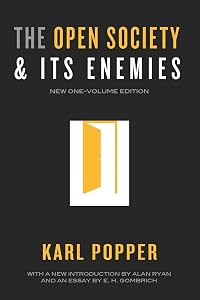
The Open Society and Its Enemies
by Karl Popper
The Open Society and Its Enemies (Collections and Selections — Complete)
On This Page
Description
One of the most important books of the twentieth century, Karl Popper's The Open Society and Its Enemies is an uncompromising defense of liberal democracy and a powerful attack on the intellectual origins of totalitarianism. Popper was born in 1902 to a Viennese family of Jewish origin. He taught in Austria until 1937, when he emigrated to New Zealand in anticipation of the Nazi annexation of Austria the following year, and he settled in England in 1949. Before the annexation, Popper had show more written mainly about the philosophy of science, but from 1938 until the end of the Second World War he focused his energies on political philosophy, seeking to diagnose the intellectual origins of German and Soviet totalitarianism. The Open Society and Its Enemies was the result. An immediate sensation when it was first published in two volumes in 1945, Popper's monumental achievement has attained legendary status on both the Left and Right and is credited with inspiring anticommunist dissidents during the Cold War. Arguing that the spirit of free, critical inquiry that governs scientific investigation should also apply to politics, Popper traces the roots of an opposite, authoritarian tendency to a tradition represented by Plato, Marx, and Hegel. show lessTags
Recommendations

















Member Reviews
The main question driving this two-volume masterpiece of political philosophy is this: What are the intellectual origins of totalitarianism and how can we combat them with better principles?
This takes Popper all the way back to ancient Greece, where he makes the strong (read: indisputable) case that the intellectual origin of totalitarianism starts with Plato (the subject of the first volume). While Popper admired many aspects of Plato’s works, he recognized in his political philosophy the first and most influential intellectual defense of totalitarian government.
Not that this was, in hindsight, particularly difficult to see (once we get over our infatuation with Plato’s genius). A quick read of Plato’s Republic will reveal his show more plans for a caste-based society with state-controlled human reproduction (i.e., eugenics), limited to no social mobility between the classes, the prevention of the mixing of blood between races, centralized and censored education, and intentionally lying to the population to maintain social control and harmony. (The link between state-controlled human breeding and totalitarianism is hard to deny even for Plato’s biggest apologists.)
Plato is quite clear in his desire to eradicate all forms of individualism. As Plato wrote, “In the highest form of the state there is common property of wives, of children, and of all chattels. And everything possible has been done to eradicate from our life everywhere and in every way all that is private and individual.”
In contrast to the egalitarian philosophy of superior thinkers like Pericles, Democritus, and others, Plato’s idea of justice is any action that benefits the state collectively, without regard to its individual members.
This idea of asking the individual members of a society to make great sacrifices for some eventual utopian ideal did not end with Plato. In fact, Karl Marx would take these ideas—transmitted principally through Aristotle and Hegel—to their most dangerous levels, as described in the second volume of The Open Society.
What you’ll find in the second volume is the best and most thorough critique of Marxism available. Unlike with Plato, however, Popper gives Marx more credit for his humanitarian intentions. We should remember that when Marx was critiquing capitalism, working conditions were horrendous, to say the least (including rampant child labor and 15-hour work days). Against this backdrop of unrestrained capitalism, we can see how Marx would think (and hope) that it would only be a matter of time before the workers revolted.
Where Marx went wrong was in his historicist approach (i.e., the uncovering of historical “laws” that can be used to predict the future). Marx thought that capitalism would destroy itself because it would inevitably lead to an increased concentration of wealth, increasing levels of misery among the workers, and increasing class tension that could never be mitigated by political reform.
Except that political reform is exactly what happened; Marx failed to anticipate wealth redistribution, in which the state redistributes capitalist profits through taxation, providing, among other things, subsidies for medical insurance, education, social security, and welfare. The state has also taken an active role in regulating the capitalists by limiting working hours and setting minimum pay levels, for example.
That Marxists fail to see these developments as falsifying Marxism speaks to the power of historical prophecy; regardless of what happens, it can always be made to fit into the Marxist narrative (i.e., the road to socialism is not linear). Ironically, this makes Marxism unscientific (because it's not falsifiable), despite the fact that Marxism is often claimed to be a scientific theory.
The dangers of Marxism are the same as with Platonism; it asks people to make great sacrifices for a distant ideal or utopian vision and ignores the types of reforms that can make people’s lives better in the near-term (and it disregards the conception of justice as the non-violent resolution of conflicting priorities).
But be careful to not take from this that Popper was a conservative. Popper used the concept of the paradox of freedom to show that unlimited freedom—including economic freedom—destroys itself. Just as the state restricts the freedom of others to commit physical violence, Popper recommends state intervention to prevent the economically strong from dominating the economically weak. That’s why Popper is best thought of as a progressive (using the state to combat economic injustice), rather than as either a Marxist (who thinks the social revolution will make the state unnecessary) or a conservative/libertarian (who advocates for unlimited economic freedom, and therefore, for economic exploitation).
The Open Society is sometimes thought of only as a critique of Plato and Marx (and an effective one at that), but it is something much more profound than even that. Popper lays out his own innovative political philosophy that replaces the question “Who should rule?” with the better question “How can we so organize political institutions that bad or incompetent rulers can be prevented from doing too much damage?”
This shift of emphasis is grounded in the historical fact that most leaders throughout history have exhibited below-average intelligence and morality, indicating that humanity is generally quite bad at selecting capable and worthwhile leaders. While we should hope for the best in our political leaders, we should also prepare for the worst. Democracy, in this sense, is less about the authoritative rule of the majority as it is the perpetual defense against tyranny.
This is why a focus on institutions, and the establishment of effective systems of accountability, is far more important than selecting any particular leader, particularly if that leader is determined to weaken those very democratic institutions.
Additionally, the implementation of policy should “adopt the method of searching for, and fighting against, the greatest and most urgent evils of society, rather than searching for, and fighting for, its greatest ultimate good.”
The “piecemeal social engineer,” using Popper’s term, will, like the scientist, run experiments and measure outcomes with an eye toward the reduction of unnecessary suffering, harm, and injustice, without concern for the eventual attainment of perfection (solving problems only introduces new ones). Because things do not always turn out as we imagine—and often generate unintended consequences—it is always necessary to test and revise our ideas. This doesn’t prohibit bold or progressive policy, it only suggests that we should maintain some humility with regard to our ability to prophesy the future. As Popper wrote:
“In fact, [a scientific orientation to politics] might lead to the happy situation where politicians begin to look out for their own mistakes instead of trying to explain them away and to prove that they have always been right. This—and not Utopian planning or historical prophecy—would mean the introduction of scientific method into politics, since the whole secret of scientific method is a readiness to learn from mistakes.” show less
This takes Popper all the way back to ancient Greece, where he makes the strong (read: indisputable) case that the intellectual origin of totalitarianism starts with Plato (the subject of the first volume). While Popper admired many aspects of Plato’s works, he recognized in his political philosophy the first and most influential intellectual defense of totalitarian government.
Not that this was, in hindsight, particularly difficult to see (once we get over our infatuation with Plato’s genius). A quick read of Plato’s Republic will reveal his show more plans for a caste-based society with state-controlled human reproduction (i.e., eugenics), limited to no social mobility between the classes, the prevention of the mixing of blood between races, centralized and censored education, and intentionally lying to the population to maintain social control and harmony. (The link between state-controlled human breeding and totalitarianism is hard to deny even for Plato’s biggest apologists.)
Plato is quite clear in his desire to eradicate all forms of individualism. As Plato wrote, “In the highest form of the state there is common property of wives, of children, and of all chattels. And everything possible has been done to eradicate from our life everywhere and in every way all that is private and individual.”
In contrast to the egalitarian philosophy of superior thinkers like Pericles, Democritus, and others, Plato’s idea of justice is any action that benefits the state collectively, without regard to its individual members.
This idea of asking the individual members of a society to make great sacrifices for some eventual utopian ideal did not end with Plato. In fact, Karl Marx would take these ideas—transmitted principally through Aristotle and Hegel—to their most dangerous levels, as described in the second volume of The Open Society.
What you’ll find in the second volume is the best and most thorough critique of Marxism available. Unlike with Plato, however, Popper gives Marx more credit for his humanitarian intentions. We should remember that when Marx was critiquing capitalism, working conditions were horrendous, to say the least (including rampant child labor and 15-hour work days). Against this backdrop of unrestrained capitalism, we can see how Marx would think (and hope) that it would only be a matter of time before the workers revolted.
Where Marx went wrong was in his historicist approach (i.e., the uncovering of historical “laws” that can be used to predict the future). Marx thought that capitalism would destroy itself because it would inevitably lead to an increased concentration of wealth, increasing levels of misery among the workers, and increasing class tension that could never be mitigated by political reform.
Except that political reform is exactly what happened; Marx failed to anticipate wealth redistribution, in which the state redistributes capitalist profits through taxation, providing, among other things, subsidies for medical insurance, education, social security, and welfare. The state has also taken an active role in regulating the capitalists by limiting working hours and setting minimum pay levels, for example.
That Marxists fail to see these developments as falsifying Marxism speaks to the power of historical prophecy; regardless of what happens, it can always be made to fit into the Marxist narrative (i.e., the road to socialism is not linear). Ironically, this makes Marxism unscientific (because it's not falsifiable), despite the fact that Marxism is often claimed to be a scientific theory.
The dangers of Marxism are the same as with Platonism; it asks people to make great sacrifices for a distant ideal or utopian vision and ignores the types of reforms that can make people’s lives better in the near-term (and it disregards the conception of justice as the non-violent resolution of conflicting priorities).
But be careful to not take from this that Popper was a conservative. Popper used the concept of the paradox of freedom to show that unlimited freedom—including economic freedom—destroys itself. Just as the state restricts the freedom of others to commit physical violence, Popper recommends state intervention to prevent the economically strong from dominating the economically weak. That’s why Popper is best thought of as a progressive (using the state to combat economic injustice), rather than as either a Marxist (who thinks the social revolution will make the state unnecessary) or a conservative/libertarian (who advocates for unlimited economic freedom, and therefore, for economic exploitation).
The Open Society is sometimes thought of only as a critique of Plato and Marx (and an effective one at that), but it is something much more profound than even that. Popper lays out his own innovative political philosophy that replaces the question “Who should rule?” with the better question “How can we so organize political institutions that bad or incompetent rulers can be prevented from doing too much damage?”
This shift of emphasis is grounded in the historical fact that most leaders throughout history have exhibited below-average intelligence and morality, indicating that humanity is generally quite bad at selecting capable and worthwhile leaders. While we should hope for the best in our political leaders, we should also prepare for the worst. Democracy, in this sense, is less about the authoritative rule of the majority as it is the perpetual defense against tyranny.
This is why a focus on institutions, and the establishment of effective systems of accountability, is far more important than selecting any particular leader, particularly if that leader is determined to weaken those very democratic institutions.
Additionally, the implementation of policy should “adopt the method of searching for, and fighting against, the greatest and most urgent evils of society, rather than searching for, and fighting for, its greatest ultimate good.”
The “piecemeal social engineer,” using Popper’s term, will, like the scientist, run experiments and measure outcomes with an eye toward the reduction of unnecessary suffering, harm, and injustice, without concern for the eventual attainment of perfection (solving problems only introduces new ones). Because things do not always turn out as we imagine—and often generate unintended consequences—it is always necessary to test and revise our ideas. This doesn’t prohibit bold or progressive policy, it only suggests that we should maintain some humility with regard to our ability to prophesy the future. As Popper wrote:
“In fact, [a scientific orientation to politics] might lead to the happy situation where politicians begin to look out for their own mistakes instead of trying to explain them away and to prove that they have always been right. This—and not Utopian planning or historical prophecy—would mean the introduction of scientific method into politics, since the whole secret of scientific method is a readiness to learn from mistakes.” show less
This book is a must for anyone interested in politics, sociology or philosophy. It’s a full-on academic piece but worth the effort.
KP exposes how fragile democracy is and how easily it can be undermined – even by those acting in its interest. His basic premise is that any society that strives to achieve some idealized goal, however honourable, will develop a totalitarian system. For democracy to survive and benefit the individual, governments must avoid “social engineering” and reserve its interventions to those aspects where the normal methods are failing. Democracy, and the Open Society, thrive only when individuals are allowed to drive the direction of societal development.
Western political philosophy has been build on 2 show more main thinkers – Plato from Antiquity arguing for a rational organization of society, and Hegel from the modern era who provided the concept of “the people” as the moral basis of the state.
Their respective systems appear to uphold the primacy of the individual in society, but their systems had inbuilt value systems in favour of particular collective ideals that eventually developed into totalitarian systems that achieved the opposite – in Plato’s case, the justification of an oppressive ruling class, and in Hegel’s case, the development of Romanticism, Nationalism and Fascism.
KP argues that both thinkers had ulterior motives for their philosophies and deliberately twisted their logic to support their hidden agendas. He proceeds to uncover these twists through the use of their own arguments and shows how they were able to win over followers to their logic, cover their contradictions and have their ideas accepted for as long as they did.
This is a lengthy work – 2 volumes that stretch to nearly 1,000 pages – and can be challenging to a non-academic orientated reader, but it is an important work with big ideas that is highly enlightening. show less
KP exposes how fragile democracy is and how easily it can be undermined – even by those acting in its interest. His basic premise is that any society that strives to achieve some idealized goal, however honourable, will develop a totalitarian system. For democracy to survive and benefit the individual, governments must avoid “social engineering” and reserve its interventions to those aspects where the normal methods are failing. Democracy, and the Open Society, thrive only when individuals are allowed to drive the direction of societal development.
Western political philosophy has been build on 2 show more main thinkers – Plato from Antiquity arguing for a rational organization of society, and Hegel from the modern era who provided the concept of “the people” as the moral basis of the state.
Their respective systems appear to uphold the primacy of the individual in society, but their systems had inbuilt value systems in favour of particular collective ideals that eventually developed into totalitarian systems that achieved the opposite – in Plato’s case, the justification of an oppressive ruling class, and in Hegel’s case, the development of Romanticism, Nationalism and Fascism.
KP argues that both thinkers had ulterior motives for their philosophies and deliberately twisted their logic to support their hidden agendas. He proceeds to uncover these twists through the use of their own arguments and shows how they were able to win over followers to their logic, cover their contradictions and have their ideas accepted for as long as they did.
This is a lengthy work – 2 volumes that stretch to nearly 1,000 pages – and can be challenging to a non-academic orientated reader, but it is an important work with big ideas that is highly enlightening. show less
Really long and dense. Primarily concerned with critiquing other thinking. Critiques included Plato (totalitarianism), Hegel (Oracular nonsense), and Marx (historicism). At times exhausting, but upon finishing I realize important.
The description and defense of a reason based world near the end of the book was great.
Some favorite quotes:
"First Democritus: ‘Not out of fear but out of a feeling of what is right should we abstain from doing wrong … Virtue is based, most of all, upon respecting the other man … Every man is a little world of his own … We ought to do our utmost to help those who have suffered injustice … To be good means to do no wrong; and also, not to want to do wrong … It is good deeds, not words, that count show more … The poverty of a democracy is better than the prosperity which allegedly goes with aristocracy or monarchy, just as liberty is better than slavery … The wise man belongs to all countries, for the home of a great soul is the whole world.’"
"Kierkegaard, who, in his Book of the Judge, described his own activity as follow: ‘He whose task it is to produce a corrective idea, has only to study, precisely and deeply, the rotten parts of the existing order—and then, in the most partial way possible, to stress the opposite of it.’"
To sum up these considerations, it may be said that what we call ‘scientific objectivity’ is not a product of the individual scientist’s impartiality, but a product of the social or public character of scientific method; and the individual scientist’s impartiality is, so far as it exists, not the source but rather the result of this socially or institutionally organized objectivity of science.
I use the word ‘rationalism’ in order to indicate, roughly, an attitude that seeks to solve as many problems as possible by an appeal to reason, i.e. to clear thought and experience, rather than by an appeal to emotions and passions.
We could then say that rationalism is an attitude of readiness to listen to critical arguments and to learn from experience. It is fundamentally an attitude of admitting that ‘I may be wrong and you may be right, and by an effort, we may get nearer to the truth’.
It is an attitude which does not lightly give up hope that by such means as argument and careful observation, people may reach some kind of agreement on many problems of importance; and that, even where their demands and their interests clash, it is often possible to argue about the various demands and proposals, and to reach—perhaps by arbitration—a compromise which, because of its equity, is acceptable to most, if not to all.
The fact that the rationalist attitude considers the argument rather than the person arguing is of far-reaching importance. It leads to the view that we must recognize everybody with whom we communicate as a potential source of argument and of reasonable information; it thus establishes what may be described as the ‘rational unity of mankind’.
But there can be no doubt that the worship of power is one of the worst kinds of human idolatries, a relic of the time of the cage, of human servitude. The worship of power is born of fear, an emotion which is rightly despised.
The life of the forgotten, of the unknown individual man; his sorrows and his joys, his suffering and death, this is the real content of human experience down the ages.
The whole problem of educating man to a sane appreciation of his own importance relative to that of other individuals is thoroughly muddled by these ethics of fame and fate, by a morality which perpetuates an educational system that is still based upon the classics with their romantic view of the history of power and their romantic tribal morality which goes back to Heraclitus; a system whose ultimate basis is the worship of power. show less
The description and defense of a reason based world near the end of the book was great.
Some favorite quotes:
"First Democritus: ‘Not out of fear but out of a feeling of what is right should we abstain from doing wrong … Virtue is based, most of all, upon respecting the other man … Every man is a little world of his own … We ought to do our utmost to help those who have suffered injustice … To be good means to do no wrong; and also, not to want to do wrong … It is good deeds, not words, that count show more … The poverty of a democracy is better than the prosperity which allegedly goes with aristocracy or monarchy, just as liberty is better than slavery … The wise man belongs to all countries, for the home of a great soul is the whole world.’"
"Kierkegaard, who, in his Book of the Judge, described his own activity as follow: ‘He whose task it is to produce a corrective idea, has only to study, precisely and deeply, the rotten parts of the existing order—and then, in the most partial way possible, to stress the opposite of it.’"
To sum up these considerations, it may be said that what we call ‘scientific objectivity’ is not a product of the individual scientist’s impartiality, but a product of the social or public character of scientific method; and the individual scientist’s impartiality is, so far as it exists, not the source but rather the result of this socially or institutionally organized objectivity of science.
I use the word ‘rationalism’ in order to indicate, roughly, an attitude that seeks to solve as many problems as possible by an appeal to reason, i.e. to clear thought and experience, rather than by an appeal to emotions and passions.
We could then say that rationalism is an attitude of readiness to listen to critical arguments and to learn from experience. It is fundamentally an attitude of admitting that ‘I may be wrong and you may be right, and by an effort, we may get nearer to the truth’.
It is an attitude which does not lightly give up hope that by such means as argument and careful observation, people may reach some kind of agreement on many problems of importance; and that, even where their demands and their interests clash, it is often possible to argue about the various demands and proposals, and to reach—perhaps by arbitration—a compromise which, because of its equity, is acceptable to most, if not to all.
The fact that the rationalist attitude considers the argument rather than the person arguing is of far-reaching importance. It leads to the view that we must recognize everybody with whom we communicate as a potential source of argument and of reasonable information; it thus establishes what may be described as the ‘rational unity of mankind’.
But there can be no doubt that the worship of power is one of the worst kinds of human idolatries, a relic of the time of the cage, of human servitude. The worship of power is born of fear, an emotion which is rightly despised.
The life of the forgotten, of the unknown individual man; his sorrows and his joys, his suffering and death, this is the real content of human experience down the ages.
The whole problem of educating man to a sane appreciation of his own importance relative to that of other individuals is thoroughly muddled by these ethics of fame and fate, by a morality which perpetuates an educational system that is still based upon the classics with their romantic view of the history of power and their romantic tribal morality which goes back to Heraclitus; a system whose ultimate basis is the worship of power. show less
In his second volume Poper turns his attention to the more modern philosophers Hegel and Marx. Again Poppers book doesn't tell anyone who has read Hegel or Marx things they didn't already know or suspect. What's interesting is the way Popper manages to place these philosophers and men into their time and place in history, They way he clearly sees why their theories fall and his suggestions for a successful way forward for an open society, many of which are common place in western democracies. It's also interesting to note Popper doesn't portray Marx as a 'bad' man. Flawed in his theories but not evil as is often insinuated in western philosophy classes.
Anyone who has read Xenophon on Socrates will already have doubts as to how well Plato really portrays his mentor. Popper's book is interesting therefore in his alternative theory of Plato's philosophies and intentions for portraying Socrates as he does.
In itself Popper doesn't teach us anything about Plato's theories that we didn't already know or suspect. Plato's ideal republic simply isn't the sort of place any modern person would want to live in or want anyone else to live in. It's good however to see somebody looking more into the 'why' than the 'what' in regards to this famous philosopher.
In itself Popper doesn't teach us anything about Plato's theories that we didn't already know or suspect. Plato's ideal republic simply isn't the sort of place any modern person would want to live in or want anyone else to live in. It's good however to see somebody looking more into the 'why' than the 'what' in regards to this famous philosopher.
A re-read. Just finished Chapter 6. More later
A re-read. Just finished Chapter 6. More later
Members
- Recently Added By
Lists

Falling for Science
56 works; 3 members

Modern Library 100 Best Nonfiction Books
100 works; 8 members

Refuse, Resist, Rebel
38 works; 3 members

Fake Top 100 Nonfiction
79 works; 3 members

Política - Clásicos
164 works; 2 members

KIB Non-Fiction Book Cloud
41 works; 1 member

essential pol.phil
17 works; 1 member

Shaykh Hamza's Book Recommendations
439 works; 3 members

Works Cited in The Life and Death of Democracy by John Keane
278 works; 1 member

Totalitarianism and Democratic Erosion: Essential Readings
45 works; 1 member
Author Information

123+ Works 11,109 Members
Although he writes widely in philosophy, Sir Karl Raimund Popper is best known for his thesis that an empirical statement is meaningless unless conditions can be specified that could show it to be false. He was born and educated in Vienna, where he was associated with, although not actually a member of, the Vienna Circle. Two years after the show more German publication of his Logic of Scientific Discovery (1935), he left Austria for New Zealand, where he was senior lecturer at the University of Canterbury. In 1945 he moved to England and began a distinguished career at the London School of Economics and Political Science. According to Popper, there is no "method of discovery" in science. His view holds that science advances by brilliant but unpredictable conjectures that then stand up well against attempts to refute them. This view was roundly criticized by more dogmatic positivists, on the one hand, and by Feyerabend and Kuhn, on the other. In 1945 he published The Open Society and Its Enemies, which condemns Plato, Georg Hegel, and Karl Marx as progenitors of totalitarianism and opponents of freedom. The scholarship that underpins this book remains controversial. Popper's later works continue his interest in philosophy of science and also develop themes in epistemology and philosophy of mind. He is particularly critical of historicism, which he regards as an attitude that fosters a deplorable tendency toward deterministic thinking in the social sciences. (Bowker Author Biography) show less
Some Editions
Awards and Honors
Awards
Notable Lists
Series

Belongs to Publisher Series
Work Relationships
Contains
Is replied to in
Has as a reference guide/companion
Common Knowledge
- Canonical title
- The Open Society and Its Enemies
- Original title
- The open society and its enemies
- Alternate titles*
- De open samenleving en haar vijanden
- Original publication date
- 1962
- People/Characters
- Plato, ca. 428-347 BC; Hegel, Georg Wilhelm Friedrich, 1770-1831; Karl Marx
- Original language*
- Engels
*Some information comes from Common Knowledge in other languages. Click "Edit" for more information.
Classifications
Statistics
- Members
- 1,101
- Popularity
- 23,204
- Reviews
- 15
- Rating
- (4.39)
- Languages
- 14 — Danish, Dutch, English, Estonian, Finnish, French, Hungarian, Italian, Portuguese, Romanian, Croatian, Spanish, Swedish, Turkish
- Media
- Paper, Audiobook, Ebook
- ISBNs
- 32
- ASINs
- 26