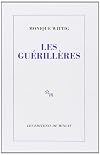
Les Guérillères
by Monique Wittig
On This Page
Description
"One of the most widely read feminist texts of the twentieth century, and Monique Wittig's most popular novel, Les Guerilleres imagines the attack on the language and bodies of men by a tribe of warrior women. Among the women's most powerful weapons is laughter, but they also threaten literary and linguistic customs of the patriarchal order with bullets. In this novel first published in 1969, Wittig animates a lesbian society that invites all women to join their fight, their circle, and show more their community. A pathbreaking novel about creating and sustaining freedom, the book derives much of its energy from its vaunting of the female body as a resource for literary invention."--BOOK JACKET. show lessTags
Recommendations






















Member Recommendations
by anonymous user
Member Reviews
On the surface this book seems like it’s about the war between the sexes, but the actual war itself only starts in the last 50 pages and everything up till that point is just world-building and slice of life in the strange, surreal future Wittig has constructed. Some may find it boring, but I actually found the little day to day details very pretty. I’ve been reading a lot of epic poetry, and this seems like something like The Iliad except from the future instead of from ancient Greece. The world building is so good that it seems like a contemporary document send back from the future- as demonstrated by her neologisms like “feminaires” and “glénures” (some sort of many-legged horse??). The story never goes into detail about show more any one character, but namedrops them (always with first and last name) in a way that makes me think we’re supposed to know who they are, just another thing that reminds me of Greek poetry. The detached third person narration kind of reminded me of text-based video games like A Dark Room, and it got kind of impersonal at times, but that also helps it sound like an oral history. Every time a page was filled up with womens’ names, I would read them to myself and it felt ritualistic, like a way to honor the fighters in this future war.
This book being so female-centric parallels how male-centric the Greeks were too. Because of that, this book is just another example of how radical feminism isn’t as radical as the media makes it out to be, because even though the story is about the war between the sexes its conclusion is compassion, basically. The line “we have been fighting as much for you as for ourselves” not only sums up the book but the 2nd wave movement in general! I think this book is very important because it contains a message of understanding and solidarity, without discounting the womens’ very real reasons to fight. Andrea Dworkin once said she wants to be remembered "In a museum, when male supremacy is dead. I'd like my work to be an anthropological artefact from an extinct, primitive society." This book seems like something from that society.
It took me about a month to read Les Guérillères, and it was so worth it. It took longer to read than it otherwise might’ve because I read it in the original French, cross referencing with a translation whenever I didn’t understand (which was pretty often!!). It’s a really dense book, but like half the words I didn’t understand turned out to be made up when I looked them up! But if you’re able to, I would definitely recommend reading it in french! I mean, there’s a reason the English edition’s title isn’t translated, it’s an untranslatable word! Wittig honestly seems kinda Oulipo-adjacent in how she plays with language. French has gendered third-person-plural pronouns, and the “gender neutral” is “ils”, same as the masculine. Therefore, in french the word “elles” (feminine plural) has a lot of power that the translation just doesn’t have. At times it’s translated to “the women” or the neutral “they”, which misses the point that Wittig herself expounds upon: “They say, the language you speak is made up of words that are killing you. They say, the language you speak is made up of signs that rightly speaking designate what men have appropriated.” show less
This book being so female-centric parallels how male-centric the Greeks were too. Because of that, this book is just another example of how radical feminism isn’t as radical as the media makes it out to be, because even though the story is about the war between the sexes its conclusion is compassion, basically. The line “we have been fighting as much for you as for ourselves” not only sums up the book but the 2nd wave movement in general! I think this book is very important because it contains a message of understanding and solidarity, without discounting the womens’ very real reasons to fight. Andrea Dworkin once said she wants to be remembered "In a museum, when male supremacy is dead. I'd like my work to be an anthropological artefact from an extinct, primitive society." This book seems like something from that society.
It took me about a month to read Les Guérillères, and it was so worth it. It took longer to read than it otherwise might’ve because I read it in the original French, cross referencing with a translation whenever I didn’t understand (which was pretty often!!). It’s a really dense book, but like half the words I didn’t understand turned out to be made up when I looked them up! But if you’re able to, I would definitely recommend reading it in french! I mean, there’s a reason the English edition’s title isn’t translated, it’s an untranslatable word! Wittig honestly seems kinda Oulipo-adjacent in how she plays with language. French has gendered third-person-plural pronouns, and the “gender neutral” is “ils”, same as the masculine. Therefore, in french the word “elles” (feminine plural) has a lot of power that the translation just doesn’t have. At times it’s translated to “the women” or the neutral “they”, which misses the point that Wittig herself expounds upon: “They say, the language you speak is made up of words that are killing you. They say, the language you speak is made up of signs that rightly speaking designate what men have appropriated.” show less
De worsteling van een kolonie tegen een imperialistische uitbuiter, waarbij de man de laatste rol lijkt te vervullen. De vrouwen bestrijden hun tot de tanden gewapende onderdrukkers met alle beschikbare middelen.
Whatever this was, it wasn't what I was expecting.
Monique Wittig writes:
They play a game. It is performed on an enormous parade-ground. The ground is divided into zones corresponding to the colours of the spectrum. There are a hundred and fifty violet hoops a hundred and fifty indigo hoops a hundred and fifty blue hoops a hundred and fifty green hoops a hundred and fifty yellow hoops a hundred and fifty orange hoops a hundred and fifty red hoops. The teams consist of seventy-five persons each, arranged on either side of the midline of the parade-ground. Each team has equal strips of violet indigo blue green yellow orange red territory. A machine situated at the centre of the parade-ground ejects the hoops one after another at a fast pace. They rise vertically above the heads of the show more players. They rotate on themselves. At the same time they describe a vast circle which continuously increases, due to the momentum imparted to them by the machine. The path of their movements would be an immense spiral. The women playing must catch the hoops without leaving the coloured zones allotted to them. Very soon there is an indescribable tumult of bodies jostling each other in the attempt to take hold of the same hoop or to withdraw from the confusion.
And:
News has arrived from the assembly that is compiling a dictionary. The example proposed to illustrate the word hate has been rejected. It concerns a phrase of Anne-Louis Germaine. The women have transformed hate into energy and energy into hate. It has been adduced as a reason that the phrase contains an antithesis and therefore lacks precision. The bearer of these tidings, who is called Jeanne Sbire, is hissed. The women surround her jostle her insult her. Jeanne Sbire weeps hot tears, saying she cannot help it. Then the women get angry saying that an antithesis is indeed involved and why has it not been supressed, retaining the first part of the phrase which alone has any meaning. Then they chant at the top of their voices the famous song which begins, Let a hundred flowers blossom, a hundred schools compete.
. show less
They play a game. It is performed on an enormous parade-ground. The ground is divided into zones corresponding to the colours of the spectrum. There are a hundred and fifty violet hoops a hundred and fifty indigo hoops a hundred and fifty blue hoops a hundred and fifty green hoops a hundred and fifty yellow hoops a hundred and fifty orange hoops a hundred and fifty red hoops. The teams consist of seventy-five persons each, arranged on either side of the midline of the parade-ground. Each team has equal strips of violet indigo blue green yellow orange red territory. A machine situated at the centre of the parade-ground ejects the hoops one after another at a fast pace. They rise vertically above the heads of the show more players. They rotate on themselves. At the same time they describe a vast circle which continuously increases, due to the momentum imparted to them by the machine. The path of their movements would be an immense spiral. The women playing must catch the hoops without leaving the coloured zones allotted to them. Very soon there is an indescribable tumult of bodies jostling each other in the attempt to take hold of the same hoop or to withdraw from the confusion.
And:
News has arrived from the assembly that is compiling a dictionary. The example proposed to illustrate the word hate has been rejected. It concerns a phrase of Anne-Louis Germaine. The women have transformed hate into energy and energy into hate. It has been adduced as a reason that the phrase contains an antithesis and therefore lacks precision. The bearer of these tidings, who is called Jeanne Sbire, is hissed. The women surround her jostle her insult her. Jeanne Sbire weeps hot tears, saying she cannot help it. Then the women get angry saying that an antithesis is indeed involved and why has it not been supressed, retaining the first part of the phrase which alone has any meaning. Then they chant at the top of their voices the famous song which begins, Let a hundred flowers blossom, a hundred schools compete.
. show less
This is a fabulous novel. The atmospherics are stupendous!
Ratings
Members
- Recently Added By
Lists

Best Science Fiction Originally Published in a Language Other Than English
449 works; 34 members

Publishing Triangle 100 Best Lesbian and Gay Novels
97 works; 6 members

Books Read in 2021
5,361 works; 114 members

My Lesbian Literature Library
14 works; 1 member
Author Information

16+ Works 1,514 Members
Some Editions
Awards and Honors
Awards
Notable Lists
Common Knowledge
- Canonical title
- Les Guérillères
- Original publication date
- 1969 (original French) (original French); 1973 (English: Le Vay) (English: Le Vay)
- First words
- When it rains the women stay in the summer-house. (first prose-ish sentence)
- Last words
- (Click to show. Warning: May contain spoilers.)And then we intoned the Funeral March, a slow, melancholy and yet triumphant air.
- Blurbers
- O'Brien, Edna; McCarthy, Mary
Classifications
- Genres
- Fiction and Literature, LGBTQ+, General Fiction, Science Fiction
- DDC/MDS
- 843.914 — Literature & rhetoric French Literature French fiction 1900- 20th Century 1945-1999
- LCC
- PQ2683 .I8 .G813 — Language and Literature French, Italian, Spanish and Portuguese literatures French literature Modern literature 1961-2000
- BISAC
Statistics
- Members
- 528
- Popularity
- 56,450
- Reviews
- 5
- Rating
- (3.65)
- Languages
- 6 — Dutch, English, French, German, Portuguese (Portugal), Spanish
- Media
- Paper, Ebook
- ISBNs
- 16
- UPCs
- 1
- ASINs
- 9