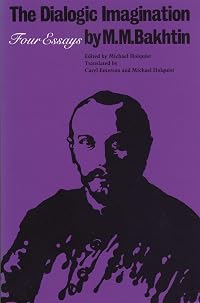
The Dialogic Imagination: Four Essays
by Mikhail Bakhtin
On This Page
Description
These essays reveal Mikhail Bakhtin (1895-1975)--known in the West largely through his studies of Rabelais and Dostoevsky--as a philosopher of language, a cultural historian, and a major theoretician of the novel. The Dialogic Imagination presents, in superb English translation, four selections from Voprosy literatury i estetiki (Problems of literature and esthetics), published in Moscow in 1975. The volume also contains a lengthy introduction to Bakhtin and his thought and a glossary of show more terminology.Bakhtin uses the category "novel" in a highly idiosyncratic way, claiming for it vastly larger territory than has been traditionally accepted. For him, the novel is not so much a genre as it is a force, "novelness," which he discusses in "From the Prehistory of Novelistic Discourse." Two essays, "Epic and Novel" and "Forms of Time and of the Chronotope in the Novel," deal with literary history in Bakhtin's own unorthodox way. In the final essay, he discusses literature and language in general, which he sees as stratified, constantly changing systems of subgenres, dialects, and fragmented "languages" in battle with one another. show lessTags
Recommendations


Member Reviews
Oh man, MM. MM Cool M. Martin muvs cool Mikhail. I have my first theory-crush, in 2008, when I should be beyond such things. What I am about to present to you are the notes I took during the reading of The Dialogic Imagination, something I never do, but this sweet man inspired it. Then I got tired, because he is, as the intro says, a "baggy monster," but there is even more in the second half of the book. There is an incredibly principled insistence on the recognition of the dialogic nature of the novel and the heteroglossia of language, and somehow you like him even MORE for not making it political, because he gave Bhabha and others the tools to do so. There is Rabelais Rabelais Rabelais. there is a treasure trove, just like how he uses show more that term to describe language itself, and whenever you disagree or don't understand you want to argie, because he is open to that - the book really does scream "written in exile in Siberia in a warm house and talking over what you write with your fellow dissident intellectuals every night (the dialogization of theory!) - or to keep reading, because he is patient and will say it again.
Notes:
-aaaah!
-not just a literary theorist - a philosopher for people whose lives are all wrapped up in books
-all non-novelistic genres, and take the epic as representative in its extremity, are finished, characterized by an absolute past where all characters' view of the world coincides, and coincides with the audience's. The novel is social, and about the present and the future. Novelization - a process, not really a genre - comes when a character slips his bounds - when there is a human surplus - THAT's what self-and world-naturalization will always miss - OMG!
-Socrates, maybe, the first novelistic hero.
-because a novelistic hero is possible: 1) carnivalize the epic hero. make him accessible to the people. Hercules and the Lindwurm. 2) folk heroes - no ritual, ossified recitation of deeds, but invention!
-Punch, Harlequin, Guy Fawkes, hell, the rogue, the clown, the fool. - practical, eternal, personable, indestructible - ever reborn
-Riddley Walker - I'm starting to see why people find Tolkien so hateful. Michael Moorcock, all is forgiven!
-the novel is the genre of becoming
-novel is comin out of songs and ad hoc stories and proto-rpgs, even, hell! - opern stories, separate from the epic song tradition - and prolly just shooting the shit
-and when we encounter the other for real - his language, not just his sword - the world is novelized. Greeks and Persians. The Renaissance. No more first best Achilles
-the epic hero is valourized by being perfect form. the novelistic hero is valorized by containng something heroic amid all the realness. We tell stories about Socrates and Xanthippe, and that carnivalizes him. He is crochety and wise. Odysseus is just brave and smart.
-L. Bloom is a carnivalized Odysseus!
-laughter is the basis of the novel - it is cynicism, forgetting, independence, joy
no more ritual, no more passivity in the face of unchange - we are the ones we've been waiting for! vs. McCain's epic America, ha ha
-laughter and dialogue make science and free thought possible - the core of the novel is dialogue
-I never really got the irony in Boethius' epic-time angels vs. doomed dude laughing - so we need the epic as a starting point, to be left behind. is that what Boe. was doing with religion?
we can enter the novel, unlike any other genre - that is its danger - Bovaryism, and Don Q. novels are not a substitute for life. No Rip van W. - put on a mask! Be Punch! Be a symbol, a dialogic pole, not a narrative!
-epic is open in content because closed in form.as the open genre, novels, oddly, NEED a story. The Iliad could not be a novel. The dudes would not have done the things they did
-the novel is deepening our discernment and understanding of the new demands of our age
-OH N MORE: hetero- and polyglossia; centrifugality and -petality; the amazing chronotope and adventure time like in comix yo; novel of everyday life as metamorphosis; public biography justifying self to world culminating in novel; parallel tradition justifying self to self begins with Augustine; oh what a lonely time the pre-dialogic era was for man; chivalric romance as precursor to magic realism - world of everyday magic and hero at home anywhere anywhen - foreign to novel of antiquity, when world was the monoglot home and alien foreign (representing the dialogic but sticking to one pole); poetry as ambiguous monolalia, prose as built of multiple coherent poles - and thus ambiguous too but anchored to real; Dante gets his power from being time man in angel world, where time and space are plastic (cf. Boethius); more, more, more, more, more. show less
Notes:
-aaaah!
-not just a literary theorist - a philosopher for people whose lives are all wrapped up in books
-all non-novelistic genres, and take the epic as representative in its extremity, are finished, characterized by an absolute past where all characters' view of the world coincides, and coincides with the audience's. The novel is social, and about the present and the future. Novelization - a process, not really a genre - comes when a character slips his bounds - when there is a human surplus - THAT's what self-and world-naturalization will always miss - OMG!
-Socrates, maybe, the first novelistic hero.
-because a novelistic hero is possible: 1) carnivalize the epic hero. make him accessible to the people. Hercules and the Lindwurm. 2) folk heroes - no ritual, ossified recitation of deeds, but invention!
-Punch, Harlequin, Guy Fawkes, hell, the rogue, the clown, the fool. - practical, eternal, personable, indestructible - ever reborn
-Riddley Walker - I'm starting to see why people find Tolkien so hateful. Michael Moorcock, all is forgiven!
-the novel is the genre of becoming
-novel is comin out of songs and ad hoc stories and proto-rpgs, even, hell! - opern stories, separate from the epic song tradition - and prolly just shooting the shit
-and when we encounter the other for real - his language, not just his sword - the world is novelized. Greeks and Persians. The Renaissance. No more first best Achilles
-the epic hero is valourized by being perfect form. the novelistic hero is valorized by containng something heroic amid all the realness. We tell stories about Socrates and Xanthippe, and that carnivalizes him. He is crochety and wise. Odysseus is just brave and smart.
-L. Bloom is a carnivalized Odysseus!
-laughter is the basis of the novel - it is cynicism, forgetting, independence, joy
no more ritual, no more passivity in the face of unchange - we are the ones we've been waiting for! vs. McCain's epic America, ha ha
-laughter and dialogue make science and free thought possible - the core of the novel is dialogue
-I never really got the irony in Boethius' epic-time angels vs. doomed dude laughing - so we need the epic as a starting point, to be left behind. is that what Boe. was doing with religion?
we can enter the novel, unlike any other genre - that is its danger - Bovaryism, and Don Q. novels are not a substitute for life. No Rip van W. - put on a mask! Be Punch! Be a symbol, a dialogic pole, not a narrative!
-epic is open in content because closed in form.as the open genre, novels, oddly, NEED a story. The Iliad could not be a novel. The dudes would not have done the things they did
-the novel is deepening our discernment and understanding of the new demands of our age
-OH N MORE: hetero- and polyglossia; centrifugality and -petality; the amazing chronotope and adventure time like in comix yo; novel of everyday life as metamorphosis; public biography justifying self to world culminating in novel; parallel tradition justifying self to self begins with Augustine; oh what a lonely time the pre-dialogic era was for man; chivalric romance as precursor to magic realism - world of everyday magic and hero at home anywhere anywhen - foreign to novel of antiquity, when world was the monoglot home and alien foreign (representing the dialogic but sticking to one pole); poetry as ambiguous monolalia, prose as built of multiple coherent poles - and thus ambiguous too but anchored to real; Dante gets his power from being time man in angel world, where time and space are plastic (cf. Boethius); more, more, more, more, more. show less
Bakhtin was a breath of fresh air for me after reading people like Foucault and Barthes and Derrida. He seemed to make a lot more sense.
Bakhtin has some interesting thoughts. Used this book to support thesis in college regarding the small-town chornotope in Stephen King's novels.
One of my favorites. This book is the foundational text for my thesis.
Bakhtin's dialogical theory of language is a brilliant influence on critical and discourse theory today.
Uitgeleend Andrei Brînză juni 2022
Ratings
Members
- Recently Added By
Lists

Literary Theory and Criticism: What Happens and Why
37 works; 5 members

Writers In Public Domain 2026
90 works; 1 member
Author Information

66+ Works 3,812 Members
Mikhail Bakhtin was born on November 17, 1895 in Orel, Russia. He attended the University of Petrograd from 1913 to 1918, where he studied classics and philology. After graduation, he taught, wrote, and developed many of his theories. From 1945 to 1961, Bakhtin taught at the Mordovia Teachers Training College. He continued to publish works and show more develop theories such as that of dialogics, which contends that language evolves dynamically and both shapes and is shaped by culture. The theories are explored in Art and Answerability and The Dialogic Imagination. Bakhtin wrote several of his early works under the pseudonyms of his friends P.N. Medvedev and V.N. Voloshinov. He was persecuted under the Stalin regime for his philosophies and sentenced to six years imprisonment. A bone disease that ultimately forced the amputation of his right leg in 1938 further complicated his troubles. Bakhtin died on March 7, 1975. (Bowker Author Biography) show less
Some Editions
Series
Belongs to Publisher Series
Common Knowledge
- Canonical title
- The Dialogic Imagination: Four Essays
- Original title
- Voprosy literatury i estetiki
- Important places
- Abbey of Thélème
- Dedication
- There is nothing more fragile than the word, and Bakhtin's was almost lost. This translation is dedicated to those devoted Russian scholars who gave so generously of themselves to Mikhail Mikhailovich the man and to the cause... (show all) of preserving dialogue.
- First words
- EPIC AND NOVEL / Toward a Methodology for the Study of the Novel /
The study of the novel as a genre is distinguished by peculiar difficulties. This is due to the unique nature of the object itself: the novel is the s... (show all)ole genre that continues to develop, that is as yet uncompleted. - Last words
- (Click to show. Warning: May contain spoilers.)A zone is the locus for hearing a voice; it is brought about by (italics) the voice.
- Original language
- Russian
Classifications
- Genres
- Literature Studies and Criticism, Nonfiction, Philosophy
- DDC/MDS
- 801.953 — Literature & rhetoric Literature, rhetoric & criticism Philosophy and theory Nature and character Literary theory and criticism Theory Of Fiction
- LCC
- PN3331 .B2513 — Language and Literature Literature (General) Literature (General) Prose. Prose fiction Philosophy, theory, etc.
- BISAC
Statistics
- Members
- 1,304
- Popularity
- 18,589
- Reviews
- 6
- Rating
- (4.22)
- Languages
- English, French, Swedish
- Media
- Paper, Ebook
- ISBNs
- 7
- ASINs
- 3