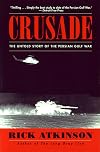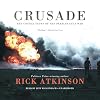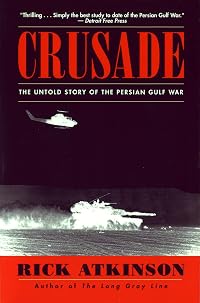
Crusade: The Untold Story of the Persian Gulf War
by Rick Atkinson
On This Page
Description
Integrating interviews with individuals ranging from senior policymakers to frontline soldiers, a look at the Persian Gulf War shows how the conflict transformed modern warfare.Tags
Recommendations























Member Reviews
This is a very good read by a superb storyteller still early in his book writing career. Despite this being only his second title on military history ("The Long Gray Line" being his first) Atkinson shows his mettle in this volume published only two years after the conflict.
Broken into three parts that bracket the first week, middle month, and last week of the war, Atkinson weaves U.S. and Middle East history prior to Iraq's August 1990 invasion of Kuwait with significant events and plays in the Desert Shield/Desert Storm saga. After closing the story chapters with an epilogue, Atkinson provides an author's note on source, an appreciation on those sources, a brief chronology of events, maps, endnotes, a bibliography, and an index. There show more is a collection of photographs in the middle of the text.
As an Army brat, Atkinson's background makes him a far better chronicleer of the war than his journalist colleagues, who frankly struggled to report on the war (I was in the Navy at the time, and I cringed at the news coverage, especially on military matters). Atkinson is certainly not error-free in his writing--for example he locates the Royal Air Force base at Muharaqq, Bahrain in Oman and he identifies the M203 40mm grenade launcher as a "203mm grenade launcher". However, of the "early" Desert Storm books (in my opinion those published within five years of the war) this is easily the best in providing clear details of event and some retrospective analysis of the war and its politics. There were quite a few books published within a year of Desert Storm's conclusion, and their poor quality is most evident compared to "Crusade".
Atkinson pays close attention to the story of people in this work, and he stood apart from many of his contemporaries by casting a critical eye on the key American figures of the era, although the author spends a great deal of his writing on the Commander in Chief, U.S. Central Command, General H. Norman Schwarzkopf. At a time when many were lionizing "the CINC", Atkinson reveals the extent to which he terrorized the Central Command headquarters and all of its subordinate senior commanders. In today's military, it is doubtful whether he would have been placed in command as the toxic command climate that Schwarzkopf engendered would have precluded him from at least any four star command billet. The strengths and weaknesses of all the major players are laid bare in this book--compelling stories of their own, and some of which were to make a reappearance on the world stage twelve years later for Operation Iraqi Freedom.
In describing some of the political consequences of Desert Storm, Atkinson shows some clairvoyance. He recognized the agony of the debate between those American voices who wanted to overthrow the Saddam Hussein regime and those who just wanted to bring the troops home after liberating Kuwait. In retrospect, however, I'm not sure that a 1991 Iraqi regime change would have led to any different outcomes other than committing this country to a counterinsurgency campaign twelve years early. U.S. leadership did not read the tea leaves of the Iraqi peoples' situation in 1990-91 any better than they did in 2001-03. The Iraqi Army did not rise up significantly against Hussein on either occasion; however, the Iraqi Army, even after Desert Storm, was stronger than the 2003 version. Would the Coalition take the gamble of a possible extended Iraqi insurgenc in 1991-92. I suspect probably not. show less
Broken into three parts that bracket the first week, middle month, and last week of the war, Atkinson weaves U.S. and Middle East history prior to Iraq's August 1990 invasion of Kuwait with significant events and plays in the Desert Shield/Desert Storm saga. After closing the story chapters with an epilogue, Atkinson provides an author's note on source, an appreciation on those sources, a brief chronology of events, maps, endnotes, a bibliography, and an index. There show more is a collection of photographs in the middle of the text.
As an Army brat, Atkinson's background makes him a far better chronicleer of the war than his journalist colleagues, who frankly struggled to report on the war (I was in the Navy at the time, and I cringed at the news coverage, especially on military matters). Atkinson is certainly not error-free in his writing--for example he locates the Royal Air Force base at Muharaqq, Bahrain in Oman and he identifies the M203 40mm grenade launcher as a "203mm grenade launcher". However, of the "early" Desert Storm books (in my opinion those published within five years of the war) this is easily the best in providing clear details of event and some retrospective analysis of the war and its politics. There were quite a few books published within a year of Desert Storm's conclusion, and their poor quality is most evident compared to "Crusade".
Atkinson pays close attention to the story of people in this work, and he stood apart from many of his contemporaries by casting a critical eye on the key American figures of the era, although the author spends a great deal of his writing on the Commander in Chief, U.S. Central Command, General H. Norman Schwarzkopf. At a time when many were lionizing "the CINC", Atkinson reveals the extent to which he terrorized the Central Command headquarters and all of its subordinate senior commanders. In today's military, it is doubtful whether he would have been placed in command as the toxic command climate that Schwarzkopf engendered would have precluded him from at least any four star command billet. The strengths and weaknesses of all the major players are laid bare in this book--compelling stories of their own, and some of which were to make a reappearance on the world stage twelve years later for Operation Iraqi Freedom.
In describing some of the political consequences of Desert Storm, Atkinson shows some clairvoyance. He recognized the agony of the debate between those American voices who wanted to overthrow the Saddam Hussein regime and those who just wanted to bring the troops home after liberating Kuwait. In retrospect, however, I'm not sure that a 1991 Iraqi regime change would have led to any different outcomes other than committing this country to a counterinsurgency campaign twelve years early. U.S. leadership did not read the tea leaves of the Iraqi peoples' situation in 1990-91 any better than they did in 2001-03. The Iraqi Army did not rise up significantly against Hussein on either occasion; however, the Iraqi Army, even after Desert Storm, was stronger than the 2003 version. Would the Coalition take the gamble of a possible extended Iraqi insurgenc in 1991-92. I suspect probably not. show less
This is a revelatory look at the military planning and early execution of Operation Desert Shield/Desert Storm, the first Gulf War to free Kuwait. The inter-service rivalry is unnecessary and disheartening. The personal stories of coalition captives and the resourceful use of Vietnam-era infrared tech to locate and destroy Iraqi armor adds a lot of depth to this military history. This book adds a lot of depth to Schwarzkopf, Commander-in-Chief, showing him to have his own curious affectation for niceties rather unexpected for this "stormin'" and ground-truth publicity. There is also the build-up to the publicity coup of the false planned amphibious landing.
Ratings
Members
- Recently Added By
Lists

Best Military History Books
125 works; 21 members
Author Information

23+ Works 11,619 Members
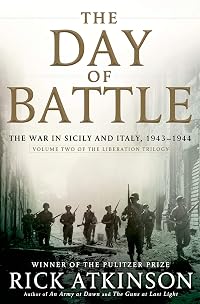
Rick Atkinson holds a master of arts degree in English literature from the University of Chicago and is a Pulitzer-Prize winning author and military historian Atkinson is the author of the highly-acclaimed Liberation Trilogy, The Long Gray Line, In the Company of Soldiers and Crusade. Atkinson received the Pulitzer Prize for the first volume of show more the Liberation Trilogy, An Army at Dawn: The War in North Africa, 1942-1943. The second volume, The Day of Battle: The War in Sicily and Italy, 1943-1944, drew praise as well. Atkinson also received the 1982 Pulitzer Prize for national reporting; and the 1999 Pulitzer Prize for public service, awarded to the Washington Post for a series of investigative articles directed and edited by Atkinson on shootings by the District of Columbia police department. He is winner of the 1989 George Polk Award for national reporting, the 2003 Society for Military History Distinguished Book Award, the 2007 Gerald R. Ford Award for Distinguished Reporting on National Defense, and the 2010 Pritzker Military Library Literature Award for Lifetime Achievement in Military Writing. Atkinson has served as the Gen. Omar N. Bradley Chair of Strategic Leadership at the U.S. Army War College. In 2014 his title The Guns at Last Light made The New York Times Best Seller List. (Bowker Author Biography) show less
Common Knowledge
- Canonical title
- Crusade: The Untold Story of the Persian Gulf War
- Original publication date
- 1993
- Important events
- Gulf War, 1990-1991
- Disambiguation notice
- Full title (1993): Crusade : the untold story of the Persian Gulf War / Rick Atkinson
Classifications
Statistics
- Members
- 505
- Popularity
- 59,860
- Reviews
- 2
- Rating
- (4.18)
- Languages
- English
- Media
- Paper, Audiobook, Ebook
- ISBNs
- 13
- UPCs
- 1
- ASINs
- 5