
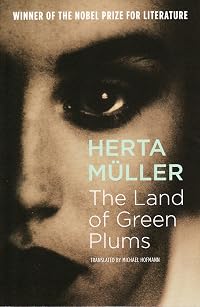
The Land of Green Plums
by Herta Müller
On This Page
Description
The lives of a group of Romanian students under Communism, with its poverty, regimentation and depressing greyness. Life gets no better after graduation, so much so that several commit suicide.Tags
Recommendations












Member Recommendations
Member Reviews
Possesses a narrative patterning that is strikingly beautiful in its effects. There's compression, too, and suspense, though it's not a mystery or thriller. It's character driven so there's no real plot. Yet the vivid picture Herta Müller paints of Communist Romania under dictator Ceausescu is an absolute horror. I mean, the inanity of harassing perfectly harmless people and interrogating them and humiliating them for no purpose other than to instill fear and, thus, submission. Hannah Arendt's phrase "the banality of evil" springs to mind. Herta Müller has taken a hideous thing and made transcendent art from it. A captivating stunner of a novel but dark, dark.
‘Hartedier’ van Herta Müller las ik in de editie van 1996, toen ze al wel de Europese Literatuurprijs had gewonnen in 1995, maar nog geen Nobelprijs. De titel is een Roemeens neologisme - inimal – een versmelting van inima (hart) en animal (dier). Zelf bestempelt ze haar werk als autofictie: hier gaat het over een vrouw die in het vizier van de Securitate komt en uiteindelijk naar het buitenland gaat.
Het begint allemaal met de zelfmoord van Lola, waardoor de ik-vertelster in contact komt met Edgar, Kurt en Georg. Ze schrijven gedichten en lezen buitenlandse boeken. Meer is er niet nodig om constant gevolgd te worden. Geen martelpraktijken bij de verhoren, maar langzaam worden ze richting uitgang geduwd: naar Duitsland.
Het verhaal show more wordt in een ongebruikelijke vorm verteld. Talloze beelden flitsen voorbij, alsof er iemand gefilmd heeft, maar er geen regisseur was om de beelden in een logische of chronologische volgorde te zetten. Metaforen verschijnen, verdwijnen en komen weer terug. De lezer moet zich inspannen, het boek wegleggen en weer opnemen, op zoek gaan naar een betekenis, want de auteur gebruikt een codetaal zoals de vrienden in hun brieven aan elkaar.
“Een zin met een nagelschaar voor verhoor, zei Kurt, voor huiszoeking een zin met schoen, voor schaduwen één met verkouden. Achter de aanhef altijd een uitroepteken, bij levensgevaar alleen een komma.”
Niets is wat het lijkt. Achter enkele kiezelsteentjes verschuilen zich bergen. Al op de eerste bladzijde staat ogenschijnlijk een vluchtige gedachte: “Vandaag kan ik me nog geen graf voorstellen. Alleen een ceintuur, een raam, een noot en een touw.” Wie ziet er hier bij de eerste lectuur vier mogelijkheden om het tijdelijke met het eeuwige te wisselen?
Herta Müller wil geen abstracte begrippen in haar werk opnemen, zoals het woord dictatuur. Aan de hand van een beeldenstroom roept ze de angst op die er in een politiestaat heerst. Vriendschap en liefde zijn uitgeholde begrippen, want wie kan je eigenlijk wel vertrouwen? Is Tereza een vriendin of toch niet? Liefde en haat schuiven als aardplaten over elkaar.
Hartedier is een moeilijk boek, omdat het geen beschrijvend boek is. Het spreekt in cryptische beelden en hanteert een geheime code die de lezer moet zien te ontcijferen. Angst kan je niet zien, maar moet je voelen. Müllers schrijfstijl is niet 100 % pur sang poëtisch - daarvoor is de ondertoon te akelig – maar haar woordenschat is (fantasie)rijk en er zit een cadans in haar zinnen. Ze heeft een unieke stijl: een Picasso met een vleugje Margritte. Zijn haar andere werken met dezelfde originele pen geschreven? show less
Het begint allemaal met de zelfmoord van Lola, waardoor de ik-vertelster in contact komt met Edgar, Kurt en Georg. Ze schrijven gedichten en lezen buitenlandse boeken. Meer is er niet nodig om constant gevolgd te worden. Geen martelpraktijken bij de verhoren, maar langzaam worden ze richting uitgang geduwd: naar Duitsland.
Het verhaal show more wordt in een ongebruikelijke vorm verteld. Talloze beelden flitsen voorbij, alsof er iemand gefilmd heeft, maar er geen regisseur was om de beelden in een logische of chronologische volgorde te zetten. Metaforen verschijnen, verdwijnen en komen weer terug. De lezer moet zich inspannen, het boek wegleggen en weer opnemen, op zoek gaan naar een betekenis, want de auteur gebruikt een codetaal zoals de vrienden in hun brieven aan elkaar.
“Een zin met een nagelschaar voor verhoor, zei Kurt, voor huiszoeking een zin met schoen, voor schaduwen één met verkouden. Achter de aanhef altijd een uitroepteken, bij levensgevaar alleen een komma.”
Niets is wat het lijkt. Achter enkele kiezelsteentjes verschuilen zich bergen. Al op de eerste bladzijde staat ogenschijnlijk een vluchtige gedachte: “Vandaag kan ik me nog geen graf voorstellen. Alleen een ceintuur, een raam, een noot en een touw.” Wie ziet er hier bij de eerste lectuur vier mogelijkheden om het tijdelijke met het eeuwige te wisselen?
Herta Müller wil geen abstracte begrippen in haar werk opnemen, zoals het woord dictatuur. Aan de hand van een beeldenstroom roept ze de angst op die er in een politiestaat heerst. Vriendschap en liefde zijn uitgeholde begrippen, want wie kan je eigenlijk wel vertrouwen? Is Tereza een vriendin of toch niet? Liefde en haat schuiven als aardplaten over elkaar.
Hartedier is een moeilijk boek, omdat het geen beschrijvend boek is. Het spreekt in cryptische beelden en hanteert een geheime code die de lezer moet zien te ontcijferen. Angst kan je niet zien, maar moet je voelen. Müllers schrijfstijl is niet 100 % pur sang poëtisch - daarvoor is de ondertoon te akelig – maar haar woordenschat is (fantasie)rijk en er zit een cadans in haar zinnen. Ze heeft een unieke stijl: een Picasso met een vleugje Margritte. Zijn haar andere werken met dezelfde originele pen geschreven? show less
This is probably Müller's best-known work, a semi-autobiographical account of a group of young people growing up in Ceaușescu's Romania and getting into conflict with the authorities. It's particularly about the way the experience of living under an authoritarian regime interferes with the freedom to articulate ideas. Everything has to be deflected into oblique images, as we learn on the opening page of the novel: the things that start out as simply encoded forms of communication (the nail-scissors, shoes and colds that stand for interrogations, searches and being followed in the group's letters) turn out to be deeply internalised in the narrator's own thought-processes.
This is a theme that is clearly central to Müller, and she came show more back to it in her Nobel lecture, where she uses a trivial image, the handkerchief, to tie together incidents from her own experience with her relatives' experiences under fascism and in Russia in the aftermath of the war. She talks about the moment when she realised that there were things she could not possibly express in speech, and started to write: "Ich lief dem gelebten im Teufelskreis der Wörter hinterher, bis etwas so auftauchte, wie ich es bisher nicht kannte." (I ran after experiences in the vicious circle of words, until something surfaced in a way I hadn't known it before) — that's a process that you can clearly see reflected in her very indirect, elliptical narrative style. And which ties in with her well-known fondness for making collages out of words cut from newspapers.
Interestingly, she uses two key incidents in the Nobel lecture that also appear in this novel: the time when she found that her office at work had been allocated to someone else, and she continued to work sitting on the stairs; and the time when her mother, locked up for the day by an irritable policeman, finds a bucket and spring-cleans the police station for want of anything better to do.
One thing that struck me about this much-translated book is the way it has two quite different families of titles, both referring to key images in the book, but oddly enough bringing out quite different aspects of what the book is about. In the German original and about half the other languages in the list that I can understand, it is called Herztier, "Heart-animal". This is a comforting image used by the narrator's grandmother, the invisible animal accompanying everyone, whose form and size reflect the strength with which we face the challenges of the outside world. (It reminded me of Philip Pullman's "daemons".). In English and the other half of the languages it is The land of green plums: Müller consistently and deliberately uses rural, agricultural imagery that we would normally think of as idyllic and nostalgic to represent the backward, inward-looking and mean-spirited qualities of peasant culture which she identifies as the driving force of the Romanian dictatorship. People who live in small villages are accustomed to denounce their neighbours for petty advantage (in fact it's probably a necessary survival strategy). Policemen are best recruited from raw peasants who haven't learnt the civilised ways of the big city, and who go around helping themselves to plums from the trees. So Herztier seems to be a novel about the internalisation of oppressive politics; Green plums becomes a novel about dictatorship as the apotheosis of rural poverty. And both are valid interpretations, of course... show less
This is a theme that is clearly central to Müller, and she came show more back to it in her Nobel lecture, where she uses a trivial image, the handkerchief, to tie together incidents from her own experience with her relatives' experiences under fascism and in Russia in the aftermath of the war. She talks about the moment when she realised that there were things she could not possibly express in speech, and started to write: "Ich lief dem gelebten im Teufelskreis der Wörter hinterher, bis etwas so auftauchte, wie ich es bisher nicht kannte." (I ran after experiences in the vicious circle of words, until something surfaced in a way I hadn't known it before) — that's a process that you can clearly see reflected in her very indirect, elliptical narrative style. And which ties in with her well-known fondness for making collages out of words cut from newspapers.
Interestingly, she uses two key incidents in the Nobel lecture that also appear in this novel: the time when she found that her office at work had been allocated to someone else, and she continued to work sitting on the stairs; and the time when her mother, locked up for the day by an irritable policeman, finds a bucket and spring-cleans the police station for want of anything better to do.
One thing that struck me about this much-translated book is the way it has two quite different families of titles, both referring to key images in the book, but oddly enough bringing out quite different aspects of what the book is about. In the German original and about half the other languages in the list that I can understand, it is called Herztier, "Heart-animal". This is a comforting image used by the narrator's grandmother, the invisible animal accompanying everyone, whose form and size reflect the strength with which we face the challenges of the outside world. (It reminded me of Philip Pullman's "daemons".). In English and the other half of the languages it is The land of green plums: Müller consistently and deliberately uses rural, agricultural imagery that we would normally think of as idyllic and nostalgic to represent the backward, inward-looking and mean-spirited qualities of peasant culture which she identifies as the driving force of the Romanian dictatorship. People who live in small villages are accustomed to denounce their neighbours for petty advantage (in fact it's probably a necessary survival strategy). Policemen are best recruited from raw peasants who haven't learnt the civilised ways of the big city, and who go around helping themselves to plums from the trees. So Herztier seems to be a novel about the internalisation of oppressive politics; Green plums becomes a novel about dictatorship as the apotheosis of rural poverty. And both are valid interpretations, of course... show less
The literature of oppression is vast and, tragically, seems to emerge from just about any country where humans exert power over other humans. The Eastern European Communist dictatorships of the latter half of the 20th century have yielded an especially rich harvest of such literature, possibly because the variety of tyranny exercised in those countries was particularly brutal and organized, and because many of those struggling under the thumb of these repressive regimes were literate and highly educated. For those of us living in an open society, this literature provides a frightening but fascinating glimpse into a time and place thankfully remote from our own experience. In her novel The Land of the Green Plums Herta Müller writes show more about life in Ceausescu's Romania. The loosely structured autobiographical story follows the struggles of a group of young Romanians of ethnic German origin to find work and survive in a country where every aspect of life is controlled by the government and everyone operates under the watchful eye of the Securitate, the Romanian secret police, and its vast network of spies. The unnamed female narrator works as a translator in a factory. She lives in a communal arrangement with other young women, one of whom is Lola. The deprivations suffered by the Romanian people are well documented. Ceausescu's government, increasingly inward-looking and seeking to establish a program of national self-sufficiency, paid off its massive foreign debt, but in the process impoverished its citizens and crippled the economy. With few goods being produced and imported, shops were virtually empty and food hard to come by. Romanians had to find ways to feed themselves and their families using whatever means were at hand. In Müller’s novel, Lola trades sexual favours in exchange for animal offal, which she hoards in the communal refrigerator. Lola also keeps a diary—a dangerous act of defiance in a country where any form of self-expression is frowned upon and regarded as treasonous—and when she succumbs to despair and kills herself, the narrator finds the diary hidden in her (the narrator’s) suitcase. The remainder of the novel describes in episodic fashion the struggles of the narrator and her friends Kurt, Georg, and Edgar as they attempt to evade the scrutiny of the Securitate and make plans to emigrate to Germany. The novel is narrated in a consistently flat and emotionally detached voice, one that reports all events—the mundane and the horrific—in a monotonously ironic tone. The effect of this is to heighten the tension, but it also leaves the reader somewhat on the outside looking in. It's possible this is what the author intends. Ceausescu's Romania was a nightmare for those who lived through it. Depicting that nightmare literally would result in an unrelentingly grim and distressing work of fiction. The ironic distance that Müller introduces between her reader and the story she is telling makes The Land of the Green Plums easier to digest, but the cost of irony is emotional depth. By telling her story in this fashion, Müller keeps the reader at arms length from the action. Reading the book is a bit like viewing the world it seeks to evoke through the wrong end of a telescope. You can see most of what's happening and you'll probably catch the gist, but some of the detail is fuzzy and you can't always tell what people are feeling. In the end, The Land of the Green Plums is a challenging novel and well worth reading, but one that appeals more strongly to the intellect than the emotions. show less
This book is about a friend-group of youth in Ceaucescu's Romania who leave poor villages for university and then careers. They are only vaguely dissident yet harassed by the state police constantly and after years of fear, mistrust, and isolation, pushed to the brinks of what they can withstand. This particular view into a totalitarian regime doesn't dwell of the outright horrors but rather the more subtle squeezing until there no joy left in life anywhere throughout society. The book is challenging to read with many layers of repeating imagery and metaphor that warrant a serious literary analysis. It's powerful and important, but not the best pleasure read.
64. The Land of Green Plums by Herta Müller
translation: from German by Michael Hofmann (1996)
OPD: 1994
format: 242-page hardcover
acquired: 2013 read: Nov 15-23 time reading: 6:59, 1.7 mpp
rating: 4
genre/style: Novel theme: TBR
locations: Communist Romania ~1970’s
about the author: Romanian-German novelist, poet, essayist and recipient of the 2009 Nobel Prize in Literature. Born in Nițchidorf in Romania in 1953.
A series of sketches of the life of college-educated political dissidents in Romania under Ceaușescu. They deal with constant harassment, abuse, economic strain and suicides.
This being Müller, it's a Swabian perspective. The Swabians are a German minority in Romania. Our main character is the daughter of an SS veteran who came show more back to Romania after WWII, remaining outrageously sympathetic to Hitler.
I think that hints at the swirl of dark stuff in here. It is relentlessly bleak. This 1994 novel was rejuvenated when Müller won the Nobel Prize in 2009. It is powerful, but tough going and I struggled through (but felt it!). I think there are times I would have lapped this up. But I found myself impatient and beaten down. I never got lost in it and read it mainly in 20-minute sessions, stopping in exhaustion. It will, despite or because of all that, hang around.
This is my 4th novel by Müller. I feel like each was harder to read than the last one. I think her anger at Communist Romania is most present here of all her works I've read. In an odd way, I feel that her act of expressing all that bitter anger has a cathartic element. It's powerful, but I'm not sure who I would recommend this to.
2023
https://www.librarything.com/topic/354226#8292394 show less
translation: from German by Michael Hofmann (1996)
OPD: 1994
format: 242-page hardcover
acquired: 2013 read: Nov 15-23 time reading: 6:59, 1.7 mpp
rating: 4
genre/style: Novel theme: TBR
locations: Communist Romania ~1970’s
about the author: Romanian-German novelist, poet, essayist and recipient of the 2009 Nobel Prize in Literature. Born in Nițchidorf in Romania in 1953.
A series of sketches of the life of college-educated political dissidents in Romania under Ceaușescu. They deal with constant harassment, abuse, economic strain and suicides.
This being Müller, it's a Swabian perspective. The Swabians are a German minority in Romania. Our main character is the daughter of an SS veteran who came show more back to Romania after WWII, remaining outrageously sympathetic to Hitler.
I think that hints at the swirl of dark stuff in here. It is relentlessly bleak. This 1994 novel was rejuvenated when Müller won the Nobel Prize in 2009. It is powerful, but tough going and I struggled through (but felt it!). I think there are times I would have lapped this up. But I found myself impatient and beaten down. I never got lost in it and read it mainly in 20-minute sessions, stopping in exhaustion. It will, despite or because of all that, hang around.
This is my 4th novel by Müller. I feel like each was harder to read than the last one. I think her anger at Communist Romania is most present here of all her works I've read. In an odd way, I feel that her act of expressing all that bitter anger has a cathartic element. It's powerful, but I'm not sure who I would recommend this to.
2023
https://www.librarything.com/topic/354226#8292394 show less
Like the author, the narrator of the novel belongs to the German minority in Romania and leaves the country for Germany in the 1980s. The protagonists of this work are four friends from rural Romania who document what they see of the activities of the Securitate and write oppositional poems. The story is not linear, but the reader learns about their daily lives, about the measures they take to stay as safe as possible, about the relationships between them and the people around them. There are also glimpses of the narrator's childhood and of the friends' lives in Germany where they still are not safe.
The narration is oddly detached and that makes it a bit hard to become invested in it, but I interpret it as a means of coping with the show more horror which was a kind of banal reality for these characters. On the other hand, there are lot of metaphors, personifications and images which convey much more than can be guessed at a first glance. To me, the strength of this novel is that the terror, restriction and loss experienced by the characters over a long time is shown in a way that slowly develops and grips you, without any dramatic arcs of suspense or turning points that make your heart beat faster, but like this, it might be even more haunting and powerful. show less
The narration is oddly detached and that makes it a bit hard to become invested in it, but I interpret it as a means of coping with the show more horror which was a kind of banal reality for these characters. On the other hand, there are lot of metaphors, personifications and images which convey much more than can be guessed at a first glance. To me, the strength of this novel is that the terror, restriction and loss experienced by the characters over a long time is shown in a way that slowly develops and grips you, without any dramatic arcs of suspense or turning points that make your heart beat faster, but like this, it might be even more haunting and powerful. show less
Members
- Recently Added By
Published Reviews
ThingScore 75
Ms. Muller's vision of a police state manned by plum thieves reads like a kind of fairy tale on the mingled evils of gluttony, stupidity and brutality.
added by jlelliott
Lists

Female Author
1,235 works; 67 members

German Literature
518 works; 49 members

Best Political Fiction
92 works; 12 members

EU Fiction: 1950-2022
223 works; 70 members

1990s
309 works; 17 members

Nobel Price Winners
222 works; 20 members

International IMPAC Dublin Literary Award
179 works; 6 members

Literature in Translation
113 works; 5 members

in pursuit of power
17 works; 2 members

Llibres que he llegit el 2018
46 works; 1 member

Writers at Risk
106 works; 17 members

Around the World in 80 Books
79 works; 4 members
Author Information

89+ Works 5,142 Members
Born in Romania in 1953, Herta Müller lost her job as a teacher and suffered repeated threats after refusing to cooperate with Ceausescu's Secret Police. She succeeded in emigrating in 1987 and now lives in Berlin. The recipient of the European Literature Prize, she has also won the International IMPAC Dublin Literary Award for her previous show more novel, The Land of Green Plums. Müller was awarded the Nobel Prize in Literature in 2009. (Publisher Provided) Herta Müller was born in Nitzkydorf, Romania on August 17, 1953 to German parents. She studied German studies and Romanian literature at Timisoara University. While there, she became part of the Aktionsgruppe Banat, a group of idealistic Romanian-German writers seeking freedom of expression under the Ceaucescu dictatorship. After graduation, she worked as a translator in a machine factory, but was fired for refusing to cooperate with the secret police. Her first short story collection, Niederungen, was published in 1982 in a censored form. She immigrated to West Germany in 1987. She is a novelist, poet and essayist whose works depict the harsh conditions of life in Communist Romania under the repressive Nicolae Ceausescu regime. Her works include Herztier or The Land of Green Plums; The Appointment; Der Fuchs War Damals Schon der Jäger or The Passport; and Atemschaukel or Everything I Possess I Carry with Me. She has won numerous awards including the Marieluise-Fleißer Prize in 1990, the Kranichsteiner Literary Prize in 1991, the Kleist Prize in 1994, and the 2009 Nobel Prize in Literature. (Bowker Author Biography) show less
Some Editions
Awards and Honors
Awards
Notable Lists
Series
Belongs to Publisher Series
Common Knowledge
- Canonical title*
- Herztier
- Original title
- Herztier
- Original publication date
- 1994 (original German) (original German); 1996 (English: Hofmann) (English: Hofmann); 1996 (Dutch translation) (Dutch translation); 1996 (Norwegian translation) (Norwegian translation); 1996 (Finnish translation) (Finnish translation); 1997 (Turkish translation) (Turkish translation) (show all 12); 1997 (Romanian translation) (Romanian translation); 1999 (Portuguese translation) (Portuguese translation); 1999 (Chinese translation) (Chinese translation); 2003 (Polish translation) (Polish translation); 2005 (Swedish translation) (Swedish translation); 2006 (Persian translation) (Persian translation)
- People/Characters
- Narrator; Georg; Kurt; Lola; Edgar; Tereza (show all 7); Frau Margit
- Important places
- Romania
- Epigraph
- Everyone had a friend in every wisp of cloud
that's how it is with friends where the world is full of fear
even my mother said, that's how it is
friends are out of the question
think of more serious things.... (show all)>
--Gellu Naum - First words
- When we don't speak, said Edgar, we become unbearable, and when we do, we make fools of ourselves.
- Last words
- (Click to show. Warning: May contain spoilers.)When we don't speak, said Edgar, we become unbearable, and when we do, we make fools of ourselves.
- Original language
- German
*Some information comes from Common Knowledge in other languages. Click "Edit" for more information.
Classifications
- Genres
- Fiction and Literature, General Fiction
- DDC/MDS
- 833.914 — Literature & rhetoric German & related literatures German fiction 1900- 1900-1990 1945-1990
- LCC
- PT2673 .U29234 .H4713 — Language and Literature German, Dutch and Scandinavian literatures German literature Individual authors or works 1961-2000
- BISAC
Statistics
- Members
- 1,211
- Popularity
- 20,441
- Reviews
- 46
- Rating
- (3.58)
- Languages
- 19 — Chinese, Czech, Danish, Dutch, English, Finnish, French, German, Italian, Norwegian (Bokmål), Farsi/Persian, Polish, Portuguese, Romanian, Russian, Croatian, Spanish, Swedish, Turkish
- Media
- Paper, Audiobook, Ebook
- ISBNs
- 44
- ASINs
- 9