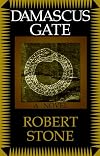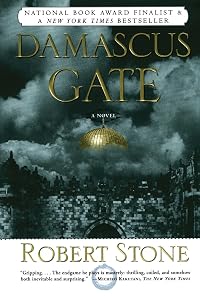
Damascus Gate
by Robert Stone
On This Page
Description
Jewish and Christian terrorists unite in a scheme to blow up Islamic mosques on the Temple Mount in Jerusalem. The plot is discovered by Christopher Lucas, a Jewish-Catholic journalist from the U.S. writing a book on religious passions. He has a romance with an Arab nightclub dancer.Tags
Recommendations












Member Recommendations
charlie68 A good historical background for the novel
Member Reviews
Damascus Gate is an unusual great novel because the constellation of characters who variously serve as its protagonists are comparatively uncompelling individual actors. The desultory freelance journalist Christopher Lucas; the half-Jewish, half-black, Communist true-believer and jazz singer Sonia Barnes; Raziel the polymath musician, former Yeshiva-boy genius, former Jew for Jesus; even the inspired and psychologically troubled Adam De Kuff whose Messianic vision drives some of the most interesting and redemptive moments in the narrative: all are dwarfed by the forces of history and religion that determine action and reaction throughout Jerusalem and the Gaza Strip, and shape the thoughts and desires of every character living in those show more places and involved in the events that unfold there. Each plays his or her part in a sprawling tragic drama that claims many lives before it temporarily resolves itself--in an endgame revelation of behind-the-scenes duplicity worthy of Le Carré--as a farcical conspiracy designed to serve secular political expedience.
The story's most engaging questions are where (or when; or whether) authentic experience blends into its counterfeit and how one is to distinguish between the genuine and its semblance. This distinction applies to religious faith and sectarian play-acting; ideological commitment and political posturing; a friend and a convenient acquaintance; love and something else. It would be exciting, for example, to read Adam De Kuff as the latest incarnation of the Messiah, yet one recognizes (thanks to the clarifying commentary of his psychiatrist, Dr. Obermann) that De Kuff is psychologically fragile and his Messianic convictions mere fantasies generated by manic-depression. Thus, De Kuff is deluded--or is he? Maybe his psychiatrist, Pinchas Obermann, is a pseudo-scientific materialist incapable of perceiving the Divine Soul immanent in a disheveled, broken-down old man. At this point, the reader might recall Peter Shaffer's brilliant play, Equus, in which an adolescent boy's savage, aberrant love of horses prompts his doctor to question whether a normal psychological state is desirable if it cancels or precludes intense, transformative emotion: that is, ecstasy. If to be psychologically "normal" is to live a life that is dead to powerful emotion, is it not preferable to forsake the "normal" and pursue the unruly, free, all-consuming, mind/body/soul orgasmic experience? Lacking such intense emotion, is a person truly alive, truly human?
Ecstasy, however, is dangerous. In Equus, the boy's love is a confused amalgam of the religious and the erotic, a volatile psycho-emotional construction created almost by chance, that causes shame and precipitates a bloody atrocity. De Kuff's manic delusions prompt him to preach what many might wish to believe--that all faiths, all beliefs, all versions of the Abrahamic God are one--and what many others consider blasphemy. De Kuff's syncretistic pronouncements attract followers and, ultimately, precipitate a street fight that kills him and puts his chief disciple and sedulous handler, Raziel Melker, in a coma. Has Raziel really believed De Kuff to be the Messiah? Has his touting De Kuff to Sonia as the herald of a new existence been the latest chapter of revealed religion born of genuine belief? Is Raziel's destruction by an intolerant mob an authentic martyrdom earned and confirmed by this belief? Is De Kuff's? Or has Raziel just been egging-on a crazy old man and "selling" him as the Messiah merely as part of a private amusement or promiscuous con? After all, De Kuff's independent wealth finances not only his itinerant preaching but also Raziel's heroin habit. Did Raziel ever truly believe the old man's assertion that "Everything is Torah" and his further claims of spiritual oneness? Or has he merely feigned belief to win De Kuff's trust and lend legitimacy and excitement to the provocations he, Raziel, seems to enjoy enacting in the faces of all true believers, Christian, Muslim, and Jew?
Any reader's understanding of the novel can prosper from asking such questions about most of what is done and said in it. Also worth considering in this light is the character of Christopher Lucas, the American journalist who is resident in Jerusalem and nominally working on a feature story about "Jerusalem Syndrome"--a tendency for certain, perhaps especially susceptible or impressionable, visitors to the city to conceive an evolving sense that they have been chosen to act out or facilitate some highly significant, even miraculous event in the service of one religion or another. Although we may take Lucas's interest in Jerusalem Syndrome at face value, we also may wonder why he settles on this story when so many others--more urgent, more violent, more "glamorous"--seem to press on his attention. Foregoing the construction of a meta-fictional mirroring that would read the text of Damascus Gate (or large portions of it) as an unmediated, unedited version of the feature piece Lucas might eventually write (I am thinking particularly, of course, of the sections that focus on Raziel and De Kuff), we recognize pretty quickly that Lucas's interest in Jerusalem's diverse and disparate seekers is a simple displacement of his interest in himself.
Half-Christian, half-Jew, Lucas admits to being undecided about his identity and the nature of his belief, or even if he has any. He haunts Jerusalem, in part, to (re)discover who he is and might become, what he might believe, and why. In the course of investigating Jerusalem Syndrome, he canvasses local figures, like Dr. Obermann and the U.S. Counsel, Sylvia Chin, as well as intriguing (and obviously dangerous) foreigners like Nuala Rice and Janusz Zimmer (more of him later), who obviously know something about the phenomenon even if they do not call it by its somewhat tendentious name. In the process of doing his journalistic legwork, Lucas gets caught up in those very impersonal and indiscriminately destructive forces of religion and history whose psychological effects he is attempting to document and interpret. Discovering how these forces so easily deny personal agency to everyone who tries to think and act outside or apart from their respective contexts, Lucas almost gets himself killed.
A poorly-planned, chaotic excursion to the Gaza Strip, instigated by Nuala Rice and, with a separate agenda, Linda Erickson, ends with the murder (also by mob violence) of a young man, Hal Morris, who is acting under the alias "Lenny" at the behest of Janusz Zimmer and in confederacy with Erickson (formerly the wife of an Evangelical American preacher who has ended a suicide [or was he pushed?], Linda at this point is the girlfriend of Zimmer and a true believer in religious apocalypse). Lenny's death could have been Lucas's; like Lenny, Lucas finds himself chased by an angry mob that also is shouting Itbah al-Yahud! Separated from the women, helped by no one, Lucas escapes; is it by chance that his most heroic act saves only Lucas himself? Linda's subsequent report to the Israel Defense Force (IDF) that Lenny, a Jew, could have been saved from the mob (a claim that circumstances tend to contradict) seals Nuala's fate as the scapegoat who must make amends with her life for shed Jewish blood.
Lucas's interest in Jerusalem Syndrome and any significance this phenomenon might ever have credibly possessed finally dissolves during those moments beneath the streets, when the plot to bomb the Temple Mount, so long rumored, seems on the verge of consummation. Janusz Zimmer is the chief agent provocateur, in league with minor operatives and mercenaries--a telling choice, as Zimmer also is nominally a journalist, yet, most unlike the curiously unprepossessing and often passive Christopher Lucas, willing to risk himself (for a price; no true believer, he) as point-man in a kind of terrorist's charade. The bomb is all flash and no boom; nothing is destroyed, no one is killed (De Kuff dies and Raziel is beaten insensate in the street) and the power-play of heretofore unknown (to the reader) Israel politicians succeeds simply because an attempt, always bogus, to bomb the Haram has been made. Jerusalem Syndrome? Nothing of the sort. It is the old game of political opportunism that sweeps aside self-interested civilians--unknowing, misinformed, naïve, blinded by desire in pursuit of private goals--as it seizes the initiative, and the moment.
Unless your undergraduate major was World Religions or you have since read-up the subject in both canonical and esoteric writings, a few narrative passages and some character-conversation will be more or less incomprehensible. Zoroastrian, Sufi, Gnostic, and Manichean notions compete with the several orthodoxies of Muslim, Christian, and Jew; Noah, Moses, and Christ, Jehovah and Yahweh (don't these names refer to one God?) and, yes, Azazel and Satan, share the metaphysical stage with Mohammed and Saladin and Teresa of Ávila, Serapis and Philo, Pico della Mirandola--and also Sabazios Sabaoth, Hermes Trismegistus, Elisha ben Abouya--and Salman Rushdie! Not to mention Marx; the Nazi apologist and historian Alfred Rosenberg; and, more implicitly, Freud, registering alternative interpretations of history and human consciousness. Although understanding each and every such allusion would be wonderful (and likely lead one to love the novel in its flattery of one's knowledge), some of this is just name-dropping for the sake of tone, as well as a shorthand method of indicating, The whole world is here. All beliefs, all ideas, everything humankind has ever thought and felt, said and done. And all of it is competing for recognition as the truth. Damascus Gate is a great, true, knowing book and repays any amount of attention the reader is willing to give it.
~JL show less
The story's most engaging questions are where (or when; or whether) authentic experience blends into its counterfeit and how one is to distinguish between the genuine and its semblance. This distinction applies to religious faith and sectarian play-acting; ideological commitment and political posturing; a friend and a convenient acquaintance; love and something else. It would be exciting, for example, to read Adam De Kuff as the latest incarnation of the Messiah, yet one recognizes (thanks to the clarifying commentary of his psychiatrist, Dr. Obermann) that De Kuff is psychologically fragile and his Messianic convictions mere fantasies generated by manic-depression. Thus, De Kuff is deluded--or is he? Maybe his psychiatrist, Pinchas Obermann, is a pseudo-scientific materialist incapable of perceiving the Divine Soul immanent in a disheveled, broken-down old man. At this point, the reader might recall Peter Shaffer's brilliant play, Equus, in which an adolescent boy's savage, aberrant love of horses prompts his doctor to question whether a normal psychological state is desirable if it cancels or precludes intense, transformative emotion: that is, ecstasy. If to be psychologically "normal" is to live a life that is dead to powerful emotion, is it not preferable to forsake the "normal" and pursue the unruly, free, all-consuming, mind/body/soul orgasmic experience? Lacking such intense emotion, is a person truly alive, truly human?
Ecstasy, however, is dangerous. In Equus, the boy's love is a confused amalgam of the religious and the erotic, a volatile psycho-emotional construction created almost by chance, that causes shame and precipitates a bloody atrocity. De Kuff's manic delusions prompt him to preach what many might wish to believe--that all faiths, all beliefs, all versions of the Abrahamic God are one--and what many others consider blasphemy. De Kuff's syncretistic pronouncements attract followers and, ultimately, precipitate a street fight that kills him and puts his chief disciple and sedulous handler, Raziel Melker, in a coma. Has Raziel really believed De Kuff to be the Messiah? Has his touting De Kuff to Sonia as the herald of a new existence been the latest chapter of revealed religion born of genuine belief? Is Raziel's destruction by an intolerant mob an authentic martyrdom earned and confirmed by this belief? Is De Kuff's? Or has Raziel just been egging-on a crazy old man and "selling" him as the Messiah merely as part of a private amusement or promiscuous con? After all, De Kuff's independent wealth finances not only his itinerant preaching but also Raziel's heroin habit. Did Raziel ever truly believe the old man's assertion that "Everything is Torah" and his further claims of spiritual oneness? Or has he merely feigned belief to win De Kuff's trust and lend legitimacy and excitement to the provocations he, Raziel, seems to enjoy enacting in the faces of all true believers, Christian, Muslim, and Jew?
Any reader's understanding of the novel can prosper from asking such questions about most of what is done and said in it. Also worth considering in this light is the character of Christopher Lucas, the American journalist who is resident in Jerusalem and nominally working on a feature story about "Jerusalem Syndrome"--a tendency for certain, perhaps especially susceptible or impressionable, visitors to the city to conceive an evolving sense that they have been chosen to act out or facilitate some highly significant, even miraculous event in the service of one religion or another. Although we may take Lucas's interest in Jerusalem Syndrome at face value, we also may wonder why he settles on this story when so many others--more urgent, more violent, more "glamorous"--seem to press on his attention. Foregoing the construction of a meta-fictional mirroring that would read the text of Damascus Gate (or large portions of it) as an unmediated, unedited version of the feature piece Lucas might eventually write (I am thinking particularly, of course, of the sections that focus on Raziel and De Kuff), we recognize pretty quickly that Lucas's interest in Jerusalem's diverse and disparate seekers is a simple displacement of his interest in himself.
Half-Christian, half-Jew, Lucas admits to being undecided about his identity and the nature of his belief, or even if he has any. He haunts Jerusalem, in part, to (re)discover who he is and might become, what he might believe, and why. In the course of investigating Jerusalem Syndrome, he canvasses local figures, like Dr. Obermann and the U.S. Counsel, Sylvia Chin, as well as intriguing (and obviously dangerous) foreigners like Nuala Rice and Janusz Zimmer (more of him later), who obviously know something about the phenomenon even if they do not call it by its somewhat tendentious name. In the process of doing his journalistic legwork, Lucas gets caught up in those very impersonal and indiscriminately destructive forces of religion and history whose psychological effects he is attempting to document and interpret. Discovering how these forces so easily deny personal agency to everyone who tries to think and act outside or apart from their respective contexts, Lucas almost gets himself killed.
A poorly-planned, chaotic excursion to the Gaza Strip, instigated by Nuala Rice and, with a separate agenda, Linda Erickson, ends with the murder (also by mob violence) of a young man, Hal Morris, who is acting under the alias "Lenny" at the behest of Janusz Zimmer and in confederacy with Erickson (formerly the wife of an Evangelical American preacher who has ended a suicide [or was he pushed?], Linda at this point is the girlfriend of Zimmer and a true believer in religious apocalypse). Lenny's death could have been Lucas's; like Lenny, Lucas finds himself chased by an angry mob that also is shouting Itbah al-Yahud! Separated from the women, helped by no one, Lucas escapes; is it by chance that his most heroic act saves only Lucas himself? Linda's subsequent report to the Israel Defense Force (IDF) that Lenny, a Jew, could have been saved from the mob (a claim that circumstances tend to contradict) seals Nuala's fate as the scapegoat who must make amends with her life for shed Jewish blood.
Lucas's interest in Jerusalem Syndrome and any significance this phenomenon might ever have credibly possessed finally dissolves during those moments beneath the streets, when the plot to bomb the Temple Mount, so long rumored, seems on the verge of consummation. Janusz Zimmer is the chief agent provocateur, in league with minor operatives and mercenaries--a telling choice, as Zimmer also is nominally a journalist, yet, most unlike the curiously unprepossessing and often passive Christopher Lucas, willing to risk himself (for a price; no true believer, he) as point-man in a kind of terrorist's charade. The bomb is all flash and no boom; nothing is destroyed, no one is killed (De Kuff dies and Raziel is beaten insensate in the street) and the power-play of heretofore unknown (to the reader) Israel politicians succeeds simply because an attempt, always bogus, to bomb the Haram has been made. Jerusalem Syndrome? Nothing of the sort. It is the old game of political opportunism that sweeps aside self-interested civilians--unknowing, misinformed, naïve, blinded by desire in pursuit of private goals--as it seizes the initiative, and the moment.
Unless your undergraduate major was World Religions or you have since read-up the subject in both canonical and esoteric writings, a few narrative passages and some character-conversation will be more or less incomprehensible. Zoroastrian, Sufi, Gnostic, and Manichean notions compete with the several orthodoxies of Muslim, Christian, and Jew; Noah, Moses, and Christ, Jehovah and Yahweh (don't these names refer to one God?) and, yes, Azazel and Satan, share the metaphysical stage with Mohammed and Saladin and Teresa of Ávila, Serapis and Philo, Pico della Mirandola--and also Sabazios Sabaoth, Hermes Trismegistus, Elisha ben Abouya--and Salman Rushdie! Not to mention Marx; the Nazi apologist and historian Alfred Rosenberg; and, more implicitly, Freud, registering alternative interpretations of history and human consciousness. Although understanding each and every such allusion would be wonderful (and likely lead one to love the novel in its flattery of one's knowledge), some of this is just name-dropping for the sake of tone, as well as a shorthand method of indicating, The whole world is here. All beliefs, all ideas, everything humankind has ever thought and felt, said and done. And all of it is competing for recognition as the truth. Damascus Gate is a great, true, knowing book and repays any amount of attention the reader is willing to give it.
~JL show less
With soaring vision and profound intelligence, Robert Stone has written a harrowing, breathtaking novel about our desperate search, at any price, for the consolation of redemption - and about the people who are all too willing to provide it. A violent confrontation in the Gaza Strip, a mind-altering pilgrimage, a race through riot-filled Jerusalem streets, a cat-and-mouse game in an underground maze, a desperate attempt to prevent a bomb from detonating beneath the Temple Mount - Damascus Gate is an exhilarating journey through the moral and religious ambiguities that haunt the holiest of cities and its seekers, cynics, hustlers, and madmen. Set in Jerusalem, where violence, ecstasy, heresy, and salvation are all to be found, Damascus show more Gate is simultaneously the story of a man's search for truth - or some version of it - and the story of a city where sanity is casually traded for faith. show less
Some elements in "Damascus Gate" will seem pretty familiar to fans of Robert Stone: illegal opiates, the presence of seductive, destructive personalities, a general atmosphere of paranoia and eschatological dread. "Damascus Gate" differs from Stone's other novels in important ways, though. Stone's made something of a specialty of exploring the messy, often sinister aftermath of the revolutionary sixties, but "Damascus Gate" is set in Jerusalem, and many of the novel's protagonists aren't merely after pleasure or some self-defined personal Nirvana. Some, such as a half-Jewish practicing Sufi and the illegitimate child of a Jewish academic and a Christian woman, are attempting to navigate between religious traditions. Others are seeking show more to fulfill age-old prophecies. Since "Damascus Gate" is still a Robert Stone novel, we do meet a few hustlers, maniacs, and con men, but all of this book's characters are attempting to reconcile ancient traditions and modernity in a place where, to paraphrase one character, religion isn't just the past, it's also the future. Stone seems to have done his homework, too. While many of the characters in his other books are more-or-less content to get by on the easy hippie aphorisms of the peace and love decade, some of the characters in "Damascus Gate" get caught up in the less-accessible mysticisms and political movements of the past. This isn't just set dressing, mind you: Stone's characters aren't always acting out of self-interest, and the choices that they face often hinge on how they've answered big questions regarding culture, place, and God. Stone's take on Jerusalem is also invigorating: he refuses to treat the place as either a shrine or a museum and seems well attuned to the complex patchwork of political, economic, religious and sectarian interests that seem to dominate even the simplest action or transaction there. What's most conventional about "Damascus Gate" is its plot -- Stone's working within a fairly standard, if well-rendered, thriller structure here, which might disappoint some of his more literary-minded readers. Even so, his writing's sinewy economy, and his gift for rendering swift, accurate descriptions of characters and landscapes is still very much in evidence. show less
Damascus Gate is an unusual great novel because the constellation of characters who variously serve as its protagonists are comparatively uncompelling individual actors. The desultory freelance journalist Christopher Lucas; the half-Jewish, half-black, Communist true-believer and jazz singer Sonia Barnes; Raziel the polymath musician, former Yeshiva-boy genius, former Jew for Jesus; even the inspired and psychologically troubled Adam De Kuff whose Messianic vision drives some of the most interesting and redemptive moments in the narrative: all are dwarfed by the forces of history and religion that determine action and reaction throughout Jerusalem and the Gaza Strip, and shape the thoughts and desires of every character living in those show more places and involved in the events that unfold there. Each plays his or her part in a sprawling tragic drama that claims many lives before it temporarily resolves itself--in an endgame revelation of behind-the-scenes duplicity worthy of Le Carré--as a farcical conspiracy designed to serve secular political expedience.
The story's most engaging questions are where (or when; or whether) authentic experience blends into its counterfeit and how one is to distinguish between the genuine and its semblance. This distinction applies to religious faith and sectarian play-acting; ideological commitment and political posturing; a friend and a convenient acquaintance; love and something else. It would be exciting, for example, to read Adam De Kuff as the latest incarnation of the Messiah, yet one recognizes (thanks to the clarifying commentary of his psychiatrist, Dr. Obermann) that De Kuff is psychologically fragile and his Messianic convictions mere fantasies generated by manic-depression. Thus, De Kuff is deluded--or is he? Maybe his psychiatrist, Pinchas Obermann, is a pseudo-scientific materialist incapable of perceiving the Divine Soul immanent in a disheveled, broken-down old man. At this point, the reader might recall Peter Shaffer's brilliant play, Equus, in which an adolescent boy's savage, aberrant love of horses prompts his doctor to question whether a normal psychological state is desirable if it cancels or precludes intense, transformative emotion: that is, ecstasy. If to be psychologically "normal" is to live a life that is dead to powerful emotion, is it not preferable to forsake the "normal" and pursue the unruly, free, all-consuming, mind/body/soul orgasmic experience? Lacking such intense emotion, is a person truly alive, truly human?
Ecstasy, however, is dangerous. In Equus, the boy's love is a confused amalgam of the religious and the erotic, a volatile psycho-emotional construction created almost by chance, that causes shame and precipitates a bloody atrocity. De Kuff's manic delusions prompt him to preach what many might wish to believe--that all faiths, all beliefs, all versions of the Abrahamic God are one--and what many others consider blasphemy. De Kuff's syncretistic pronouncements attract followers and, ultimately, precipitate a street fight that kills him and puts his chief disciple and sedulous handler, Raziel Melker, in a coma. Has Raziel really believed De Kuff to be the Messiah? Has his touting De Kuff to Sonia as the herald of a new existence been the latest chapter of revealed religion born of genuine belief? Is Raziel's destruction by an intolerant mob an authentic martyrdom earned and confirmed by this belief? Is De Kuff's? Or has Raziel just been egging-on a crazy old man and "selling" him as the Messiah merely as part of a private amusement or promiscuous con? After all, De Kuff's independent wealth finances not only his itinerant preaching but also Raziel's heroin habit. Did Raziel ever truly believe the old man's assertion that "Everything is Torah" and his further claims of spiritual oneness? Or has he merely feigned belief to win De Kuff's trust and lend legitimacy and excitement to the provocations he, Raziel, seems to enjoy enacting in the faces of all true believers, Christian, Muslim, and Jew?
Any reader's understanding of the novel can prosper from asking such questions about most of what is done and said in it. Also worth considering in this light is the character of Christopher Lucas, the American journalist who is resident in Jerusalem and nominally working on a feature story about "Jerusalem Syndrome"--a tendency for certain, perhaps especially susceptible or impressionable, visitors to the city to conceive an evolving sense that they have been chosen to act out or facilitate some highly significant, even miraculous event in the service of one religion or another. Although we may take Lucas's interest in Jerusalem Syndrome at face value, we also may wonder why he settles on this story when so many others--more urgent, more violent, more "glamorous"--seem to press on his attention. Foregoing the construction of a meta-fictional mirroring that would read the text of Damascus Gate (or large portions of it) as an unmediated, unedited version of the feature piece Lucas might eventually write (I am thinking particularly, of course, of the sections that focus on Raziel and De Kuff), we recognize pretty quickly that Lucas's interest in Jerusalem's diverse and disparate seekers is a simple displacement of his interest in himself.
Half-Christian, half-Jew, Lucas admits to being undecided about his identity and the nature of his belief, or even if he has any. He haunts Jerusalem, in part, to (re)discover who he is and might become, what he might believe, and why. In the course of investigating Jerusalem Syndrome, he canvasses local figures, like Dr. Obermann and the U.S. Counsel, Sylvia Chin, as well as intriguing (and obviously dangerous) foreigners like Nuala Rice and Janusz Zimmer (more of him later), who obviously know something about the phenomenon even if they do not call it by its somewhat tendentious name. In the process of doing his journalistic legwork, Lucas gets caught up in those very impersonal and indiscriminately destructive forces of religion and history whose psychological effects he is attempting to document and interpret. Discovering how these forces so easily deny personal agency to everyone who tries to think and act outside or apart from their respective contexts, Lucas almost gets himself killed.
A poorly-planned, chaotic excursion to the Gaza Strip, instigated by Nuala Rice and, with a separate agenda, Linda Erickson, ends with the murder (also by mob violence) of a young man, Hal Morris, who is acting under the alias "Lenny" at the behest of Janusz Zimmer and in confederacy with Erickson (formerly the wife of an Evangelical American preacher who has ended a suicide [or was he pushed?], Linda at this point is the girlfriend of Zimmer and a true believer in religious apocalypse). Lenny's death could have been Lucas's; like Lenny, Lucas finds himself chased by an angry mob that also is shouting Itbah al-Yahud! Separated from the women, helped by no one, Lucas escapes; is it by chance that his most heroic act saves only Lucas himself? Linda's subsequent report to the Israel Defense Force (IDF) that Lenny, a Jew, could have been saved from the mob (a claim that circumstances tend to contradict) seals Nuala's fate as the scapegoat who must make amends with her life for shed Jewish blood.
Lucas's interest in Jerusalem Syndrome and any significance this phenomenon might ever have credibly possessed finally dissolves during those moments beneath the streets, when the plot to bomb the Temple Mount, so long rumored, seems on the verge of consummation. Janusz Zimmer is the chief agent provocateur, in league with minor operatives and mercenaries--a telling choice, as Zimmer also is nominally a journalist, yet, most unlike the curiously unprepossessing and often passive Christopher Lucas, willing to risk himself (for a price; no true believer, he) as point-man in a kind of terrorist's charade. The bomb is all flash and no boom; nothing is destroyed, no one is killed (De Kuff dies and Raziel is beaten insensate in the street) and the power-play of heretofore unknown (to the reader) Israel politicians succeeds simply because an attempt, always bogus, to bomb the Haram has been made. Jerusalem Syndrome? Nothing of the sort. It is the old game of political opportunism that sweeps aside self-interested civilians--unknowing, misinformed, naïve, blinded by desire in pursuit of private goals--as it seizes the initiative, and the moment.
Unless your undergraduate major was World Religions or you have since read-up the subject in both canonical and esoteric writings, a few narrative passages and some character-conversation will be more or less incomprehensible. Zoroastrian, Sufi, Gnostic, and Manichean notions compete with the several orthodoxies of Muslim, Christian, and Jew; Noah, Moses, and Christ, Jehovah and Yahweh (don't these names refer to one God?) and, yes, Azazel and Satan, share the metaphysical stage with Mohammed and Saladin and Teresa of Ávila, Serapis and Philo, Pico della Mirandola--and also Sabazios Sabaoth, Hermes Trismegistus, Elisha ben Abouya--and Salman Rushdie! Not to mention Marx; the Nazi apologist and historian Alfred Rosenberg; and, more implicitly, Freud, registering alternative interpretations of history and human consciousness. Although understanding each and every such allusion would be wonderful (and likely lead one to love the novel in its flattery of one's knowledge), some of this is just name-dropping for the sake of tone, as well as a shorthand method of indicating, The whole world is here. All beliefs, all ideas, everything humankind has ever thought and felt, said and done. And all of it is competing for recognition as the truth. Damascus Gate is a great, true, knowing book and repays any amount of attention the reader is willing to give it.
~JL show less
The story's most engaging questions are where (or when; or whether) authentic experience blends into its counterfeit and how one is to distinguish between the genuine and its semblance. This distinction applies to religious faith and sectarian play-acting; ideological commitment and political posturing; a friend and a convenient acquaintance; love and something else. It would be exciting, for example, to read Adam De Kuff as the latest incarnation of the Messiah, yet one recognizes (thanks to the clarifying commentary of his psychiatrist, Dr. Obermann) that De Kuff is psychologically fragile and his Messianic convictions mere fantasies generated by manic-depression. Thus, De Kuff is deluded--or is he? Maybe his psychiatrist, Pinchas Obermann, is a pseudo-scientific materialist incapable of perceiving the Divine Soul immanent in a disheveled, broken-down old man. At this point, the reader might recall Peter Shaffer's brilliant play, Equus, in which an adolescent boy's savage, aberrant love of horses prompts his doctor to question whether a normal psychological state is desirable if it cancels or precludes intense, transformative emotion: that is, ecstasy. If to be psychologically "normal" is to live a life that is dead to powerful emotion, is it not preferable to forsake the "normal" and pursue the unruly, free, all-consuming, mind/body/soul orgasmic experience? Lacking such intense emotion, is a person truly alive, truly human?
Ecstasy, however, is dangerous. In Equus, the boy's love is a confused amalgam of the religious and the erotic, a volatile psycho-emotional construction created almost by chance, that causes shame and precipitates a bloody atrocity. De Kuff's manic delusions prompt him to preach what many might wish to believe--that all faiths, all beliefs, all versions of the Abrahamic God are one--and what many others consider blasphemy. De Kuff's syncretistic pronouncements attract followers and, ultimately, precipitate a street fight that kills him and puts his chief disciple and sedulous handler, Raziel Melker, in a coma. Has Raziel really believed De Kuff to be the Messiah? Has his touting De Kuff to Sonia as the herald of a new existence been the latest chapter of revealed religion born of genuine belief? Is Raziel's destruction by an intolerant mob an authentic martyrdom earned and confirmed by this belief? Is De Kuff's? Or has Raziel just been egging-on a crazy old man and "selling" him as the Messiah merely as part of a private amusement or promiscuous con? After all, De Kuff's independent wealth finances not only his itinerant preaching but also Raziel's heroin habit. Did Raziel ever truly believe the old man's assertion that "Everything is Torah" and his further claims of spiritual oneness? Or has he merely feigned belief to win De Kuff's trust and lend legitimacy and excitement to the provocations he, Raziel, seems to enjoy enacting in the faces of all true believers, Christian, Muslim, and Jew?
Any reader's understanding of the novel can prosper from asking such questions about most of what is done and said in it. Also worth considering in this light is the character of Christopher Lucas, the American journalist who is resident in Jerusalem and nominally working on a feature story about "Jerusalem Syndrome"--a tendency for certain, perhaps especially susceptible or impressionable, visitors to the city to conceive an evolving sense that they have been chosen to act out or facilitate some highly significant, even miraculous event in the service of one religion or another. Although we may take Lucas's interest in Jerusalem Syndrome at face value, we also may wonder why he settles on this story when so many others--more urgent, more violent, more "glamorous"--seem to press on his attention. Foregoing the construction of a meta-fictional mirroring that would read the text of Damascus Gate (or large portions of it) as an unmediated, unedited version of the feature piece Lucas might eventually write (I am thinking particularly, of course, of the sections that focus on Raziel and De Kuff), we recognize pretty quickly that Lucas's interest in Jerusalem's diverse and disparate seekers is a simple displacement of his interest in himself.
Half-Christian, half-Jew, Lucas admits to being undecided about his identity and the nature of his belief, or even if he has any. He haunts Jerusalem, in part, to (re)discover who he is and might become, what he might believe, and why. In the course of investigating Jerusalem Syndrome, he canvasses local figures, like Dr. Obermann and the U.S. Counsel, Sylvia Chin, as well as intriguing (and obviously dangerous) foreigners like Nuala Rice and Janusz Zimmer (more of him later), who obviously know something about the phenomenon even if they do not call it by its somewhat tendentious name. In the process of doing his journalistic legwork, Lucas gets caught up in those very impersonal and indiscriminately destructive forces of religion and history whose psychological effects he is attempting to document and interpret. Discovering how these forces so easily deny personal agency to everyone who tries to think and act outside or apart from their respective contexts, Lucas almost gets himself killed.
A poorly-planned, chaotic excursion to the Gaza Strip, instigated by Nuala Rice and, with a separate agenda, Linda Erickson, ends with the murder (also by mob violence) of a young man, Hal Morris, who is acting under the alias "Lenny" at the behest of Janusz Zimmer and in confederacy with Erickson (formerly the wife of an Evangelical American preacher who has ended a suicide [or was he pushed?], Linda at this point is the girlfriend of Zimmer and a true believer in religious apocalypse). Lenny's death could have been Lucas's; like Lenny, Lucas finds himself chased by an angry mob that also is shouting Itbah al-Yahud! Separated from the women, helped by no one, Lucas escapes; is it by chance that his most heroic act saves only Lucas himself? Linda's subsequent report to the Israel Defense Force (IDF) that Lenny, a Jew, could have been saved from the mob (a claim that circumstances tend to contradict) seals Nuala's fate as the scapegoat who must make amends with her life for shed Jewish blood.
Lucas's interest in Jerusalem Syndrome and any significance this phenomenon might ever have credibly possessed finally dissolves during those moments beneath the streets, when the plot to bomb the Temple Mount, so long rumored, seems on the verge of consummation. Janusz Zimmer is the chief agent provocateur, in league with minor operatives and mercenaries--a telling choice, as Zimmer also is nominally a journalist, yet, most unlike the curiously unprepossessing and often passive Christopher Lucas, willing to risk himself (for a price; no true believer, he) as point-man in a kind of terrorist's charade. The bomb is all flash and no boom; nothing is destroyed, no one is killed (De Kuff dies and Raziel is beaten insensate in the street) and the power-play of heretofore unknown (to the reader) Israel politicians succeeds simply because an attempt, always bogus, to bomb the Haram has been made. Jerusalem Syndrome? Nothing of the sort. It is the old game of political opportunism that sweeps aside self-interested civilians--unknowing, misinformed, naïve, blinded by desire in pursuit of private goals--as it seizes the initiative, and the moment.
Unless your undergraduate major was World Religions or you have since read-up the subject in both canonical and esoteric writings, a few narrative passages and some character-conversation will be more or less incomprehensible. Zoroastrian, Sufi, Gnostic, and Manichean notions compete with the several orthodoxies of Muslim, Christian, and Jew; Noah, Moses, and Christ, Jehovah and Yahweh (don't these names refer to one God?) and, yes, Azazel and Satan, share the metaphysical stage with Mohammed and Saladin and Teresa of Ávila, Serapis and Philo, Pico della Mirandola--and also Sabazios Sabaoth, Hermes Trismegistus, Elisha ben Abouya--and Salman Rushdie! Not to mention Marx; the Nazi apologist and historian Alfred Rosenberg; and, more implicitly, Freud, registering alternative interpretations of history and human consciousness. Although understanding each and every such allusion would be wonderful (and likely lead one to love the novel in its flattery of one's knowledge), some of this is just name-dropping for the sake of tone, as well as a shorthand method of indicating, The whole world is here. All beliefs, all ideas, everything humankind has ever thought and felt, said and done. And all of it is competing for recognition as the truth. Damascus Gate is a great, true, knowing book and repays any amount of attention the reader is willing to give it.
~JL show less
Damascus Gate is an unusual great novel because the constellation of characters who variously serve as its protagonists are comparatively uncompelling individual actors. The desultory freelance journalist Christopher Lucas; the half-Jewish, half-black, Communist true-believer and jazz singer Sonia Barnes; Raziel the polymath musician, former Yeshiva-boy genius, former Jew for Jesus; even the inspired and psychologically troubled Adam De Kuff whose Messianic vision drives some of the most interesting and redemptive moments in the narrative: all are dwarfed by the forces of history and religion that determine action and reaction throughout Jerusalem and the Gaza Strip, and shape the thoughts and desires of every character living in those show more places and involved in the events that unfold there. Each plays his or her part in a sprawling tragic drama that claims many lives before it temporarily resolves itself--in an endgame revelation of behind-the-scenes duplicity worthy of Le Carré--as a farcical conspiracy designed to serve secular political expedience.
The story's most engaging questions are where (or when; or whether) authentic experience blends into its counterfeit and how one is to distinguish between the genuine and its semblance. This distinction applies to religious faith and sectarian play-acting; ideological commitment and political posturing; a friend and a convenient acquaintance; love and something else. It would be exciting, for example, to read Adam De Kuff as the latest incarnation of the Messiah, yet one recognizes (thanks to the clarifying commentary of his psychiatrist, Dr. Obermann) that De Kuff is psychologically fragile and his Messianic convictions mere fantasies generated by manic-depression. Thus, De Kuff is deluded--or is he? Maybe his psychiatrist, Pinchas Obermann, is a pseudo-scientific materialist incapable of perceiving the Divine Soul immanent in a disheveled, broken-down old man. At this point, the reader might recall Peter Shaffer's brilliant play, Equus, in which an adolescent boy's savage, aberrant love of horses prompts his doctor to question whether a normal psychological state is desirable if it cancels or precludes intense, transformative emotion: that is, ecstasy. If to be psychologically "normal" is to live a life that is dead to powerful emotion, is it not preferable to forsake the "normal" and pursue the unruly, free, all-consuming, mind/body/soul orgasmic experience? Lacking such intense emotion, is a person truly alive, truly human?
Ecstasy, however, is dangerous. In Equus, the boy's love is a confused amalgam of the religious and the erotic, a volatile psycho-emotional construction created almost by chance, that causes shame and precipitates a bloody atrocity. De Kuff's manic delusions prompt him to preach what many might wish to believe--that all faiths, all beliefs, all versions of the Abrahamic God are one--and what many others consider blasphemy. De Kuff's syncretistic pronouncements attract followers and, ultimately, precipitate a street fight that kills him and puts his chief disciple and sedulous handler, Raziel Melker, in a coma. Has Raziel really believed De Kuff to be the Messiah? Has his touting De Kuff to Sonia as the herald of a new existence been the latest chapter of revealed religion born of genuine belief? Is Raziel's destruction by an intolerant mob an authentic martyrdom earned and confirmed by this belief? Is De Kuff's? Or has Raziel just been egging-on a crazy old man and "selling" him as the Messiah merely as part of a private amusement or promiscuous con? After all, De Kuff's independent wealth finances not only his itinerant preaching but also Raziel's heroin habit. Did Raziel ever truly believe the old man's assertion that "Everything is Torah" and his further claims of spiritual oneness? Or has he merely feigned belief to win De Kuff's trust and lend legitimacy and excitement to the provocations he, Raziel, seems to enjoy enacting in the faces of all true believers, Christian, Muslim, and Jew?
Any reader's understanding of the novel can prosper from asking such questions about most of what is done and said in it. Also worth considering in this light is the character of Christopher Lucas, the American journalist who is resident in Jerusalem and nominally working on a feature story about "Jerusalem Syndrome"--a tendency for certain, perhaps especially susceptible or impressionable, visitors to the city to conceive an evolving sense that they have been chosen to act out or facilitate some highly significant, even miraculous event in the service of one religion or another. Although we may take Lucas's interest in Jerusalem Syndrome at face value, we also may wonder why he settles on this story when so many others--more urgent, more violent, more "glamorous"--seem to press on his attention. Foregoing the construction of a meta-fictional mirroring that would read the text of Damascus Gate (or large portions of it) as an unmediated, unedited version of the feature piece Lucas might eventually write (I am thinking particularly, of course, of the sections that focus on Raziel and De Kuff), we recognize pretty quickly that Lucas's interest in Jerusalem's diverse and disparate seekers is a simple displacement of his interest in himself.
Half-Christian, half-Jew, Lucas admits to being undecided about his identity and the nature of his belief, or even if he has any. He haunts Jerusalem, in part, to (re)discover who he is and might become, what he might believe, and why. In the course of investigating Jerusalem Syndrome, he canvasses local figures, like Dr. Obermann and the U.S. Counsel, Sylvia Chin, as well as intriguing (and obviously dangerous) foreigners like Nuala Rice and Janusz Zimmer (more of him later), who obviously know something about the phenomenon even if they do not call it by its somewhat tendentious name. In the process of doing his journalistic legwork, Lucas gets caught up in those very impersonal and indiscriminately destructive forces of religion and history whose psychological effects he is attempting to document and interpret. Discovering how these forces so easily deny personal agency to everyone who tries to think and act outside or apart from their respective contexts, Lucas almost gets himself killed.
A poorly-planned, chaotic excursion to the Gaza Strip, instigated by Nuala Rice and, with a separate agenda, Linda Erickson, ends with the murder (also by mob violence) of a young man, Hal Morris, who is acting under the alias "Lenny" at the behest of Janusz Zimmer and in confederacy with Erickson (formerly the wife of an Evangelical American preacher who has ended a suicide [or was he pushed?], Linda at this point is the girlfriend of Zimmer and a true believer in religious apocalypse). Lenny's death could have been Lucas's; like Lenny, Lucas finds himself chased by an angry mob that also is shouting Itbah al-Yahud! Separated from the women, helped by no one, Lucas escapes; is it by chance that his most heroic act saves only Lucas himself? Linda's subsequent report to the Israel Defense Force (IDF) that Lenny, a Jew, could have been saved from the mob (a claim that circumstances tend to contradict) seals Nuala's fate as the scapegoat who must make amends with her life for shed Jewish blood.
Lucas's interest in Jerusalem Syndrome and any significance this phenomenon might ever have credibly possessed finally dissolves during those moments beneath the streets, when the plot to bomb the Temple Mount, so long rumored, seems on the verge of consummation. Janusz Zimmer is the chief agent provocateur, in league with minor operatives and mercenaries--a telling choice, as Zimmer also is nominally a journalist, yet, most unlike the curiously unprepossessing and often passive Christopher Lucas, willing to risk himself (for a price; no true believer, he) as point-man in a kind of terrorist's charade. The bomb is all flash and no boom; nothing is destroyed, no one is killed (De Kuff dies and Raziel is beaten insensate in the street) and the power-play of heretofore unknown (to the reader) Israel politicians succeeds simply because an attempt, always bogus, to bomb the Haram has been made. Jerusalem Syndrome? Nothing of the sort. It is the old game of political opportunism that sweeps aside self-interested civilians--unknowing, misinformed, naïve, blinded by desire in pursuit of private goals--as it seizes the initiative, and the moment.
Unless your undergraduate major was World Religions or you have since read-up the subject in both canonical and esoteric writings, a few narrative passages and some character-conversation will be more or less incomprehensible. Zoroastrian, Sufi, Gnostic, and Manichean notions compete with the several orthodoxies of Muslim, Christian, and Jew; Noah, Moses, and Christ, Jehovah and Yahweh (don't these names refer to one God?) and, yes, Azazel and Satan, share the metaphysical stage with Mohammed and Saladin and Teresa of Ávila, Serapis and Philo, Pico della Mirandola--and also Sabazios Sabaoth, Hermes Trismegistus, Elisha ben Abouya--and Salman Rushdie! Not to mention Marx; the Nazi apologist and historian Alfred Rosenberg; and, more implicitly, Freud, registering alternative interpretations of history and human consciousness. Although understanding each and every such allusion would be wonderful (and likely lead one to love the novel in its flattery of one's knowledge), some of this is just name-dropping for the sake of tone, as well as a shorthand method of indicating, The whole world is here. All beliefs, all ideas, everything humankind has ever thought and felt, said and done. And all of it is competing for recognition as the truth. Damascus Gate is a great, true, knowing book and repays any amount of attention the reader is willing to give it.
~JL show less
The story's most engaging questions are where (or when; or whether) authentic experience blends into its counterfeit and how one is to distinguish between the genuine and its semblance. This distinction applies to religious faith and sectarian play-acting; ideological commitment and political posturing; a friend and a convenient acquaintance; love and something else. It would be exciting, for example, to read Adam De Kuff as the latest incarnation of the Messiah, yet one recognizes (thanks to the clarifying commentary of his psychiatrist, Dr. Obermann) that De Kuff is psychologically fragile and his Messianic convictions mere fantasies generated by manic-depression. Thus, De Kuff is deluded--or is he? Maybe his psychiatrist, Pinchas Obermann, is a pseudo-scientific materialist incapable of perceiving the Divine Soul immanent in a disheveled, broken-down old man. At this point, the reader might recall Peter Shaffer's brilliant play, Equus, in which an adolescent boy's savage, aberrant love of horses prompts his doctor to question whether a normal psychological state is desirable if it cancels or precludes intense, transformative emotion: that is, ecstasy. If to be psychologically "normal" is to live a life that is dead to powerful emotion, is it not preferable to forsake the "normal" and pursue the unruly, free, all-consuming, mind/body/soul orgasmic experience? Lacking such intense emotion, is a person truly alive, truly human?
Ecstasy, however, is dangerous. In Equus, the boy's love is a confused amalgam of the religious and the erotic, a volatile psycho-emotional construction created almost by chance, that causes shame and precipitates a bloody atrocity. De Kuff's manic delusions prompt him to preach what many might wish to believe--that all faiths, all beliefs, all versions of the Abrahamic God are one--and what many others consider blasphemy. De Kuff's syncretistic pronouncements attract followers and, ultimately, precipitate a street fight that kills him and puts his chief disciple and sedulous handler, Raziel Melker, in a coma. Has Raziel really believed De Kuff to be the Messiah? Has his touting De Kuff to Sonia as the herald of a new existence been the latest chapter of revealed religion born of genuine belief? Is Raziel's destruction by an intolerant mob an authentic martyrdom earned and confirmed by this belief? Is De Kuff's? Or has Raziel just been egging-on a crazy old man and "selling" him as the Messiah merely as part of a private amusement or promiscuous con? After all, De Kuff's independent wealth finances not only his itinerant preaching but also Raziel's heroin habit. Did Raziel ever truly believe the old man's assertion that "Everything is Torah" and his further claims of spiritual oneness? Or has he merely feigned belief to win De Kuff's trust and lend legitimacy and excitement to the provocations he, Raziel, seems to enjoy enacting in the faces of all true believers, Christian, Muslim, and Jew?
Any reader's understanding of the novel can prosper from asking such questions about most of what is done and said in it. Also worth considering in this light is the character of Christopher Lucas, the American journalist who is resident in Jerusalem and nominally working on a feature story about "Jerusalem Syndrome"--a tendency for certain, perhaps especially susceptible or impressionable, visitors to the city to conceive an evolving sense that they have been chosen to act out or facilitate some highly significant, even miraculous event in the service of one religion or another. Although we may take Lucas's interest in Jerusalem Syndrome at face value, we also may wonder why he settles on this story when so many others--more urgent, more violent, more "glamorous"--seem to press on his attention. Foregoing the construction of a meta-fictional mirroring that would read the text of Damascus Gate (or large portions of it) as an unmediated, unedited version of the feature piece Lucas might eventually write (I am thinking particularly, of course, of the sections that focus on Raziel and De Kuff), we recognize pretty quickly that Lucas's interest in Jerusalem's diverse and disparate seekers is a simple displacement of his interest in himself.
Half-Christian, half-Jew, Lucas admits to being undecided about his identity and the nature of his belief, or even if he has any. He haunts Jerusalem, in part, to (re)discover who he is and might become, what he might believe, and why. In the course of investigating Jerusalem Syndrome, he canvasses local figures, like Dr. Obermann and the U.S. Counsel, Sylvia Chin, as well as intriguing (and obviously dangerous) foreigners like Nuala Rice and Janusz Zimmer (more of him later), who obviously know something about the phenomenon even if they do not call it by its somewhat tendentious name. In the process of doing his journalistic legwork, Lucas gets caught up in those very impersonal and indiscriminately destructive forces of religion and history whose psychological effects he is attempting to document and interpret. Discovering how these forces so easily deny personal agency to everyone who tries to think and act outside or apart from their respective contexts, Lucas almost gets himself killed.
A poorly-planned, chaotic excursion to the Gaza Strip, instigated by Nuala Rice and, with a separate agenda, Linda Erickson, ends with the murder (also by mob violence) of a young man, Hal Morris, who is acting under the alias "Lenny" at the behest of Janusz Zimmer and in confederacy with Erickson (formerly the wife of an Evangelical American preacher who has ended a suicide [or was he pushed?], Linda at this point is the girlfriend of Zimmer and a true believer in religious apocalypse). Lenny's death could have been Lucas's; like Lenny, Lucas finds himself chased by an angry mob that also is shouting Itbah al-Yahud! Separated from the women, helped by no one, Lucas escapes; is it by chance that his most heroic act saves only Lucas himself? Linda's subsequent report to the Israel Defense Force (IDF) that Lenny, a Jew, could have been saved from the mob (a claim that circumstances tend to contradict) seals Nuala's fate as the scapegoat who must make amends with her life for shed Jewish blood.
Lucas's interest in Jerusalem Syndrome and any significance this phenomenon might ever have credibly possessed finally dissolves during those moments beneath the streets, when the plot to bomb the Temple Mount, so long rumored, seems on the verge of consummation. Janusz Zimmer is the chief agent provocateur, in league with minor operatives and mercenaries--a telling choice, as Zimmer also is nominally a journalist, yet, most unlike the curiously unprepossessing and often passive Christopher Lucas, willing to risk himself (for a price; no true believer, he) as point-man in a kind of terrorist's charade. The bomb is all flash and no boom; nothing is destroyed, no one is killed (De Kuff dies and Raziel is beaten insensate in the street) and the power-play of heretofore unknown (to the reader) Israel politicians succeeds simply because an attempt, always bogus, to bomb the Haram has been made. Jerusalem Syndrome? Nothing of the sort. It is the old game of political opportunism that sweeps aside self-interested civilians--unknowing, misinformed, naïve, blinded by desire in pursuit of private goals--as it seizes the initiative, and the moment.
Unless your undergraduate major was World Religions or you have since read-up the subject in both canonical and esoteric writings, a few narrative passages and some character-conversation will be more or less incomprehensible. Zoroastrian, Sufi, Gnostic, and Manichean notions compete with the several orthodoxies of Muslim, Christian, and Jew; Noah, Moses, and Christ, Jehovah and Yahweh (don't these names refer to one God?) and, yes, Azazel and Satan, share the metaphysical stage with Mohammed and Saladin and Teresa of Ávila, Serapis and Philo, Pico della Mirandola--and also Sabazios Sabaoth, Hermes Trismegistus, Elisha ben Abouya--and Salman Rushdie! Not to mention Marx; the Nazi apologist and historian Alfred Rosenberg; and, more implicitly, Freud, registering alternative interpretations of history and human consciousness. Although understanding each and every such allusion would be wonderful (and likely lead one to love the novel in its flattery of one's knowledge), some of this is just name-dropping for the sake of tone, as well as a shorthand method of indicating, The whole world is here. All beliefs, all ideas, everything humankind has ever thought and felt, said and done. And all of it is competing for recognition as the truth. Damascus Gate is a great, true, knowing book and repays any amount of attention the reader is willing to give it.
~JL show less
Damascus Gate is an unusual great novel because the constellation of characters who variously serve as its protagonists are comparatively uncompelling individual actors. The desultory freelance journalist Christopher Lucas; the half-Jewish, half-black, Communist true-believer and jazz singer Sonia Barnes; Raziel the polymath musician, former Yeshiva-boy genius, former Jew for Jesus; even the inspired and psychologically troubled Adam De Kuff whose Messianic vision drives some of the most interesting and redemptive moments in the narrative: all are dwarfed by the forces of history and religion that determine action and reaction throughout Jerusalem and the Gaza Strip, and shape the thoughts and desires of every character living in those show more places and involved in the events that unfold there. Each plays his or her part in a sprawling tragic drama that claims many lives before it temporarily resolves itself--in an endgame revelation of behind-the-scenes duplicity worthy of Le Carré--as a farcical conspiracy designed to serve secular political expedience.
The story's most engaging questions are where (or when; or whether) authentic experience blends into its counterfeit and how one is to distinguish between the genuine and its semblance. This distinction applies to religious faith and sectarian play-acting; ideological commitment and political posturing; a friend and a convenient acquaintance; love and something else. It would be exciting, for example, to read Adam De Kuff as the latest incarnation of the Messiah, yet one recognizes (thanks to the clarifying commentary of his psychiatrist, Dr. Obermann) that De Kuff is psychologically fragile and his Messianic convictions mere fantasies generated by manic-depression. Thus, De Kuff is deluded--or is he? Maybe his psychiatrist, Pinchas Obermann, is a pseudo-scientific materialist incapable of perceiving the Divine Soul immanent in a disheveled, broken-down old man. At this point, the reader might recall Peter Shaffer's brilliant play, Equus, in which an adolescent boy's savage, aberrant love of horses prompts his doctor to question whether a normal psychological state is desirable if it cancels or precludes intense, transformative emotion: that is, ecstasy. If to be psychologically "normal" is to live a life that is dead to powerful emotion, is it not preferable to forsake the "normal" and pursue the unruly, free, all-consuming, mind/body/soul orgasmic experience? Lacking such intense emotion, is a person truly alive, truly human?
Ecstasy, however, is dangerous. In Equus, the boy's love is a confused amalgam of the religious and the erotic, a volatile psycho-emotional construction created almost by chance, that causes shame and precipitates a bloody atrocity. De Kuff's manic delusions prompt him to preach what many might wish to believe--that all faiths, all beliefs, all versions of the Abrahamic God are one--and what many others consider blasphemy. De Kuff's syncretistic pronouncements attract followers and, ultimately, precipitate a street fight that kills him and puts his chief disciple and sedulous handler, Raziel Melker, in a coma. Has Raziel really believed De Kuff to be the Messiah? Has his touting De Kuff to Sonia as the herald of a new existence been the latest chapter of revealed religion born of genuine belief? Is Raziel's destruction by an intolerant mob an authentic martyrdom earned and confirmed by this belief? Is De Kuff's? Or has Raziel just been egging-on a crazy old man and "selling" him as the Messiah merely as part of a private amusement or promiscuous con? After all, De Kuff's independent wealth finances not only his itinerant preaching but also Raziel's heroin habit. Did Raziel ever truly believe the old man's assertion that "Everything is Torah" and his further claims of spiritual oneness? Or has he merely feigned belief to win De Kuff's trust and lend legitimacy and excitement to the provocations he, Raziel, seems to enjoy enacting in the faces of all true believers, Christian, Muslim, and Jew?
Any reader's understanding of the novel can prosper from asking such questions about most of what is done and said in it. Also worth considering in this light is the character of Christopher Lucas, the American journalist who is resident in Jerusalem and nominally working on a feature story about "Jerusalem Syndrome"--a tendency for certain, perhaps especially susceptible or impressionable, visitors to the city to conceive an evolving sense that they have been chosen to act out or facilitate some highly significant, even miraculous event in the service of one religion or another. Although we may take Lucas's interest in Jerusalem Syndrome at face value, we also may wonder why he settles on this story when so many others--more urgent, more violent, more "glamorous"--seem to press on his attention. Foregoing the construction of a meta-fictional mirroring that would read the text of Damascus Gate (or large portions of it) as an unmediated, unedited version of the feature piece Lucas might eventually write (I am thinking particularly, of course, of the sections that focus on Raziel and De Kuff), we recognize pretty quickly that Lucas's interest in Jerusalem's diverse and disparate seekers is a simple displacement of his interest in himself.
Half-Christian, half-Jew, Lucas admits to being undecided about his identity and the nature of his belief, or even if he has any. He haunts Jerusalem, in part, to (re)discover who he is and might become, what he might believe, and why. In the course of investigating Jerusalem Syndrome, he canvasses local figures, like Dr. Obermann and the U.S. Counsel, Sylvia Chin, as well as intriguing (and obviously dangerous) foreigners like Nuala Rice and Janusz Zimmer (more of him later), who obviously know something about the phenomenon even if they do not call it by its somewhat tendentious name. In the process of doing his journalistic legwork, Lucas gets caught up in those very impersonal and indiscriminately destructive forces of religion and history whose psychological effects he is attempting to document and interpret. Discovering how these forces so easily deny personal agency to everyone who tries to think and act outside or apart from their respective contexts, Lucas almost gets himself killed.
A poorly-planned, chaotic excursion to the Gaza Strip, instigated by Nuala Rice and, with a separate agenda, Linda Erickson, ends with the murder (also by mob violence) of a young man, Hal Morris, who is acting under the alias "Lenny" at the behest of Janusz Zimmer and in confederacy with Erickson (formerly the wife of an Evangelical American preacher who has ended a suicide [or was he pushed?], Linda at this point is the girlfriend of Zimmer and a true believer in religious apocalypse). Lenny's death could have been Lucas's; like Lenny, Lucas finds himself chased by an angry mob that also is shouting Itbah al-Yahud! Separated from the women, helped by no one, Lucas escapes; is it by chance that his most heroic act saves only Lucas himself? Linda's subsequent report to the Israel Defense Force (IDF) that Lenny, a Jew, could have been saved from the mob (a claim that circumstances tend to contradict) seals Nuala's fate as the scapegoat who must make amends with her life for shed Jewish blood.
Lucas's interest in Jerusalem Syndrome and any significance this phenomenon might ever have credibly possessed finally dissolves during those moments beneath the streets, when the plot to bomb the Temple Mount, so long rumored, seems on the verge of consummation. Janusz Zimmer is the chief agent provocateur, in league with minor operatives and mercenaries--a telling choice, as Zimmer also is nominally a journalist, yet, most unlike the curiously unprepossessing and often passive Christopher Lucas, willing to risk himself (for a price; no true believer, he) as point-man in a kind of terrorist's charade. The bomb is all flash and no boom; nothing is destroyed, no one is killed (De Kuff dies and Raziel is beaten insensate in the street) and the power-play of heretofore unknown (to the reader) Israel politicians succeeds simply because an attempt, always bogus, to bomb the Haram has been made. Jerusalem Syndrome? Nothing of the sort. It is the old game of political opportunism that sweeps aside self-interested civilians--unknowing, misinformed, naïve, blinded by desire in pursuit of private goals--as it seizes the initiative, and the moment.
Unless your undergraduate major was World Religions or you have since read-up the subject in both canonical and esoteric writings, a few narrative passages and some character-conversation will be more or less incomprehensible. Zoroastrian, Sufi, Gnostic, and Manichean notions compete with the several orthodoxies of Muslim, Christian, and Jew; Noah, Moses, and Christ, Jehovah and Yahweh (don't these names refer to one God?) and, yes, Azazel and Satan, share the metaphysical stage with Mohammed and Saladin and Teresa of Ávila, Serapis and Philo, Pico della Mirandola--and also Sabazios Sabaoth, Hermes Trismegistus, Elisha ben Abouya--and Salman Rushdie! Not to mention Marx; the Nazi apologist and historian Alfred Rosenberg; and, more implicitly, Freud, registering alternative interpretations of history and human consciousness. Although understanding each and every such allusion would be wonderful (and likely lead one to love the novel in its flattery of one's knowledge), some of this is just name-dropping for the sake of tone, as well as a shorthand method of indicating, The whole world is here. All beliefs, all ideas, everything humankind has ever thought and felt, said and done. And all of it is competing for recognition as the truth. Damascus Gate is a great, true, knowing book and repays any amount of attention the reader is willing to give it.
~JL show less
The story's most engaging questions are where (or when; or whether) authentic experience blends into its counterfeit and how one is to distinguish between the genuine and its semblance. This distinction applies to religious faith and sectarian play-acting; ideological commitment and political posturing; a friend and a convenient acquaintance; love and something else. It would be exciting, for example, to read Adam De Kuff as the latest incarnation of the Messiah, yet one recognizes (thanks to the clarifying commentary of his psychiatrist, Dr. Obermann) that De Kuff is psychologically fragile and his Messianic convictions mere fantasies generated by manic-depression. Thus, De Kuff is deluded--or is he? Maybe his psychiatrist, Pinchas Obermann, is a pseudo-scientific materialist incapable of perceiving the Divine Soul immanent in a disheveled, broken-down old man. At this point, the reader might recall Peter Shaffer's brilliant play, Equus, in which an adolescent boy's savage, aberrant love of horses prompts his doctor to question whether a normal psychological state is desirable if it cancels or precludes intense, transformative emotion: that is, ecstasy. If to be psychologically "normal" is to live a life that is dead to powerful emotion, is it not preferable to forsake the "normal" and pursue the unruly, free, all-consuming, mind/body/soul orgasmic experience? Lacking such intense emotion, is a person truly alive, truly human?
Ecstasy, however, is dangerous. In Equus, the boy's love is a confused amalgam of the religious and the erotic, a volatile psycho-emotional construction created almost by chance, that causes shame and precipitates a bloody atrocity. De Kuff's manic delusions prompt him to preach what many might wish to believe--that all faiths, all beliefs, all versions of the Abrahamic God are one--and what many others consider blasphemy. De Kuff's syncretistic pronouncements attract followers and, ultimately, precipitate a street fight that kills him and puts his chief disciple and sedulous handler, Raziel Melker, in a coma. Has Raziel really believed De Kuff to be the Messiah? Has his touting De Kuff to Sonia as the herald of a new existence been the latest chapter of revealed religion born of genuine belief? Is Raziel's destruction by an intolerant mob an authentic martyrdom earned and confirmed by this belief? Is De Kuff's? Or has Raziel just been egging-on a crazy old man and "selling" him as the Messiah merely as part of a private amusement or promiscuous con? After all, De Kuff's independent wealth finances not only his itinerant preaching but also Raziel's heroin habit. Did Raziel ever truly believe the old man's assertion that "Everything is Torah" and his further claims of spiritual oneness? Or has he merely feigned belief to win De Kuff's trust and lend legitimacy and excitement to the provocations he, Raziel, seems to enjoy enacting in the faces of all true believers, Christian, Muslim, and Jew?
Any reader's understanding of the novel can prosper from asking such questions about most of what is done and said in it. Also worth considering in this light is the character of Christopher Lucas, the American journalist who is resident in Jerusalem and nominally working on a feature story about "Jerusalem Syndrome"--a tendency for certain, perhaps especially susceptible or impressionable, visitors to the city to conceive an evolving sense that they have been chosen to act out or facilitate some highly significant, even miraculous event in the service of one religion or another. Although we may take Lucas's interest in Jerusalem Syndrome at face value, we also may wonder why he settles on this story when so many others--more urgent, more violent, more "glamorous"--seem to press on his attention. Foregoing the construction of a meta-fictional mirroring that would read the text of Damascus Gate (or large portions of it) as an unmediated, unedited version of the feature piece Lucas might eventually write (I am thinking particularly, of course, of the sections that focus on Raziel and De Kuff), we recognize pretty quickly that Lucas's interest in Jerusalem's diverse and disparate seekers is a simple displacement of his interest in himself.
Half-Christian, half-Jew, Lucas admits to being undecided about his identity and the nature of his belief, or even if he has any. He haunts Jerusalem, in part, to (re)discover who he is and might become, what he might believe, and why. In the course of investigating Jerusalem Syndrome, he canvasses local figures, like Dr. Obermann and the U.S. Counsel, Sylvia Chin, as well as intriguing (and obviously dangerous) foreigners like Nuala Rice and Janusz Zimmer (more of him later), who obviously know something about the phenomenon even if they do not call it by its somewhat tendentious name. In the process of doing his journalistic legwork, Lucas gets caught up in those very impersonal and indiscriminately destructive forces of religion and history whose psychological effects he is attempting to document and interpret. Discovering how these forces so easily deny personal agency to everyone who tries to think and act outside or apart from their respective contexts, Lucas almost gets himself killed.
A poorly-planned, chaotic excursion to the Gaza Strip, instigated by Nuala Rice and, with a separate agenda, Linda Erickson, ends with the murder (also by mob violence) of a young man, Hal Morris, who is acting under the alias "Lenny" at the behest of Janusz Zimmer and in confederacy with Erickson (formerly the wife of an Evangelical American preacher who has ended a suicide [or was he pushed?], Linda at this point is the girlfriend of Zimmer and a true believer in religious apocalypse). Lenny's death could have been Lucas's; like Lenny, Lucas finds himself chased by an angry mob that also is shouting Itbah al-Yahud! Separated from the women, helped by no one, Lucas escapes; is it by chance that his most heroic act saves only Lucas himself? Linda's subsequent report to the Israel Defense Force (IDF) that Lenny, a Jew, could have been saved from the mob (a claim that circumstances tend to contradict) seals Nuala's fate as the scapegoat who must make amends with her life for shed Jewish blood.
Lucas's interest in Jerusalem Syndrome and any significance this phenomenon might ever have credibly possessed finally dissolves during those moments beneath the streets, when the plot to bomb the Temple Mount, so long rumored, seems on the verge of consummation. Janusz Zimmer is the chief agent provocateur, in league with minor operatives and mercenaries--a telling choice, as Zimmer also is nominally a journalist, yet, most unlike the curiously unprepossessing and often passive Christopher Lucas, willing to risk himself (for a price; no true believer, he) as point-man in a kind of terrorist's charade. The bomb is all flash and no boom; nothing is destroyed, no one is killed (De Kuff dies and Raziel is beaten insensate in the street) and the power-play of heretofore unknown (to the reader) Israel politicians succeeds simply because an attempt, always bogus, to bomb the Haram has been made. Jerusalem Syndrome? Nothing of the sort. It is the old game of political opportunism that sweeps aside self-interested civilians--unknowing, misinformed, naïve, blinded by desire in pursuit of private goals--as it seizes the initiative, and the moment.
Unless your undergraduate major was World Religions or you have since read-up the subject in both canonical and esoteric writings, a few narrative passages and some character-conversation will be more or less incomprehensible. Zoroastrian, Sufi, Gnostic, and Manichean notions compete with the several orthodoxies of Muslim, Christian, and Jew; Noah, Moses, and Christ, Jehovah and Yahweh (don't these names refer to one God?) and, yes, Azazel and Satan, share the metaphysical stage with Mohammed and Saladin and Teresa of Ávila, Serapis and Philo, Pico della Mirandola--and also Sabazios Sabaoth, Hermes Trismegistus, Elisha ben Abouya--and Salman Rushdie! Not to mention Marx; the Nazi apologist and historian Alfred Rosenberg; and, more implicitly, Freud, registering alternative interpretations of history and human consciousness. Although understanding each and every such allusion would be wonderful (and likely lead one to love the novel in its flattery of one's knowledge), some of this is just name-dropping for the sake of tone, as well as a shorthand method of indicating, The whole world is here. All beliefs, all ideas, everything humankind has ever thought and felt, said and done. And all of it is competing for recognition as the truth. Damascus Gate is a great, true, knowing book and repays any amount of attention the reader is willing to give it.
~JL show less
Not for me, this one. It looks like I'm destined to return to A Flag for Sunrise whenever I want to experience the journey to the heart of darkness that Stone did so well. Some of his short stories are also masterful accounts of dissolution and ambivalent resurrection. But in this novel the metaphysical concerns I don't share overwhelmed the social and political ones I do. And the narrative and characters seemed pale imitations of that earlier novel to me as well.
Members
- Recently Added By
Published Reviews
added by doomjesse
Lists

National Book Award Finalists - Fiction
377 works; 12 members
Author Information

26+ Works 5,151 Members
Robert Stone was born in Brooklyn, New York on August 21, 1937. His parents never married and his father was not part of his life. His mother had schizophrenia and was frequently hospitalized. From the ages of 6 to 10, he lived in an orphanage run by the Marist brothers. In 1954, he dropped out of high school and joined the Navy, where he earned show more his high school equivalency diploma. In the 1960's, he briefly attended New York University, worked as a copy boy for the New York Daily News, and attended the Wallace Stegner writing workshop at Standford University. His first novel, A Hall of Mirrors, won a William Faulkner Foundation award for best first novel of 1967 and was adapted into a movie entitled WUSA starring Paul Newman. His other books include Children of Light, Outerbridge Reach, Damascus Gate, Bear and His Daughter, Fun with Problems, Bay of Souls, and Death of the Black-Haired Girl. He also wrote a memoir entitled Prime Green: Remembering the Sixties. He won numerous awards including the National Book Award in 1975 for Dog Soldier, which was adapted into a movie entitled Who'll Stop the Rain starring Nick Nolte and Tuesday Weld, and a PEN/Faulkner Award for A Flag for Sunrise. He died of chronic obstructive pulmonary disease on January 10, 2015 at the age of 77. (Bowker Author Biography) show less
Awards and Honors
Awards
Distinctions
Common Knowledge
- Canonical title*
- Damascus Poort
- Original title
- Damascus Gate
- Alternate titles*
- Damascuspoort; De Poort van Damascus
- Original publication date
- 1998
- People/Characters
- Christopher Lucas
- Important places
- Jerusalem
*Some information comes from Common Knowledge in other languages. Click "Edit" for more information.
Classifications
Statistics
- Members
- 938
- Popularity
- 28,552
- Reviews
- 14
- Rating
- (3.35)
- Languages
- 7 — Dutch, English, French, German, Italian, Portuguese, Spanish
- Media
- Paper, Audiobook, Ebook
- ISBNs
- 25
- UPCs
- 1
- ASINs
- 9