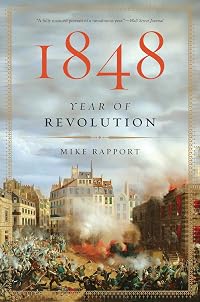
1848: Year of Revolution
by Mike Rapport
On This Page
Description
In 1848, a violent storm of revolutions ripped through Europe. The torrent all but swept away the conservative order that had kept peace on the continent since Napoleon's defeat at Waterloo in 1815-but which in many countries had also suppressed dreams of national freedom. Political events so dramatic had not been seen in Europe since the French Revolution, and they would not be witnessed again until 1989, with the revolutions in Eastern and Central Europe. In 1848, historian Mike Rapport show more examines the roots of the ferment and then, with breathtaking pace, chronicles the explosive spread of violence across Europe. A vivid narrative of a complex chain of interconnected revolutions, 1848 tells the exhilarating story of Europe's violent "Spring of Nations" and traces its reverberations to the present day. show lessTags
Recommendations

























Member Recommendations

The World That Never Was: A True Story of Dreamers, Schemers, Anarchists, and Secret Agents by Alex Butterworth
CGlanovsky The one almost serves as the sequel to the other. Panoramic picture of a tumultuous time and the people who fought for and against it.
Member Reviews
A cogent and clear recounting of a vital but all-too-forgotten period (in America, at least) in Europe's history, the 1848 wave of European revolutions when the people momentarily overthrew a dozen monarchs, only to be crushed again in a subsequent wave of counter-revolutions. The tale could easily have been lost among the dozens of names in different languages, but Rapport keeps a firm grasp on his storyline. His thesis is also relatively clear, with appropriate nuance: the revolutions succeeded because of genuine discontent with European governments that was channelled by a strong alliance of liberals and radicals — and then failed when that alliance fell apart and was unable to contend with the forces of reaction. Vital for show more understanding later events, such as the recent Arab Spring. show less
Very well done general history of the revolutions of 1848 and the counter-revolutions of 1849 that occurred in France, Germany, Italy, Austria, Hungary, Bohemia, Transylvania and various other outposts of the Hapsburg Empire. Rapport chronicles all the major events, and the leading actors treating each country or aspiring country in succession in each chapter. I was a little taken aback to learn that for a time Pope Pius IX was regarded as the focus of liberal reformers in favor of Italian unification. Ultimately, he could not make war upon the Catholic Emperor of Austria and yielded this role to Charles Albert of Piedmont. Pius was forced to abandon Rome disguised as a common priest and went into exile in Gaeta until after the French show more army at he direction of Louis Napoleon Bonaparte defeated Roman republican forces and restored the pope's authority in the Papal States.
Also worth noting among the cast was one Richard Wagner, who played a role in the government of revolutionary Saxony following the flight of its king into exile. Wagner at one point climbed to a church steeple where he rang the bells to alert the revolutionaries and performed reconnaissance on the Prussian forces looking to suppress the insurrection.
Ultimately, the revolutions foundered due to a great extent the inability of the liberal constitutionalists to achieve a critical mass significant enough to resist the more radical revolutionary impulses of the left and the traditionalist segments of society who feared for the wholesale destruction of the existing social order. What was lacking is best summed by the author in his concluding chapter.
"Most modern democracies cope with the social question because it is debated within a constitutional framework on which are parties are (more or less) agreed and which protect democratic freedoms." This lack of consensus and the inability to establish and live within the constraints of a constitutional framework ultimately influenced many of the revolutionaries of 1848 to side with their erstwhile conservative opposition. show less
Also worth noting among the cast was one Richard Wagner, who played a role in the government of revolutionary Saxony following the flight of its king into exile. Wagner at one point climbed to a church steeple where he rang the bells to alert the revolutionaries and performed reconnaissance on the Prussian forces looking to suppress the insurrection.
Ultimately, the revolutions foundered due to a great extent the inability of the liberal constitutionalists to achieve a critical mass significant enough to resist the more radical revolutionary impulses of the left and the traditionalist segments of society who feared for the wholesale destruction of the existing social order. What was lacking is best summed by the author in his concluding chapter.
"Most modern democracies cope with the social question because it is debated within a constitutional framework on which are parties are (more or less) agreed and which protect democratic freedoms." This lack of consensus and the inability to establish and live within the constraints of a constitutional framework ultimately influenced many of the revolutionaries of 1848 to side with their erstwhile conservative opposition. show less
I sought out this book after the events now being called the "Arab Spring" really got rolling. I was looking to see if the intuition that the events unfolding in North Africa and the Middle East were really comparable across time and space. The term sui generis comes to mind whenever such comparisons are attempted, and while it's fair to acknowledge that the popular uprisings happening in our time arise from conditions and motivations native to the context of Arab/Islamic culture and history, those distinctions that make the two phenomena different are themselves enlightening. As Mark Twain said, "History does not repeat itself, but is does rhyme."
Complaints can certainly be marshaled against the structure and character of this show more treatment of history. Any reading of a book is accompanied by comparisons to other books that it might have been had the author placed different emphasis. The content is intimidatingly broad and requires an effort to keep straight the various threads across the several concurrent revolutions. So saying, I think that Rapport's treatment is honest and shows integrity in dealing with the material. To have placed particular emphasis in any one theater of events while glossing over some aspects would have done an injustice to the very things that make this year of history fascinating. All of this happened at once, and no piece of it was for any reason more valid or important unless from a myopic perspective that generally eschews regions we think of as backwaters of European civilization. I see complaints of a lack of background explanation, but a moment's reflection on what that would entail and how much weight and density it would add to the total work should cause a retraction of that desire. This book deals with a certain set of events. Any information not contained therein is available elsewhere. If the reader is spurred to learn more, that's great. If it requires concerted effort to comprehend the complexity it is possible that it may be because the events themselves are complex and any movement to reduce complexity would be dishonest.
Back to the comparison with the Arab Spring, I certainly don't appreciate the news media's sound-bite-style journalism that virtually ignores events in any countries other than Egypt and Syria. No doubt they do so because they have a low opinion of our ability to process complexity and therefore serve-up a condensed version. I can't help thinking that there are just some times when an endeavor to actually grapple with complexity is actually the only way to get a visceral sense of that complexity. Who ever said the reading of a history book should be a passive experience? I agree it's not a beach read, and you may have to pay attention to it and occasionally come to grips with the fact that there are important historical figures you've never heard of whose context in a larger historical picture may have to be sought out elsewhere. So be it.
Finally, the comparisons to the revolutions from Algeria to Bahrain are--I think--elucidating. To see how the retrenchment of those empowered can stubbornly resist the conflicting idealisms of fracturing progressive movements mirrors in many respects the events we've seen over the last couple years. Two steps forward, one step back is perhaps the rhyme running through a world history of progressiveness. show less
Complaints can certainly be marshaled against the structure and character of this show more treatment of history. Any reading of a book is accompanied by comparisons to other books that it might have been had the author placed different emphasis. The content is intimidatingly broad and requires an effort to keep straight the various threads across the several concurrent revolutions. So saying, I think that Rapport's treatment is honest and shows integrity in dealing with the material. To have placed particular emphasis in any one theater of events while glossing over some aspects would have done an injustice to the very things that make this year of history fascinating. All of this happened at once, and no piece of it was for any reason more valid or important unless from a myopic perspective that generally eschews regions we think of as backwaters of European civilization. I see complaints of a lack of background explanation, but a moment's reflection on what that would entail and how much weight and density it would add to the total work should cause a retraction of that desire. This book deals with a certain set of events. Any information not contained therein is available elsewhere. If the reader is spurred to learn more, that's great. If it requires concerted effort to comprehend the complexity it is possible that it may be because the events themselves are complex and any movement to reduce complexity would be dishonest.
Back to the comparison with the Arab Spring, I certainly don't appreciate the news media's sound-bite-style journalism that virtually ignores events in any countries other than Egypt and Syria. No doubt they do so because they have a low opinion of our ability to process complexity and therefore serve-up a condensed version. I can't help thinking that there are just some times when an endeavor to actually grapple with complexity is actually the only way to get a visceral sense of that complexity. Who ever said the reading of a history book should be a passive experience? I agree it's not a beach read, and you may have to pay attention to it and occasionally come to grips with the fact that there are important historical figures you've never heard of whose context in a larger historical picture may have to be sought out elsewhere. So be it.
Finally, the comparisons to the revolutions from Algeria to Bahrain are--I think--elucidating. To see how the retrenchment of those empowered can stubbornly resist the conflicting idealisms of fracturing progressive movements mirrors in many respects the events we've seen over the last couple years. Two steps forward, one step back is perhaps the rhyme running through a world history of progressiveness. show less
I've read a lot about the revolutions of 1848 in recent months. Both overview works like this one and books focusing on certain aspects of it. To me this was the best overview of the events. Less dry than many of the other books and I like how the chapters is in chronological order while the subsections in the book covers different geographical regions.
It certainly helped me that I already read a lot about this subject in recent times. As for one thing Rapport doesn't go into detail about historical personalities which I kind of like, but many, which hasn't become familiar with the names like Kossuth, Ledru-Rollin, Garibaldi, Metternich and so on, will probably feel like there is a deluge of names impossible to keep track of. The author show more mostly focus on bigger social forces, both rooted in material and nationalist/ethnic conditions, which is the historical approach I usually prefer. Both the split between the political (for a constitution and nation) and social (alleviate poverty and other reforms for the poor) question among the revolutionaries is covered (mainly, but not exclusively, in France) and the problems of determining the borders of the aspiring nations and the conflicts this led to (mainly, but not exclusively, in Hungary).
Other reviewers has asked for a coherent story and claimed Rapport is a bad story teller. For me careful analysis and discussion of the events is more important than an easily digested story. In any case, it has to be acknowledged the events of 1848 is very hard to write a unified narrative of. While all the revolutions, France, Austria, Hungary, Italy and Germany, are revolutions against the conservative order of the day and for a written constitution of some sort and all failed, they all differ widely. In their goals, inherent contradictions and failures. No person or group, with the exception of the Austrian court, played a big role in more than one revolution, but still many decisions taken by different actors sometimes directly and often indirectly influenced events of other revolutions. To sum it up; it was a mess.
I do recommend this book for everyone interested in an overview of the revolutions of 1848. But it will certainly help, more than when reading history books in general, to have some background knowledge of the revolutions or the 19th century in general. show less
It certainly helped me that I already read a lot about this subject in recent times. As for one thing Rapport doesn't go into detail about historical personalities which I kind of like, but many, which hasn't become familiar with the names like Kossuth, Ledru-Rollin, Garibaldi, Metternich and so on, will probably feel like there is a deluge of names impossible to keep track of. The author show more mostly focus on bigger social forces, both rooted in material and nationalist/ethnic conditions, which is the historical approach I usually prefer. Both the split between the political (for a constitution and nation) and social (alleviate poverty and other reforms for the poor) question among the revolutionaries is covered (mainly, but not exclusively, in France) and the problems of determining the borders of the aspiring nations and the conflicts this led to (mainly, but not exclusively, in Hungary).
Other reviewers has asked for a coherent story and claimed Rapport is a bad story teller. For me careful analysis and discussion of the events is more important than an easily digested story. In any case, it has to be acknowledged the events of 1848 is very hard to write a unified narrative of. While all the revolutions, France, Austria, Hungary, Italy and Germany, are revolutions against the conservative order of the day and for a written constitution of some sort and all failed, they all differ widely. In their goals, inherent contradictions and failures. No person or group, with the exception of the Austrian court, played a big role in more than one revolution, but still many decisions taken by different actors sometimes directly and often indirectly influenced events of other revolutions. To sum it up; it was a mess.
I do recommend this book for everyone interested in an overview of the revolutions of 1848. But it will certainly help, more than when reading history books in general, to have some background knowledge of the revolutions or the 19th century in general. show less
Make no mistake - this is a fine, painstakingly detailed book. It's apparent problem is that it's a 70% scholarly opus and only 30% general audience non-fiction. Hence, low ratings from incensed public, tired by its density and thickness.
This book is a stew. It mixes a half-dozen revolutions and stirs the pot. It is an overview of the revolutions and counter-revolutions of 1848. It is a tough subject, granted, but more framing would have been nice. Rapport makes his main points well, the economic and political reasons for the revolutions, the fractionalism and sometimes opposing goals of the moderates and radicals and the circumstances that finally allowed their conservative opponents to overwhelm the revolutionaries.
As other reviewers have commented Rapport takes in a lot of territory in a fairly short book. The timeline bounces back and forth. And finally the protagonists pop in and out with little to identify them. He assumed more knowledge of mid 19th century show more politicians than I have, especially those in Central Europe. A timeline and more biographical information would have been good.
That said, Rapport writes well and clearly. He explains the political happenings in a clear, straightforward manner. The book is worth reading. show less
As other reviewers have commented Rapport takes in a lot of territory in a fairly short book. The timeline bounces back and forth. And finally the protagonists pop in and out with little to identify them. He assumed more knowledge of mid 19th century show more politicians than I have, especially those in Central Europe. A timeline and more biographical information would have been good.
That said, Rapport writes well and clearly. He explains the political happenings in a clear, straightforward manner. The book is worth reading. show less
A broad overview of the revolutions of 1848. Rapport takes in the whole of Europe, not only the usual suspects of Italy, Austria, Hungary, France and Germany, but also Scandinavia, the Low Countries and even England. This forms a part of the weakness of the book. Inevitably, some choices have to be made. Italy is dealt with in depth, while Frankfurt doesn't receive a lot of attention. The main problem, however, is a lack of context. Reactionaries and revolutionaries pop in and out of the narrative with bewildering speed, events happen in several places at once.... Even if you are reasonably familiar with the politics of mid 19C Europe, you sometimes feel lost. The book would have been a lot better with a set a biographical sketches of show more the main protagonists, and a timeline of what happened when and where.
That being said, it gives a good overview of the events, the reasons why the revolution failed, and the legacy of 1848. show less
That being said, it gives a good overview of the events, the reasons why the revolution failed, and the legacy of 1848. show less
Members
- Recently Added By
Lists

What A Year: Books titled with a particular year
147 works; 2 members
Author Information

8 Works 785 Members
Common Knowledge
- People/Characters
- Joseph Radetzky von Radetz
- Important events
- Revolutions of 1848
Classifications
- Genres
- History, Nonfiction, General Nonfiction
- DDC/MDS
- 940.284 — History & geography History of Europe History of Europe Europe: Renaissance, Reformation, Enlightenment, Napolean 19th century 1815-1914 Revolutions of 1848
- LCC
- D387 .R36 — History of Europe, Asia, Africa and Oceania History (General) Modern history, 1453- 1789- 19th century. 1801-1914/1920 1830-1870
- BISAC
Statistics
- Members
- 500
- Popularity
- 60,519
- Reviews
- 15
- Rating
- (3.60)
- Languages
- Danish, English, German, Italian
- Media
- Paper, Audiobook, Ebook
- ISBNs
- 14
- ASINs
- 4