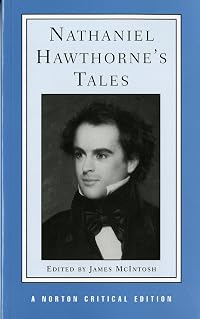
Nathaniel Hawthorne's Tales [Norton Critical Edition]
by Nathaniel Hawthorne, James McIntosh (Editor)
On This Page
Description
Contains fully annotated reprints of twenty-one tales and sketches by nineteenth-century American author Nathaniel Hawthorne; selected commentary by the author on his works; and several examples of criticism from contemporaries such as Herman Melville and Edgar Allan Poe and more recent writers.Tags
Recommendations








Member Reviews
Maybe it was my mood, maybe I wasn't being patient enough (reading short story collections uses different muscles than novels), but I struggled with a number of these. "The Birthmark" and "Rappacini's Daughter" are both as good as ever, but I felt like most of the new-to-me stories didn't really click except for "My Kinsman, Major Molineux" and "The Celestial Raild-road." The former is a well-observed story of character; the latter is fun riff updating Pilgrim's Progress for the industrial era. But going back over the table of contents now, I struggle to recall any of the others.
(I didn't read any of the supplemental material here, which runs almost two hundred pages. I'm not in grad school, you can't make me.)
(I didn't read any of the supplemental material here, which runs almost two hundred pages. I'm not in grad school, you can't make me.)
After reading this collection of short stories, which is supplemented with letters and diary entries among other material, I believe that Hawthorne and I are a bit of kindred spirits. Perhaps an odd statement to make about the author of The Scarlet Letter, but if people only remember him as the author of a book they were forced to read in high school, they are doing him an injustice. Hawthorne's prose is lovely, frequently Gothic in its romance, and original. I enjoyed some of his short stories better than others, and recognize that having most of them revolve around his Puritan heritage is limiting, but they are a fascinating read that deserves the attention of readers who appreciate literature.
Why kindred spirits, though? Reading his show more stories, I discovered a lot of sentiments that echo my own. Primarily, I was caught by Hawthorne's stance towards his faith. He disdained extremism and faith-led hatred and judgment. Yet he seemed to endorse a purer kind of belief that accepted God, and also the beauty of redemption and forgiveness and this world and its people. Likewise, he was repulsed by some of the Puritan's harsh practices, but proud of their hardiness and strength. Other themes that he explored also eerily matched my own thoughts on the subjects. For example, his musings on mortality, his fluctuating representations of the artistic personality, and his many ideas connected to books and reading.
This collection includes stories from a variety of sources, primarily from Twice Told Tales and Mosses from an Old Manse. His most anthologized short stories are included, such as "Young Goodman Brown" and "Rappaccini's Daughter", and other stories that are lesser known, for example "The Wives of the Dead". Since this is a Norton edition, the stories are followed by supplementary material. In this case, the book has copies of some of Hawthorne's letters and diary entries, several contemporary reviews of his work, and many modern critical pieces from a wide range of years. A lot of the tales have their themes explored in one of the critical essays in the latter half of the book, so even if some of the stories didn't grab my attention when I first read them, I found them much more compelling after I explored the thought-provoking analyses that other minds built around them.
In my experience, people consider Hawthorne a musty, old-fashioned writer. I disagree. True, his writing does reflect the style of older times and can be a bit wordy, but his ideas are as fresh today as they were when he wrote them, and he had a distinct voice and intelligent mind. I think his reputation suffers from being introduced to young high school students as required reading (I reread Scarlet Letter in college and found it far more impressive than when I read it in high school). This book is a great way to experience his shorter fiction, with the quality supplementary material to support it. show less
Why kindred spirits, though? Reading his show more stories, I discovered a lot of sentiments that echo my own. Primarily, I was caught by Hawthorne's stance towards his faith. He disdained extremism and faith-led hatred and judgment. Yet he seemed to endorse a purer kind of belief that accepted God, and also the beauty of redemption and forgiveness and this world and its people. Likewise, he was repulsed by some of the Puritan's harsh practices, but proud of their hardiness and strength. Other themes that he explored also eerily matched my own thoughts on the subjects. For example, his musings on mortality, his fluctuating representations of the artistic personality, and his many ideas connected to books and reading.
This collection includes stories from a variety of sources, primarily from Twice Told Tales and Mosses from an Old Manse. His most anthologized short stories are included, such as "Young Goodman Brown" and "Rappaccini's Daughter", and other stories that are lesser known, for example "The Wives of the Dead". Since this is a Norton edition, the stories are followed by supplementary material. In this case, the book has copies of some of Hawthorne's letters and diary entries, several contemporary reviews of his work, and many modern critical pieces from a wide range of years. A lot of the tales have their themes explored in one of the critical essays in the latter half of the book, so even if some of the stories didn't grab my attention when I first read them, I found them much more compelling after I explored the thought-provoking analyses that other minds built around them.
In my experience, people consider Hawthorne a musty, old-fashioned writer. I disagree. True, his writing does reflect the style of older times and can be a bit wordy, but his ideas are as fresh today as they were when he wrote them, and he had a distinct voice and intelligent mind. I think his reputation suffers from being introduced to young high school students as required reading (I reread Scarlet Letter in college and found it far more impressive than when I read it in high school). This book is a great way to experience his shorter fiction, with the quality supplementary material to support it. show less
Specter and Science:
The tales in this collection include the best written by Hawthorne. Among them it is hard to rate one over another, however Rappaccini's Daughter is near the top. A tale of the natural versus the supernatural with overtones of professional jealousy, first love, and the desire for perfection. Perfection as desiderata, but unwillingness to pay the price. There are two scientists in Baglioni and Rappaccini himself. The latter seems to have created a new Eden with his garden that is lovingly overseen by his daughter, Beatrice, who is even more lovely than the flowers that surround her. Enter the young student, Giovanni, who is in Padua to study but is distracted by the view from his window: first, by the beautiful purple show more blossoms of a shrub in the center of the garden that illuminated it with a light that rivaled the sun; and second, by the entrance of Beatrice who made such an impression on the young student that it was as if "here were another flower . . . more beautiful than the richest of them,". The story develops into a question of whether the poison in the flowers (yes, they are poisonous plants) has overtaken Beatrice as well making her dangerous to other plants, animals, and even Giovanni. The question of whether she is a supernatural being or mere mortal is answered by the end of the story, but Giovanni's life is forever changed - how we may only speculate.
This story only hints at some of the myriad emotions and strange occurrences in these stories of men and women in settings as disparate as Salem Massachusetts and Padua Italy. show less
The tales in this collection include the best written by Hawthorne. Among them it is hard to rate one over another, however Rappaccini's Daughter is near the top. A tale of the natural versus the supernatural with overtones of professional jealousy, first love, and the desire for perfection. Perfection as desiderata, but unwillingness to pay the price. There are two scientists in Baglioni and Rappaccini himself. The latter seems to have created a new Eden with his garden that is lovingly overseen by his daughter, Beatrice, who is even more lovely than the flowers that surround her. Enter the young student, Giovanni, who is in Padua to study but is distracted by the view from his window: first, by the beautiful purple show more blossoms of a shrub in the center of the garden that illuminated it with a light that rivaled the sun; and second, by the entrance of Beatrice who made such an impression on the young student that it was as if "here were another flower . . . more beautiful than the richest of them,". The story develops into a question of whether the poison in the flowers (yes, they are poisonous plants) has overtaken Beatrice as well making her dangerous to other plants, animals, and even Giovanni. The question of whether she is a supernatural being or mere mortal is answered by the end of the story, but Giovanni's life is forever changed - how we may only speculate.
This story only hints at some of the myriad emotions and strange occurrences in these stories of men and women in settings as disparate as Salem Massachusetts and Padua Italy. show less
A much better storyteller than a novelist, this has all of his best work. Hawthorne is particularly interesting when read from a Jungian perspective, as his symbols and archetypes line up nicely with Jung's later work.
Ratings
Members
- Recently Added By
Author Information

881+ Works 79,418 Members
Nathaniel Hawthorne was born on July 4, 1804 in Salem, Massachusetts. When he was four years old, his father died. Years later, with financial help from his maternal relatives who recognized his literary talent, Hawthorne was able to enroll in Bowdoin College. Among his classmates were the important literary and political figures Horatio Bridge, show more Henry Wadsworth Longfellow, and Franklin Pierce. These friends supplied Hawthorne with employment during the early years after graduation while Hawthorne was still establishing himself as a legitimate author. Hawthorne's first novel, Fanshawe, which he self-published in 1828, wasn't quite the success that he had hoped it would be. Not willing to give up, he began writing stories for Twice-Told Tales. These stories established Hawthorne as a leading writer. In 1842, Hawthorne moved to Concord, Massachusetts, where he wrote a number of tales, including "Rappaccini's Daughter" and "Young Goodman Brown," that were later published as Mosses from an Old Manse. The overall theme of Hawthorne's novels was a deep concern with ethical problems of sin, punishment, and atonement. No one novel demonstrated that more vividly than The Scarlet Letter. This tale about the adulterous Puritan Hester Prynne is regarded as Hawthorne's best work and is a classic of American literature. Other famous novels written by Hawthorne include The House of Seven Gables and The Blithedale Romance. In 1852, Hawthorne wrote a campaign biography of his college friend Franklin Pierce. After Pierce was elected as President of the United States, he rewarded Hawthorne with the Consulship at Liverpool, England. Hawthorne died in his sleep on May 19, 1864, while on a trip with Franklin Pierce. (Bowker Author Biography) show less
James McIntosh is Professor of English and American Culture, University of Michigan.
Series
Belongs to Publisher Series
Common Knowledge
- Canonical title
- Nathaniel Hawthorne's Tales [Norton Critical Edition]
- Disambiguation notice
- Do Not Combine: This is a "Norton Critical Edition", it is a unique work with significant added material, including essays and background materials. Do not combine with other editions of the work. Please maintain the p... (show all)hrase "Norton Critical Edition" in the Canonical Title and Series fields.
Classifications
Statistics
- Members
- 313
- Popularity
- 102,525
- Reviews
- 4
- Rating
- (4.12)
- Languages
- English
- Media
- Paper
- ISBNs
- 3
- ASINs
- 1