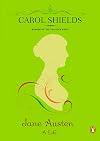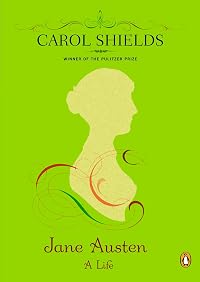
Jane Austen
by Carol Shields
On This Page
Description
"In her fictional biography, The Stone Diaries, Carol Shields created an astonishing portrait of Daisy Goodwill Flett, a modern woman struggling to understand her place in her own life. With the same sensitivity and artfulness that are the trade-marks of her award-winning novels, Shields here explores the life of a writer whose own novels have engaged and delighted readers for the past two hundred years." "In Jane Austen, Shields follows this superb and beloved novelist from her early family show more life in Steventon to her later years in Bath, her broken engagement, and her intense relationship with her sister Cassandra. She reveals both the very private woman and the acclaimed author behind the enduring classics Sense and Sensibility, Pride and Prejudice, and Emma. With its fascinating insights into the writing process from an award-winning novelist, Carol Shields's magnificent biography of Jane Austen is also a compelling meditation on how great fiction is created."--BOOK JACKET. show lessTags
Recommendations














Member Reviews
Insightful, although at times it seems that Shields tried to find Jane Austen in the contents of her fiction, and makes some powerful assumptions based on Austen's writing. One of these assumptions, that Austen may have been atheist based on the omission of any reference to faith in her books, is absurd. Disbelief would not have occurred to a clergyman's daughter in that era - or even later times - especially without outside influence, of which there was little in Austen's world. Despite other minor quibbles, mostly regarding a lack of focus, repetition, and financial details, this is a nice little book, useful for reference, that I will keep. Now I will follow up with a recent acquisition A Memoir of Jane Austen by her Nephew by James show more Edward Austen-Leigh as a comparison while Shields' work is still fresh in my mind, although without giving examples, Shields claims he "got a lot wrong". show less
One imagines a sensitive novelist of particularity, such as Carol Shields, measuring herself in the process of writing this short literary biography of Jane Austen. For what better measure might there be? Now two hundred years since their initial publication, Austen’s novels continue to delight and surprise. Writing in obscurity away from the bustle of the writerly world of “workshops”, “MFAs”, “public readings”, “writer circles”, and “literary festivals”, without the input of her literary contemporaries, without the lucrative compensation of a hefty advance or a well-publicised book tour, with only the modest praise and encouragement of family and a few close friends, Jane Austen made the novel form her own. show more Shields strikes precisely the right tone here – respectful.
Shields’ prose is crisp and insightful, with just enough facts drawn from Austen’s correspondence and other sources to gently move along the progress of her life, whilst keeping the focus where it ought to always be, on Austen’s texts. A literary biography succeeds when the reader finishes it and wants immediately to immerse himself or herself in the subject’s texts. Reader, the desire to plunge headlong into a rereading of each of Austen’s novels is nearly irresistible. Delightfully recommended. show less
Shields’ prose is crisp and insightful, with just enough facts drawn from Austen’s correspondence and other sources to gently move along the progress of her life, whilst keeping the focus where it ought to always be, on Austen’s texts. A literary biography succeeds when the reader finishes it and wants immediately to immerse himself or herself in the subject’s texts. Reader, the desire to plunge headlong into a rereading of each of Austen’s novels is nearly irresistible. Delightfully recommended. show less
I've read a lot of great biographies on Jane Austen, but this one was truly excellent. First off, I would not recommend this for someone who knows very little about Jane Austen or her books, as a lot of basics are assumed in order to get on to things that better interest the knowledgeable "Janeite". I think that's why I enjoyed it so much---it was a refreshing take on the details behind that "Jane Austen Fact Sheet" that a lot of biographies seem to be drawing from.
I love Shields' metaphor of "glances" on page 3-4. She discusses how Austen never really goes into detail about some of the things that were so newsworthy in her day: the Napoleonic wars, changes in societal structure and the Church, advances in science and medicine. She show more describes Austen's dealings with them as "glances"---an implied commentary.
Another thing the biographer brought to my attention, in respect to the writer in me---and in Austen---was that Jane Austen never had that quiet place that I seem not to be able to write without. "The encouragement of her imagination did not arise from conditions offered her by others." I am always looking for that place of solitude---the "Perfect Place to Write." Yet, Jane Austen just wrote wherever she was and however she could---no matter what was going on around her. I can't expect others to pave the way for me. If I really want to finish that story that I'm working on, I need to make it happen.
After reading this short bio, I'm more encouraged to track down some of her published correspondence. Maybe I'll have the chance to find some on my trip to England next month. show less
I love Shields' metaphor of "glances" on page 3-4. She discusses how Austen never really goes into detail about some of the things that were so newsworthy in her day: the Napoleonic wars, changes in societal structure and the Church, advances in science and medicine. She show more describes Austen's dealings with them as "glances"---an implied commentary.
Another thing the biographer brought to my attention, in respect to the writer in me---and in Austen---was that Jane Austen never had that quiet place that I seem not to be able to write without. "The encouragement of her imagination did not arise from conditions offered her by others." I am always looking for that place of solitude---the "Perfect Place to Write." Yet, Jane Austen just wrote wherever she was and however she could---no matter what was going on around her. I can't expect others to pave the way for me. If I really want to finish that story that I'm working on, I need to make it happen.
After reading this short bio, I'm more encouraged to track down some of her published correspondence. Maybe I'll have the chance to find some on my trip to England next month. show less
Amazing that so short a book could be so unsatisfactory for so many reasons. Just a few examples:
Shields insists all throughout the book that Austen "longed" all her life to be married, and that any happiness she managed to find was because she learned to live with disappointment. (Shields also mentions how annoying it is when readers conflate a fiction writer's life with her writing, right after "explaining" how much Austen has in common with the heroine of "Persuasion.")
Hold this book carefully if you do read it. If you tip it the least bit, all the billions of "Austen must have"s, "Austen would have"s, and "Austen surely"s will fall out and break your foot.
Shields hates "Lady Susan." HATES it. How on earth can anyone who loves Austen show more enough to want to write even a brief biography of her not enjoy this darkly hilarious novella?
Shields describes the money left to Austen's sister, Cassandra Austen, as not very much -- "certainly not enough to live on." The sum was a thousand pounds. A YEAR. The main character family (mother, two grown daughters, and one teenager) in "Sense and Sensibility" manage to live in cozy gentility, employing three servants, on 500 a year. A thousand pounds a year for a single woman with no dependents would have been *ample.*
Shields says that Emma is her favorite Austen heroine. She describes Mr. Knightley as drawing up lists of books for Emma to read. In fact, Mr. Knightley mentions admiring the lists of books Emma drew up for *herself* to read at various times of her life. The reader gets the feeling that she spent more time writing these lists than she ever did reading. Mr. Knightley saved one of the lists for some time, but he *never* wrote one for her.
At the end of the book, Shields offers a bizarre list of body parts Austen never mentions in her novels, including toes.
I could go on and on. Suffice it to say that halfway through this book, I was begging Jane Austen to die and put me out of my misery. show less
Shields insists all throughout the book that Austen "longed" all her life to be married, and that any happiness she managed to find was because she learned to live with disappointment. (Shields also mentions how annoying it is when readers conflate a fiction writer's life with her writing, right after "explaining" how much Austen has in common with the heroine of "Persuasion.")
Hold this book carefully if you do read it. If you tip it the least bit, all the billions of "Austen must have"s, "Austen would have"s, and "Austen surely"s will fall out and break your foot.
Shields hates "Lady Susan." HATES it. How on earth can anyone who loves Austen show more enough to want to write even a brief biography of her not enjoy this darkly hilarious novella?
Shields describes the money left to Austen's sister, Cassandra Austen, as not very much -- "certainly not enough to live on." The sum was a thousand pounds. A YEAR. The main character family (mother, two grown daughters, and one teenager) in "Sense and Sensibility" manage to live in cozy gentility, employing three servants, on 500 a year. A thousand pounds a year for a single woman with no dependents would have been *ample.*
Shields says that Emma is her favorite Austen heroine. She describes Mr. Knightley as drawing up lists of books for Emma to read. In fact, Mr. Knightley mentions admiring the lists of books Emma drew up for *herself* to read at various times of her life. The reader gets the feeling that she spent more time writing these lists than she ever did reading. Mr. Knightley saved one of the lists for some time, but he *never* wrote one for her.
At the end of the book, Shields offers a bizarre list of body parts Austen never mentions in her novels, including toes.
I could go on and on. Suffice it to say that halfway through this book, I was begging Jane Austen to die and put me out of my misery. show less
Erittäin mielenkiintoinen elämäkerta Jane Austenin elämästä tämän lapsuudesta kirjailijan kuolemaan saakka. Teoksen kirjoittanut ja itsekin kirjailija, kanadalainen Carol Shields (mm. Kivipäiväkirjat) luo kertomukselle viitekehyksen, ja kirjassa esiintyvä kirjailijan ääni soveltuukin hyvin tekstiin mukaan. Shields ei pyri kaunistelemaan tai romantisoimaan Jane Austenin henkilöhahmoa, vaan tuo myös esille tämän persoonan mutkikkaammatkin puolet, ja vaikea äitisuhdekin vilahtaa tekstissä. Austenin kirjallisia teoksia ja niiden henkilöhahmoja arvostellaan mielenkiintoisesti ja kattavasti, toki Shieldsin oman näkökulman takia myös puolueellisesti. Teos ei käsittele pelkästään Jane Austenia tai hänen teoksiaan, show more vaan kerronnassa on myös kuvattu 1800-luvun alun tapakulttuuria, kuten kirjeiden kirjoittamista, naisen asemaa, elämää perhepiirissä jne. Jos on kiinnostunut Jane Austenista, tai naisen elämästä 1800-luvun alun aikakaudella, kirja kannattaa lukea. show less
As a fellow novelist, author Carol Shields brings a unique perspective to her biography of Jane Austen. In the first chapter, Shields writes: Traditionally Jane Austen's biographers have nailed together the established facts of her life--her birth, her travels, her enthusiasms, her death--and clothed this rickety skeleton with speculation gleaned from the novels, an exercise akin to ransacking an author's bureau drawers and drawing conclusions from piles of neatly folded handkerchiefs or worn gloves. In so doing, the assumption is made that fiction flows directly from a novelist's experience rather than from her imagination. While Shields then goes on to glean speculation from Austen's novels, she does so through the lens of a writer show more who knows how inspiration functions and who may therefore be able to discern the line between experience and imagination in Austen's works. Readers don't need to be Jane Austen experts, but do need a basic familiarity with her novels. While this isn't a work for scholars (there are no footnotes/endnotes), it isn't an introduction, either. Warmly recommended to Austen readers. show less
It is a source of perennial frustration to Jane Austen's admirers that so little is known about her quiet existence as an unmarried woman with no outlet for her ferocious intelligence in genteel, rural England at the turn of the 19th century. Carol Shields, who won a Pulitzer Prize in 1995 for The Stone Diaries, has already proved herself a writer who can convey large truths with an economical amount of material, which makes her an excellent choice as Austen's biographer. Shields' brief but cogent text makes persuasive connections between Austen's novels and her life (the plethora of unsatisfactory mothers, for example, and the obvious sympathy for women barred from marriage by poverty and from careers by social custom), but she never show more forgets that fiction expresses first and foremost an artist's response to the world around her, not actual personal history. In fact, Shields argues, it may well have been Austen's sense that the novels she loved to read didn't provide a very accurate picture of the society she knew that fired her own work. Her merciless portraits of the economic underpinnings of marriage and family relations are in many ways more "realistic" than male writers' dramas of battle or females' fantasies of romantic bliss. As for her life's lack of incident, its one major disruption, her parents' move to Bath, prompted a nine-year silence from their formerly prolific daughter. Shields gleans as much as she can from Austen's letters, while remembering that they too gave voice to a persona not the whole truth, to delineate a quirky, sometimes cranky, sometimes catty woman who was by no means the perfect maiden aunt her surviving relatives sought to immortalise. An Austen biography will never be as much fun as an Austen novel, but Shields does a remarkably entertaining job of discerning the links between the two. --Wendy Smith show less
Members
- Recently Added By
Lists

Best Biographies
216 works; 26 members

Books Read in 2013
1,630 works; 51 members
Author Information

36+ Works 17,673 Members
Carol Shields is a writer and critic who was born on June 2, 1935 in Chicago and grew up in Illinois. Shields resided in Canada, where she was the Chancellor of the University of Winnipeg, and a professor at the University of Manitoba. Shields's first novel, Small Ceremonies, was published the week of her 40th birthday. Her other works of fiction show more include The Orange Fish, Larry's Party, Various Miracles, and The Stone Diaries, which received the Governor's General Award and the Pulitzer Prize for Fiction. Shields has also been awarded the Canadian Bookseller's Prize, the National Book Critics Circle Award, and the CBC Prize for Drama. She died on July 16, 2003. (Bowker Author Biography) show less
Some Editions
Awards and Honors
Series
Belongs to Publisher Series
Common Knowledge
- Canonical title
- Jane Austen
- Original title
- Jane Austen
- Original publication date
- 2001
- People/Characters
- Jane Austen
- Dedication
- For Grace and Hazel
- First words
- Today Jane Austen belongs to the nearly unreachable past.
- Last words
- (Click to show. Warning: May contain spoilers.)They are as alive today in their longings as they were, two hundred years ago, when she first gave them breath.
- Original language*
- English
*Some information comes from Common Knowledge in other languages. Click "Edit" for more information.
Classifications
Statistics
- Members
- 871
- Popularity
- 31,257
- Reviews
- 21
- Rating
- (3.71)
- Languages
- 7 — English, Finnish, French, German, Hungarian, Spanish, Swedish
- Media
- Paper, Audiobook, Ebook
- ISBNs
- 22
- ASINs
- 3