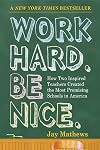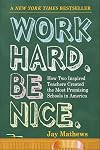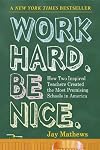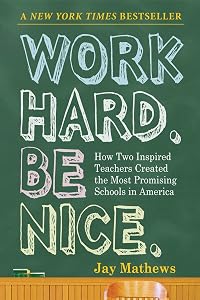
Work Hard, Be Nice
by Jay Mathews
On This Page
Description
When Mike Feinberg and Dave Levin signed up for Teach for America right after college and found themselves utter failures in the classroom, they vowed to remake themselves into superior educators. They did that—and more. In their early twenties, by sheer force of talent and determination never to take no for an answer, they created a wildly successful fifth-grade experience that would grow into the Knowledge Is Power Program (KIPP), which today includes sixty-six schools in nineteen states show more and the District of Columbia.KIPP schools incorporate what Feinberg and Levin learned from America's best, most charismatic teachers: lessons need to be lively; school days need to be longer (the KIPP day is nine and a half hours); the completion of homework has to be sacrosanct (KIPP teachers are available by telephone day and night). Chants, songs, and slogans such as "Work hard, be nice" energize the program. Illuminating the ups and downs of the KIPP founders and their students, Mathews gives us something quite rare: a hopeful book about education.
. show less
Tags
Recommendations




Member Recommendations
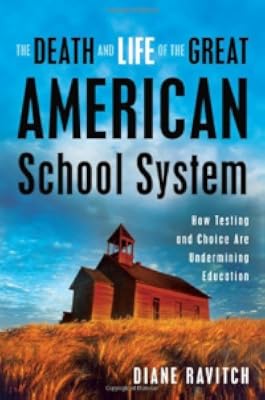
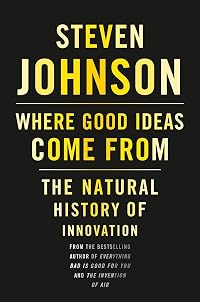
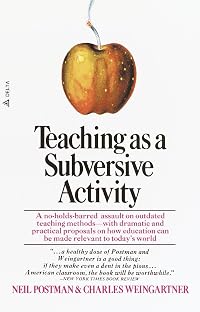
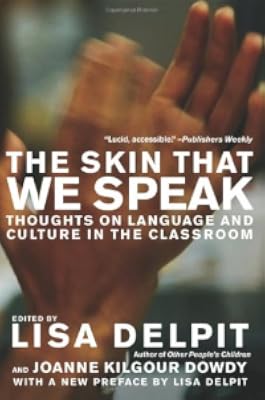
bluenotebookonline Both books feature an in-depth look at KIPP: Mathews focuses on the organization's early development and growth, while Tough focuses on KIPP's efforts to improve in later years.
bluenotebookonline Two highly readable--and very different--books that tell the story of how high-performing charter networks were founded. They're good complements to one another and both are important stories for anyone trying to understand the charter school movement.
Member Reviews
Jay Mathews, as a long-time education writer for the Washington Post, displays an enviable ability to produce a real page-turner on a topic far from the top of the average person's reading list. The narrative flow is far more engaging than much of what we find in contemporary novels; the emotional engagement he fosters has us rooting for his protagonists and feeling the occasional personal losses he documents. As he chronicles the story of Mike Feinberg and Dave Levinâs journey from being two inexperienced yet idealistic, highly energetic, and incredibly persistent Teach for America alums to running a successful chain of charter schools--the Knowledge is Power Program (KIPP)--serving disadvantaged children, he tells an archetypal show more tale that any trainer-teacher-learner can appreciate. As we absorb the wonderful story of how they engaged their youngest learners in actions to shame reticent school district officials into action--thereby providing a lesson in civics by inspiring the students to engage in civic action--we have an extremely important example of the importance of providing learning opportunities that are grounded in experience that puts what is being learned into action--experiential learning at its best. It's not all rosy in "Work Hard, Be Nice." Mathews and his interviewees do not shy away from acknowledging the occasional small and large failures that sometimes come from overzealous actions. We are, however, never in doubt as to where Mathews himself stands on the issue of whether KIPP is worth studying: "Over time, the debate about KIPP among educators has grown, full of misinformation and misimpressions because few of the people talking about KIPP schools have actually seen them in action," he writes (p. 281). And he fully intends to continue exploring the KIPP model, he adds: "In the search for the best schools, I still have a lot of work to do" (p. 317). show less
What do we really know about how well low-income children could do in school if they were given more opportunities? Jay Mathews (Washington Post education reporter) investigated the Knowledge Is Power Program (KIPP) to discover the answer. He spent two years visiting 31 KIPP schools and interviewing the founders, teachers, and parents.
KIPP is a controversial middle school education program founded in 1995 by Mike Feinberg and Dave Levin, former educators in the Teach for America program. Feinberg and Levin believed that with proper mentoring, teacher enthusiasm, and student incentives, kids from poor neighborhoods could excel.
Feeling defeated by their experiences in a barrio school, they came up with a model for change. They wanted to show more give students “something productive, constructive and fun to do, versus just hanging out on the streets." They convinced the Houston school district to try out their plan, and were wildly successful. (According to their website, http://www.kipp.org, there are now 82 KIPP schools in 19 states and the District of Columbia.)
Over 90 percent of KIPP students are African American or Hispanic/Latino, and most enter these middle schools two grade levels behind. But results have been inspirational. Some of the KIPP schools even boast 100% college attendance rates among graduates.
Their school day runs from 7:30 a.m. to 5 p.m., with classes held every other Saturday and for three weeks during the summer. A "KIPPster" spends 60 percent more time in class than a peer in a typical public school. And KIPPsters leave their nine-hour school day with another two hours of homework. Teachers are involved and enthusiastic and most importantly, convey belief in the success of their students. Both students and parents have to sign a contract expressing commitment to fulfill the requirements of attendance.
This book is a fascinating and hopeful look at what dedication and, frankly, financial investment, can do to reclaim students who get left behind. The sad part is that there aren’t more of these schools. The program’s detractors make some valid points (e.g., some say KIPP acts as an enabler giving society a pass on larger inequality issues, such as bad public schools, residential segregation, and unequal access for mothers and children to pediatric care. Others say KIPP's rigid rules requiring parental participation filter out children who might in fact need the schools more.) But given the choices, it sounds like the program is giving opportunities to some children who would not have had them regardless. If we wait until complete societal change is effected, no one would be helped.
Recommended especially if you’re in sociology or education! show less
KIPP is a controversial middle school education program founded in 1995 by Mike Feinberg and Dave Levin, former educators in the Teach for America program. Feinberg and Levin believed that with proper mentoring, teacher enthusiasm, and student incentives, kids from poor neighborhoods could excel.
Feeling defeated by their experiences in a barrio school, they came up with a model for change. They wanted to show more give students “something productive, constructive and fun to do, versus just hanging out on the streets." They convinced the Houston school district to try out their plan, and were wildly successful. (According to their website, http://www.kipp.org, there are now 82 KIPP schools in 19 states and the District of Columbia.)
Over 90 percent of KIPP students are African American or Hispanic/Latino, and most enter these middle schools two grade levels behind. But results have been inspirational. Some of the KIPP schools even boast 100% college attendance rates among graduates.
Their school day runs from 7:30 a.m. to 5 p.m., with classes held every other Saturday and for three weeks during the summer. A "KIPPster" spends 60 percent more time in class than a peer in a typical public school. And KIPPsters leave their nine-hour school day with another two hours of homework. Teachers are involved and enthusiastic and most importantly, convey belief in the success of their students. Both students and parents have to sign a contract expressing commitment to fulfill the requirements of attendance.
This book is a fascinating and hopeful look at what dedication and, frankly, financial investment, can do to reclaim students who get left behind. The sad part is that there aren’t more of these schools. The program’s detractors make some valid points (e.g., some say KIPP acts as an enabler giving society a pass on larger inequality issues, such as bad public schools, residential segregation, and unequal access for mothers and children to pediatric care. Others say KIPP's rigid rules requiring parental participation filter out children who might in fact need the schools more.) But given the choices, it sounds like the program is giving opportunities to some children who would not have had them regardless. If we wait until complete societal change is effected, no one would be helped.
Recommended especially if you’re in sociology or education! show less
 This review was written for LibraryThing Early Reviewers.
This is an easy-to-read book about the vision and excitement generated by 2 young Americans who started KIPP school programs after their Teach For American experiences. As an educator, I respect their passion and the energy they bring to their jobs. I know, however, that requiring teachers to work 7am-5pm daily, teach summer school with these tough kids, and be available by phone 24/7 is not realistic. I did it when I was young. They are doing it now. I respect them.
The book is well written in a comfortable way. I did skip parts as they felt a bit too detailed. Even so, I enjoyed the stories of their teaching methods & the success of their students. Admirable!
The book is well written in a comfortable way. I did skip parts as they felt a bit too detailed. Even so, I enjoyed the stories of their teaching methods & the success of their students. Admirable!
This review was written for LibraryThing Early Reviewers.3.5 Stars. I read this book because my son told me his teacher's heroes are the two guys about whom this book is written. I'm not an educator, but it was good to read about people taking a new approach to educating impoverished, urban kids. The author spends a bit of time on controversy and criticism by some of their approach (long hours, strict discipline, summer and Saturday school, plenty of homework, and teachers always available by phone for answering homework questions), but comes to the conclusion that the KIPP program is one of the best programs out there for increasing achievement in inner city schools.
This book is basically the "life and times" of the KIPP program. The book is very well written, but unfortunately, the subject matter isn't the best. KIPP, in my area, is referred to as "the cult." Teachers I know that have been part of it or know others who have all say they suck the life out of you during the best years of your professional life and then spit you out when they've finished leaching off you. From what I have read in this book, I can see why that is the case.
I'm not reviewing the program though, so I guess I'll just say that this book is an interesting insight into the minds of a couple of madmen. I wouldn't really recommend it though.
I'm not reviewing the program though, so I guess I'll just say that this book is an interesting insight into the minds of a couple of madmen. I wouldn't really recommend it though.
This review was written for LibraryThing Early Reviewers.An absolutely engaging, amazing “listen” about the formation and execution of a middle school design known as KIPP by two teachers driven by their thrill of seeing kids learn.
This is an inspiring story of two young men who find their mission in life early, and don’t waiver from it no matter how many obstacles are placed in front of them. As their story unfolds, you find yourself cheering for them at each triumph, and ready to jump in and help them fight off the naysayer who throws up the roadblocks.
The manner that Mr. Mathews uses to weave all the individual stories together is very appealing and helpful in putting a personal face on the story of public education with all its flaws. So many books have been written about different show more aspects of K-12 education, charter education, and different models, but this book will engage anyone regardless of their exposure to the subject. Without an overload of statistics or rankings, this story is told with the clear concise pictures of success and the rewards of that success.
If you have an interest in education, listen to this book, if you have children entering the public school system, listen to this book, if you are a new teacher looking for a successful curriculum to embrace, listen to this book, or if you just love a real world story of success, listen to this book.
I have been involved in the charter school movement since 1999 and have 4 children that have attended charter schools. Two of them have just graduated from a KIPP school and one is entering the 7th grade. That being said, I did not know the story of Mike Fienberg and David Levin or how the design was conceived and refined, I just knew it worked for my kids. The two graduates are both headed off to private schools on scholarships, and I am thrilled that I have been able to listen to the story of KIPP which gave them their head start to college. show less
This is an inspiring story of two young men who find their mission in life early, and don’t waiver from it no matter how many obstacles are placed in front of them. As their story unfolds, you find yourself cheering for them at each triumph, and ready to jump in and help them fight off the naysayer who throws up the roadblocks.
The manner that Mr. Mathews uses to weave all the individual stories together is very appealing and helpful in putting a personal face on the story of public education with all its flaws. So many books have been written about different show more aspects of K-12 education, charter education, and different models, but this book will engage anyone regardless of their exposure to the subject. Without an overload of statistics or rankings, this story is told with the clear concise pictures of success and the rewards of that success.
If you have an interest in education, listen to this book, if you have children entering the public school system, listen to this book, if you are a new teacher looking for a successful curriculum to embrace, listen to this book, or if you just love a real world story of success, listen to this book.
I have been involved in the charter school movement since 1999 and have 4 children that have attended charter schools. Two of them have just graduated from a KIPP school and one is entering the 7th grade. That being said, I did not know the story of Mike Fienberg and David Levin or how the design was conceived and refined, I just knew it worked for my kids. The two graduates are both headed off to private schools on scholarships, and I am thrilled that I have been able to listen to the story of KIPP which gave them their head start to college. show less
This review was written for LibraryThing Early Reviewers.This is an inspiring book detailing the struggles of two young Teach for America participants who ended up starting the now-famous KIPP schools. It would be easy to come away from this book believing that all our inner-city schools (and the failing rural schools that get much less publicity) should follow the KIPP model. Close examination of the student stories in this book, as in so many other similar books, will however reveal that parent involvement is crucial to student success, even if the involvement is as little as signing a form to agree to a school change. Sadly, there are still many parents who can't or won't manage even that level of engagement with their children's learning.
Members
- Recently Added By
Author Information

10+ Works 471 Members
Common Knowledge
- Canonical title
- Work Hard, Be Nice
- Original publication date
- 2009
- People/Characters
- Mike Feinberg ; Dave Levin
- Dedication
- To Linda
- First words
- Many people in the United States believe that low-income children can no more be expected to do well in school than ballerinas can be counted on to excel in football.
- Last words
- (Click to show. Warning: May contain spoilers.)They were just two educators, and they were going to need many more who were willing to believe that good teaching can make a big difference and that all children will learn if they receive the time and encouragement and love they deserve.
Classifications
- Genres
- Nonfiction, General Nonfiction, Biography & Memoir
- DDC/MDS
- 370 — Society, government, & culture Education Education
- LCC
- LC4091 .M327 — Education Special aspects of education Special aspects of education Education of special classes of persons Exceptional children and youth. Special Children and youth with disabilities. Learning
- BISAC
Statistics
- Members
- 315
- Popularity
- 101,261
- Reviews
- 30
- Rating
- (3.63)
- Languages
- English
- Media
- Paper, Audiobook, Ebook
- ISBNs
- 5
- ASINs
- 2