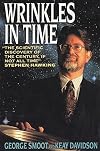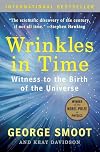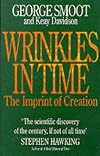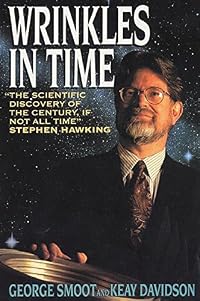
Wrinkles in Time
by George Smoot, Keay Davidson
On This Page
Description
In April 1992, a discovery was made that changed the way we view the world. Dr. George Smoot, distinguished cosmologist and adventurer, whose quest for cosmic knowledge had taken him from the Brazilian rain forest to the South Pole unveiled his momentous discovery, bringing to light the very nature of the universe. For anyone who has ever looked up at the night sky and wondered, for anyone who has ever longed to pull aside the fabric of the universe for a glimpse of what lies behind it. show more Wrinkles in Time is the story of Smoot's search to uncover the cosmic seeds of the universe. Wrinkles in Time is the Double Helix of cosmology, an intimate look at the inner world of men and women who ask. "Why are we here?" It tells the story of George Smoot's dogged pursuit of the cosmic wrinkles in the frozen wastes of Antarctica, on mountaintops, in experiments borne aloft aboard high-altitude balloons, U-2 spy planes, and finally a space satellite. Wrinkles in Time presents the hard science behind the structured violence of the big bang theory through breathtakingly clear, lucid images and meaningful comparisons. Scientists and nonscientists alike can follow with rapt attention the story of how, in a fiery creation, wrinkles formed in space ultimately to become stars, galaxies, and even greater delicate structures. Anyone can appreciate the implications of a universe whose end is written in its beginnings - whose course developed according to a kind of cosmic DNA, which guided the universe from simplicity and symmetry to ever-greater complexity and structure. As controversial as it may seem today, Wrinkles in Time reveals truths that, in an earlier century, would have doomed its proclaimers to the fiery stake. For four thousand years some people have accepted the Genesis account of cosmic origin; for most of this century, scientists debated two rival scientific explanations known as the steady state and big bang theories. And now, Wrinkles in Time tells what really happened. show lessTags
Recommendations













Member Reviews
This is one of best popular science books I've read for some time. Its core is the discovery (using the COBE satellite) of small variations in in the cosmic microwave background radiation which provided evidence for inflation and the big bang. George Smoot led the team behind this. Science in this area has moved on quite a bit, but that's no reason not to seek out this book and enjoy reading it.
The writing is accessible throughout, and easy to consume in large chunks despite the amount of information that's being conveyed in some parts of the book. The early chapters give an excellent description of the history of cosmology and the parts of particle physics that are key to the theories behind the discovery. I'm relatively familiar with show more both areas but there were aspects that were new to me, and even the parts that were familiar were written in a way that I felt deepened my understanding. The bulk of the book then focusses on Smoot's research career, the work that led up to COBE and the story of COBE itself and the investigation of the data it returned.
This narrative is excellent in giving a truer picture of what scientific research in fields such as this is really like - gruelling at times, stretching out over many years, full of failure as well as success, and dependent on large teams of specialists. Smoot is meticulous throughout in giving credit to others. There's a 16-page appendix listing over 1000 names of those who worked on COBE in some way, and the contributions of many of them are highlighted throughout the text.
Overall, an excellent book. show less
The writing is accessible throughout, and easy to consume in large chunks despite the amount of information that's being conveyed in some parts of the book. The early chapters give an excellent description of the history of cosmology and the parts of particle physics that are key to the theories behind the discovery. I'm relatively familiar with show more both areas but there were aspects that were new to me, and even the parts that were familiar were written in a way that I felt deepened my understanding. The bulk of the book then focusses on Smoot's research career, the work that led up to COBE and the story of COBE itself and the investigation of the data it returned.
This narrative is excellent in giving a truer picture of what scientific research in fields such as this is really like - gruelling at times, stretching out over many years, full of failure as well as success, and dependent on large teams of specialists. Smoot is meticulous throughout in giving credit to others. There's a 16-page appendix listing over 1000 names of those who worked on COBE in some way, and the contributions of many of them are highlighted throughout the text.
Overall, an excellent book. show less
Enjoyable and mostly non-technical account of Nobel prize winner George Smoot and his various teams' attempts to unravel some of the mysteries of the Big Bang. Scientific discovery is popularly conceived of as consisting of epiphanic Eureka moments, but Wrinkles in Time shows how some of the most significant advances are made through decades of painstaking, repetitive work and methodological innovation.
Relato del maravilloso descubrimiento del "eco del big bang", el espectro completo la radiación de fondo de microondas, incluyendo su asimetría de cuadrupolo, que ponía firmes cimientos a la teoría del Big Bang. Desde que Arno Penzias y Robert Wilson descubrieran accidentalmente la señal ubicua que dejó el petardazo del Big Bang hasta la publicación, en intensa rueda de prensa, de los resultados del satélite COBE en 1992 (al autor del estudio y del libro le caería el Nobel de 2006). Maravillosa aventura por la historia del Universo, muy, muy recomendable.
Stodgy. But the inside story
Great book, will probably buy mine own soon
El 23 de abril de 1992, George Smoot anunció que había detectado el origen de las galaxias en el universo de hace quince mil millones de años. Arrugas en el tiempo narra la historia de este extraordinario descubrimiento que ha provocado un espectacular avance en la comprensión del cosmos, impensable unos años atrás. Las fluctuaciones de densidad y temperatura captadas por Smoot -con ayuda de la más sofisticada tecnología de la NASA- prueban que el universo, originariamente uniforme, se convirtió en heterogéneo al crearse las galaxias. Dichas fluctuaciones confirman irrebatiblemente la teoría del segundo Big Bang, ocurrido inmediatamente después del primero y causante de la expansión del universo. Según Stephen Hawking, se show more trata del «mayor descubrimiento de la historia», dado que constituye la prueba última y definitiva sobre el origen del cosmos. Para dar respuesta a este último gran enigma, George Smoot realizó una paciente y ardua investigación a lo largo de casi dos décadas. show less
Feb 20, 2019Spanish
Ratings
Members
- Recently Added By
Lists

Favourite Books
1,817 works; 316 members
Author Information

5 Works 634 Members
5+ Works 1,008 Members
Keay Davidson is the science writer for the San Francisco Examiner. He has won the two top awards in American science journalism: the American Association for the Advancement of Science-Westinghouse Prize and the National Association of Science Writers' Science in Society award. His articles have appeared in many magazines, including National show more Geographic, New Scientist, Sky and Telescope, and Mother Jones, and his books include the internationally acclaimed Wrinkles in Time (with George Smoot). He is a major contributor of biographical essays on scientists and scholars to Oxford University Press's multivolume American National Biography. show less
Common Knowledge
- Original title
- Wrinkles in Time
- Original publication date
- 1993
Classifications
Statistics
- Members
- 626
- Popularity
- 46,016
- Reviews
- 6
- Rating
- (3.66)
- Languages
- 6 — Dutch, English, French, Norwegian (Bokmål), Spanish, Swedish
- Media
- Paper, Ebook
- ISBNs
- 15
- ASINs
- 9