On This Page
Description
Book four of the Inspector Maigret series. On a trip to Brussels, Maigret unwittingly causes a man's suicide, but his own remorse is overshadowed by the discovery of the sordid events that drove the desperate man to shoot himself.Tags
Recommendations












































Member Reviews
A strange book this. One written in a way that shows how much has changed, both in society and in the expectations of crime fiction readers, since this book was published in 1931.
The start is strong but odd. Strong perhaps because it's odd.
While spending time in Belgium on police business, Maigret's curiosity is snagged by a man's aberrant and possibly criminal behaviour. On a whim, Maigret follows the man onto a train to Germany and takes an opportunity to steal the man's suitcase, replacing it with an identical one. He follows the man to Germany to see what will happen next. Even Maigret feels some remorse when, on finding that his suitcase has been swapped and its contents lost, the man commits suicide. Partly as a penance and show more partly to feed Maigret's insatiable curiosity, Maigret decides to find out why the man committed suicide when the stolen case contained only an old and stained suit of clothes.
That was quite a hook. I was taken aback by Maigret's arrogance, by his criminality and by the fact that neither he nor the authorities expected any penalties for his transgression. At this point, I was very much disliking Maigret but I had also been infected by his curiosity. I wanted to know why this man killed himself and that want carried me through the rest of the book.
The middle section of the book shows Maigret doing what he normally does: working alone, keeping his insights to himself and trying to solve the puzzle mostly by turning up where he's neither wanted nor expected and trying to wear people down until they tell him what he wants to know.
I enjoyed the descriptions of the people and the places more than the exposition of the plot. It gave me a window into a world now long gone: Germany and Belgium between the wars through the eyes of middle-aged middle-class men.
The plot was elaborate and improbable but the original incident that all the bad things flowed from was a colourful period piece set in the student days of the now middle-aged men and that brought its own interest.
The final section of the book didn't work for me. Maigret doesn't really work anything out. He just keeps staring at people until they explain it all. This took a long time and wasn't particularly credible. It didn't help that when I finally found out why the man whose suitcase Maigret stole committed suicide, I didn't believe in his response.
This was more of an atmospheric curiosity with some nice contemporary (now historical) details along the way rather than a mystery. show less
The start is strong but odd. Strong perhaps because it's odd.
While spending time in Belgium on police business, Maigret's curiosity is snagged by a man's aberrant and possibly criminal behaviour. On a whim, Maigret follows the man onto a train to Germany and takes an opportunity to steal the man's suitcase, replacing it with an identical one. He follows the man to Germany to see what will happen next. Even Maigret feels some remorse when, on finding that his suitcase has been swapped and its contents lost, the man commits suicide. Partly as a penance and show more partly to feed Maigret's insatiable curiosity, Maigret decides to find out why the man committed suicide when the stolen case contained only an old and stained suit of clothes.
That was quite a hook. I was taken aback by Maigret's arrogance, by his criminality and by the fact that neither he nor the authorities expected any penalties for his transgression. At this point, I was very much disliking Maigret but I had also been infected by his curiosity. I wanted to know why this man killed himself and that want carried me through the rest of the book.
The middle section of the book shows Maigret doing what he normally does: working alone, keeping his insights to himself and trying to solve the puzzle mostly by turning up where he's neither wanted nor expected and trying to wear people down until they tell him what he wants to know.
I enjoyed the descriptions of the people and the places more than the exposition of the plot. It gave me a window into a world now long gone: Germany and Belgium between the wars through the eyes of middle-aged middle-class men.
The plot was elaborate and improbable but the original incident that all the bad things flowed from was a colourful period piece set in the student days of the now middle-aged men and that brought its own interest.
The final section of the book didn't work for me. Maigret doesn't really work anything out. He just keeps staring at people until they explain it all. This took a long time and wasn't particularly credible. It didn't help that when I finally found out why the man whose suitcase Maigret stole committed suicide, I didn't believe in his response.
This was more of an atmospheric curiosity with some nice contemporary (now historical) details along the way rather than a mystery. show less
The third Maigret story is definitely in a sad minor key, and it is all the better for it. A chance encounter sends the inspector off in search of the truth behind a suicide, and as he digs deeper and deeper, the sadness of the story pervades everything. It concerns a group of men, members of a sort of drinking society in their younger days, who are now brought back together by the suicide—but for what purpose? Maigret’s intrusion into their close circle creates a lot of conflict, which the inspector navigates his way through to find the truth. But then, what will he do with it? This one is definitely recommended.
With time to kill after handling a bit of routine police work in Belgium, Chief Inspector Maigret of Paris amuses himself by trailing a shabby, shifty stranger, idly calculating whether or not there’s anything worth reporting to his Flemish colleagues. He never expected to follow his quarry into a maze of violent death and endless guilt. Maigret’s relentless pursuit of the truth reflects a more sobering reality: that no matter how much moss grows on the grave, the ghosts of sins past are as sleepless as the sinners they haunt.
When I lived in Neuchatel, Switzerland for a couple of years while in high school, I fell in love with Inspector Maigret and read most of the series in French. My French being worse than dormant in my dotage, I have been pleased to see the release of the Maigret stories for my Kindle and have added several.
Hanged Man was the fourth of the series. Unlike most of the subsequent books, it’s less a police procedural as technically he doesn’t even has a case, and more of a psychological novel resembling his non-Maigret stories. Here, Maigret has been traveling and watching a man senses something peculiar in his behavior. He follows the man who then commits suicide. This leads Maigret to pursue assorted leads in order to understand the show more motivation behind the man’s suicide. I won’t give away more except to say the book is an interesting examination of guilt.
Maigret is such an interesting character. He can adopt a multitude of persona from the bumbling ignoramus to the brilliant and insightful detective while being compassionate or cruel as the situation demands. show less
Hanged Man was the fourth of the series. Unlike most of the subsequent books, it’s less a police procedural as technically he doesn’t even has a case, and more of a psychological novel resembling his non-Maigret stories. Here, Maigret has been traveling and watching a man senses something peculiar in his behavior. He follows the man who then commits suicide. This leads Maigret to pursue assorted leads in order to understand the show more motivation behind the man’s suicide. I won’t give away more except to say the book is an interesting examination of guilt.
Maigret is such an interesting character. He can adopt a multitude of persona from the bumbling ignoramus to the brilliant and insightful detective while being compassionate or cruel as the situation demands. show less
Maigret Unravels a Conspiracy
Review of the Penguin Classics paperback (2014) of a new translation by Linda Coverdale from the French language original "Le Pendu de Saint-Pholien" (1931)
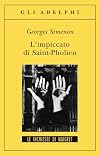
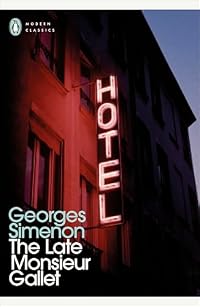
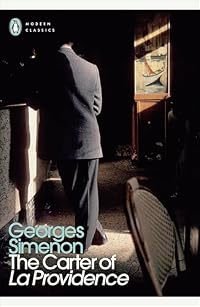
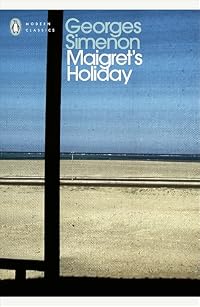
See photograph at https://loeildelaphotographie.com/wp-content/uploads/2018/10/%C2%A9-Harry-Gruyae...
Photography by Harry Gruyaert for Magnum Photos, of which a portion is used for the new Penguin show more Classics cover of "The Hanged Man of Saint-Pholien." Image sourced from L'oeil de la Photographie.
As unorthodox as "The Late Monsieur Gallet", the previous entry in the series was, Georges Simenon (1903-1989) takes even more risks in this one. One of the first English translations even titled it as "The Crime of Inspector Maigret" in 1932. The opening has Maigret following a suspicious character who he sees mailing money as 'printed matter.' When the suspect buys a cheap suitcase, Maigret buys an identical one. He then continues to follow and has an opportunity to switch suitcases. Arriving at a hotel with the suspect, he finds the purloined suitcase only contains a bloodied old suit and the suspect has committed suicide after discovering he has been robbed. What to do now?
Maigret sets out to unravel the background to the suicide and gradually unveils a conspiracy that dates back 10 years. He is confounded in that pre-internet age by one of the conspirators going around town and destroying any item in any newspaper archive that would reveal incidents at a certain time and place. But Maigret will not stop until all is revealed.
In order to confuse the completists, this is Maigret #3 in the Penguin Classics series of new translations (2013-2019) of the Inspector Maigret novels and short stories, but it is considered #4 according to the previous standard Inspector Maigret chronology.
Trivia and Links
The Hanged Man of Saint-Pholien, under its original French title Le pendu de Saint-Pholien, was adapted for French television in 1981 as Episode 48 of Les enquêtes du commissaire Maigret (The Investigations of Commissioner Maigret) (1967-1990) with Jean Richard as Inspector Maigret.
There is an article about the Penguin Classics re-translations of the Inspector Maigret novels at Maigret, the Enduring Appeal of the Parisian Sleuth by Paddy Kehoe, RTE, August 17, 2019. show less
Review of the Penguin Classics paperback (2014) of a new translation by Linda Coverdale from the French language original "Le Pendu de Saint-Pholien" (1931)
"You know, vieux, ten more cases like that one and I'll hand in my resignation. Because it would prove that there's a good old Good Lord up there who's decided to take up police work." - Chief Inspector Maigret to his vieux (Untranslated French expression for 'old chum', 'old pal') Inspector Lucas towards the conclusion of The Hanged Man of Saint-Pholien.
See photograph at https://loeildelaphotographie.com/wp-content/uploads/2018/10/%C2%A9-Harry-Gruyae...
Photography by Harry Gruyaert for Magnum Photos, of which a portion is used for the new Penguin show more Classics cover of "The Hanged Man of Saint-Pholien." Image sourced from L'oeil de la Photographie.
As unorthodox as "The Late Monsieur Gallet", the previous entry in the series was, Georges Simenon (1903-1989) takes even more risks in this one. One of the first English translations even titled it as "The Crime of Inspector Maigret" in 1932. The opening has Maigret following a suspicious character who he sees mailing money as 'printed matter.' When the suspect buys a cheap suitcase, Maigret buys an identical one. He then continues to follow and has an opportunity to switch suitcases. Arriving at a hotel with the suspect, he finds the purloined suitcase only contains a bloodied old suit and the suspect has committed suicide after discovering he has been robbed. What to do now?
Maigret sets out to unravel the background to the suicide and gradually unveils a conspiracy that dates back 10 years. He is confounded in that pre-internet age by one of the conspirators going around town and destroying any item in any newspaper archive that would reveal incidents at a certain time and place. But Maigret will not stop until all is revealed.
In order to confuse the completists, this is Maigret #3 in the Penguin Classics series of new translations (2013-2019) of the Inspector Maigret novels and short stories, but it is considered #4 according to the previous standard Inspector Maigret chronology.
Trivia and Links
The Hanged Man of Saint-Pholien, under its original French title Le pendu de Saint-Pholien, was adapted for French television in 1981 as Episode 48 of Les enquêtes du commissaire Maigret (The Investigations of Commissioner Maigret) (1967-1990) with Jean Richard as Inspector Maigret.
There is an article about the Penguin Classics re-translations of the Inspector Maigret novels at Maigret, the Enduring Appeal of the Parisian Sleuth by Paddy Kehoe, RTE, August 17, 2019. show less
The fourth Maigret novel, in which Simenon stretches our credulity rather too far by having Maigret pursue an investigation (a) where there is no convincing reason to believe that any crime has been committed and (b) in a foreign country. So not the greatest crime story technically, but he makes up for that with a splendidly dramatic finale and some fascinating glimpses into early-20th century student life in Liège - the city where Simenon himself grew up.
It all boils down to the usual Simenon idea of the painfully thin line between bourgeois respectability and the disordered world of crime, and this isn't his most elegant statement of it, but it is an early hint of the sort of writing he could be capable of when he went a bit beyond show more the limits of the genre. It isn't quite the Simenon of L’homme qui regardait passer les trains yet, but it's a step on the way. show less
It all boils down to the usual Simenon idea of the painfully thin line between bourgeois respectability and the disordered world of crime, and this isn't his most elegant statement of it, but it is an early hint of the sort of writing he could be capable of when he went a bit beyond show more the limits of the genre. It isn't quite the Simenon of L’homme qui regardait passer les trains yet, but it's a step on the way. show less
While visiting Liege, Belgium, on business Maigret spots an obviously impoverished man parcelling up a large amount of cash and posting it. On a whim Maigret follows him and sees the man commit suicide. A small group of men take an interest in the man's death without having any obvious connection to him. Out of his natural jurisdiction, Maigret nevertheless pursues the case to a very strange conclusion.
A not very typical Maigret story. The crime itself is a very elusive one. The 'hanged man' of the title does not play that great a part in the story. Maigret seems very detached from events, as if he was only half-interested in finding out what happened and who was responsible. The ending is an exercise in philosophy more than the show more satisfactory arrest of a criminal.
The key to this book is the writing and language (thanks to Linda Coverdale, the translator) where Simenon describes rather matter-of-factly events, journeys and lives that seem far outside our experience today. The narrative pulls us along, but the overall feel is not so much whodunnit as what exactly has happened. show less
A not very typical Maigret story. The crime itself is a very elusive one. The 'hanged man' of the title does not play that great a part in the story. Maigret seems very detached from events, as if he was only half-interested in finding out what happened and who was responsible. The ending is an exercise in philosophy more than the show more satisfactory arrest of a criminal.
The key to this book is the writing and language (thanks to Linda Coverdale, the translator) where Simenon describes rather matter-of-factly events, journeys and lives that seem far outside our experience today. The narrative pulls us along, but the overall feel is not so much whodunnit as what exactly has happened. show less
Members
- Recently Added By
Lists

Books mentioned in Julian Symons’ Bloody Murder
438 works; 6 members

Books Read in 2024
4,623 works; 126 members

Reading LIst
648 works; 1 member
Author Information

1,313+ Works 62,658 Members
The prolific Belgian-born writer Georges Simenon produced hundreds of fictional works under his own name and 17 pseudonyms, in addition to more than 70 books about Inspector Maigret, long "the favorite sleuth of highbrow detective-story readers" (SR). More than 50 "Simenons" have been made into films. In addition to his mystery stories, he wrote show more what he called "hard" books, the serious psychological novels numbering well over 100. The autobiographical Pedigree, set in his native town of Liege, is perhaps his finest work. The publication of Simenon's intimate memoirs also attracted considerable attention. Simenon himself once said that he would never write a "great novel." Yet Gide called him "a great novelist, perhaps the greatest and truest novelist we have in French literature today," and Thornton Wilder (see Vol. 1) found that Simenon's narrative gift extends "to the tips of his fingers." The following are some of Simenon's novels, exclusive of the Maigret detective stories, that are in print. (Bowker Author Biography) Georges Simenon was born on February 13, 1903 in Liege, Belgium. He wrote more than 200 fiction works under 16 different pseudonyms. His first book, The Case of Peter the Lent led to 80 more of the like including the main character, Inspector Maigret. He published over 400 books that were translated into 50 different languages and sold by the millions. He also wrote psychological novels, including The Man Who Watched the Train Go By. He died on September 4, 1989 in Lausanne. (Bowker Author Biography) show less
Some Editions
Series

Belongs to Publisher Series
Work Relationships
Common Knowledge
- Canonical title
- The Hanged Man of Saint-Pholien
- Original title
- Le Pendu de Saint-Pholien
- Alternate titles
- The Crime of Inspector Maigret; Maigret and the Hundred Gibbets
- Original publication date
- 1931-02; 1932 (in English) (in English)
- People/Characters
- Jules Maigret; Louis Jeunet; Joseph Van Damme; Maurice Belloir; Jef Lombard; Gaston Janin (show all 13); Armand Lecocq d'Arneville; Jeanne Jeunet; André Lucas; Jean Lecocq d'Arneville; Louise Maigret; Émile Klein; Willy Mortier
- Important places
- Bremen, Germany; Liège, Liège, Belgium; Paris, France; 36 Quai des Orfèvres, Paris, Île-de-France, France; Rheims, France; Luzancy, Seine-et-Marne, Île-de-France, France (show all 7); Boulevard Richard-Lenoir, Paris, France
- Important events*
- Suicide de Louis Jeunet
- First words
- No one noticed what was going on.
No one noticed what was happening.
(Coverdale translation) - Last words
- (Click to show. Warning: May contain spoilers.)"What's the news back at H.Q.?..."
- Original language
- French
- Disambiguation notice
- In the French original, Le pendu de Saint-Pholien (1931).
Variously published in English as:
(i) The Crime of Inspector Maigret (1932), and in Introducing Inspector Maigret (1933) ... (show all)(trans. Anthony Abbot);
(ii) Maigret and the Hundred Gibbets (1963), and in Maigret Meets a Milord (1983) (trans. Tony White);
(iii) The Hanged Man of Saint-Pholien (2014) (trans. Linda Coverdale).
*Some information comes from Common Knowledge in other languages. Click "Edit" for more information.
Classifications
Statistics
- Members
- 834
- Popularity
- 32,735
- Reviews
- 36
- Rating
- (3.65)
- Languages
- 13 — Catalan, Danish, Dutch, English, Estonian, Finnish, French, German, Italian, Norwegian (Bokmål), Portuguese, Spanish, Swedish
- Media
- Paper, Audiobook, Ebook
- ISBNs
- 45
- UPCs
- 1
- ASINs
- 21