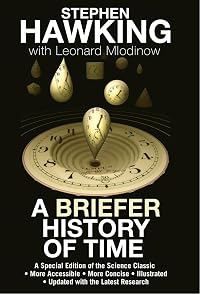
A Briefer History of Time
by Stephen Hawking, Leonard Mlodinow
There is 1 current discussion about this work.
On This Page
Description
In the years since the publication of Hawking's A Brief History of Time, readers have repeatedly told Hawking of their great difficulty in understanding some of the book's most important concepts. This is the reason for A Briefer History: his wish to make its content more accessible to readers--as well as to bring it up-to-date with the latest scientific observations and findings. Purely technical concepts, such as the mathematics of chaotic boundary conditions, are gone. Conversely, show more subjects of wide interest that have now been given entire chapters of their own, including relativity, curved space, and quantum theory. This reorganization has allowed the authors to expand areas of recent progress, from string theory to exciting developments in the search for a unified theory of all the forces of physics.--From publisher description. show lessTags
Recommendations


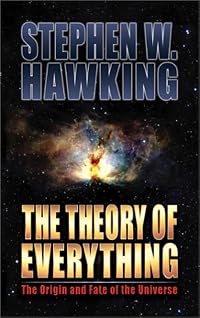

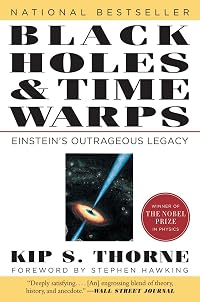




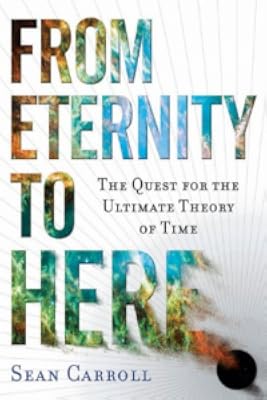
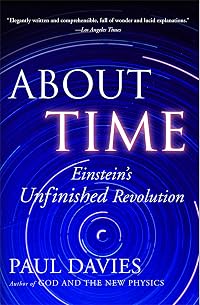
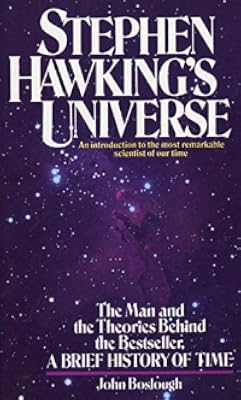
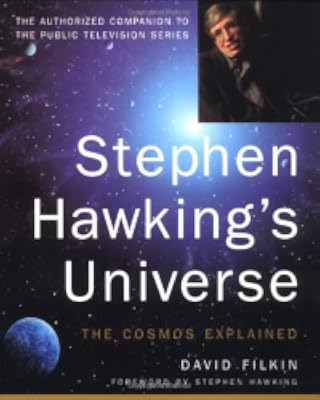





Member Recommendations
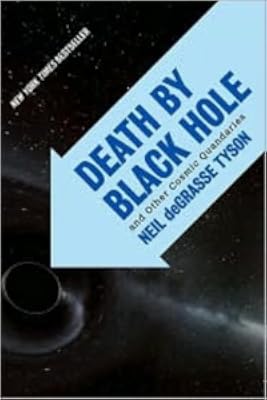
Bad Astronomy : Misconceptions and Misuses Revealed, from Astrology to the Moon Landing "Hoax" by Philip Plait
ElBarto Ein weiteres gut gemachtes und deutlich humorvolleres Einführungswerk für Menschen, die sich für Astronomie interessieren.
Member Reviews
First read, I grasped more than I thought I would, a part of this is down to my own journey in books of trying to get here, the other part is how this book explains things; when it says in numerals ten-to the powertwenty-four it doesn’t assume the reader knows and explains in brackets that this means one with twenty-four zeros (I know one-million has 6 so this number I couldn’t even imagine). And right throughout it’s not taken for granted that I will be able to follow what it says, frequently everyday relatable examples are used to demonstrate the point further. This helped as there is a lot to take in; like my understanding of time (with its explanation of absolute time), or seeing the progression of how ideas changed from being show more geocentric to quantum mechanics. So, there was a lot here I couldn't follow but I am going to read more books and then come back to this one to read again.
It feels really good to finally read this, I got this book 6 years ago, a year after getting [A Brief History of Time], the book I’ve been wanting to read. My rating is more a reflection of where I am with this book rather than this book itself. I always thought this would be a challenging read and it is, it’s not reading this that’s challenging, what’s challenging is to see the world, or rather the universe, in terms that this book proposes but are not familiar to me. show less
It feels really good to finally read this, I got this book 6 years ago, a year after getting [A Brief History of Time], the book I’ve been wanting to read. My rating is more a reflection of where I am with this book rather than this book itself. I always thought this would be a challenging read and it is, it’s not reading this that’s challenging, what’s challenging is to see the world, or rather the universe, in terms that this book proposes but are not familiar to me. show less
This is an excellent book about the nature of the universe, space-time, and the history of our understanding of the laws of nature. Hawking makes difficult concepts easy to understand. His explanation of the theories of Aristotle, Newton and Einstein, and the everything in between, are superb. My only issue is that he gets bogged down at the end of the book, writing about the search for a unified theory of everything. He mentions concepts without explaining well - such as the weak nuclear force and renormalization, while talking of superfluous details of the publishing of discarded theories like supergravity. I understand that concepts of string theory are still in flux and are difficult to grasp. However I feel the writing could have show more used some more focus and clarity. I feel that Michio Kaku succeeded in explaining string theory better in "Physics of The Impossible". show less
As its name suggests, this is a shorter, and less technical, version of the great scientist's most famous work, which I have read to mark his recent passing. It covers in fairly crisp form the main historical developments in our understanding of the history of the universe, and the nature of time and space, and sub-atomic physics. In places, it still got a bit too technical for a lay reader like me, but for the most part offered a fairly easily digestible summary of some mind-blowing theories and chains of reasoning. This is mind-expanding stuff, that puts our concerns on planet Earth into a unique perspective. The diagrams I thought were not very good, though.
Needless to say Hawking is brilliant; but he takes it to another level by not only carefully explaining the areas of relativity and quantum mechanics in a way we can understand; he adds valuable yet humorous illustrations. While its not "Dr Suess does Cosmology" its far and away more approachable than other books on the topic. Personally I love learning new things and areas like String theory have been the most difficult. That said, I feel I have a far better grasp on these two areas after having read this book.
Renowned astrophysicist Stephen Hawking provides a concise follow-up to his best-selling "A Brief History of Time" in this slim volume. He boils it down to the most essential concepts pertaining to scientific understanding of the universe, space and time from the ancient Greeks to the present. I must concede that I learned at least 90% of this material in high school physics class, still, Hawking presents it the material in a fresh, witty way and has included more recent theories.
Hawking gives a cogent summary of the essential points of Einstein's theory of relativity, as well as the quantum mechanics of Planck and others. The prose is highly readable to general audiences without being dumbed down- which is a formidable task within show more itself. Unlike his "Brief History of Time" which reads like a wonkish college course in astrophysics or cosmology, "A Briefer History of Time" is readily accessible to non-scientific readers. He also incorporates some more recent theories and discoveries, including developments in string theory and others.
I highly recommend this book to any general reader looking for a fascinating, concise crash course on the space-time continuum and the essential scientific underpinnings to how the universe functions and evolves. If you want the wonkish details and to delve deeper into the technical science, I also recommend the original "A Brief History of Time." show less
Hawking gives a cogent summary of the essential points of Einstein's theory of relativity, as well as the quantum mechanics of Planck and others. The prose is highly readable to general audiences without being dumbed down- which is a formidable task within show more itself. Unlike his "Brief History of Time" which reads like a wonkish college course in astrophysics or cosmology, "A Briefer History of Time" is readily accessible to non-scientific readers. He also incorporates some more recent theories and discoveries, including developments in string theory and others.
I highly recommend this book to any general reader looking for a fascinating, concise crash course on the space-time continuum and the essential scientific underpinnings to how the universe functions and evolves. If you want the wonkish details and to delve deeper into the technical science, I also recommend the original "A Brief History of Time." show less
Dumbed-down (and updated) rewrite of the original (1988) _Brief History of Time_ bestseller. I don't think the original book, when compared with many other popular-science books, was anywhere near as impenetrable as it is commonly said to be. (The complainers ought to look at Penrose's _Road to Reality_ to see what *real* toughness is like.) This kind of bleating about incomprehensibility arises, I think, only when bestsellerdom and author celebrity are factors. If the new little book succeeds in teaching the masses a smidgen of fundamental physics and cosmology, I say bravo.
If you're thinking of reading A Brief History of Time, read this first. At least if you're a total civilian, which I am.
My son and I read this together. We did have to hit the Internet pretty hard a few times to get clarification on some critical points; but all in all, this is a well-written, accessible introduction to some pretty heady stuff.
I would recommend having the basics of atomic structure and the life cycles of stars under your belt before giving this a go. Also, it really helped my son and me to resign ourselves to not being able to visualize certain concepts. Wave-particle duality is just plain weird, and I think it helps to do the best you can and ultimately just go with it, rather than struggling to fit this contradictory show more idea into a conventional kind of "making sense."
And now: on to The Illustrated A Brief History of Time (expanded and updated edition)! show less
My son and I read this together. We did have to hit the Internet pretty hard a few times to get clarification on some critical points; but all in all, this is a well-written, accessible introduction to some pretty heady stuff.
I would recommend having the basics of atomic structure and the life cycles of stars under your belt before giving this a go. Also, it really helped my son and me to resign ourselves to not being able to visualize certain concepts. Wave-particle duality is just plain weird, and I think it helps to do the best you can and ultimately just go with it, rather than struggling to fit this contradictory show more idea into a conventional kind of "making sense."
And now: on to The Illustrated A Brief History of Time (expanded and updated edition)! show less
Members
- Recently Added By
Lists

Northern Exposure's Chris in the Morning Reading List
31 works; 1 member

Books Read in 2007
326 works; 8 members

Ambleside Year 8
80 works; 1 member

Read in 2007
55 works; 1 member
Talk Discussions
Current Discussions
Reading A Briefer History of Time by Stephen Hawking & More in Journey In Books (June 27)
Author Information

133+ Works 54,828 Members
Stephen William Hawking was born in Oxford, England on January 8, 1942. He received a first class honors degree in natural science from Oxford University and a Ph.D. from Cambridge University. He was a theoretical physicist and has held the post of Lucasian Professor of Mathematics at Cambridge University from 1982 until his death. In 1974, he was show more elected a Fellow of the Royal Society, the world's oldest scientific organization. In 1963, he learned he had amyotrophic lateral sclerosis, a neuromuscular wasting disease also known as Lou Gehrig's disease. The disease confined him to a wheelchair and reduced his bodily control to the flexing of a finger and voluntary eye movements, but left his mental faculties untouched. He became a leader in exploring gravity and the properties of black holes. He wrote numerous books including A Brief History of Time: From the Big Bang to Black Holes, Black Holes and Baby Universes, On the Shoulders of Giants, A Briefer History of Time, The Universe in a Nutshell, The Grand Design, and Brief Answers to the Big Questions. In 1982, he was named a commander of the British Empire. A film about his life, The Theory of Everything, was released in 2014 and was based on his first wife Jane Hawking's book Traveling to Infinity: My Life with Stephen. He died on March 14, 2018 at the age of 76. (Bowker Author Biography) show less

20+ Works 13,944 Members
Leonard Mlodinow was born in Chicago, Illinois, in 1954. He received bachelor's degrees in math and physics and a master's degree in physics from Brandeis University and a PhD in theoretical physics from the University of California, Berkeley. He was a Bantrell Research Fellow in Theoretical Physics at the California Institute of Technology, and show more then became an Alexander von Humboldt fellow at the Max-Planck-Institute for Physics and Astrophysics in Munich, Germany. In the 1980s, he wrote for numerous television shows including MacGyver, Star Trek: the Next Generation, and Night Court. In 1993, he decided to switch to computer gaming and became producer, executive producer and designer of several award-winning games. From 1997 to 2003, he was the vice president for software development and then vice president and publisher for math education at Scholastic Inc. In 2005, he began teaching at the California Institute of Technology. He is now a full-time writer. His books include Euclid's Window, Feynman's Rainbow, A Briefer History of Time with Stephen Hawking, The Drunkard's Walk, The Grand Design with Stephen Hawking, and War of the Worldviews with Deepak Chopra. He has also written two children's books with Matt Costello: The Last Dinosaur and Titanic Cat. (Bowker Author Biography) show less
Some Editions
Awards and Honors
Notable Lists
Work Relationships
Is abridged in
Common Knowledge
- Canonical title
- A Briefer History of Time
- Original title
- A Briefer History of Time
- Original publication date
- 2005
- First words
- We live in a strange and wonderful universe.
- Last words
- (Click to show. Warning: May contain spoilers.)If we find the answer to that, it would be the ultimate triumph of human reason—for then we would know the mind of God.
- Original language
- English
Classifications
Statistics
- Members
- 2,787
- Popularity
- 6,566
- Reviews
- 45
- Rating
- (4.02)
- Languages
- 14 — English, French, German, Hungarian, Italian, Latvian, Malayalam, Norwegian (Bokmål), Polish, Russian, Spanish, Turkish, Portuguese (Portugal), Chinese, traditional
- Media
- Paper, Audiobook, Ebook
- ISBNs
- 56
- ASINs
- 18