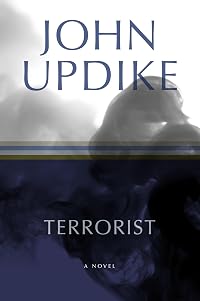
Terrorist
by John Updike
On This Page
Description
Ahmad, threatened by the hedonistic society around him, gets involved in a plot, with reverberations that rouse the Department of Homeland Security.Tags
Recommendations








Member Recommendations
Member Reviews
TERRORIST (2006) is the first Updike novel I have read in several years, and it was his last. (He died in January 2009.) It is a book quite unlike his previous novels in that it could easily be classified a "suspense-thriller," not a label I would ever have assigned to an Updike novel before. But here it is, an absolute page-turner, with the usual Updike eloquence and meticulous attention to the smallest of details. Updike also seems to have abandoned his usual Pennsylvania and New England settings and stepped over into Philip Roth country, setting his story in northern New Jersey and creating a memorable protagonist/anti-hero in sixty-ish high school counselor Jack Levy, a disillusioned secular Jew. But make no mistake, the result is show more still pure Updike, particularly in its depictions of sexual situations.
Ahmad, the product of an Irish-American mother and an absent Egyptian father, is a youthful protagonist you will not soon forget. His self-chosen and atypical 'uniform' of starched white shirt and black jeans is perhaps representative of his black-and-white view of right and wrong and the glaring disparity between his islamic "straight path" and the godless ways of the infidels that surround him. Fatherless, brotherless, and all but motherless, Ahmad has been instructed in the Koran from the age of eleven by a shady imam in a shabby store-front mosque. Ripe for the picking, he is recruited as a soldier in the jihad. And here's the thing: Updike has constructed a precise narrative that seeks to explain and understand exactly how a jihadist - a terrorist - is born. And he succeeds admirably, because Ahmad is certainly not a monster. He is a flesh-and-blood young man who simply wants to do what is right and good. As opposed to all the evil, greed, and vice he sees all around him. He is coached by his closest mentor, Charlie Chehab, in how the "jihad and the [American] Revolution waged the same kind of war ... the desperate and vicious war of the underdog ..." and "One revolution led to another ... Revolution never stops."
Updike peppers his narrative with quotes from the Koran, in its original Arabic, with English explanations, as supplied by Ahmad's imam and as Ahmad himself interprets them. Ahmad learns of the Prophet Mohammed astride a white horse, and Ahmad's own vehicle of vengeance is a white truck carrying a deadly payload.
But enough. Filled with suspense, filled with trademark John Updike craftsmanship. A new and odd combination, but it works perfectly. Be prepared to read late into the night, because TERRORIST will keep you up, turning those pages, wondering ... This may have been Updike's last novel, but it shows him at the peak of his writing powers. I miss him. Very highly recommended. show less
Ahmad, the product of an Irish-American mother and an absent Egyptian father, is a youthful protagonist you will not soon forget. His self-chosen and atypical 'uniform' of starched white shirt and black jeans is perhaps representative of his black-and-white view of right and wrong and the glaring disparity between his islamic "straight path" and the godless ways of the infidels that surround him. Fatherless, brotherless, and all but motherless, Ahmad has been instructed in the Koran from the age of eleven by a shady imam in a shabby store-front mosque. Ripe for the picking, he is recruited as a soldier in the jihad. And here's the thing: Updike has constructed a precise narrative that seeks to explain and understand exactly how a jihadist - a terrorist - is born. And he succeeds admirably, because Ahmad is certainly not a monster. He is a flesh-and-blood young man who simply wants to do what is right and good. As opposed to all the evil, greed, and vice he sees all around him. He is coached by his closest mentor, Charlie Chehab, in how the "jihad and the [American] Revolution waged the same kind of war ... the desperate and vicious war of the underdog ..." and "One revolution led to another ... Revolution never stops."
Updike peppers his narrative with quotes from the Koran, in its original Arabic, with English explanations, as supplied by Ahmad's imam and as Ahmad himself interprets them. Ahmad learns of the Prophet Mohammed astride a white horse, and Ahmad's own vehicle of vengeance is a white truck carrying a deadly payload.
But enough. Filled with suspense, filled with trademark John Updike craftsmanship. A new and odd combination, but it works perfectly. Be prepared to read late into the night, because TERRORIST will keep you up, turning those pages, wondering ... This may have been Updike's last novel, but it shows him at the peak of his writing powers. I miss him. Very highly recommended. show less
Deciding whether Updike succeeded in portraying a complicated development of a terrorist, or if he merely expressed a cliché and gave it stereotypical life, the weight of my feeling hedges toward the later. My uncertainty arises due to his well developed tone of sarcasm and irony with which he populates the novel, perhaps overpopulates. Though an intriguing representation of hysteria and fear pervasive after 9/11, I wonder if his intention does not become muddled in the disdain he evinces toward his main character, indeed, most of his characters.
While reading about Ahmad and his mixed ethnic upbringing, his rather flighty mother, the high school counselor with decent intentions and a wandering eye, and the rapaciously stereotyped show more mullah, I could not shake Updike's pejorative presentation of them and the events to which they subscribe, collude, and surrender. Perhaps this falls entirely within Updike's plan, to build a distance from the characters, but it provoked a less involved and less interested reading from me. I longed to have some measure of sympathy for Ahmad, despite the stupidity and gullibility of his youth, even a fraction of a desire to slap him upside the head would have been better than the indifference I felt.
The thread of Ahmad's fanaticism and objection to the sybaritic consumerism of his American home and surroundings was also tantalizingly insufficient; Updike had the opportunity to offer scathing reproach through Ahmad, and instead it felt merely like the whining of a spoiled child, an insouciant attempt to proffer justification for Ahmad's later actions. Without this involvement of character I felt like the novel was a hollow platform to criticize attitudes toward terrorist activity, edging precariously near racist propaganda, lacking the strident support of satire, the subtle nudge and wink to let the reader become aware of the hypocritical nature of most terrorist discourse. show less
While reading about Ahmad and his mixed ethnic upbringing, his rather flighty mother, the high school counselor with decent intentions and a wandering eye, and the rapaciously stereotyped show more mullah, I could not shake Updike's pejorative presentation of them and the events to which they subscribe, collude, and surrender. Perhaps this falls entirely within Updike's plan, to build a distance from the characters, but it provoked a less involved and less interested reading from me. I longed to have some measure of sympathy for Ahmad, despite the stupidity and gullibility of his youth, even a fraction of a desire to slap him upside the head would have been better than the indifference I felt.
The thread of Ahmad's fanaticism and objection to the sybaritic consumerism of his American home and surroundings was also tantalizingly insufficient; Updike had the opportunity to offer scathing reproach through Ahmad, and instead it felt merely like the whining of a spoiled child, an insouciant attempt to proffer justification for Ahmad's later actions. Without this involvement of character I felt like the novel was a hollow platform to criticize attitudes toward terrorist activity, edging precariously near racist propaganda, lacking the strident support of satire, the subtle nudge and wink to let the reader become aware of the hypocritical nature of most terrorist discourse. show less
From: John Updike: His Novel Evokes Feelings of Sept. 11 Tragedy
http://wp.me/p14mpp-dH
John Updike has written an evocative response to the Sept. 11 tragedy in New York. It is my favorite of the many novels spawned by the attack. I re-read the book this week, not in memory of 9/11, but as a ‘book of the our times.’ In that sense, I found it thoughtful and to the point—A book about the inner city and the problems faced by young people as they cope with the environment they are given.
I think that this is a brilliant novel that ranks among the most provocative of his distinguished career. It is the story of an alienated American teenager who spurns the materialistic life he witnesses in the New Jersey town where he lives (Updike show more modeled it on Patterson, NJ). He turned to the words of the Holy Qur'an as expounded to him by his imam. Ahmad devotes himself fervently to God, but gets recruited into terrorism. He could easily have been recruited into the Peace Corps to serve in a Muslim country, but he wasn't.
Updike’s novel seems to raise more questions that it answers, but it is definitely worth reading. show less
http://wp.me/p14mpp-dH
John Updike has written an evocative response to the Sept. 11 tragedy in New York. It is my favorite of the many novels spawned by the attack. I re-read the book this week, not in memory of 9/11, but as a ‘book of the our times.’ In that sense, I found it thoughtful and to the point—A book about the inner city and the problems faced by young people as they cope with the environment they are given.
I think that this is a brilliant novel that ranks among the most provocative of his distinguished career. It is the story of an alienated American teenager who spurns the materialistic life he witnesses in the New Jersey town where he lives (Updike show more modeled it on Patterson, NJ). He turned to the words of the Holy Qur'an as expounded to him by his imam. Ahmad devotes himself fervently to God, but gets recruited into terrorism. He could easily have been recruited into the Peace Corps to serve in a Muslim country, but he wasn't.
Updike’s novel seems to raise more questions that it answers, but it is definitely worth reading. show less
Starred Review. Ripped from the headlines doesn't begin to describe Updike's latest, a by-the-numbers novelization of the last five years' news reports on the dangers of home-grown terror that packs a gut punch. Ahmad Mulloy Ashmawy is 18 and attends Central High School in the New York metro area working class city of New Prospect, N.J. He is the son of an Egyptian exchange student who married a working-class Irish-American girl and then disappeared when Ahmad was three. Ahmad, disgusted by his mother's inability to get it together, is in the thrall of Shaikh Rashid, who runs a storefront mosque and preaches divine retribution for "devils," including the "Zionist dominated federal government." The list of devils is long: it includes show more Joryleen Grant, the wayward African-American girl with a heart of gold; Tylenol Jones, a black tough guy with whom Ahmad obliquely competes for Joryleen's attentions (which Ahmad eventually pays for); Jack Levy, a Central High guidance counselor who at 63 has seen enough failure, including his own, to last him a lifetime (and whose Jewishness plays a part in a manner unthinkable before 9/11); Jack's wife, Beth, as ineffectual and overweight (Updike is merciless on this) as she is oblivious; and Teresa Mulloy, a nurse's aide and Sunday painter as desperate for Jack's attention, when he takes on Ahmad's case, as Jack is for hers. Updike has distilled all their flaws to a caustic, crystalline essence; he dwells on their poor bodies and the debased world in which they move unrelentingly, and with a dispassionate cruelty that verges on shocking. Ahmad's revulsion for American culture doesn't seem to displease Updike one iota. But Updike has also thoroughly digested all of the discursive pap surrounding the post-9/11 threat of terrorism, and that is the real story here. Mullahs, botched CIA gambits, race and class shame (that leads to poor self-worth that leads to vulnerability that leads to extremism), half-baked plots that just might work-all are here, and dispatched with an elegance that highlights their banality and how very real they may be. So smooth is Updike in putting his grotesques through their paces-effortlessly putting them in each others' orbits-that his contempt for them enhances rather than spoils the novel. show less
Updike is one of my favorite authors of all time. I have 323 books by, about, or containing a work by him and literally thousands of magazines in which he has appeared. The fact that I have not read anything except magazine appearances by him in a while desperately needs remedying. I will not be away so long again.
No one writing today can fashion and shape language the way John Updike can. To me, he is The Master wordsmith of the last fifty years. His essays, his book reviews, his poetry, his short stories, and his novels spin webs of incredible beauty with deep insights and characters as finely drawn and accurate as any ever written. His prose is so graceful, the reader is carried along to places never visited, to characters never met, show more to situations unimaginable, with the ease of an early morning walk as the eastern sky grows pink and a soft breeze cools the face.
Terrorist is such a story. The reader is taken on a ride in a truck driven by a misguided, manipulated young man, who is determined to wreak vengeance on people he does not know, because he has been convinced the strangers he kills have stolen his God.
Early in the novel, the third-person narrator reveals something about the angry young man. Updike writes:
"Ahmad knows it is a sin to be vain of his appearance: self-love is a form of competition with God, and competition is what He cannot abide. But how can the boy not cherish his ripened manhood, his lengthened limbs, the upright, dense, and wavy crown of his hair, his flawless dun skin, paler than his father’s but not freckled, blotchy pink of his red-haired mother and those peroxided blondes who in white-bread America are considered the acme of beauty?” (18).
In the unlikely event that nothing else happens while reading this novel, it will force any one with a shred of heart or soul to closely examine our culture, what it values, and how we treat each other.
Updike also anoints unlikely characters as heroes in the epic sense -- disillusioned, semi-failed, lost souls searching for some light at the end of the dark tunnels which are their lives. At first, these individuals seem to be mere dressing, a bit of bright ribbon on a dull coat or shirt. But Updike brings them along with the reader, and in the end they all find something, even if it was not what they were seeking.
In the early pages of the novel, I felt a bit frustrated because of many the Arabic words and phrases which were not translated. Only a few could be worked out from the context; however, as I read on, I realized Updike was deliberately wrapping Islam in a shroud to keep it as mysterious as it is in real life. How can we understand the anger, the hatred of the fanatical jihadist who believes in a God that will welcome a martyr with 72 “houris” at the instant of death. They believe this God is as close to them as "the veins in their necks."
I don’t pretend to understand any of this after reading Terrorist, but I could feel the anger, the hatred, and the devout belief in an religion that promises the best of everything after a life that offers the worst of everything. This is the same message which fixed the grip of the Catholic Church on the hapless, ignorant peasants of the Middle Ages. The scary thing is these characters are not ignorant and not hapless. Perhaps that is the greatest danger of all. A perfect novel! Unqualified five stars.
--Jim, 7/27/08 show less
No one writing today can fashion and shape language the way John Updike can. To me, he is The Master wordsmith of the last fifty years. His essays, his book reviews, his poetry, his short stories, and his novels spin webs of incredible beauty with deep insights and characters as finely drawn and accurate as any ever written. His prose is so graceful, the reader is carried along to places never visited, to characters never met, show more to situations unimaginable, with the ease of an early morning walk as the eastern sky grows pink and a soft breeze cools the face.
Terrorist is such a story. The reader is taken on a ride in a truck driven by a misguided, manipulated young man, who is determined to wreak vengeance on people he does not know, because he has been convinced the strangers he kills have stolen his God.
Early in the novel, the third-person narrator reveals something about the angry young man. Updike writes:
"Ahmad knows it is a sin to be vain of his appearance: self-love is a form of competition with God, and competition is what He cannot abide. But how can the boy not cherish his ripened manhood, his lengthened limbs, the upright, dense, and wavy crown of his hair, his flawless dun skin, paler than his father’s but not freckled, blotchy pink of his red-haired mother and those peroxided blondes who in white-bread America are considered the acme of beauty?” (18).
In the unlikely event that nothing else happens while reading this novel, it will force any one with a shred of heart or soul to closely examine our culture, what it values, and how we treat each other.
Updike also anoints unlikely characters as heroes in the epic sense -- disillusioned, semi-failed, lost souls searching for some light at the end of the dark tunnels which are their lives. At first, these individuals seem to be mere dressing, a bit of bright ribbon on a dull coat or shirt. But Updike brings them along with the reader, and in the end they all find something, even if it was not what they were seeking.
In the early pages of the novel, I felt a bit frustrated because of many the Arabic words and phrases which were not translated. Only a few could be worked out from the context; however, as I read on, I realized Updike was deliberately wrapping Islam in a shroud to keep it as mysterious as it is in real life. How can we understand the anger, the hatred of the fanatical jihadist who believes in a God that will welcome a martyr with 72 “houris” at the instant of death. They believe this God is as close to them as "the veins in their necks."
I don’t pretend to understand any of this after reading Terrorist, but I could feel the anger, the hatred, and the devout belief in an religion that promises the best of everything after a life that offers the worst of everything. This is the same message which fixed the grip of the Catholic Church on the hapless, ignorant peasants of the Middle Ages. The scary thing is these characters are not ignorant and not hapless. Perhaps that is the greatest danger of all. A perfect novel! Unqualified five stars.
--Jim, 7/27/08 show less
Terrorist is the story of a disaffected 18 year old Arab-American who slowly and inexorably gets caught up in a terror plot. While a fascinating portrait of alienation and a sharp social critique, there are some jarring elements to the novel that brought one out of the story and diminished what was otherwise a very good, suspenseful tale and a timely exploration of disaffection and the search for belonging.
Starred Review. Ripped from the headlines doesn't begin to describe Updike's latest, a by-the-numbers novelization of the last five years' news reports on the dangers of home-grown terror that packs a gut punch. Ahmad Mulloy Ashmawy is 18 and attends Central High School in the New York metro area working class city of New Prospect, N.J. He is the son of an Egyptian exchange student who married a working-class Irish-American girl and then disappeared when Ahmad was three. Ahmad, disgusted by his mother's inability to get it together, is in the thrall of Shaikh Rashid, who runs a storefront mosque and preaches divine retribution for "devils," including the "Zionist dominated federal government." The list of devils is long: it includes show more Joryleen Grant, the wayward African-American girl with a heart of gold; Tylenol Jones, a black tough guy with whom Ahmad obliquely competes for Joryleen's attentions (which Ahmad eventually pays for); Jack Levy, a Central High guidance counselor who at 63 has seen enough failure, including his own, to last him a lifetime (and whose Jewishness plays a part in a manner unthinkable before 9/11); Jack's wife, Beth, as ineffectual and overweight (Updike is merciless on this) as she is oblivious; and Teresa Mulloy, a nurse's aide and Sunday painter as desperate for Jack's attention, when he takes on Ahmad's case, as Jack is for hers. Updike has distilled all their flaws to a caustic, crystalline essence; he dwells on their poor bodies and the debased world in which they move unrelentingly, and with a dispassionate cruelty that verges on shocking. Ahmad's revulsion for American culture doesn't seem to displease Updike one iota. But Updike has also thoroughly digested all of the discursive pap surrounding the post-9/11 threat of terrorism, and that is the real story here. Mullahs, botched CIA gambits, race and class shame (that leads to poor self-worth that leads to vulnerability that leads to extremism), half-baked plots that just might work-all are here, and dispatched with an elegance that highlights their banality and how very real they may be. So smooth is Updike in putting his grotesques through their paces-effortlessly putting them in each others' orbits-that his contempt for them enhances rather than spoils the novel. show less
Members
- Recently Added By
Published Reviews
ThingScore 33
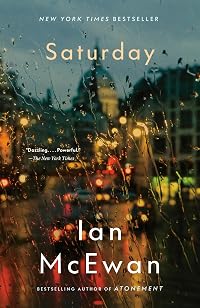
Terrorist is a more successful post-September 11 literary novel than Dead Air, Saturday, The Good Life or Extremely Loud and Incredibly Close. Perhaps more significantly, it is the best late novel from this American master, opening up a whole new intellectual territory for Updike to explore.
added by MikeBriggs
If there's anything harder to read than a pulp novelist trying to write a serious book miles above his pay grade, it is a high-brow novelist trying to write below his pay grade.
added by MikeBriggs
Unfortunately, the would-be terrorist in this novel turns out to be a completely unbelievable individual: more robot than human being and such a cliché that the reader cannot help suspecting that Mr. Updike found the idea of such a person so incomprehensible that he at some point abandoned any earnest attempt to depict his inner life and settled instead for giving us a static, one-dimensional show more stereotype. show less
added by MikeBriggs
Lists

Lucy's Long List
69 works; 1 member
Author Information

341+ Works 53,437 Members
American novelist, poet, and critic John Updike was born in Reading, Pennsylvania on March 18, 1932. He received an A.B. degree from Harvard University, which he attended on a scholarship, in 1954. After graduation, he accepted a one-year fellowship to study painting at the Ruskin School of Drawing and Fine Art in Oxford, England. After returning show more from England in 1955, he worked for two years on the staff of The New Yorker. This marked the beginning of a long relationship with the magazine, during which he has contributed numerous short stories, poems, and book reviews. Although Updike's first published book was a collection of verse, The Carpentered Hen and Other Tame Creatures (1958), his renown as a writer is based on his fiction, beginning with The Poorhouse Fair (1959). During his lifetime, he wrote more than 50 books and primarily focused on middle-class America and their major concerns---marriage, divorce, religion, materialism, and sex. Among his best-known works are the Rabbit tetrology---Rabbit, Run (1960), Rabbit Redux (1971), Rabbit Is Rich (1981), and Rabbit at Rest (1988). Rabbit, Run introduces Harry "Rabbit" Angstrom as a 26-year-old salesman of dime-store gadgets trapped in an unhappy marriage in a dismal Pennsylvania town, looking back wistfully on his days as a high school basketball star. Rabbit Redux takes up the story 10 years later, and Rabbit's relationship with representative figures of the 1960s enables Updike to provide social commentary in a story marked by mellow wisdom and compassion in spite of some shocking jolts. In Rabbit Is Rich, Harry is comfortably middle-aged and complacent, and much of the book seems to satirize the country-club set and the swinging sexual/social life of Rabbit and his friends. Finally, in Rabbit at Rest, Harry arrives at the age where he must confront his mortality. Updike won the Pulitzer Prize for both Rabbit Is Rich and Rabbit at Rest. Updike's other novels range widely in subject and locale, from The Poorhouse Fair, about a home for the aged that seems to be a microcosm for society as a whole, through The Court (1978), about a revolution in Africa, to The Witches of Eastwick (1984), in which Updike tries to write from inside the sensibilities of three witches in contemporary New England. The Centaur (1963) is a subtle, complicated allegorical novel that won Updike the National Book Award in 1964. In addition to his novels, Updike also has written short stories, poems, critical essays, and reviews. Self-Consciousness (1989) is a memoir of his early life, his thoughts on issues such as the Vietnam War, and his attitude toward religion. He was elected to the American Academy of Arts and Letters in 1977. He died of lung cancer on January 27, 2009 at the age of 76. (Bowker Author Biography) John Updike was born in 1932, in Shillington, Pennsylvania. Since 1957 he has lived in Massachusetts. His novels have won the Pulitzer Prize, the National Book Award, the National Book Critics Circle Award, & the Howells Medal. (Publisher Provided) John Updike was born in 1932 and attended Harvard College and the Ruskin School of Drawing and Fine Art in Oxford, England. Form 1955 to 1957 he was a staff member of The New Yorker, which he contributed numerous writings. Updike's art criticism has appeared in publications including Arts and Antiques, The New Republic, The New York Times Book Review, and Realites, among many others. He is the author of such best-selling novels as Rabbit Run and Rabbit is Rich. His many works of fiction, poetry and criticism have been awarded the Pulitzer Prize, the National Book Award, the American Book Award, and the National Book Critics Circle Award. For the past 40 years he has lived in Massachusetts. (Publisher Provided) John Updike is the author of some 50 books, including collections of short stories, poems, & criticism. His novels have won the Pulitzer Prize, the National Book Award, the National Book Critics Circle Award, & the Howells Medal. Born in Shillington, Pennsylvania, in 1932, he has lived in Massachusetts since 1957. (Publisher Provided) show less
Awards and Honors
Series
Belongs to Publisher Series
L'eclèctica (138)
rororo (24473)
Common Knowledge
- Canonical title*
- Terrorist
- Original title
- Terrorist
- Original publication date
- 2006
- People/Characters
- Jack Levy; Ahmad Ashmaway Mulloy
- Important places*
- New Prospect, New Jersey, USA
- Epigraph
- And now, O Lord, please take my life from me,
for it is better for me to die than to live.
And the Lord said, "Is it right for you to be
angry?"
—Jonah 4:3-4
Disbelief is more resistant than faith because it is sustained by the senses.
—Gabriel García Márquez,
Of Love and Other Demons - First words
- Devils, Ahmad thinks.
- Last words
- (Click to show. Warning: May contain spoilers.)These devils, Ahmad thinks, have taken away my God.
- Publisher's editor
- Jones, Judith
- Blurbers
- McEwan, Ian; Banville, John
*Some information comes from Common Knowledge in other languages. Click "Edit" for more information.
Classifications
Statistics
- Members
- 1,783
- Popularity
- 12,281
- Reviews
- 42
- Rating
- (3.19)
- Languages
- 21 — Catalan, Czech, Danish, Dutch, English, French, German, Galician, Hungarian, Indonesian, Italian, Lithuanian, Polish, Portuguese, Russian, Serbian, Croatian, Slovak, Spanish, Swedish, Turkish
- Media
- Paper, Audiobook, Ebook
- ISBNs
- 56
- ASINs
- 13