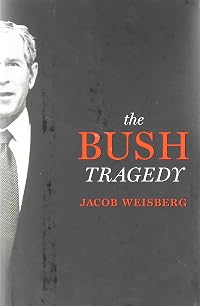
The Bush Tragedy
by Jacob Weisberg
On This Page
Description
Explores the whole Bush story, distilling all that has been previously written about Bush into a defining portrait and illuminating the fateful choices and key decisions that led George W., and thereby the country, into its current predicament.--From publisher description.Tags
Recommendations








Member Reviews
Weisberg portrays these disastrous years, with a backdrop of Shakespeare's Henry V and Prince Hal, as an over-determined perfect storm. Each chapter is another nail in the coffin: the dysfunction of the Bush family, going back generations; the oedipal and sibling conflicts of black sheep George W.; the Machiavellian deliberate divisiveness of Rove (leading to the total incompetence of government agencies with loyalists in charge) and the brutal power-mongering of Cheney (leading to the evisceration of balance of powers); the cynical use of religion; and the ultimate disaster of America's foreign policy. A book every American should read, but won't.
There is certainly no shortage of books out there conjecturing who George W. really is, and The Bush Tragedy is no exception. While Weisberg admits that only time will tell how the Bush presidency and W. the man will be viewed historically, he does make a compelling case for how he is viewed today. In short, W. is egotistical, self-righteous, and arrogant. Two passages from the book highlight those character features, and I found them intriguingly explanatory:
"Bush rejects nuance not because he's mentally incapable of engaging with it, but because he has chosen to disavow it. Applying a crude religious lens that clarifies all decisions as moral choices rather than complicated trade-offs helps him fend off the deliberation and show more uncertainty he identifies with his father." (p. 106)
and
"If all criticism is discounted as whining and accepting it equates to personal weakness, how can you ever recognize that you're wrong?" (p. 212)
The first part of the book chronicles the Bush family saga, dating back to James Smith Bush in the late 1800s, focusing on multi-generational interplay and the issues between fathers and sons that have a recurring tendency in this family. Weisberg posits the Bush family (George H.W. and George W. in particular) as similar to Shakespeare's Henry IV - Hal, a son that has let his father down, finds religion and makes something of himself while still stifling against his father's legacy. Weisberg notes that this religious awakening, in both Hal and George W., would be used more for political ends than personal salvation.
There is also a chapter dedicated to Rove and Cheney each. In these chapters, we see that W. surrounds himself with people who will reassure him in the correctness of his decisions while they urge him to create policies that inevitably help themselves. They manipulate ways of looking at events, using intimate knowledge about W.'s psychological make-up and his need to differentiate himself from his father. They have a knack for empowering the President by making him think that the ideas originated with him.
George W. also has a tendency to attempt to model himself on great historical leaders. Apparently, he reads biography upon biography of American presidents and world leaders. However, he is never consistent. When a situation arises, he will switch from one style to another, changing his doctrines on a whim. In comparing Bush to other leaders, Weisberg states:
"Where Wilson was undermined by his arrogance and Carter by his innocence, Bush's failure grew out of his incompetence and his blatant inconsistency in applying his precepts. While claiming divine mandate for the promotion of democracy abroad, he disregarded civil liberties and asserted unconstitutional authority at home." (p. 238)
I found this book to explain much about Bush in a historical context, a familial context, and in his relationships with those around him. Weisberg's conclusions and research into the presidency and the man are astute. For anyone interested in how we came to this place in the country's history, the man who led us here, and the ways in which Bush reconciles his self-assurance amidst such vociferous criticism, I highly recommend The Bush Tragedy. show less
"Bush rejects nuance not because he's mentally incapable of engaging with it, but because he has chosen to disavow it. Applying a crude religious lens that clarifies all decisions as moral choices rather than complicated trade-offs helps him fend off the deliberation and show more uncertainty he identifies with his father." (p. 106)
and
"If all criticism is discounted as whining and accepting it equates to personal weakness, how can you ever recognize that you're wrong?" (p. 212)
The first part of the book chronicles the Bush family saga, dating back to James Smith Bush in the late 1800s, focusing on multi-generational interplay and the issues between fathers and sons that have a recurring tendency in this family. Weisberg posits the Bush family (George H.W. and George W. in particular) as similar to Shakespeare's Henry IV - Hal, a son that has let his father down, finds religion and makes something of himself while still stifling against his father's legacy. Weisberg notes that this religious awakening, in both Hal and George W., would be used more for political ends than personal salvation.
There is also a chapter dedicated to Rove and Cheney each. In these chapters, we see that W. surrounds himself with people who will reassure him in the correctness of his decisions while they urge him to create policies that inevitably help themselves. They manipulate ways of looking at events, using intimate knowledge about W.'s psychological make-up and his need to differentiate himself from his father. They have a knack for empowering the President by making him think that the ideas originated with him.
George W. also has a tendency to attempt to model himself on great historical leaders. Apparently, he reads biography upon biography of American presidents and world leaders. However, he is never consistent. When a situation arises, he will switch from one style to another, changing his doctrines on a whim. In comparing Bush to other leaders, Weisberg states:
"Where Wilson was undermined by his arrogance and Carter by his innocence, Bush's failure grew out of his incompetence and his blatant inconsistency in applying his precepts. While claiming divine mandate for the promotion of democracy abroad, he disregarded civil liberties and asserted unconstitutional authority at home." (p. 238)
I found this book to explain much about Bush in a historical context, a familial context, and in his relationships with those around him. Weisberg's conclusions and research into the presidency and the man are astute. For anyone interested in how we came to this place in the country's history, the man who led us here, and the ways in which Bush reconciles his self-assurance amidst such vociferous criticism, I highly recommend The Bush Tragedy. show less
I was only reading this becuase 3 years ago I decided to read a biography of each pres. I don't know that this was as balanced as it was purported to be . I came in with prejudices against the former president and they remained intact. It was heavy on the psychoanalysis and I loved the comparisons to Prince Hal, but I question its objectivity.
Jacob Weisberg must thank his lucky stars every day that George W. Bush became the forty-third president of the United States because first he was able to cash in with a series of junk books on “Bushisms” and is now playing armchair shrink with a real book in which he claims to have gotten into Bush’s mind to the extent that he can explain every major decision made in the White House during the last eight years. Even better he claims to understand the motivation of pretty near every decision Bush has made since he was a boy. That would indeed be a remarkable achievement if it were to be believed.
Amateur psychoanalysis aside, The Bush Tragedy is an interesting biography of George W. Bush primarily because of the amount of time and show more research spent on the Walker side of Bush’s family tree. While the Bush and Walker families had much in common, Weisberg points out that their differences are more important than their similarities, much as was the case when the Kennedy and Fitzgerald families merged. The Bush family, as headed by Prescott Bush, was a modest one that did not believe in flashing, or wasting, its wealth. Prescott Bush’s ideals demanded that he treat others as equals and that his wealth be as hidden as possible while he and his family lived its relatively frugal lifestyle. Other than money, the Walkers seem to have had little in common with the Bush family. The Walker family, as headed by George Herbert Walker, was a flamboyant one never afraid to display its wealthy lifestyle to the rest of the world, a family that thrived on the acquisition of all of the toys, estates and hired help that fit the image it had of itself; an aggressive, impatient and class-conscious family.
George H.W. Bush, by all outward appearances and temperament, is very much a Bush as he demonstrated during his four years in office, a period during which he was usually cautious, open to counsel and not afraid to change his mind. George W. Bush, on the other hand, seems to have more the personality of a Walker than that of a Bush, traits that can be observed in the way he has run his own presidency: impatience, aggressiveness, personal certainty and the preference for action over time spent on careful analysis.
Weisberg covers all of the main players in the Bush administration and ably illustrates the ways that men like Cheney, Rumsfeld and other neoconservatives have been able to influence George W. Bush to attain their own goals. Others, such as Karl Rove, Condoleeza Rice and Colin Powell, come across as weaker characters that either worked to stay on Bush’s good side or found themselves actually conforming their own core beliefs to fit those of the President. Of all the main players, Powell seems to be the one to have been most isolated and taken into the inner circle only when he was needed for some specific task.
The Bush Tragedy has much to offer despite its overdependence on psychobabble and Shakespeare to explain the mind of George W. Bush. Weisberg’s theories may be interesting, but they are only theories, and the real meat of his book is found in its biographical details and its look at the inner-workings of the Bush White House. There is much there that will be new to casual followers of political history and that makes the book a worthwhile one.
Rated at: 3.0 show less
Amateur psychoanalysis aside, The Bush Tragedy is an interesting biography of George W. Bush primarily because of the amount of time and show more research spent on the Walker side of Bush’s family tree. While the Bush and Walker families had much in common, Weisberg points out that their differences are more important than their similarities, much as was the case when the Kennedy and Fitzgerald families merged. The Bush family, as headed by Prescott Bush, was a modest one that did not believe in flashing, or wasting, its wealth. Prescott Bush’s ideals demanded that he treat others as equals and that his wealth be as hidden as possible while he and his family lived its relatively frugal lifestyle. Other than money, the Walkers seem to have had little in common with the Bush family. The Walker family, as headed by George Herbert Walker, was a flamboyant one never afraid to display its wealthy lifestyle to the rest of the world, a family that thrived on the acquisition of all of the toys, estates and hired help that fit the image it had of itself; an aggressive, impatient and class-conscious family.
George H.W. Bush, by all outward appearances and temperament, is very much a Bush as he demonstrated during his four years in office, a period during which he was usually cautious, open to counsel and not afraid to change his mind. George W. Bush, on the other hand, seems to have more the personality of a Walker than that of a Bush, traits that can be observed in the way he has run his own presidency: impatience, aggressiveness, personal certainty and the preference for action over time spent on careful analysis.
Weisberg covers all of the main players in the Bush administration and ably illustrates the ways that men like Cheney, Rumsfeld and other neoconservatives have been able to influence George W. Bush to attain their own goals. Others, such as Karl Rove, Condoleeza Rice and Colin Powell, come across as weaker characters that either worked to stay on Bush’s good side or found themselves actually conforming their own core beliefs to fit those of the President. Of all the main players, Powell seems to be the one to have been most isolated and taken into the inner circle only when he was needed for some specific task.
The Bush Tragedy has much to offer despite its overdependence on psychobabble and Shakespeare to explain the mind of George W. Bush. Weisberg’s theories may be interesting, but they are only theories, and the real meat of his book is found in its biographical details and its look at the inner-workings of the Bush White House. There is much there that will be new to casual followers of political history and that makes the book a worthwhile one.
Rated at: 3.0 show less
Elle is predominantly a fashion magazine, but it occasionally has some great political interviews. Last month's issue had an excerpt from a new book entitled The Bush Tragedy and I couldn't wait to get my hands on it! Most political biographies villify Bush or present him as a self centered buffoon...and perhaps both opinions are justified. But Weisberg's take on the situation is unabashedly Oedpial; according to him, Bush's decisions in the White House have been fueled by drive to distinguish himself from his father. Instead of looking at what went wrong in the Bush regime, the book examines the motives and familial influences that shaped our commander-in-chief into the unpleasant person he is today. Part biography, part psychological show more analysis, this book was good enough for me to finish in one sitting. Even the president's got daddy issues! show less
This isn't straight Freudian psycho-history, but the thesis that Bush junior's life has been a constant quest to define himself as anything-but-dad does wear thin.
Weisberg corrects some common misconceptions. Bush is not an evangelical. Has never even tried to convert his children apparently. Sounds more like the relationship AA members have to a higher power. Also, Texans are used to religious references.
Weisberg, of course, is the editor of Slate and co-wrote Robt Rubin's memoir. A Democrat. But he's not a blogger/Huffington Post type. No tiresome splurge of invective and conspiracy theories. Nor is this a Woodward style pile of details with no rhyme or reason. Weisberg tries to be fair, he's studied Bush's background and that of show more people like Rove and Cheney. *Then* he came to his conclusions. Succinctly.
Best parts:
1) Weisberg's explication of Bush's religious faith. He's not an evangelical. Probably the relationship of AA members to a higher power is the best way to understand it. Then in the way Texans, or Texan politicians, address the citizenry.
Like Mollie Ivins, he doesn't think Bush is stupid.
And, yes, he reads. Real history books too.
2) the analysis of Cheney's motives. How could a realpolitik guy get sucked into Iraq? Or maybe like State and Powell, he was cut totally out of the loop by Wolfowitz & company? Well, maybe that's part of it but Weisberg goes back and looks at Cheney's political philosophy since his graduate student days. More the old story of restoring executive powers.
3) Bush family history, particularly the Walker side. Not so Yankee blueblood. show less
Weisberg corrects some common misconceptions. Bush is not an evangelical. Has never even tried to convert his children apparently. Sounds more like the relationship AA members have to a higher power. Also, Texans are used to religious references.
Weisberg, of course, is the editor of Slate and co-wrote Robt Rubin's memoir. A Democrat. But he's not a blogger/Huffington Post type. No tiresome splurge of invective and conspiracy theories. Nor is this a Woodward style pile of details with no rhyme or reason. Weisberg tries to be fair, he's studied Bush's background and that of show more people like Rove and Cheney. *Then* he came to his conclusions. Succinctly.
Best parts:
1) Weisberg's explication of Bush's religious faith. He's not an evangelical. Probably the relationship of AA members to a higher power is the best way to understand it. Then in the way Texans, or Texan politicians, address the citizenry.
Like Mollie Ivins, he doesn't think Bush is stupid.
And, yes, he reads. Real history books too.
2) the analysis of Cheney's motives. How could a realpolitik guy get sucked into Iraq? Or maybe like State and Powell, he was cut totally out of the loop by Wolfowitz & company? Well, maybe that's part of it but Weisberg goes back and looks at Cheney's political philosophy since his graduate student days. More the old story of restoring executive powers.
3) Bush family history, particularly the Walker side. Not so Yankee blueblood. show less
Start with: An intensely competitive man who is determined to outshine Dad, despite the fact that he cannot match Dad's intelligence, athletic ability, or military valor.
Add: A classic sibling rivalry with a favored brother.
Mix in: an intellectual humiliation at Yale, along with a dash of alcoholism and a string of failed business pursuits.
Stir constantly for decades, adding constant observations of Dad being "preppie-baited" and "out-Texaned" by opponents who accuse Dad of being soft and overly analytical. Sprinkle with a heavy dose of teetotaling religious conversion while still warm, and serve up on a platter that confers entre to the most powerful job in the world.
As if this isn't already bad enough, add the provocations of two men show more (Cheney and Rove) who know Bush 43's innermost conflicts and desires and exactly how to manipulate them in order to achieve their personal goals (as opposed to the good of the American people or even the good of Bush), and you have a grand recipe for disaster. Enjoy. show less
Add: A classic sibling rivalry with a favored brother.
Mix in: an intellectual humiliation at Yale, along with a dash of alcoholism and a string of failed business pursuits.
Stir constantly for decades, adding constant observations of Dad being "preppie-baited" and "out-Texaned" by opponents who accuse Dad of being soft and overly analytical. Sprinkle with a heavy dose of teetotaling religious conversion while still warm, and serve up on a platter that confers entre to the most powerful job in the world.
As if this isn't already bad enough, add the provocations of two men show more (Cheney and Rove) who know Bush 43's innermost conflicts and desires and exactly how to manipulate them in order to achieve their personal goals (as opposed to the good of the American people or even the good of Bush), and you have a grand recipe for disaster. Enjoy. show less
Members
- Recently Added By
Author Information

15+ Works 1,437 Members
Jacob Weisberg is chief political correspondent for Slate magazine and a contributing writer for The New York Times Magazine. He lives in New York City.
Awards and Honors
Distinctions
Common Knowledge
- Original publication date
- 2008
- People/Characters
- George W. Bush; Laura Bush; George H. W. Bush; Barbara Bush; Dick Cheney; Karl Rove
Classifications
- Genres
- Nonfiction, General Nonfiction, History, Biography & Memoir, Politics and Government
- DDC/MDS
- 973.931092 — History & geography History of North America United States 1901- New Millennium, Post 9/11 (2001-Present) George W. Bush (2001-2009) Sept 11 Attacks, Iraq War, Patriot Act
- LCC
- E903.3 .W46 — History of the United States George W. Bush's administrations, 2001-2009
- BISAC
Statistics
- Members
- 217
- Popularity
- 150,384
- Reviews
- 14
- Rating
- (3.71)
- Languages
- Dutch, English
- Media
- Paper, Audiobook, Ebook
- ISBNs
- 14
- ASINs
- 2