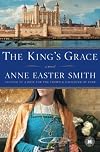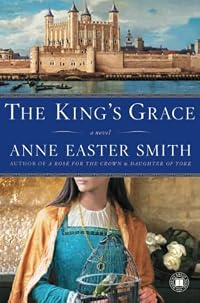
The King's Grace: A Novel
by Anne Easter Smith
On This Page
Description
The bestselling author of A Rose for the Crown and Daughter of York takes a young woman that history noticed only once and sets her on a quest for the truth about the murder of two boys and a man who claims to be king. All that history knows of Grace Plantagenet is that she was an illegitimate daughter of Edward IV and one of two attendants aboard the funeral barge of his widowed queen. Thus, she was half sister of the famous young princes, who -- when this story begins in 1485 -- had been show more housed in the Tower by their uncle, Richard III, and are presumed dead. But in the 1490s, a young man appears at the courts of Europe claiming to be Richard, duke of York, the younger of the boys, and seeking to claim his rightful throne from England's first Tudor king, Henry VII. But is this man who he says he is? Or is he Perkin Warbeck, a puppet of Margaret of York, duchess of Burgundy, who is determined to regain the crown for her York family? Grace Plantagenet finds herself in the midst of one of English history's greatest mysteries. If she can discover the fate of the princes and the true identity of Perkin Warbeck, perhaps she will find her own place in her family. show lessTags
Recommendations










Member Reviews
A really good story about 4 of the illegitimate children of Edward IV, focusing on Grace Plantagenet. The story centered on one of the "pretenders" to the throne, the youngest prince in the tower (Richard, aka Dickie). Perkin Warbeck is a real historical personage, which made this a very good historical fiction read. I've read a lot about the Plantagenets, but this one was exceptionally good. 610 pages
I ended up giving this book only 4 stars only because as much as I wanted to I could not come to like the main character Grace until nearly the end of the book. Grace is the bastard daughter of King Edward IV and she was a real person. Nothing is known about her in history other then she accompanied Edward's wife, Elizabeth's coffin, at her funeral. With that, you could literally right whatever you want about her life because there is nothing to contradict her. The story was well told, but Grace came off with an air about her that I just couldn't get around. All in all - I enjoyed the book.
In the questions for discussion she asks Why Elizabeth Woodville agrees to the marriage of Bess & Henry if she is such a loyal Yorkist. Anne Easter Smith seems to have forgotten that Elizabeth's first husband died fighting for the Lancaster side. Elizabeth was on the side that would benefit her the most.
Grace Plantagenet, bastard daughter of King Edward IV of England is only mentioned once in history - in a account written first hand about the small party seen escorting the Dowager Queen Elizabeth Woodville’s funeral barge. This lack of the Grace’s historical background provides the author, Anne Easter Smith, complete control over her heroine, which is quite unique in a historical fiction novel (if it’s a GOOD historical fiction novel, that is!).
Grace spends the first 11 years of her life in an abbey, when one day Dowager Queen Elizabeth Woodville summons her to court. England is in much turmoil at this time - King Edward IV is dead and the marriage between he and Elizabeth has been declared invalid and their children made show more bastards, based on the facts now coming to light of Edward’s previous betrothal. Edward’s brother, King Richard III wears the crown, the two York princes and heirs to the throne are in the tower for “safe keeping” and Henry Tudor is threatening to invade.
When Henry Tudor succeeds with his invasion and King Richard III dies in battle, the Tudor Dynasty is born. Edward and Elizabeth’s daughter, Bess, reluctantly marries the usurper and surprisingly they end up very happy together. They will eventually produce four children: Arthur, Mary, Margaret and the infamous, Henry VIII.
As his hold on the crown is not very secure, Henry is constantly fearful and paranoid. He suspects Elizabeth Woodville of plotting against him and sends her to Bermondsey Abbey. Grace accompanies her out of respect and feelings of gratitude, although she never thought she’d be once again in an abbey. This part was really interesting to me – we get to see a softer side of the formidable Woodville woman and even though she’s every bit of a Royal snob, she is a real human being underneath and I actually grew to like her a bit! The proper and moral Good Queen Bess and her less than moral, impetuous sister, Cecily bring amusing moments to the novel and provide a sense of family among the siblings. Grace is the diplomat between these two very strong personalities.
Stories of a young man calling himself Richard, the lost duke of York, begin reaching England. No one knows what to believe – is it the lost prince or a boatman’s son from Tournai named Perkin Warbeck (sp) pretending to be Richard? And if he is just a boatman’s son, how does he know French & Latin? Grace’s inquisitive nature takes her on a mission to find out the truth – for her and for her family. In the end, nothing is quite what it seemed to be.
Not only is The King’s Grace about the mystery of Perkin Warbeck, but of Grace - a girl who is trying to find her own path in life and the obstacles she overcomes to get there. Sweet natured and one for the underdogs, Grace is a pleasure to read about and I truly enjoyed this story. I’m no expert on The Princes in the Tower, so I can’t really comment on Smith’s explanation of the Perkin/Richard debate, but her conclusion doesn’t seem too out there and was believable for me. And the happy ending was a nice change of pace from your usual historical fiction ending. show less
Grace spends the first 11 years of her life in an abbey, when one day Dowager Queen Elizabeth Woodville summons her to court. England is in much turmoil at this time - King Edward IV is dead and the marriage between he and Elizabeth has been declared invalid and their children made show more bastards, based on the facts now coming to light of Edward’s previous betrothal. Edward’s brother, King Richard III wears the crown, the two York princes and heirs to the throne are in the tower for “safe keeping” and Henry Tudor is threatening to invade.
When Henry Tudor succeeds with his invasion and King Richard III dies in battle, the Tudor Dynasty is born. Edward and Elizabeth’s daughter, Bess, reluctantly marries the usurper and surprisingly they end up very happy together. They will eventually produce four children: Arthur, Mary, Margaret and the infamous, Henry VIII.
As his hold on the crown is not very secure, Henry is constantly fearful and paranoid. He suspects Elizabeth Woodville of plotting against him and sends her to Bermondsey Abbey. Grace accompanies her out of respect and feelings of gratitude, although she never thought she’d be once again in an abbey. This part was really interesting to me – we get to see a softer side of the formidable Woodville woman and even though she’s every bit of a Royal snob, she is a real human being underneath and I actually grew to like her a bit! The proper and moral Good Queen Bess and her less than moral, impetuous sister, Cecily bring amusing moments to the novel and provide a sense of family among the siblings. Grace is the diplomat between these two very strong personalities.
Stories of a young man calling himself Richard, the lost duke of York, begin reaching England. No one knows what to believe – is it the lost prince or a boatman’s son from Tournai named Perkin Warbeck (sp) pretending to be Richard? And if he is just a boatman’s son, how does he know French & Latin? Grace’s inquisitive nature takes her on a mission to find out the truth – for her and for her family. In the end, nothing is quite what it seemed to be.
Not only is The King’s Grace about the mystery of Perkin Warbeck, but of Grace - a girl who is trying to find her own path in life and the obstacles she overcomes to get there. Sweet natured and one for the underdogs, Grace is a pleasure to read about and I truly enjoyed this story. I’m no expert on The Princes in the Tower, so I can’t really comment on Smith’s explanation of the Perkin/Richard debate, but her conclusion doesn’t seem too out there and was believable for me. And the happy ending was a nice change of pace from your usual historical fiction ending. show less
I enjoyed this a great deal more than Daughter of York, but neither title lives up to the original volume in the series, A Rose for the Crown. Nonetheless, this was an engaging read with a strong mix of historical fiction, romance, and intrigue.
Another excellent effort by Anne Easter Smith. It gave a deeper view of an almost unknown character in history. While it is not as good as A Rose for the Crown it is still worth the read and ties in with the other 2 books in the series.
Like all Anne Easter Smith's book, this one is certainly worth a read. I like the fact there is a tie with Anne Easter Smith's other books.
The author has picked a good subject for her book. Although history acknowledges that Edward 1V did have a illegitimate daughter, little has been said on the subject. This gives the author room her her creativity.
I loved the way she developed the character of Grace. If one closed their eyes, you could imagine her standing in front of you. She also brought to life Grace's half sister Cecily and Bess.
The author description of the life and times of the period in history she is writing about also gives me a vivid pictures regarding court and rural life during the early Tudor reign.
Thank you, I loved show more the book! show less
The author has picked a good subject for her book. Although history acknowledges that Edward 1V did have a illegitimate daughter, little has been said on the subject. This gives the author room her her creativity.
I loved the way she developed the character of Grace. If one closed their eyes, you could imagine her standing in front of you. She also brought to life Grace's half sister Cecily and Bess.
The author description of the life and times of the period in history she is writing about also gives me a vivid pictures regarding court and rural life during the early Tudor reign.
Thank you, I loved show more the book! show less
Members
- Recently Added By
Author Information

7 Works 1,967 Members
Awards and Honors
Common Knowledge
- Original publication date
- 2009-03
- People/Characters
- Grace Plantagenet; Edward IV, King of England; Richard III, King of England; Henry VII, King of England; Elizabeth Woodville, Queen Consort of England; Perkin Warbeck
- Important places
- England, UK
- Important events
- Wars of the Roses
- Epigraph
- The lamb that belonged to the sheep whose skin the wolf was wearing began to follow the wolf in the sheep's clothing.--Aesop's Fable
- Dedication
- For Ann Wroe, with thanks for her inspiration, insight and support.
- First words
- A crow's incessant caw outside the palace window magnified the boy's misery as each raucous note only served to punctuate the pronouncements made by the woman seated in front of him.
- Last words
- (Click to show. Warning: May contain spoilers.)"I have never had such a hunger to hold my children."
- Publisher's editor
- Todd, Trish (Simon and Schuster)
Classifications
Statistics
- Members
- 377
- Popularity
- 82,802
- Reviews
- 12
- Rating
- (3.78)
- Languages
- English
- Media
- Paper, Audiobook, Ebook
- ISBNs
- 4
- ASINs
- 5