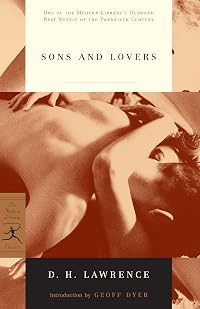
Sons and Lovers
by D. H. Lawrence
On This Page
Description
Widely regarded as D.H. Lawrence's masterpiece, Sons and Lovers is a sprawling, multi-generational look at family relationships, class dynamics, and the intimate ties with others that pull young adults toward independence. This largely autobiographical novel made Lawrence's reputation as a writer—it's a must read for fans of classic literary fiction..
Tags
Recommendations











Member Reviews
This book took me a while to get through. I wasn't into fiction during winter, the first third of the book is unnecessary to the main of it, and Lawrence spends an awfully long time describing flowers, trees, and other such natural scenes.
But boy was it worth it. The descriptions of nature serve to draw out the main moments and let them breathe and take up significance. And they really do: Sons and Lovers, first published in 1913 manages to achieve something I can't really say I have found elsewhere now - an honest portrayal and description of the emotional map of life, the instinctual animal feelings that drive so much of our social behaviour and experience, and to do so in English as a first language. This is so much more than a show more refreshingly wide embrace of Freudian frameworks of looking at human relations, which we would do well to recover in contemporary writing. It is remarkable and blows my mind to see that English can be used this way. It is not that English is such a necessarily cold and mercantile/scientific language, but rather that we have developed a culture that has produced it as such. Lawrence shows us another way.
Our emotional lives, the emotional decisions of parents and families, set up real consequences for the lives of all of us. It was lovely to read a story that centres this understanding so significantly. More please! show less
But boy was it worth it. The descriptions of nature serve to draw out the main moments and let them breathe and take up significance. And they really do: Sons and Lovers, first published in 1913 manages to achieve something I can't really say I have found elsewhere now - an honest portrayal and description of the emotional map of life, the instinctual animal feelings that drive so much of our social behaviour and experience, and to do so in English as a first language. This is so much more than a show more refreshingly wide embrace of Freudian frameworks of looking at human relations, which we would do well to recover in contemporary writing. It is remarkable and blows my mind to see that English can be used this way. It is not that English is such a necessarily cold and mercantile/scientific language, but rather that we have developed a culture that has produced it as such. Lawrence shows us another way.
Our emotional lives, the emotional decisions of parents and families, set up real consequences for the lives of all of us. It was lovely to read a story that centres this understanding so significantly. More please! show less
I started the year transfixed by the visceral floral and fiery passion of Lawrence's The Rainbow (my review HERE). Its rich earth ripened buds of promise into irresistible blooms of vibrant delicacy. But reading this at the end of the year, I felt more like I'd been dragged through barren mud. Perhaps that’s fitting for the story of a miner’s family.
There is lyrical imagery and “caressive” talk (see quotes, below), but far too much plodding Janet-and-John prose, and characters who infuriated me. My 3* rating is generous.
On the psychiatrist’s couch
The plot is straightforward (and heavily autobiographical): Gertrude marries beneath herself, to Walter Morel, a miner. It quickly becomes an unhappy marriage (he drinks and loses show more money), but several children are born, and she strives to raise them up, rather than merely raise them. Once they are grown, and the eldest son, William, is out of the picture, the story is mainly about Paul and specifically how he is torn between love for his mother and for two women (mind versus body?): religious, poetry-loving Miriam Leivers, and suffragist Clara Dawes, who is estranged from her husband, Baxter. (Mrs Morel likes one and dislikes the other.)
I have no expertise in psychiatry, but almost everyone in this story needs help, Paul most of all. It became increasingly frustrating to read. Confusion of love and hate; love for a parent or child versus love for a partner; love versus duty; and the difference between platonic friendship, chaste intimacy, and sensual, sexual love. All are exacerbated by endless indecision and, in many cases, by obliviousness to the feelings of others. Conversely, but perhaps more plausibly, “confirmed enemies”, Paul and Baxter, had a “peculiar feeling of intimacy” and were oddly drawn to each other.
My friend Apatt pointed out in his review that there is more to Walter Morel than just being drunk and abusing his wife and kids, yet I initially forgot to mention that in mine. Walter's portrayal is nicely nuanced, though not in initial drafts (DHL changed it to be fairer to his father). The finished version is more credible, and makes the story more balanced. But he's as easily left out of a reader's mind as his children's.
An agonising death, drawn out in painful detail, over many months, is all the more acute and momentous because of the conflicted and unbalanced relationships of those affected.
The Oedipal overtones become uncomfortably strong and frequent. Paul is a shy and delicate child, and mother and son are very close, sharing almost everything about their lives. As he hones his art, “all his work was hers”. That’s fine. But.
When she takes him to his first job interview in the city, they were “feeling the excitement of lovers having an adventure together.” He forswears all women to be with his mother (sort of), and on another jaunt, he buys and pins flowers on her clothes because “I want people to think we’re awful swells” and justifies his extravagance because “I’m a fellow taking his girl for an outing.” There many occasions where the way he touches his mother’s hair and face, and kisses her goodnight are unsettling, too.
More generally, I came to wonder if "hate" meant something different and weaker to Lawrence. Every couple relationship here - without exception - has love or mere attraction permanently tainted with hate. Not hate after the love has gone, but allegedly co-existing with it. Even when the hate is temporarily subdued, attraction is strongest when rebuffed. I know that people get angry, and love can be messy and conflicted, but constant hate is not a feature of love I have known, or want to know.
“For one day he had loved her utterly. But it never came again.” That’s not love either - though there are flowers that live, bloom and die in a single day (but not native to Nottinghamshire)..
Flowers and fruit
“Trying to sooth herself with the scent of flowers and the fading, beautiful evening… The sky overhead throbbed and pulsed with light… The earth and the hedges smoked dusk.”
Flowers are a regular feature, but not so laden with sexual allegory as in The Rainbow. Troubled people turn to flowers, gardens, and woods for solace in the vast, mysterious beauty of nature: tender touch, “fervid kisses”, and subtle smells.
This was first published in 1913, but I did wonder if Lawrence was referencing the symbolism of Victorian Flower Language, especially in a passage with repeated and specific mention of chrysanthemums: seen out of a window, in a bowl on the table, then walking among them, choosing favourites. They were associated with platonic friendship and lost love. They also bloom in autumn or early winter (thanks, Alfred): late bloomers, like Paul and, to a lesser extent, Miriam. See Lawrence's short story Odour of Chrysanthemums, which I reviewed HERE.
No such glossary is needed when a person with forget-me-not blue eyes, who is nearing death, watches “the tangled sunflowers dying” each day.
And yet when Paul teaches Miriam algebra and she gives him an apple, there’s little of Eve, until later, when questioning her feelings for him, she fears “there was a serpent in her Eden” because of the disgrace and shame of wanting him. However, on another occasion, there is a great crop of cherries at a potentially pertinent time.
Clara thinks differently about many things. She questions the ethics of picking wild flowers, even when plentiful: “I don’t want corpses of flowers about me… watching them die.” Miriam counters, “I think if you treat them with reverence you don’t do them any harm. It is the spirit you pluck them in that matters.” Therein lies the difference between the friends - except that on other occasions, when Miriam is not present, Clara lets Paul pin scarlet carnations and unspecified berries to her clothes.
Nature and landscape quotes
Hidden for brevity; no plot spoilers.
• She and her child “melted... in the mixing-pot of moonlight... The night was very large, and very strange, stretching its hoary distances infinitely.”
• Chrysanthemums in a cemetery “frilled themselves in the warmth”.
• Trees “in whose branches a twilight was tangled, below the bright sky of afternoon”.
• Paul paints trees and leaves: "Not the stiffness of the shape. That seems dead to me. Only this shimmeriness is the real living. The shape is a dead crust. The shimmer is inside really."
• The surface of a reservoir, “tossing its sunshine like petals lightly in its lap.”
• “The river slid by in a body, utterly silent and swift, intertwining among itself like some subtle, complex creature.”
• “The stars shuddered and broke upon the water.”
• “The hillside was all rife with sunshine. It was wild and tussocky, given over to rabbits.”
• “The hills… were blazed over with red sunset. Mrs Morel watched the sun sink from the glistening sky, leaving a soft flower-blue overhead, while the western space went red, as if all the fire had swum down there… It was one of those still moments when the small frets vanish, and the beauty of things stands out.”
• At sunset “watching the gold clouds fall to pieces, and go in immense, rose-coloured ruin towards the darkness. Gold flamed to scarlet, like pain in its intense brightness. Then the scarlet sank to rose, and rose to crimson, and quickly the passion went out of the sky.”
• “Watching the gold clouds fall to pieces, and go in immense, rose-coloured ruin towards the darkness. Gold flamed to scarlet, like pain in its intense brightness… and quickly the passion went out of the sky.”
• “The long waste of foreshore lay moaning under the dawn and the sea… Over the gloomy sea the sky grew red. Quickly the fire spread among the clouds and scattered them… In a golden glitter the sun came up, dribbling fierily over the waves in little splashes, as if someone had gone along and the light had spilled from her pail as she walked.”
• The dichotomous tension between natural wonders and industrial power:
• “From the train… he used to watch the lights of the town, sprinkled thick on the hills, fusing together in a blaze in the valleys… There was a patch of lights at Bulwell like myriad petals shaken to the ground from the shed stars; and beyond was the red glare of the furnaces, playing like hot breath on the clouds.”
Relationship quotes
Hidden for brevity; no plot spoilers.
• “She was more tolerant because she loved him less… Not feeling him so much part of herself, but merely part of her circumstances.”
• “She always wanted to embrace him, so long as he did not want her.”
• "She knew it [wild rose] was wonderful. And yet, till he had seen it, she felt it had not come into her soul. Only he could make it her own, immortal."
• “His nature was purely sensuous, and she strove to make him moral and religious.”
• “In seeking to make him nobler than he could be, she destroyed him.”
• “She folded herself to him… Now she radiated with joy and pride again. It was her restoration and recognition.”
• “Having known the immensity of passion… They felt small, half afraid, childish, and wondering, like Adam and Even when they lost their innocence and realized the magnificence of the power which drove them out of Paradise… It was for each of them an initiation and a satisfaction. To know their own nothingness, to know the tremendous living flood which carried them.”
• “He had known the baptism of fire in passion, and it left him at rest… It was something that happened because of her, but it was not her. They were scarcely any nearer each other.”
Other quotes
Hidden for brevity; no plot spoilers.
• “The dusky, golden softness of this man’s sensuous flame of life, that flowed off his flesh like the flame from a candle… seemed to her something wonderful, beyond her.”
• “Sleep is still most perfect… when it is shared with a beloved. The warmth, the security and peace of soul, the utter comfort from the touch of the other, knits the sleep, so that it takes the body and soul completely in its healing.”
• “Her bright eyes alight like water that shakes with a stream of gold in the dark.”
• “Even your joy is like a flame coming off of sadness.” (Yes, “off of”.)
Alternative titles?
Just as Women in Love could well be titled Men in Love (my review HERE), this could be Sons and Mothers. Or perhaps I should copyright Sins and Livers for a light fan-fic akin to Pride and Prejudice and Zombies?
Image sources
Man on psychiatrist's couch: http://i.huffpost.com/gen/2067786/images/o-PSYCHIATRIST-facebook.jpg
Chrysanthemum: http://freeflowerpictures.net/image/flowers/chrysanthemum/yellow-chrysanthemum.j.... show less
There is lyrical imagery and “caressive” talk (see quotes, below), but far too much plodding Janet-and-John prose, and characters who infuriated me. My 3* rating is generous.
On the psychiatrist’s couch
The plot is straightforward (and heavily autobiographical): Gertrude marries beneath herself, to Walter Morel, a miner. It quickly becomes an unhappy marriage (he drinks and loses show more money), but several children are born, and she strives to raise them up, rather than merely raise them. Once they are grown, and the eldest son, William, is out of the picture, the story is mainly about Paul and specifically how he is torn between love for his mother and for two women (mind versus body?): religious, poetry-loving Miriam Leivers, and suffragist Clara Dawes, who is estranged from her husband, Baxter. (Mrs Morel likes one and dislikes the other.)
I have no expertise in psychiatry, but almost everyone in this story needs help, Paul most of all. It became increasingly frustrating to read. Confusion of love and hate; love for a parent or child versus love for a partner; love versus duty; and the difference between platonic friendship, chaste intimacy, and sensual, sexual love. All are exacerbated by endless indecision and, in many cases, by obliviousness to the feelings of others. Conversely, but perhaps more plausibly, “confirmed enemies”, Paul and Baxter, had a “peculiar feeling of intimacy” and were oddly drawn to each other.
My friend Apatt pointed out in his review that there is more to Walter Morel than just being drunk and abusing his wife and kids, yet I initially forgot to mention that in mine. Walter's portrayal is nicely nuanced, though not in initial drafts (DHL changed it to be fairer to his father). The finished version is more credible, and makes the story more balanced. But he's as easily left out of a reader's mind as his children's.
An agonising death, drawn out in painful detail, over many months, is all the more acute and momentous because of the conflicted and unbalanced relationships of those affected.
The Oedipal overtones become uncomfortably strong and frequent. Paul is a shy and delicate child, and mother and son are very close, sharing almost everything about their lives. As he hones his art, “all his work was hers”. That’s fine. But.
When she takes him to his first job interview in the city, they were “feeling the excitement of lovers having an adventure together.” He forswears all women to be with his mother (sort of), and on another jaunt, he buys and pins flowers on her clothes because “I want people to think we’re awful swells” and justifies his extravagance because “I’m a fellow taking his girl for an outing.” There many occasions where the way he touches his mother’s hair and face, and kisses her goodnight are unsettling, too.
More generally, I came to wonder if "hate" meant something different and weaker to Lawrence. Every couple relationship here - without exception - has love or mere attraction permanently tainted with hate. Not hate after the love has gone, but allegedly co-existing with it. Even when the hate is temporarily subdued, attraction is strongest when rebuffed. I know that people get angry, and love can be messy and conflicted, but constant hate is not a feature of love I have known, or want to know.
“For one day he had loved her utterly. But it never came again.” That’s not love either - though there are flowers that live, bloom and die in a single day (but not native to Nottinghamshire)..
Flowers and fruit
“Trying to sooth herself with the scent of flowers and the fading, beautiful evening… The sky overhead throbbed and pulsed with light… The earth and the hedges smoked dusk.”
Flowers are a regular feature, but not so laden with sexual allegory as in The Rainbow. Troubled people turn to flowers, gardens, and woods for solace in the vast, mysterious beauty of nature: tender touch, “fervid kisses”, and subtle smells.
This was first published in 1913, but I did wonder if Lawrence was referencing the symbolism of Victorian Flower Language, especially in a passage with repeated and specific mention of chrysanthemums: seen out of a window, in a bowl on the table, then walking among them, choosing favourites. They were associated with platonic friendship and lost love. They also bloom in autumn or early winter (thanks, Alfred): late bloomers, like Paul and, to a lesser extent, Miriam. See Lawrence's short story Odour of Chrysanthemums, which I reviewed HERE.
No such glossary is needed when a person with forget-me-not blue eyes, who is nearing death, watches “the tangled sunflowers dying” each day.
And yet when Paul teaches Miriam algebra and she gives him an apple, there’s little of Eve, until later, when questioning her feelings for him, she fears “there was a serpent in her Eden” because of the disgrace and shame of wanting him. However, on another occasion, there is a great crop of cherries at a potentially pertinent time.
Clara thinks differently about many things. She questions the ethics of picking wild flowers, even when plentiful: “I don’t want corpses of flowers about me… watching them die.” Miriam counters, “I think if you treat them with reverence you don’t do them any harm. It is the spirit you pluck them in that matters.” Therein lies the difference between the friends - except that on other occasions, when Miriam is not present, Clara lets Paul pin scarlet carnations and unspecified berries to her clothes.
Nature and landscape quotes
Hidden for brevity; no plot spoilers.
• She and her child “melted... in the mixing-pot of moonlight... The night was very large, and very strange, stretching its hoary distances infinitely.”
• Chrysanthemums in a cemetery “frilled themselves in the warmth”.
• Trees “in whose branches a twilight was tangled, below the bright sky of afternoon”.
• Paul paints trees and leaves: "Not the stiffness of the shape. That seems dead to me. Only this shimmeriness is the real living. The shape is a dead crust. The shimmer is inside really."
• The surface of a reservoir, “tossing its sunshine like petals lightly in its lap.”
• “The river slid by in a body, utterly silent and swift, intertwining among itself like some subtle, complex creature.”
• “The stars shuddered and broke upon the water.”
• “The hillside was all rife with sunshine. It was wild and tussocky, given over to rabbits.”
• “The hills… were blazed over with red sunset. Mrs Morel watched the sun sink from the glistening sky, leaving a soft flower-blue overhead, while the western space went red, as if all the fire had swum down there… It was one of those still moments when the small frets vanish, and the beauty of things stands out.”
• At sunset “watching the gold clouds fall to pieces, and go in immense, rose-coloured ruin towards the darkness. Gold flamed to scarlet, like pain in its intense brightness. Then the scarlet sank to rose, and rose to crimson, and quickly the passion went out of the sky.”
• “Watching the gold clouds fall to pieces, and go in immense, rose-coloured ruin towards the darkness. Gold flamed to scarlet, like pain in its intense brightness… and quickly the passion went out of the sky.”
• “The long waste of foreshore lay moaning under the dawn and the sea… Over the gloomy sea the sky grew red. Quickly the fire spread among the clouds and scattered them… In a golden glitter the sun came up, dribbling fierily over the waves in little splashes, as if someone had gone along and the light had spilled from her pail as she walked.”
• The dichotomous tension between natural wonders and industrial power:
• “From the train… he used to watch the lights of the town, sprinkled thick on the hills, fusing together in a blaze in the valleys… There was a patch of lights at Bulwell like myriad petals shaken to the ground from the shed stars; and beyond was the red glare of the furnaces, playing like hot breath on the clouds.”
Relationship quotes
Hidden for brevity; no plot spoilers.
• “She was more tolerant because she loved him less… Not feeling him so much part of herself, but merely part of her circumstances.”
• “She always wanted to embrace him, so long as he did not want her.”
• "She knew it [wild rose] was wonderful. And yet, till he had seen it, she felt it had not come into her soul. Only he could make it her own, immortal."
• “His nature was purely sensuous, and she strove to make him moral and religious.”
• “In seeking to make him nobler than he could be, she destroyed him.”
• “She folded herself to him… Now she radiated with joy and pride again. It was her restoration and recognition.”
• “Having known the immensity of passion… They felt small, half afraid, childish, and wondering, like Adam and Even when they lost their innocence and realized the magnificence of the power which drove them out of Paradise… It was for each of them an initiation and a satisfaction. To know their own nothingness, to know the tremendous living flood which carried them.”
• “He had known the baptism of fire in passion, and it left him at rest… It was something that happened because of her, but it was not her. They were scarcely any nearer each other.”
Other quotes
Hidden for brevity; no plot spoilers.
• “The dusky, golden softness of this man’s sensuous flame of life, that flowed off his flesh like the flame from a candle… seemed to her something wonderful, beyond her.”
• “Sleep is still most perfect… when it is shared with a beloved. The warmth, the security and peace of soul, the utter comfort from the touch of the other, knits the sleep, so that it takes the body and soul completely in its healing.”
• “Her bright eyes alight like water that shakes with a stream of gold in the dark.”
• “Even your joy is like a flame coming off of sadness.” (Yes, “off of”.)
Alternative titles?
Just as Women in Love could well be titled Men in Love (my review HERE), this could be Sons and Mothers. Or perhaps I should copyright Sins and Livers for a light fan-fic akin to Pride and Prejudice and Zombies?
Image sources
Man on psychiatrist's couch: http://i.huffpost.com/gen/2067786/images/o-PSYCHIATRIST-facebook.jpg
Chrysanthemum: http://freeflowerpictures.net/image/flowers/chrysanthemum/yellow-chrysanthemum.j.... show less
Calling Dr. Freud! Calling Dr. Freud! There is nothing subtle about the Oedipus Complex at the center of this novel. What does contain subtlety and ambiguity is the characters response to it. This was a hard book to like because none of the characters were particularly likeable (and I wanted to bitchslap Paul Morel on more than one occasion and tell him to grow up!). I initially liked Gertrude Morel, Paul's mother, but as soon as she insinuated herself into her son's lives as a figurative lover, the bloom was off the rose. It is a beautifully written, very visual novel, but absolutely infuriating. The lone daughter, Annie, is the only character to escape the damage caused by this love of mother and hatred of father (so, of course, Annie show more is a very minor character). If Paul Morel fought half as much against his mother as he did with Miriam and Clara, he might have finally broken her stranglehold and become a man, instead of a mere shadow of a man. Miriam and Clara both turned into weak, needy creatures who clung to someone who never deserved their love. The healthiest relationship in the book was that between Paul and Baxter Dawes (and the only time the reader sees much in the way of selflessness on the part of Paul). I ended up having a love/hate relationship with the book. It really is beautifully written and the inner life of the characters is incredibly well drawn, but in the end, I just didn't care about any of them. I didn't care what happened to them. I didn't care about their problems or their desires or anything else. That is a shame. show less
After reading "Sons and Lovers" for the first time since college, I am saddened to report that D.H. Lawrence has retained the title of Modernist Who is Most Likely to Irritate Me. I'm not saying that "Sons and Lovers" is a bad book. Honestly, it'd be easier to talk about if it were. It is, I suppose, an example of the traditional, third-person nineteenth-century novel bursting at the seams. Lawrence's interest isn't to describe the way the world works, it's to describe his characters inner lives and hidden motivations, and while some readers will surely be frustrated by the length of "Sons and Lovers" and the amount of detail it contains, the fact that he's able to do this without resorting to psycho-therapeutic language or a show more stream-of-consciousness first-person narrative is pretty remarkable. "Sons and Lovers is, at the very least, a convincing psychological portrait of a family and a perceptive telling of how their emotional attachments play out over the course of an entire life. One also gets the feeling that Paul Morel, a sensitive young man who also has a certain hardness about him, an artist who comes from the lower classes and feels drawn to the world of industry, is something distinctly novel, a sort of character one couldn't imagine meeting in a book by Dickens. Even if much of the material that "Sons and Lovers" was drawn from the author's own life experiences, Lawrence crafts his characters with an extraordinary amount of care and precision. There are, I admit, good reasons why this book is considered a classic.
Even so...there's a lot of prose that seems, to this twenty-first century reader, sort of tin-eared. Lawrence's descriptions of the English countryside are both knowledgeable beautiful, and his ear for local dialect is admirable. There's a lot of fine writing here, particularly in the novel's final pages, which are nothing short of breathtaking. Still, Lawrence is also fond of pinpointing his characters' emotional states and psychoanalyzing them in mid-paragraph, habits that drove me up the wall. Lawrence is also fond of discussing his characters' spiritual traits as if they were wholly separate from the rest of their personalities, a distinction that, considering modernism's focus on the inner workings of the psyche and the main character's own professed atheism, feels a bit strained. While I realize that Lawrence might be demonstrating the limitations of the perspective he chose to work in, I often wished that his prose did less telling and more showing. It feels wrong, somehow, to critique a recognized Great Writer using such basic terms, but, in this case, I just can't help it. D.H. Lawrence drives me nuts.
And that's a another thing. In the same way some people debate whether T.S. Eliot's "The Waste Land" is a spot-on psychological snapshot of postwar Europe or the muddled product of one neurasthenic's difficult recovery, I can't help thinking that "Sons and Lovers," accomplished as it is, might be the product of one sickly, neurotic, sexually frustrated coal miner's son's bad moods. Lawrence's predilection for emotionally cool, powerful women, his habit of describing romantic relationship in terms of domination and subjugation, and, of course, the Oedipus complex and the novel's center suggest that "Sons and Lovers" says more about Lawrence's obsessions than about either his characters or the time and place in which they lived. The fact that Lawrence, like some of his fellow Modernists, drifted into the world of far-right politics at the end of his life doesn't also doesn't help, and the fact that so much of this book has to do with frustration, self-denial and emotional self-laceration only makes evaluating it as a work of art more difficult. In the final analysis, I just can't assign "Sons and Lovers" a star rating. It's a novel that is probably unlike any book written before it, and perhaps unlike any novel written since. It's slow, tortured, and infinitely frustrating. But, in many ways, it also a successful, and sometimes affecting, work, an honest, if not particularly likable, product of both its author's personal demons and his considerable talent and imagination. show less
Even so...there's a lot of prose that seems, to this twenty-first century reader, sort of tin-eared. Lawrence's descriptions of the English countryside are both knowledgeable beautiful, and his ear for local dialect is admirable. There's a lot of fine writing here, particularly in the novel's final pages, which are nothing short of breathtaking. Still, Lawrence is also fond of pinpointing his characters' emotional states and psychoanalyzing them in mid-paragraph, habits that drove me up the wall. Lawrence is also fond of discussing his characters' spiritual traits as if they were wholly separate from the rest of their personalities, a distinction that, considering modernism's focus on the inner workings of the psyche and the main character's own professed atheism, feels a bit strained. While I realize that Lawrence might be demonstrating the limitations of the perspective he chose to work in, I often wished that his prose did less telling and more showing. It feels wrong, somehow, to critique a recognized Great Writer using such basic terms, but, in this case, I just can't help it. D.H. Lawrence drives me nuts.
And that's a another thing. In the same way some people debate whether T.S. Eliot's "The Waste Land" is a spot-on psychological snapshot of postwar Europe or the muddled product of one neurasthenic's difficult recovery, I can't help thinking that "Sons and Lovers," accomplished as it is, might be the product of one sickly, neurotic, sexually frustrated coal miner's son's bad moods. Lawrence's predilection for emotionally cool, powerful women, his habit of describing romantic relationship in terms of domination and subjugation, and, of course, the Oedipus complex and the novel's center suggest that "Sons and Lovers" says more about Lawrence's obsessions than about either his characters or the time and place in which they lived. The fact that Lawrence, like some of his fellow Modernists, drifted into the world of far-right politics at the end of his life doesn't also doesn't help, and the fact that so much of this book has to do with frustration, self-denial and emotional self-laceration only makes evaluating it as a work of art more difficult. In the final analysis, I just can't assign "Sons and Lovers" a star rating. It's a novel that is probably unlike any book written before it, and perhaps unlike any novel written since. It's slow, tortured, and infinitely frustrating. But, in many ways, it also a successful, and sometimes affecting, work, an honest, if not particularly likable, product of both its author's personal demons and his considerable talent and imagination. show less
I was in a foul humor, so I decided to take it out on a book I hate.
Rating: 0.125* of five
BkC51) [SONS AND LOVERS] by [[D.H. Lawrence]]: The worst, most horrendously offensively overrated piece of crap I've read in my life.
Yeup. Since I'm in a real bitch-slappin' mood, here goes.
The Book Report: Sensitive, aesthetic nebbish gets born to rough miner and his neurasthenic dishcloth of a wife. She falls in love with her progeny and tries to Save Him From Being Like His Father, which clearly is a fate worse than death. So, lady, if you didn't like the guy, why didn't you just become a prostitute like all the other women too dumb to teach did in the 19th century?
Things drone tediously on, some vaguely coherent sentences pass before one's show more eyes, the end and not a moment too soon.
My Review: Listen. DH Lawrence couldn't write his way out of a wet paper bag. The reason his stuff is known at all today is the scene in Lady Chatterly where the gamekeeper bangs her from behind. Oh, and those two dudes wrestling naked in front of the fireplace in Women in Love.
Believe me when I tell you, those are *the* highlights of the man's ouevre. The hero of this book, Paul MOREL, is named after a bloody MUSHROOM! He's as soft and ishy and vaguely dirty-smelling as a mushroom, too.
Lawrence was one of those lads I'd've beaten the snot out of in grade school, just because he was gross. Weedy and moist are the two words that leap forcefully to mind when I contemplate his sorry visage, which exercise in masochistic knowledge-seeking I do not urge upon you.
If you, for some reason, liked this tedious, crapulous drivel, then goody good good, but if we're friends, I urge you not to communicate your admiration to me. It will not do good things for our relationship. I more easily forgive Hemingwayism than affection for this. show less
Rating: 0.125* of five
BkC51) [SONS AND LOVERS] by [[D.H. Lawrence]]: The worst, most horrendously offensively overrated piece of crap I've read in my life.
Yeup. Since I'm in a real bitch-slappin' mood, here goes.
The Book Report: Sensitive, aesthetic nebbish gets born to rough miner and his neurasthenic dishcloth of a wife. She falls in love with her progeny and tries to Save Him From Being Like His Father, which clearly is a fate worse than death. So, lady, if you didn't like the guy, why didn't you just become a prostitute like all the other women too dumb to teach did in the 19th century?
Things drone tediously on, some vaguely coherent sentences pass before one's show more eyes, the end and not a moment too soon.
My Review: Listen. DH Lawrence couldn't write his way out of a wet paper bag. The reason his stuff is known at all today is the scene in Lady Chatterly where the gamekeeper bangs her from behind. Oh, and those two dudes wrestling naked in front of the fireplace in Women in Love.
Believe me when I tell you, those are *the* highlights of the man's ouevre. The hero of this book, Paul MOREL, is named after a bloody MUSHROOM! He's as soft and ishy and vaguely dirty-smelling as a mushroom, too.
Lawrence was one of those lads I'd've beaten the snot out of in grade school, just because he was gross. Weedy and moist are the two words that leap forcefully to mind when I contemplate his sorry visage, which exercise in masochistic knowledge-seeking I do not urge upon you.
If you, for some reason, liked this tedious, crapulous drivel, then goody good good, but if we're friends, I urge you not to communicate your admiration to me. It will not do good things for our relationship. I more easily forgive Hemingwayism than affection for this. show less
One notable aspect of Lawrence's work is the simplicity of how it is written. Lawrence does not go overboard with his descriptions and drama. Everything is kept just right. Never focusing too long on details that would not matter, such as how the view looked from head to toe, what tree did they pass, how many items were there in the house - he gave just the right amount of attention to every detail in the novel to ensure that the readers would not grow bored from reading things which they have absolutely or little interest in and leaves these details to tackle the issues or concerns that are much more pressing. It is in stories like these that prove to readers and writers alike that simplicity is a powerful tool for presenting what one show more wants to say and having the audience understand what he or she is trying to say without much explanation. While there are words that have changed from 1913 to the present, it is still written so that despite the changes in the times, the words could still be linked to their present word and meaning. A few examples are morphia for morphine and programme for the program of the drama or play.
While the language and simplicity are notable enough, another aspect of Lawrence's writing that makes the work move like a panther in a cage, moving back and forth restlessly in the small space it has been given, growling and tense, waiting to jump out and run into the wild, is the power of his characters' emotions and feelings that flow off the pages and seep into the readers' skin, drawing them nearer to the characters and their own motives. The greatest example is Mrs. Morel. While readers might not personally like the idea of her having a possessive, obsessive love for her son/s, she makes it so that the readers side with her, first of all by making her the spunky housewife that does not allow her husband to take the power away from her and by continually doing everything she can to ensure that her son/s would always return to her despite their current infatuation with a certain girl. She is so strong that she manipulates the people, especially her sons, to remember or heed her words and even have them think the way she does. Despite her overbearing and unnatural love, she is the kind of character that readers later on sympathize with and hope that she would leave Paul in the state he is in. Another great example is Miriam. Though the reaction did not tackle her deeply, she is one of the most memorable characters in the sense that she is so strange in her way of behaving that when she comes to love Paul and loves him with her soul, willing to sacrifice himself to whatever he wanted, the readers feel that she is either a saint with a tight hold on Paul or a saint that wanted to be rewarded for her being good by getting what she wanted. show less
While the language and simplicity are notable enough, another aspect of Lawrence's writing that makes the work move like a panther in a cage, moving back and forth restlessly in the small space it has been given, growling and tense, waiting to jump out and run into the wild, is the power of his characters' emotions and feelings that flow off the pages and seep into the readers' skin, drawing them nearer to the characters and their own motives. The greatest example is Mrs. Morel. While readers might not personally like the idea of her having a possessive, obsessive love for her son/s, she makes it so that the readers side with her, first of all by making her the spunky housewife that does not allow her husband to take the power away from her and by continually doing everything she can to ensure that her son/s would always return to her despite their current infatuation with a certain girl. She is so strong that she manipulates the people, especially her sons, to remember or heed her words and even have them think the way she does. Despite her overbearing and unnatural love, she is the kind of character that readers later on sympathize with and hope that she would leave Paul in the state he is in. Another great example is Miriam. Though the reaction did not tackle her deeply, she is one of the most memorable characters in the sense that she is so strange in her way of behaving that when she comes to love Paul and loves him with her soul, willing to sacrifice himself to whatever he wanted, the readers feel that she is either a saint with a tight hold on Paul or a saint that wanted to be rewarded for her being good by getting what she wanted. show less
eBook
Quite simply, this is a gorgeous book, and I'm more than a little ashamed that it's taken me this long to get around to reading it. Although, honestly, I never really bought into all the oedipal stuff, which seems to be the aspect of the book for which it is most revered.
It's a simple story, really, of a woman, her son, and the two women he pursues and rejects (often simultaneously), but it's the characters, rather than the plot (of which there isn't much), that are truly compelling. I found myself bookmarking so many pages, less because of what they were saying than the fact that so much of what they said sounded like an echo of things I've said or thought.
I'm always confused by books wherein I have such a strong sense of personal show more identification with the characters. Am I responding to the book or to some sick mixture of egotism and self-loathing. I suppose it doesn't much matter, nor do the two have to be mutually exclusive.
Anyway, Paul is such a great character. His struggles to navigate the murky and treacherous waters of his own conflicted desires are profoundly epic, despite their small scale, and in his treatment of Miriam, especially, Lawrence has painted the definitive portrait of the atrocities a profoundly self-involved douchebag can commit, even when he's fighting futilely to do what he sees as "the right thing." show less
Quite simply, this is a gorgeous book, and I'm more than a little ashamed that it's taken me this long to get around to reading it. Although, honestly, I never really bought into all the oedipal stuff, which seems to be the aspect of the book for which it is most revered.
It's a simple story, really, of a woman, her son, and the two women he pursues and rejects (often simultaneously), but it's the characters, rather than the plot (of which there isn't much), that are truly compelling. I found myself bookmarking so many pages, less because of what they were saying than the fact that so much of what they said sounded like an echo of things I've said or thought.
I'm always confused by books wherein I have such a strong sense of personal show more identification with the characters. Am I responding to the book or to some sick mixture of egotism and self-loathing. I suppose it doesn't much matter, nor do the two have to be mutually exclusive.
Anyway, Paul is such a great character. His struggles to navigate the murky and treacherous waters of his own conflicted desires are profoundly epic, despite their small scale, and in his treatment of Miriam, especially, Lawrence has painted the definitive portrait of the atrocities a profoundly self-involved douchebag can commit, even when he's fighting futilely to do what he sees as "the right thing." show less
Members
- Recently Added By
Lists

1001 Books You Must Read Before You Die
1,448 works; 1,135 members

The Guardian's 1000 Novels Everyone Must Read
1,005 works; 551 members

Classics you know you should have read but probably haven't
421 works; 409 members

Radcliffe's 100 Best Novel of the 20th Century
100 works; 32 members
BBC Big Read
191 works; 46 members

The 100 Best Books of All Time by Norwegian Book Club (World Library)
104 works; 23 members

Literature About Social Class
134 works; 19 members
Newsweek's Top 100 Books: The Meta-List
100 works; 18 members
20th Century Literature
1,161 works; 55 members
Favorite Coming of Age Novels.
164 works; 51 members

1910s
90 works; 16 members

Unread books
1,063 works; 87 members
Best of British Literature
226 works; 41 members
Best Family Stories
241 works; 22 members

Philip Ward's Lifetime Reading Plan
592 works; 22 members
Favourite Books
1,820 works; 316 members

Canon de la narrativa universal del siglo XX
254 works; 6 members

Best Workplace Fiction
47 works; 18 members
Harold Bloom - The Western Canon: D. The Chaotic Age
833 works; 24 members

Western World's Greatest Books - Project Gutenberg
295 works; 15 members
Banned or Challenged Books
400 works; 41 members
Banned Books Week 2014
268 works; 63 members

100 Most Recommended Works
100 works; 11 members

Daria Morgendorffer's Bookshelf
70 works; 5 members
Mensa for Kids Excellence in Reading Award Program (Grades 9-12)
116 works; 5 members
1,001 BYMRBYD Concensus
723 works; 27 members
College Reads (Lit Edition)
75 works; 5 members

Modernism
140 works; 8 members
My list of 100 books to read next
100 works; 4 members
100 World Classics
99 works; 15 members

Allie's Favourite 150 Books
145 works; 3 members
The Modern Library's 100 Best Novels: The Board's List
85 works; 6 members
Lamont's Hundred Best Novels (1947)
100 works; 4 members

Fiction about the Working Class
74 works; 10 members

Dysfunctional Families
133 works; 7 members
The Greatest Books
99 works; 5 members
Mensa for Kids Excellence in Reading Award Program (Grades 9-12)
116 works; 3 members

What are your favourite books?
121 works; 11 members

Review 4
37 works; 3 members

SHOULD Read Books!
354 works; 9 members

United Kingdom
82 works; 5 members

Books Read in 2015
3,299 works; 129 members
Best Books of the 20th Century
193 works; 5 members

100
56 works; 1 member

Llibres que he llegit el 2016
36 works; 1 member

Novels featuring Mothers
64 works; 8 members
Trinity College Booklist (1951): Class Ten, English Literature
358 works; 5 members

For Further Reading: A List of 160 Novels from 15 Literatures
160 works; 4 members
http://thegreatestbooks.org's Greatest Fiction Books
59 works; 1 member

My favourite books
96 works; 3 members

Retrospective of 20th- and 21st-century literature
154 works; 1 member
Modern Library's 100 Best Novels
100 works; 2 members
.
396 works; 1 member
Reading LIst
648 works; 1 member
School Made Us Read It
380 works; 196 members

.
194 works; 2 members
DigitalDreamDoor top 300
300 works; 4 members

Tagged 19th Century
104 works; 7 members

Mustich's 1000 Books to Read Before You Die: A Life Changing List
1,001 works; 20 members

Classics Book Club 2025
11 works; 1 member

Recommended Reading : 600 Classics Reviewed, Editors of Salem Press, 2015
634 works; 6 members
Canon de la narrativa universal del s. XX (cicutadry)
499 works; 3 members
New Lifetime Reading Plan by Fadiman and Major
225 works; 5 members

Greatest Books, allegedly
484 works; 9 members

Books Read in 2021
5,361 works; 114 members

Books With Family Relationships in the Title
44 works; 4 members
bound
100 works; 1 member

Five star books
1,767 works; 110 members

Best of World Literature
436 works; 52 members
Talk Discussions
Past Discussions
1001 Group Read: Sons and Lovers in 1001 Books to read before you die (October 2011)
Author Information

898+ Works 60,735 Members
D(avid) H(erbert) Lawrence was born on September 11, 1885. His father was a coal miner and Lawrence grew up in a mining town in England. He always hated the mines, however, and frequently used them in his writing to represent both darkness and industrialism, which he despised because he felt it was scarring the English countryside. Lawrence show more attended high school and college in Nottingham and, after graduation, became a school teacher in Croyden in 1908. Although his first two novels had been unsuccessful, he turned to writing full time when a serious illness forced him to stop teaching. Lawrence spent much of his adult life abroad in Europe, particularly Italy, where he wrote some of his most significant and most controversial novels, including Sons and Lovers and Lady Chatterly's Lover. Lawrence and his wife, Frieda, who had left her first husband and her children to live with him, spent several years touring Europe and also lived in New Mexico for a time. Lawrence had been a frail child, and he suffered much of his life from tuberculosis. Eventually, he retired to a sanitorium in Nice, France. He died in France in 1930, at age 44. In his relatively short life, he produced more than 50 volumes of short stories, poems, plays, essays, travel journals, and letters, in addition to the novels for which he is best known. (Bowker Author Biography) show less
Some Editions
Awards and Honors
Awards
Notable Lists
BBC's Big Read (190)
Series
Belongs to Publisher Series
Penguin English Library, 2012 series (2012-09)
Limited Editions Club (S:43.04)
Modern Library (109.1,333.1)
rororo (381-382)
Gallimard, Folio (1255)
Work Relationships
Is contained in
Sons and Lovers; St Mawr; The Fox; The White Peacock; Love among the Haystacks; The Virgin and the Gypsy; Lady Chatterley's Lover by D. H. Lawrence
Sons and Lovers [and] The Fox [and] Love Among the Haystacks [and] Aaron's Rod [and] The Ladybird [and] Women in Love by D. H. Lawrence
D.H. LAWRENCE OMNIBUS: THE COMPLETE NOVELS: SONS AND LOVERS, ST. MAWR, THE FOX, THE WHITE PEACOCK, LOVE AMONG THE HAYSTA by D. H. Lawrence
90 Masterpieces You Must Read (Vol.1): Novels, Poetry, Plays, Short Stories, Essays, Psychology & Philosophy by Various
100 Books You Must Read Before You Die (Genuine List): How many have you read? (Kindle) by Fei Yang (indirect)
Sons and Lovers / Women in Love / Lady Chatterly's Lover / Love Among the Haystacks by D. H. Lawrence
Women in Love • Lady Chatterley's Lovers • The Rainbow • Sons and Lovers • The Plumed Serpent by D. H. Lawrence
Sons and Lovers • The Prussian Officer and Other Stories • Lady Chatterley's Lover by D. H. Lawrence
Has the adaptation
Is abridged in
Has as a reference guide/companion
Has as a study
Has as a commentary on the text
Has as a student's study guide
Common Knowledge
- Canonical title
- Sons and Lovers
- Original title
- Sons and Lovers
- Original publication date
- 1913
- People/Characters
- Paul Morel
- Important places
- Eastwood, Nottinghamshire, England, UK; Skegness, Lincolnshire, England, UK; Lincolnshire, England, UK; Nottinghamshire, England, UK
- Related movies
- Sons and Lovers (1960 | IMDb); Sons and Lovers (1981 | IMDb); Sons & Lovers (2003 | IMDb)
- Dedication
- TO EDWARD GARNETT
- First words
- "The Bottoms" succeeded to "Hell Row."
- Last words
- (Click to show. Warning: May contain spoilers.)He walked towards the family humming, glowing town, quickly.
- Original language
- English
- Disambiguation notice
- See also the Wikipedia article.
Classifications
Statistics
- Members
- 10,458
- Popularity
- 928
- Reviews
- 104
- Rating
- (3.57)
- Languages
- 23 — Arabic, Bengali, Catalan, Czech, Danish, Dutch, English, Estonian, Finnish, French, German, Greek, Hungarian, Italian, Latvian, Norwegian (Bokmål), Polish, Portuguese, Romanian, Serbian, Spanish, Swedish, Turkish
- Media
- Paper, Audiobook, Ebook
- ISBNs
- 411
- UPCs
- 4
- ASINs
- 199