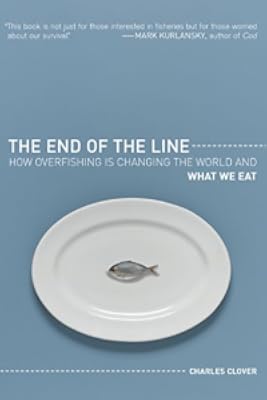
The End of the Line: How Overfishing Is Changing the World and What We Eat
by Charles Clover
On This Page
Description
Packed with nutrients and naturally low in fat, fish is the last animal we can still eat in good conscience--or can we? In this eye-opening book, environmental journalist Clover argues that our passion for fish is unsustainable. Seventy-five percent of the world's fish stocks are now fully exploited or overfished; the most popular varieties risk extinction within the next few decades. Clover trawls the globe for answers, from Tokyo to New England. He joins hardy sailors on high-tech boats, show more interviews top chefs whose menu selections can influence the fate of entire species, and examines the ineffective organizations regulating the world's fisheries. He argues that governments as well as consumers can take steps to reverse this disturbing trend before it's too late. The price of Chilean sea bass may seem outrageous, but this book shows its real cost to the ecosystem is far greater.--From publisher description. show lessTags
Recommendations







Member Reviews
This book started out irritating me, and I think it was the brassy holier-than-thou attitude ("Tsukiji may be one of the few fish markets in the world that does not smell of fish... But Tsukiji stinks all the same, for its daily trade is pushing bluefin tuna daily closer to extinction" [p.34]). In the second chapter the author complains loudly about the trade in bluefin tuna (the western atlantic stock is listed as critically endangered, and the eastern atlantic stock is listed as endangered by IUCN) and then proceeds to have some bluefin tuna sashimi for breakfast. However, I started warming to him (despite his poor breakfast choices and awful Adrian Monk publicity photo) and did learn some interesting stuff about the world's fishing show more industries. Here's where I laughed out loud and genuinely started liking the book (he's talking about an unpublished paper about bycatch in the Spanish tuna fleet): "The observers also noted the scientific names, in Latin, of the species caught as bycatch. I looked up the common names with growing disbelief. It amounted to almost the entire cast list of Finding Nemo [he lists 5 species of sea turtles, 3 whale species including humpback, a great white shark, other sharks and rays, etc] On the bright side, they didn't catch any dolphins." [p. 211]. Ha!
Villains that I knew nothing about: the system (or lack thereof) of prosecution for infractions in the EU and in international waters. The entire government of Spain, apparently. Government initiatives in Canada and Scotland that purport to retrain fisherman and decrease fishing capacity but instead create salmon farms and people who are chronically underemployed.
Unlikely heroes: Unilever (owner of Birdseye and Gorton's), one of the original founders (with WWF) of the Marine Stewardship Council. Who knew? I think i'll buy more Birds Eye veggies next time I'm at the supermarket. show less
Villains that I knew nothing about: the system (or lack thereof) of prosecution for infractions in the EU and in international waters. The entire government of Spain, apparently. Government initiatives in Canada and Scotland that purport to retrain fisherman and decrease fishing capacity but instead create salmon farms and people who are chronically underemployed.
Unlikely heroes: Unilever (owner of Birdseye and Gorton's), one of the original founders (with WWF) of the Marine Stewardship Council. Who knew? I think i'll buy more Birds Eye veggies next time I'm at the supermarket. show less
Ratings
Members
- Recently Added By
Author Information
7+ Works 436 Members
Charles Clover is a journalist and the environmental editor of the Daily Telegraph in London
Awards and Honors
Work Relationships
Has the adaptation
Common Knowledge
- Canonical title
- The End of the Line: How Overfishing Is Changing the World and What We Eat
- Original publication date
- 2004-06-01
- Related movies
- The End of the Line (2009 | IMDb)
Classifications
- Genres
- Science & Nature, Nonfiction, Economics, Hunting and Fishing, General Nonfiction, Sports and Leisure, Food & Cooking
- DDC/MDS
- 333.95 — Society, government, & culture Economics Economics of land and energy Other natural resources Biofuel, biodiversity, wildlife refuges
- LCC
- SH327.5 .C58 — Agriculture Aquaculture. Fisheries. Angling Aquaculture. Fisheries. Angling Fisheries Fishery resources. Fishery conservation
- BISAC
Statistics
- Members
- 224
- Popularity
- 146,158
- Reviews
- 1
- Rating
- (4.06)
- Languages
- Dutch, English, French, German
- Media
- Paper
- ISBNs
- 8
- ASINs
- 2