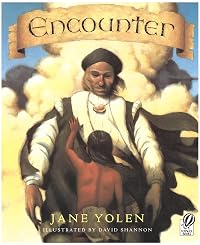
Encounter
by Jane Yolen
On This Page
Description
A Taino Indian boy on the island of San Salvador recounts the landing of Columbus and his men in 1492.Tags
Recommendations






Member Reviews
The story of Christopher Columbus' first meeting with the indigenous peoples of the western hemisphere, when he and his men came ashore on San Salvador, on October 12, 1492, is here told from the perspective of a young Taino boy. After a terrible dream involving three white birds, the boy tries to warn his elders when three extraordinary 'canoes' show up on their shores, but to no avail. The white strangers, who seem almost human, are welcomed, and the consequences are terrible and long-lasting...
Published in 1992, on the 500th anniversary of Columbus' landfall on San Salvador, Encounter is meant to retell a familiar story - the 'discovery' of the 'New World' by Europeans - from an important but long-neglected perspective. The story show more does not reference many of the terrible things done by Columbus and his men directly. Rather, it concentrates on the narrator's first encounter with these strange non-quite human creatures, describes the feeling of unease the boy experiences, and his escape from their great ship, when he is taken away. After brief mention of his efforts to warn others, the narrative then skips ahead to the narrator's old age, as he looks back on the changes the coming of Europeans brought to his home island and region. On the whole, I find this approach quite constructive, and think it is age appropriate for younger children, perhaps six and under. It's important not to hide the terrible aspects of human history from children, but I believe it's equally important to consider the well-being of the child, when thinking of how to present that history to them. I have little patience with those who would whitewash history, but I have even less for those who would wallow in every historical atrocity, and insist that others do the same. When that insistence involves children, I become even less patient, as it often seems to me that such people preference their own desires - to share what they see as the truth, to feel righteous - over the psychological welfare of those most dependent upon them for protection and care.
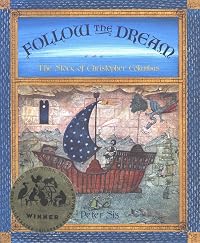
All of which is to say, I prefer balance in these matters. Teach the truth, show multiple perspectives, and choose what specific narratives to share based on the developmental needs of the audience. I recently read three picture-book biographies of Christopher Columbus - David A. Adler's A Picture Book of Christopher Columbus, Peter Sís' Follow the Dream: The Story of Christopher Columbus and Demi's Columbus - in order to mark Columbus Day, and each takes a different approach to this issue. The Adler mentions but does not explore the impact Columbus' voyages had on the people of the Caribbean, the Sís' does not explore the aftermath of that landfall on San Salvador whatsoever, and the Demi offers the fullest depiction of some of the deleterious effects of the arrival of Europeans in the Caribbean. Each approach would work best with a slightly different age group, and for a different purpose, whether to learn about Columbus' life or to explore what drives explorers to head off into the unknown. Whatever the focus may be however, each one of these books is told from the perspective of Columbus, making a book like Encounter valuable, in its presentation of the parallel perspective of the native Taino. The fact that it is told (mostly) from a child's perspective makes it more powerful, as do the striking illustrations of David Shannon. I would recommend this one as a companion volume to any of the biographies mentioned above, and think it could be used in a Columbus Day lesson for younger children, or even in a lesson about how perspective shapes the historical narratives we embrace as a culture. show less
Published in 1992, on the 500th anniversary of Columbus' landfall on San Salvador, Encounter is meant to retell a familiar story - the 'discovery' of the 'New World' by Europeans - from an important but long-neglected perspective. The story show more does not reference many of the terrible things done by Columbus and his men directly. Rather, it concentrates on the narrator's first encounter with these strange non-quite human creatures, describes the feeling of unease the boy experiences, and his escape from their great ship, when he is taken away. After brief mention of his efforts to warn others, the narrative then skips ahead to the narrator's old age, as he looks back on the changes the coming of Europeans brought to his home island and region. On the whole, I find this approach quite constructive, and think it is age appropriate for younger children, perhaps six and under. It's important not to hide the terrible aspects of human history from children, but I believe it's equally important to consider the well-being of the child, when thinking of how to present that history to them. I have little patience with those who would whitewash history, but I have even less for those who would wallow in every historical atrocity, and insist that others do the same. When that insistence involves children, I become even less patient, as it often seems to me that such people preference their own desires - to share what they see as the truth, to feel righteous - over the psychological welfare of those most dependent upon them for protection and care.
All of which is to say, I prefer balance in these matters. Teach the truth, show multiple perspectives, and choose what specific narratives to share based on the developmental needs of the audience. I recently read three picture-book biographies of Christopher Columbus - David A. Adler's A Picture Book of Christopher Columbus, Peter Sís' Follow the Dream: The Story of Christopher Columbus and Demi's Columbus - in order to mark Columbus Day, and each takes a different approach to this issue. The Adler mentions but does not explore the impact Columbus' voyages had on the people of the Caribbean, the Sís' does not explore the aftermath of that landfall on San Salvador whatsoever, and the Demi offers the fullest depiction of some of the deleterious effects of the arrival of Europeans in the Caribbean. Each approach would work best with a slightly different age group, and for a different purpose, whether to learn about Columbus' life or to explore what drives explorers to head off into the unknown. Whatever the focus may be however, each one of these books is told from the perspective of Columbus, making a book like Encounter valuable, in its presentation of the parallel perspective of the native Taino. The fact that it is told (mostly) from a child's perspective makes it more powerful, as do the striking illustrations of David Shannon. I would recommend this one as a companion volume to any of the biographies mentioned above, and think it could be used in a Columbus Day lesson for younger children, or even in a lesson about how perspective shapes the historical narratives we embrace as a culture. show less
This is one of the picture books that shows a historical event through a fictional character's perspective. He is a young Taino boy, living on the island now called San Salvador. He has a nightmare of three great winged birds with sharp white teeth. The next day, Columbus and his men arrive on three white-sailed boats. The boy tries to warn his people, but he is just a child, and ignored. His people offer Columbus the welcome they give to all strangers, and are fooled by the foreigner's round stones and red hats. But the boy sees the greedy look of the Europeans and the serpent smile of their teeth.
The tragic story captures a perspective of history that is only slowly emerging into the mainstream, that of the Native American's opinion show more of Columbus. Even though most of us have recognized that Columbus and the other "explorers" were wrong in their actions, I think that most people still view the Native Americans as the foreigners. Yolen does an excellent job in portraying the Europeans as the strange ones, with odd characteristics and behaviors.
I strive to be open to other cultures and beliefs, and this book reminded me of my own biases, and the need to look through other eyes once in a while. Also, historical violence and the importance of perspective are lessons that we all need to be reminded of. In addition to all these values of the book, Yolen again writes with poetic skill, capturing the voice of this precocious young Taino child and the sorrow of his collapsing world. show less
The tragic story captures a perspective of history that is only slowly emerging into the mainstream, that of the Native American's opinion show more of Columbus. Even though most of us have recognized that Columbus and the other "explorers" were wrong in their actions, I think that most people still view the Native Americans as the foreigners. Yolen does an excellent job in portraying the Europeans as the strange ones, with odd characteristics and behaviors.
I strive to be open to other cultures and beliefs, and this book reminded me of my own biases, and the need to look through other eyes once in a while. Also, historical violence and the importance of perspective are lessons that we all need to be reminded of. In addition to all these values of the book, Yolen again writes with poetic skill, capturing the voice of this precocious young Taino child and the sorrow of his collapsing world. show less
This is the very famous tale of Columbus' discovery of 'The New World' told from the perspective of those people who already lived in a world they considered anything but new. It is the story of how they lost their land to a man and a people with whom they could neither understand or be understood by. The book has an overall dark feeling and some of the illustrations may even be frightening to some children, but this is all an affect that I believe he author and illustrator to be well aware of. The experience of being invaded and conquered by a foreign people would be both frightening and dark for any young boy, and this story makes the point of allowing children to not just hear this young boy's perspective but to feel it as well.
An indigenous child's encounter with Columbus and his crew makes an important point, but it felt like propaganda rather than history or story-telling. I wouldn't give it to a child.
This retelling of Christopher Columbus's first landfall is told from the point of view of a Taino boy who senses that it will be bad from the time that the ships lay anchor in the harbor. He sees through all the supposed kindnesses that Columbus and his men offer and is one of the Taino that are tricked into being kidnapped by the sailors when they depart. He luckily jumps overboard, however, and returns to the islands to warn his people. Sadly, his warnings go unheeded because he is a child, and his people are overcome by the Spaniards that are to come later until no more of his culture remains. This is a well-told story, despite its depressing overtone. It's historical, and when a period in history is that dark, there's no avoiding show more the tone matching the history. This is another great example of historical fiction by Jane Yolen. show less
A young boy dreams of mysteries arriving from the ocean, and they arrive the next day in the form of strange European men. He is wary of them, but his people welcome them. The book ends sadly, with the narrator reflecting on the disappearance of his people and his culture in the wake of European exploration.
While an imagined account, this book can be a helpful additional perspective on Christopher Columbus.
While an imagined account, this book can be a helpful additional perspective on Christopher Columbus.
3.5 stars rounded up. Yolen didn't do the research to give us accurate details about Taino culture and people (maybe at the time, 1992, she couldn't?) but enough is known, and enough descendants still live, that they shouldn't be relegated to a simple role as lost victims. And of course she's not #OwnVoices (back then, what she did was considered a good thing, as she intended to give a voice to the powerless...).
But victimized by the invaders they were, and Yolen gets points for letting readers (of three decades ago!) know that. Back then the idea that "Columbus Day" should not be celebrated with joy, but as a day for realizing that there have been so many lost opportunities, was just starting to gain ground among progressives (I know; show more I was there).
And Shannon gets major points for the artwork which adds clarity and resonance to the text. The story could not stand alone.
In fact, it stands even better as companion to [b:Encounter|41859656|Encounter|Brittany Luby|https://i.gr-assets.com/images/S/compressed.photo.goodreads.com/books/1565397962l/41859656._SX50_.jpg|65347107] by [a:Brittany Luby|15292850|Brittany Luby|https://s.gr-assets.com/assets/nophoto/user/u_50x66-632230dc9882b4352d753eedf9396530.png]. show less
But victimized by the invaders they were, and Yolen gets points for letting readers (of three decades ago!) know that. Back then the idea that "Columbus Day" should not be celebrated with joy, but as a day for realizing that there have been so many lost opportunities, was just starting to gain ground among progressives (I know; show more I was there).
And Shannon gets major points for the artwork which adds clarity and resonance to the text. The story could not stand alone.
In fact, it stands even better as companion to [b:Encounter|41859656|Encounter|Brittany Luby|https://i.gr-assets.com/images/S/compressed.photo.goodreads.com/books/1565397962l/41859656._SX50_.jpg|65347107] by [a:Brittany Luby|15292850|Brittany Luby|https://s.gr-assets.com/assets/nophoto/user/u_50x66-632230dc9882b4352d753eedf9396530.png]. show less
Members
- Recently Added By
Lists

Beautiful Feet Books
304 works; 7 members
Author Information

663+ Works 104,496 Members
Jane Yolen was born February 11, 1939 in New York City. She received a bachelor's degree from Smith College in 1960 and a master's degree in education from the University of Massachusetts in 1976. After college, she became an editor in New York City and wrote during her lunch break. She sold her first children's book, Pirates in Petticoats, at the show more age of 22. Since then, she has written over 300 books for children, young adults, and adults. Her other works include the Emperor and the Kite, Owl Moon, How Do Dinosaurs Say Goodnight? and The Devil's Arithmetic. She has won numerous awards including the Kerlan Award, the Regina Medal, the Keene State Children's Literature Award, the Caldecott Medal, two Nebula Awards, two Christopher Medals, the World Fantasy Award, three Mythopoeic Fantasy Awards, the Golden Kite Award, the Jewish Book Award, the World Fantasy Association's Lifetime Achievement Award, and the Association of Jewish Libraries Award. (Bowker Author Biography) show less
All Editions
Awards and Honors
Awards
Common Knowledge
- Canonical title
- Encounter
- Original publication date
- 1996-09-20
- People/Characters
- Christopher Columbus
Classifications
Statistics
- Members
- 1,319
- Popularity
- 18,347
- Reviews
- 42
- Rating
- (4.03)
- Languages
- English, French, Spanish
- Media
- Paper
- ISBNs
- 14
- ASINs
- 3