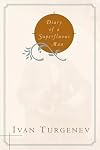
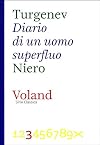
Diary of a Superfluous Man
by Ivan Turgenev
On This Page
Description
Immerse yourself in a compendium of literary virtuosity with this volume of short stories from Russian author Ivan Turgenev, who is regarded as one of the masters of the form. In the title piece, a man on the verge of succumbing to a terminal illness looks back over his life and marvels over the mystery of his own mundane existence.Tags
Recommendations














Member Recommendations
Member Reviews
A ótima tradução de Samuel Junqueira para “Diário de um homem supérfluo”, do escritor russo Ivan Turguêniev, ajuda a entender que o adjetivo vai além de uma pessoa dispensável. É também alguém deslocado, impotente diante de um estado autoritário. E esse é o caso de Tchulkatúrin, um jovem à beira da morte que reflete num diário uma profunda desilusão amorosa e desencanto com as frustrações da vida.
“Diário de um homem supérfluo” foi Publicado em 1850 e estava inédito no Brasil até ser lançado pela editora 34. Além de traduzir, Samuel Junqueira também assina as notas de rodapé e o posfácio que contextualiza essa ótima novela.
“Diário de um homem supérfluo” foi Publicado em 1850 e estava inédito no Brasil até ser lançado pela editora 34. Além de traduzir, Samuel Junqueira também assina as notas de rodapé e o posfácio que contextualiza essa ótima novela.
The very simple story of a man lying on his deathbed, and recalling mostly the incidents in his life that have to do with a young woman he loved, but did not love him back. He is isolated, awkward, and “superfluous”, treated by life as “an unexpected and uninvited guest”, and endures stinging humiliation again and again from the woman and the man she loves instead. Turgenev knew about failure in love first-hand, and the scenes he renders, including a duel, are pretty good. However, the story is too short and not developed enough to really give it a higher rating. You might try Lermontov’s “A Hero of Our Times” instead.
This is a moving novella. The premise is that the diarist is on his deathbed and resolves to write about his life to prove that he is superfluous. He doesn't make it far before he gets to the issue that really bothers him--a love affair from earlier in his life. As he recounts the story over a series of diary entries, his present condition casts a pall over the tale, and he comes off as maudlin rather than tragic.
This is my first work by Turgenev, and I found it to be an interesting psychological study. The novella plays on the concept of the deathbed confession or the "unfinished business" that many people who are dying need to resolve. It's a quick read, and there aren't a ton of characters to confuse (as can sometimes happen in show more Russian novels). I recommend it very much. show less
This is my first work by Turgenev, and I found it to be an interesting psychological study. The novella plays on the concept of the deathbed confession or the "unfinished business" that many people who are dying need to resolve. It's a quick read, and there aren't a ton of characters to confuse (as can sometimes happen in show more Russian novels). I recommend it very much. show less
St. Barts 2013 #8 - Very short novella involving the recollections of a young man as he prepares to die of illness, all centering on one dramatic (for him) instance of unrequited love. A rather timid, uninteresting man to begin with, this unexpected one-sided romance ends poorly for him and likely begins his slide into ill-health way before his time. Turgenev certainly can capture all of those emotions one feels when blind-sided by love. A quick read and a good one.
A dying man, Chulkaturin, reflects on his life, without love and importance of any kind. The more he tried to love and be loved, the more he alienated himself from society in general.
The Diary of a Superfluous Man (1850) is about a "Superfluous Man", a recurring Russian literary meme about upper class nihilistic men who resort to gambling, dueling and women to give meaning to an otherwise disconnected and alienated existence. The story starts of slow but eventually take on a strong narrative direction dealing with "love" lost. Some great imagery and insights on the human condition. I think the 19thC Russian "Superfluous Man" archetypal character is not well known to most English readers, but this is a good introduction (see Wikipedia for other stories), and I believe the origin of the term. Alexsandr Kuprin's masterpiece The Duel (1905) is another Superfluous Man story.
Martin Geeson's passionate narration for show more LibriVox deserves special attention. It's as good or better than professional and obviously a labor of love. The sort of antique sound quality I believe was done on purpose in-line with the novella's first person diary voice, and the occasional sound of an old typewriter adds to the atmosphere. I'm now a fan of Geeson and would listen to anything he narrated in the future.
--Review by Stephen Balbach, via CoolReading (c) 2008 cc-by-nd show less
Martin Geeson's passionate narration for show more LibriVox deserves special attention. It's as good or better than professional and obviously a labor of love. The sort of antique sound quality I believe was done on purpose in-line with the novella's first person diary voice, and the occasional sound of an old typewriter adds to the atmosphere. I'm now a fan of Geeson and would listen to anything he narrated in the future.
--Review by Stephen Balbach, via CoolReading (c) 2008 cc-by-nd show less
A phenomenal look at the helpless antagonist and mediocrity.
Members
- Recently Added By
Lists

CCE 1000 Good Books List
1,033 works; 12 members
Author Information

616+ Works 24,534 Members
Ivan Turgenev, 1818 - 1883 Novelist, poet and playwright, Ivan Turgenev, was born to a wealthy family in Oryol in the Ukraine region of Russia. He attended St. Petersburg University (1834-37) and Berlin University (1838-41), completing his master's exam at St. Petersburg. His career at the Russian Civil Service began in 1841. He worded for the show more Ministry of Interior from 1843-1845. In the 1840's, Turgenev began writing poetry, criticism, and short stories under Nikolay Gogol's influence. "A Sportsman's Sketches" (1852) were short pieces written from the point of view of a nobleman who learns to appreciate the wisdom of the peasants who live on his family's estate. This brought him a month of detention and eighteen months of house arrest. From 1853-62, he wrote stories and novellas, which include the titles "Rudin" (1856), "Dvorianskoe Gnedo" (1859), "Nakanune" (1860) and "Ottsy I Deti" (1862). Turgenev left Russia, in 1856, because of the hostile reaction to his work titled "Fathers and Sons" (1862). Turgenev finally settled in Paris. He became a corresponding member of the Imperial Academy of Sciences in 1860 and Doctor of Civil Law at Oxford University in 1879. His last published work, "Poems in Prose," was a collection of meditations and anecdotes. On September 3, 1883, Turgenev died in Bougival, near Paris. (Bowker Author Biography) show less
Some Editions
Series
Belongs to Publisher Series
Clube de Literatura Clássica (CLC) (44.1 [December 2023])
Work Relationships
Common Knowledge
- Canonical title
- Diary of a Superfluous Man
- Original title
- Дневник лишнего человека
- Original publication date
- 1850
- Related movies
- The Journey of the Fifth Horse (1966 | IMDb)
- Original language*
- venäjä
- Disambiguation notice
- This entry is for works containing only "Diary of a Superfluous Man". Please do not combine with entries containing additional stories.
*Some information comes from Common Knowledge in other languages. Click "Edit" for more information.
Classifications
- Genres
- Fiction and Literature, General Fiction
- DDC/MDS
- 891.73 — Literature & rhetoric Literatures of other languages East Indo-European and Celtic literatures Russian and East Slavic languages Russian fiction
- LCC
- PG3421 .D58 — Language and Literature Slavic languages and literatures. Baltic languages. Albanian language Slavic. Baltic. Albanian Russian literature Individual authors and works 1800-1870 Turgenev
- BISAC
Statistics
- Members
- 348
- Popularity
- 91,112
- Reviews
- 11
- Rating
- (3.70)
- Languages
- 11 — Dutch, English, Finnish, French, Greek, Italian, Norwegian (Bokmål), Portuguese, Russian, Spanish, Turkish
- Media
- Paper, Ebook
- ISBNs
- 54
- ASINs
- 13