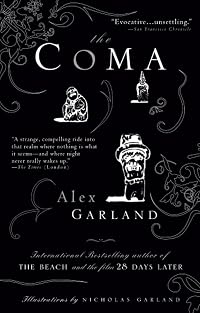
The Coma
by Alex Garland
On This Page
Description
When Carl awakens from a coma after being attacked on a subway train, life around him feels unfamiliar, even strange. He arrives at his best friend's house without remembering how he got there; he seems to be having an affair with his secretary, which is pleasant but surprising. He starts to notice distortions in his experience, strange leaps in his perception of time. Is he truly reacting with the outside world, he wonders, or might he be terribly mistaken? So begins a dark psychological show more drama that raises questions about the the human psyche, dream versus reality, and the boundaries of consciousness. As Carl grapples with his predicament, Alex Garland-author of The Beach and the screenplay for 28 Days Later, plays with conventions and questions our assumptions about the way we exist in the world, even as it draws us into the unsettling and haunting book about a lost suitcase and a forgotten identity. show lessTags
Recommendations









Member Recommendations

Member Reviews
On the back cover of my copy of this, Kazuo Ishiguro states that “The Coma is a bold step towards the creation of a new genre, perhaps even a new art form”, which is ridiculous even for publishers’ blurb. New art form? What this book strongly reminded me of was Philip K Dick’s science-fiction classic, Ubik, published nearly four decades earlier.
The set-up is this: punched and kicked into unconsciousness one night (by four assailants, while trying to defend a fellow passenger on the Tube) Carl reawakens in a hospital bed. Patched up, he’s allowed to return home. But, almost immediately, a series of puzzling incidents set him wondering whether he’d been more badly injured than he’s realised—whether he has, in fact, show more even woken up at all. It soon becomes obvious enough: he hasn’t. What’s “happening” now is happening inside his own head, while in reality he’s still lying in that hospital bed sunk in a coma (this isn’t a huge spoiler; he tells us himself fairly early on, and of course there’s the book’s title). So far, so unremarkable. What he also realises, though, is that his goal should be to wake from this coma. But how? If you realise you’re living in a sort of dream-world, how do you find your way back to the real one? And that’s where it does all begin to get interesting.
If you’re of a mind to (just as with Ubik) you can read Eastern philosophy into all this: our everyday life as the equivalent of a coma, from which we must, somehow, try to wake back to reality. The book’s many completely blank pages, its woodcut illustrations and writing style (very plain, with lots of short simple sentences) are all, I think, intended to enhance this impression. It’s a short read overall too; at no more than seventy or eighty pages of actual text, you can read, mull over, reread…and it was during my second read-through that the penny finally dropped: rereading, perhaps, is itself the key to understanding this book’s odd “ending” in particular. Interesting…
That’s very much the kind of book The Coma is: ancient ideas, sure, dulled by overfamiliarity maybe, but here expressed in a fresh, and much more modern, way. show less
The set-up is this: punched and kicked into unconsciousness one night (by four assailants, while trying to defend a fellow passenger on the Tube) Carl reawakens in a hospital bed. Patched up, he’s allowed to return home. But, almost immediately, a series of puzzling incidents set him wondering whether he’d been more badly injured than he’s realised—whether he has, in fact, show more even woken up at all. It soon becomes obvious enough: he hasn’t. What’s “happening” now is happening inside his own head, while in reality he’s still lying in that hospital bed sunk in a coma (this isn’t a huge spoiler; he tells us himself fairly early on, and of course there’s the book’s title). So far, so unremarkable. What he also realises, though, is that his goal should be to wake from this coma. But how? If you realise you’re living in a sort of dream-world, how do you find your way back to the real one? And that’s where it does all begin to get interesting.
If you’re of a mind to (just as with Ubik) you can read Eastern philosophy into all this: our everyday life as the equivalent of a coma, from which we must, somehow, try to wake back to reality. The book’s many completely blank pages, its woodcut illustrations and writing style (very plain, with lots of short simple sentences) are all, I think, intended to enhance this impression. It’s a short read overall too; at no more than seventy or eighty pages of actual text, you can read, mull over, reread…and it was during my second read-through that the penny finally dropped: rereading, perhaps, is itself the key to understanding this book’s odd “ending” in particular. Interesting…
That’s very much the kind of book The Coma is: ancient ideas, sure, dulled by overfamiliarity maybe, but here expressed in a fresh, and much more modern, way. show less
When Carl wakes up from a coma, which he slipped into after receiving the beating of a lifetime while traveling the subway, his life seems very different from his life before the coma. He experiences black-outs, and discovers strange things about himself that surprise him. As more time passes, Carl grows increasingly confused; is he really out there and awake, or is his mind playing a cruel trick on him?
The Coma takes you on a trip, exploring consciousness and how it intertwines with reality. I finished the book in one sitting. That’s rare for me. (I usually need to put a book down every once in a while and mull it over while keeping myself occupied with other chores and hobbies, and then get back to it later, more attentive.)
Then show more again, the book isn’t even 200 pages long with a large type, wide spacing between sentences and including page-sized (but suitably atmospheric) woodcut illustrations by the author‘s father Nicholas Garland - so that had something to do with it. It didn’t take long, in other words.
Nonetheless, The Coma was unputdownable; it kept me in suspense and wonder. I like being surprised, I like wondering. Oh, I got plenty of that in the form of surreal settings and dreamlike descriptions.
“What the [….]?” (insert curse word of your own preference; mine started with an ‘f’) was exclaimed a countless amount of times. My eyebrows found their way up, nearing my hairline, throughout most of the book. I reread paragraphs to make sense of it all.
Oh yes, I felt intrigued at first, but taken for a fool as I neared the ending. (Yet I kept hoping for something. After all, Alex Garland wrote “The Beach” and the screenplay for “28 Days Later”.) As much as I like being a bit of a detective as I read (which is what appeals me to reading mysteries; feeling as if I‘m actively thinking with the narrator), I also need to feel like I’m going somewhere. Alex Garland didn’t offer me that. And then I reached the end, and I felt robbed.
The experience reminded me of Michael Douglas in that movie, “The Game”. Yeah thanks for watching it was all a joke, SURPRISE, hahahahaha. Haaaaa. There’s two hours of my life that I am NEVER, EVER getting back. And The Coma, similarly, fell flat.
Even though this book was clearly more about the reading experience, exploring the dream state, The Coma was more like an indulgent writing exercise for the writer; in my opinion, it should have stayed in his drawer, or it should have been rewritten to have more substance before being published. I’m positive Garland is a fine writer, I got that from his prose in this book, but The Coma didn’t serve as the best first impression. Luckily, I purchased this book for a few euros at a book fair.
I could end this review cleverly with a, “This book was so boring, it nearly put me to sleep!” But that would be untrue. It wasn’t boring. But with an ending such as this, in hindsight I feel that I have wasted my time. Time I now think would have been better spent actually asleep, dreaming my own dreams.
Find the review and an accompanying portrait at the Reading & Reviewing blog: http://ofbooks.blogspot.com/2009/09/r-057-coma.html show less
The Coma takes you on a trip, exploring consciousness and how it intertwines with reality. I finished the book in one sitting. That’s rare for me. (I usually need to put a book down every once in a while and mull it over while keeping myself occupied with other chores and hobbies, and then get back to it later, more attentive.)
Then show more again, the book isn’t even 200 pages long with a large type, wide spacing between sentences and including page-sized (but suitably atmospheric) woodcut illustrations by the author‘s father Nicholas Garland - so that had something to do with it. It didn’t take long, in other words.
Nonetheless, The Coma was unputdownable; it kept me in suspense and wonder. I like being surprised, I like wondering. Oh, I got plenty of that in the form of surreal settings and dreamlike descriptions.
“What the [….]?” (insert curse word of your own preference; mine started with an ‘f’) was exclaimed a countless amount of times. My eyebrows found their way up, nearing my hairline, throughout most of the book. I reread paragraphs to make sense of it all.
Oh yes, I felt intrigued at first, but taken for a fool as I neared the ending. (Yet I kept hoping for something. After all, Alex Garland wrote “The Beach” and the screenplay for “28 Days Later”.) As much as I like being a bit of a detective as I read (which is what appeals me to reading mysteries; feeling as if I‘m actively thinking with the narrator), I also need to feel like I’m going somewhere. Alex Garland didn’t offer me that. And then I reached the end, and I felt robbed.
The experience reminded me of Michael Douglas in that movie, “The Game”. Yeah thanks for watching it was all a joke, SURPRISE, hahahahaha. Haaaaa. There’s two hours of my life that I am NEVER, EVER getting back. And The Coma, similarly, fell flat.
Even though this book was clearly more about the reading experience, exploring the dream state, The Coma was more like an indulgent writing exercise for the writer; in my opinion, it should have stayed in his drawer, or it should have been rewritten to have more substance before being published. I’m positive Garland is a fine writer, I got that from his prose in this book, but The Coma didn’t serve as the best first impression. Luckily, I purchased this book for a few euros at a book fair.
I could end this review cleverly with a, “This book was so boring, it nearly put me to sleep!” But that would be untrue. It wasn’t boring. But with an ending such as this, in hindsight I feel that I have wasted my time. Time I now think would have been better spent actually asleep, dreaming my own dreams.
Find the review and an accompanying portrait at the Reading & Reviewing blog: http://ofbooks.blogspot.com/2009/09/r-057-coma.html show less
Getting into reading Alex Garland's work. After Annihilation came out I became aware that we was / is a novelist. Not sure if he has anything forthcoming but if he does I would love to read it since, for me, The Coma was a great read. Garland takes a disjointed approach to the short novel and the effect is, as intended, dream like, surreal, and thoroughly off-kilter. His written work here is really amazing approach to creating the effect to keep the reader just out of the loop till the end / endish.
The story centers around a man who is the victim of a violent crime on the subway. From there the story goes into and out of scenes and the reader is kept guessing as to what is happening or not happening. There are scenes and sections and show more short chapters that keep things moving and are filled with imagery and descriptions that are sure to stick with you. The short novel is enhanced by really great woodcuts by Alex Garlands father and they really help to propel the story forward as well. I found myself flipping back and forth between chapters and woodcuts through the entire read.
The Coma is a suberb short read. I will be reading it again - it was so very good. show less
The story centers around a man who is the victim of a violent crime on the subway. From there the story goes into and out of scenes and the reader is kept guessing as to what is happening or not happening. There are scenes and sections and show more short chapters that keep things moving and are filled with imagery and descriptions that are sure to stick with you. The short novel is enhanced by really great woodcuts by Alex Garlands father and they really help to propel the story forward as well. I found myself flipping back and forth between chapters and woodcuts through the entire read.
The Coma is a suberb short read. I will be reading it again - it was so very good. show less
Coma starts off very promisingly; Carl is in a coma, and we suffer along with him all his experiences, never sure what is real and what imagined, never sure what is his real state or condition. Up to this point it is a fascinating read, and we are probably switching from one opinion to another as to what the reality is, however when we finally learn what the reality is comes as something of a let down. There is no question about the quality of the writing and how well it conveys dream like images, but its drift toward a somewhat predicable conclusion seems to be a lost opportunity, an opportunity for something really imaginative.
The Coma has a simple premise: while commuting home late one night, a man named Carl tries to protect a woman from thugs on a train and finds himself brutally assaulted. After being released from hospital he realises that something is wrong: his life is disjointed, impossible things are happening, and he seems to be hallucinating. He soon realises that he never left the hospital at all, and that he is trapped in a coma. Realising that he must be the instrument of his own salvation, he sets about exploring the dreamscape in an effort to wake up.
Clocking in at around two hundred pages (this is one of the first books I've read in ages that doesn't number its pages; I got the count off Amazon), many of which are white space of woodcut show more illustrations made by garland's father, The Coma is a quick and easy read. It had to be, of course - an exploration of one's mental landscape, with all the metaphors and weirdness required, would be far too tedious to cover a whole novel. As it stands, Garland manages the description quite well, and The Coma never feels like a chore to read - although novellas rarely do.
It does work quite well as a story, with a few glimpses of figures in Carl's hospital room making intriguing statements providing mystery, plus the simple desire to find out whether or not he successfully wakes up. There's also an unsettling sense of eerie alienation, with a few genuinely disturbing scenes; this is a book that could very easily be adapted into a horror film.
Interesting enough to hold my attention. Not worth seeking out, but certainly worth the $5 for which I bought it at Borders' holy-shit-we-are-on-the-brink-of-bankruptcy sale. show less
Clocking in at around two hundred pages (this is one of the first books I've read in ages that doesn't number its pages; I got the count off Amazon), many of which are white space of woodcut show more illustrations made by garland's father, The Coma is a quick and easy read. It had to be, of course - an exploration of one's mental landscape, with all the metaphors and weirdness required, would be far too tedious to cover a whole novel. As it stands, Garland manages the description quite well, and The Coma never feels like a chore to read - although novellas rarely do.
It does work quite well as a story, with a few glimpses of figures in Carl's hospital room making intriguing statements providing mystery, plus the simple desire to find out whether or not he successfully wakes up. There's also an unsettling sense of eerie alienation, with a few genuinely disturbing scenes; this is a book that could very easily be adapted into a horror film.
Interesting enough to hold my attention. Not worth seeking out, but certainly worth the $5 for which I bought it at Borders' holy-shit-we-are-on-the-brink-of-bankruptcy sale. show less
Alex Garland wrote The Beach and the screenplay for 28 Days Later, so I was expecting something a bit less predictable from this shortish story, illustrated with woodcuts by his father, political cartoonist Nicholas Garland. The Coma makes the reader think, but our thought-lines run in fairly obvious directions, as does Carl’s, the narrator and coma patient. It has – or could have, if Garland had let it – an interesting psychological angle, and there are moments that provoke an unsettled reaction, but as professional a writer as Garland obviously is, I can’t help feeling that the subject and event line were pulled from a list of college essay-writing options.
An easy read, not a complete waste of time, but I was left with the show more urge to smack the author about the head and point out that he’s a high calibre writer who can deliver better. show less
An easy read, not a complete waste of time, but I was left with the show more urge to smack the author about the head and point out that he’s a high calibre writer who can deliver better. show less
bought the novel The Coma a few weeks back because it is written by the fellow who wrote the screenplay for 28 Days Later, and because it was really cheap. I like buying books that are 80% off at Indigo. You can get it at Indigo for $7—in hardcover no less. I don’t want to tell you much about the novel’s plot, because its twists and turns are probably the best thing about it. I will tell you the book starts with a vicious beating that leaves a man in a coma, and continues from there. It’s quite short, and can be finished quite quickly. I read it on my commute to work over the course of a few days. The book is really quite interesting; it’s very well thought out—at least I thought so. If you are looking for something to read, show more I recommend you check this out. -- http://funkaoshi.com/blog/the-coma show less
Members
- Recently Added By
Lists

Lit Lattes Ep 006
12 works; 1 member
Author Information

23+ Works 9,065 Members
Born in London in 1970, Alex Garland published his first novel, The Beach, when he was 26. Set among a group of backpackers in Southeast Asia, The Beach is a fast-paced and suspenseful thriller that has been called the first serious Generation X novel. Like The Lord of the Flies, to which it has sometimes been compared, The Beach deals with a dark show more side of humanity, revealed when the characters find themselves set apart from civilization. Garland's second novel, The Tesseract, was published in 1998 and is also set in Southeast Asia, this time in the Philippines. The Tesseract follows the lives of several different characters during one night in Manila, with the different stories all coming together to meet in an explosive ending. (Bowker Author Biography) show less
Awards and Honors
Common Knowledge
Classifications
Statistics
- Members
- 1,048
- Popularity
- 24,632
- Reviews
- 23
- Rating
- (3.17)
- Languages
- 8 — Dutch, English, French, German, Italian, Portuguese, Russian, Spanish
- Media
- Paper, Audiobook, Ebook
- ISBNs
- 23
- UPCs
- 4
- ASINs
- 4