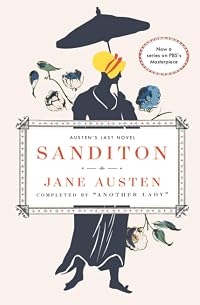
Sanditon
by Jane Austen, Another Lady, Anne Telscombe
On This Page
Description
In the vein of Downton Abbey, Jane Austen's beloved but unfinished masterpiece—often considered her most modern and exciting novel—gets a spectacular second act in this tie-in to a major new limited television series.Written only months before Austen's death in 1817, Sanditon tells the story of the joyously impulsive, spirited and unconventional Charlotte Heywood and her spiky relationship with the humorous, charming (and slightly wild!) Sidney Parker. When a chance accident transports show more her from her rural hometown of Willingden to the would-be coastal resort of the eponymous title, it exposes Charlotte to the intrigues and dalliances of a seaside town on the make, and the characters whose fortunes depend on its commercial success. The twists and turns of the plot, which takes viewers from the West Indies to the rotting alleys of London, exposes the hidden agendas of each character and sees Charlotte discover herself... and ultimately find love. show less
Tags
Recommendations








Member Recommendations
merry10 Reginald Hill makes a homage to Jane Austen, basing the structure of the novel and character names on Sanditon, Jane Austen's unfinished novel.
Member Reviews
*Please note: the author, who published this under the name of "Another Lady" also publishes under the names Anne Telscombe and Marie Dobbs. I'm not sure if either is her real name, but for the sake of brevity, I'm calling her "Dobbs" from here on out.
To properly explain to you why I love this novel, first I need to set the scene: the year was 2008, I wasn't blogging yet, and was in need of some structure; I was planning my summer reading and wishing for something like Jane Austen, when I realized that there were all these adaptations out there. At first, I was a bit startled. People would dare to "continue" and "adapt" Jane Austen? The horror. But then I thought, Maybe I could just embrace it? Maybe I could have a "Summer of Jane" and show more read all the adaptations I can get my hands on... (sound familiar?) Well, it didn't work out quite the way I'd planned, because the first few I picked up (the names long since forgotten) were dreadful. Awful, awful, awful stuff. In fact, I had just read another completion of Jane Austen's last unfinished work (ie this one) called "Charlotte" - about which I wrote my most scathing review EVER...only to have a Goodreads pageload error when I hit publish and I lost everything. Thwarted!
Anyway, I was about to give up and write off all Austen adaptations as puerile trash, but I had one more book in my stack of library books that was waiting to be read. I was really hesitant to read it, not only because it was another Austen adaptation, but because it was an adaptation of the very same work I'd just finished and loathed. Even if it turned out marginally better (I wasn't expecting much), I doubted I'd be able to separate it from the crap that filled the other book. But I decided to suck it up and give it a chance, and oh my sweet Jane, if it didn't completely change my mind about Austen adaptations. It was a revelation.
Now, I'm not saying this was perfect by any means. And I don't know how Jane Herself would have actually finished out the story (the fragment, if you didn't know, is 11 chapters long, so a good amount of the groundwork had been laid), but I have to say, Dobbs did a really admirable job of taking what she had to work with, parsing it out and figuring out where Austen may have intended the story to go, as well as where modern readers might want it to go, and then embracing that and going there. Aside from one particular sub-plot (that of the foolish wannabe-rake who takes things too far), I really didn't have any trouble believing that the story Dobbs presented was the one Jane intended. It has her characteristic wit, and skewers the foibles of a population in a very Jane-like way. The hero and heroine Dobbs presents feel very well-suited to each other and to Austen's world, like they may be close to what Austen intended of them, and most of the things they go through worked for me.
I was also very impressed with how seamlessly Dobbs blended her writing with Austen's. I was so invested in the story (both the first and second times I read it) that I was 3/4 of the way through before I ever had the thought to wonder where specifically Austen's fragment left off and Dobbs writing picked up. I had to google, and then flip back and forth and compare. Dobbs did a very admirable job of mimicking Austen's tone and style without feeling forced or hitting many false notes. She captured that sly sense of humor, the sharp eye towards the follies of others, the characterization, the structure - she really took her time to make the story and the style - Austen's style - shine, rather than letting her own style intrude. Rather, when it came time for her to take over the story, she injected her style gradually, so that - even though the plot does become more absurd and somewhat modern in its telling - the transition happens at such a good pace, and the style remains consistent enough, that the reader is never jarred out of the story by an abrupt shift in style or content.
Now, four years later, my "Summer of Jane" - which was to be a single, read-it-all and move on project - has evolved into a yearly tradition, and I've stumbled across many more good - and more than my share of bad - adaptations. To make sure my enjoyment of Sanditon wasn't a fluke due to the horrid nature of the other adaptations I'd read, I bought a copy and curled up with it for a second time. It wasn't a fluke; I fell just as in love with it as I did the first time around, and if it weren't for the fact that people would look at me like, Who? in Austen conversations, I'd talk just as readily of Charlotte and Sidney as I do of Elizabeth and Darcy, Catherine and Tilney, Wentworth and Anne... This was the first Austen adaptation I read that made me feel anything even close to what I felt the first time I read any of Austen's works, and it remains one of the few to have done so. show less
To properly explain to you why I love this novel, first I need to set the scene: the year was 2008, I wasn't blogging yet, and was in need of some structure; I was planning my summer reading and wishing for something like Jane Austen, when I realized that there were all these adaptations out there. At first, I was a bit startled. People would dare to "continue" and "adapt" Jane Austen? The horror. But then I thought, Maybe I could just embrace it? Maybe I could have a "Summer of Jane" and show more read all the adaptations I can get my hands on... (sound familiar?) Well, it didn't work out quite the way I'd planned, because the first few I picked up (the names long since forgotten) were dreadful. Awful, awful, awful stuff. In fact, I had just read another completion of Jane Austen's last unfinished work (ie this one) called "Charlotte" - about which I wrote my most scathing review EVER...only to have a Goodreads pageload error when I hit publish and I lost everything. Thwarted!
Anyway, I was about to give up and write off all Austen adaptations as puerile trash, but I had one more book in my stack of library books that was waiting to be read. I was really hesitant to read it, not only because it was another Austen adaptation, but because it was an adaptation of the very same work I'd just finished and loathed. Even if it turned out marginally better (I wasn't expecting much), I doubted I'd be able to separate it from the crap that filled the other book. But I decided to suck it up and give it a chance, and oh my sweet Jane, if it didn't completely change my mind about Austen adaptations. It was a revelation.
Now, I'm not saying this was perfect by any means. And I don't know how Jane Herself would have actually finished out the story (the fragment, if you didn't know, is 11 chapters long, so a good amount of the groundwork had been laid), but I have to say, Dobbs did a really admirable job of taking what she had to work with, parsing it out and figuring out where Austen may have intended the story to go, as well as where modern readers might want it to go, and then embracing that and going there. Aside from one particular sub-plot (that of the foolish wannabe-rake who takes things too far), I really didn't have any trouble believing that the story Dobbs presented was the one Jane intended. It has her characteristic wit, and skewers the foibles of a population in a very Jane-like way. The hero and heroine Dobbs presents feel very well-suited to each other and to Austen's world, like they may be close to what Austen intended of them, and most of the things they go through worked for me.
I was also very impressed with how seamlessly Dobbs blended her writing with Austen's. I was so invested in the story (both the first and second times I read it) that I was 3/4 of the way through before I ever had the thought to wonder where specifically Austen's fragment left off and Dobbs writing picked up. I had to google, and then flip back and forth and compare. Dobbs did a very admirable job of mimicking Austen's tone and style without feeling forced or hitting many false notes. She captured that sly sense of humor, the sharp eye towards the follies of others, the characterization, the structure - she really took her time to make the story and the style - Austen's style - shine, rather than letting her own style intrude. Rather, when it came time for her to take over the story, she injected her style gradually, so that - even though the plot does become more absurd and somewhat modern in its telling - the transition happens at such a good pace, and the style remains consistent enough, that the reader is never jarred out of the story by an abrupt shift in style or content.
Now, four years later, my "Summer of Jane" - which was to be a single, read-it-all and move on project - has evolved into a yearly tradition, and I've stumbled across many more good - and more than my share of bad - adaptations. To make sure my enjoyment of Sanditon wasn't a fluke due to the horrid nature of the other adaptations I'd read, I bought a copy and curled up with it for a second time. It wasn't a fluke; I fell just as in love with it as I did the first time around, and if it weren't for the fact that people would look at me like, Who? in Austen conversations, I'd talk just as readily of Charlotte and Sidney as I do of Elizabeth and Darcy, Catherine and Tilney, Wentworth and Anne... This was the first Austen adaptation I read that made me feel anything even close to what I felt the first time I read any of Austen's works, and it remains one of the few to have done so. show less
When I first read this completion of Jane Austen's fragment some years ago, I thought it was pretty good. This time through, I loved it.
It's possible that more exposure to Regency chick-lit and JA fan-fic has shown me just how rare it is for an author to creditably handle the language of that period, and the style of Austen. Because I was so much more impressed this time around. I don't think the "other lady" puts a foot wrong in her completion of the novel. It's fun, funny, and deftly worded.
Jane Austen's plot set-up is as follows: Charlotte Heywood and her family make friends with the Parkers, who invite her to come stay with them for a while at Sanditon, which is an up-and-coming seaside resort that Mr. Parker is heavily invested show more in. They arrive in town and Charlotte starts to meet the quirky people who live there or are visiting. There's Lady Denham (shades of Lady Catherine). There's her beautiful young relative Clara, who seems to have a secret. There's Sir Edward, a fool who imagines he's a villain. And there's Mr. Parker's siblings who are egregious hypochondriacs.
Jane Austen manages to introduce all of these people, but you know who she barely gets to introduce before coming to a screeching halt?
Sidney.
The hero.
He literally drives up in his carriage and doesn't really get to say anything just moments before Austen's part of the story ends. We know he's going to be Charlotte's guy because Austen has her characters mention him repeatedly before he arrives, and he sounds like a bit of a Henry Tilney. What could be better? Nothing!
In this completion, Sidney is every bit as interesting as he's set up to be. He's witty, he's surprising, he's intelligent, and he's a plotter... just enough to make Charlotte question how far she should trust him. I loved their interactions, and the mild amount of mystery surrounding his actions. I also loved how hard Charlotte genuinely tries to be sensible and balanced, even while Sidney is completely sweeping the rug out from under her feet. It's a satisfying read about falling in love. show less
It's possible that more exposure to Regency chick-lit and JA fan-fic has shown me just how rare it is for an author to creditably handle the language of that period, and the style of Austen. Because I was so much more impressed this time around. I don't think the "other lady" puts a foot wrong in her completion of the novel. It's fun, funny, and deftly worded.
Jane Austen's plot set-up is as follows: Charlotte Heywood and her family make friends with the Parkers, who invite her to come stay with them for a while at Sanditon, which is an up-and-coming seaside resort that Mr. Parker is heavily invested show more in. They arrive in town and Charlotte starts to meet the quirky people who live there or are visiting. There's Lady Denham (shades of Lady Catherine). There's her beautiful young relative Clara, who seems to have a secret. There's Sir Edward, a fool who imagines he's a villain. And there's Mr. Parker's siblings who are egregious hypochondriacs.
Jane Austen manages to introduce all of these people, but you know who she barely gets to introduce before coming to a screeching halt?
Sidney.
The hero.
He literally drives up in his carriage and doesn't really get to say anything just moments before Austen's part of the story ends. We know he's going to be Charlotte's guy because Austen has her characters mention him repeatedly before he arrives, and he sounds like a bit of a Henry Tilney. What could be better? Nothing!
In this completion, Sidney is every bit as interesting as he's set up to be. He's witty, he's surprising, he's intelligent, and he's a plotter... just enough to make Charlotte question how far she should trust him. I loved their interactions, and the mild amount of mystery surrounding his actions. I also loved how hard Charlotte genuinely tries to be sensible and balanced, even while Sidney is completely sweeping the rug out from under her feet. It's a satisfying read about falling in love. show less
Another ‘continuation’ or ‘completion’ of a Jane Austen work in progress, though Marie Dobbs’ take on Sanditon, which Austen began six months before her death in 1817, falls short of the original chapters, in my opinion. No author can successfully imitate Austen’s style or humour, and granted, the finished six novels in her compact oeuvre are limited in plot and players, but Dobbs doesn’t develop one likeable or sympathetic character and the story, such as it is, merely follows the direction of Emma and Northanger Abbey.
The first eleven chapters penned by Austen introduce the cast and set the scene. A carriage overturns in a small town on the Sussex coast, and the gentleman travelling within seeks medical assistance for a show more threatened sprained ankle. He is Mr Parker of Sanditon, a seaside village, with his wife, Mrs Parker. They meet a kind farmer by the name of Mr Heywood, who takes the beleaguered travellers home to meet his family of a wife and fourteen children. In return, the Parkers offer to transport the whole Heywood family on with them to Sanditon, which Mr Parker likes to promote as a bathing place and modern health resort. Mr Heywood declines on his own part, but accepts for his eldest daughter, Charlotte, who becomes the Parkers’ house guest. When the three of them finally reach Sanditon, Charlotte finds not a populous location like Brighton or Eastbourne, but instead a small community by the sea, being slowly transformed into an up and coming holiday destination by Mr Parker and his co-sponsor, Lady Denham. There she meets Mr Parker’s brothers, Sidney and Arthur, and his two hypochondriac sisters, Susan and Diana. Lady Denham’s hateful relations are also on the scene, including the pompous and ridiculous Sir Edward and his sister Miss Denham, plus a distant cousin, Clara Brereton, who is on probation as Lady Denham’s companion. And a veritable influx of summer guests are promised to arrive at Sanditon any day, but there might be some confusion as to numbers.
And then, after presenting all of Sanditon’s inhabitants to the reader and hinting at a secret romance between two of the characters, Jane Austen died. Marie Dobbs picks up on mid-paragraph, but loses the irony and sharp wit of Austen’s writing in almost the same chapter. Instead of letting the characters make fools of themselves, Dobbs mocks them through the penetrating observations of her snotty heroine, Charlotte. Austen’s Sir Edward spends half a page expounding on romance novels, but Dobbs cuts to the chase, and condemns him for using ‘nonsensical words and inappropriate quotations’. Charlotte herself turns from a laughing Elizabeth Bennet into a prudish Fanny Price, and seems ill-matched with the only decent suitor of the set, Mr Parker’s brother Sidney, who is himself an unappealing combination of Frank Churchill and Henry Tilney. The rest of the characters are little more than caricatures, from the fussy Parker sisters to the Misses Steele – sorry, wrong novel – Beaufort, staying at the hotel. I don’t mind comic relief, if the characters are actually amusing, or at least pleasant, but I didn’t even like the heroine of this novel. The only pair I was actually happy for was Arthur Parker and Miss Lambe, who at least didn’t mess around and deserved their happiness.
The direction of the story is fairly predictable, and painfully slow to get to the point – which is fine when reading Austen, but not a pale imitation. There are pages of dialogue about toast and seaweed, all in the proper language but not really helpful to the plot and tedious to read. The romances are signalled from the beginning, and the lovers too flat and pathetic to care about. I think Dobbs was struggling with so many names and relationships, because nobody really makes the grade in the end. How I wish Austen could have finished her own novel, or at least written a few more notes before she died. show less
The first eleven chapters penned by Austen introduce the cast and set the scene. A carriage overturns in a small town on the Sussex coast, and the gentleman travelling within seeks medical assistance for a show more threatened sprained ankle. He is Mr Parker of Sanditon, a seaside village, with his wife, Mrs Parker. They meet a kind farmer by the name of Mr Heywood, who takes the beleaguered travellers home to meet his family of a wife and fourteen children. In return, the Parkers offer to transport the whole Heywood family on with them to Sanditon, which Mr Parker likes to promote as a bathing place and modern health resort. Mr Heywood declines on his own part, but accepts for his eldest daughter, Charlotte, who becomes the Parkers’ house guest. When the three of them finally reach Sanditon, Charlotte finds not a populous location like Brighton or Eastbourne, but instead a small community by the sea, being slowly transformed into an up and coming holiday destination by Mr Parker and his co-sponsor, Lady Denham. There she meets Mr Parker’s brothers, Sidney and Arthur, and his two hypochondriac sisters, Susan and Diana. Lady Denham’s hateful relations are also on the scene, including the pompous and ridiculous Sir Edward and his sister Miss Denham, plus a distant cousin, Clara Brereton, who is on probation as Lady Denham’s companion. And a veritable influx of summer guests are promised to arrive at Sanditon any day, but there might be some confusion as to numbers.
And then, after presenting all of Sanditon’s inhabitants to the reader and hinting at a secret romance between two of the characters, Jane Austen died. Marie Dobbs picks up on mid-paragraph, but loses the irony and sharp wit of Austen’s writing in almost the same chapter. Instead of letting the characters make fools of themselves, Dobbs mocks them through the penetrating observations of her snotty heroine, Charlotte. Austen’s Sir Edward spends half a page expounding on romance novels, but Dobbs cuts to the chase, and condemns him for using ‘nonsensical words and inappropriate quotations’. Charlotte herself turns from a laughing Elizabeth Bennet into a prudish Fanny Price, and seems ill-matched with the only decent suitor of the set, Mr Parker’s brother Sidney, who is himself an unappealing combination of Frank Churchill and Henry Tilney. The rest of the characters are little more than caricatures, from the fussy Parker sisters to the Misses Steele – sorry, wrong novel – Beaufort, staying at the hotel. I don’t mind comic relief, if the characters are actually amusing, or at least pleasant, but I didn’t even like the heroine of this novel. The only pair I was actually happy for was Arthur Parker and Miss Lambe, who at least didn’t mess around and deserved their happiness.
The direction of the story is fairly predictable, and painfully slow to get to the point – which is fine when reading Austen, but not a pale imitation. There are pages of dialogue about toast and seaweed, all in the proper language but not really helpful to the plot and tedious to read. The romances are signalled from the beginning, and the lovers too flat and pathetic to care about. I think Dobbs was struggling with so many names and relationships, because nobody really makes the grade in the end. How I wish Austen could have finished her own novel, or at least written a few more notes before she died. show less
Loved it. I know most of it was not Jane Austen's work, but we still have her to thank for almost all the characters and that wonderful scene with Arthur Parker trying to justify buttering his toast by saying it was "for the coats of the stomach," my first laugh-out-loud moment of the book. The romance was sweet, and I thought "the other lady" did a delightful job with the characters. Sidney and Charlotte's turns at thwarting each other was very entertaining, and I was happy to see one of my favorites, Arthur Parker, have a nice little side story too. I highly recommend it.
I wouldn't like to say that it was impossible for another author to complete Jane Austen's unfinished novel, Sandition, or to pen a sequel worthy of her masterpieces, but I have simply never seen it done. Sadly, this book did not prove me wrong...
I am not sure who "Another Lady" may be, but as admirable as I find her attempt, her prose is no match for the witty Jane, and I recall being instantly aware of the change in authorship, when passing from the eleventh to the twelfth chapter. How I wish that Austen had been able to complete this novel... but as she didn't, I must simply reconcile myself to the fact that there will be no more Jane Austen discoveries for me...
Unless, of course, I decide to read her letters... hmmm - now there's an show more idea! show less
I am not sure who "Another Lady" may be, but as admirable as I find her attempt, her prose is no match for the witty Jane, and I recall being instantly aware of the change in authorship, when passing from the eleventh to the twelfth chapter. How I wish that Austen had been able to complete this novel... but as she didn't, I must simply reconcile myself to the fact that there will be no more Jane Austen discoveries for me...
Unless, of course, I decide to read her letters... hmmm - now there's an show more idea! show less
Jane Austen began this novel not long before her death and she never had a chance to finish it. I had expected the written version to mimic Jane Austen’s refined prose; however, this proved not to be the case. It is a shame that Austen could not finish this book because the premise is unlike anything she had previously written.
The storyline involves a strong female character, Charlotte Heywood, who meets Mr. & Mrs. Parker due to a carriage accident that occurs near her home at Willingden, Sussex, where she lives with her parents and siblings. She is later invited to the visit and stay with the Parkers. Mr. Parker is an entrepreneur who is transforming a small fishing village into a seaside resort at Sanditon. Charlotte meets the show more second son of Mr. and Mrs. Parker, and it appears a relationship may develop between the two.
This is where the new material begins. It includes much more contemporary content than anything ever written by Jane Austen. It includes cursing, anachronisms, and much more sexual content than anything in Austen’s chaste romances. I did not care for the new material. I wish there had been some attempt to blend the two styles. Oh well. For me, the first half is great. The second is awful. show less
The storyline involves a strong female character, Charlotte Heywood, who meets Mr. & Mrs. Parker due to a carriage accident that occurs near her home at Willingden, Sussex, where she lives with her parents and siblings. She is later invited to the visit and stay with the Parkers. Mr. Parker is an entrepreneur who is transforming a small fishing village into a seaside resort at Sanditon. Charlotte meets the show more second son of Mr. and Mrs. Parker, and it appears a relationship may develop between the two.
This is where the new material begins. It includes much more contemporary content than anything ever written by Jane Austen. It includes cursing, anachronisms, and much more sexual content than anything in Austen’s chaste romances. I did not care for the new material. I wish there had been some attempt to blend the two styles. Oh well. For me, the first half is great. The second is awful. show less
I have been saving up this book for myself for two reasons. First, it's Jane Austen's last novel — once I read this, there remain only a few fragments of her work that I have not devoured. Alas. And second, I was afraid that the completion of the story (written in 1975) by "Another Lady" would disappoint. I was correct on both counts. Do be aware that this review will contain spoilers.
Charlotte Heywood is a sensible young woman of twenty-two, the eldest child in a family of fourteen children. Because of the number of children, the Heywoods are never able to visit anywhere fashionable. So when chance throws the Heywoods together with the gentleman proprietor of a new seaside resort, Sanditon, the family is delighted that Charlotte is show more invited to spend the summer there. The Parkers are a kind and respectable family, though Mr. Parker is perhaps a trifle gullible on the point of his pet project, Sanditon.
When Charlotte arrives, she finds plentiful subjects for her great pleasure, observing the behavior of others. Lady Denham is the principal leader of Sanditon society, and despite her riches she is shamefully parsimonious, selfish, and mean. Her suspicious nature makes life very difficult for her dependent cousin, the lovely Miss Clara Brereton. Sir Edward Denham and his sister Miss Denham are hangers-on at Lady Denham's elbow, hoping for a share of the inheritance. Sir Edward — a passionate young man with more feeling than sense — hopes to woo the fair Clara. But what does Clara want?
Add to the mix a young mulatto heiress of weak health, Miss Lambe; two coquettish young fortune-hunters, the Misses Beaufort; Mr. Parker's two hypochondriac sisters, Diana and Susan, who have taught their other brother, Arthur, to be as worried over his health as they; and Mr. Sidney Parker, the last of the Parker siblings, who is a joking, intelligent, and apparently untruthful young man. He brings his two friends, Henry Brudenall and Reginald Catton, to the neighborhood as well. The young ladies are excessively interested in the possibilities afforded by the influx of so many eligible gentlemen. Charlotte, feeling herself possessed of no particular beauty or fortune to tempt any of them, is content to observe the machinations of the party as each person politely connives to get his way.
Jane Austen's part of the story ends with chapter eleven, and it really is a pity that she was unable to finish. I would love to know the full storyline that she had in mind. While it is not immediately apparent where the join comes in, things get a little out of hand as the story progresses. The plot becomes a bit uncharacteristic and the characters begin to say and do things that do not always feel authentic. Sir Edward, for example, seems altogether unfit to be an Austenian character (even for a villain) when he fails to carry off Clara and decides to abduct Charlotte instead. I know Austen laid the foundation for this with Sir Edward's unhealthy obsession with novels in which the hero can never control his passion for the heroine, but eesh! Abduction in an Austen novel?
The person most inconsistent with the Austenian formula, however, is Charlotte herself. I can understand how she would inadvertently fall in love with Sidney, but to confess that she would have done whatever he wanted, regardless of her moral convictions — it just doesn't feel right. Austen's heroines are perhaps weak at times in controlling their feelings, but they can always control their actions and regulate their behavior with good sense. The way it sounds in this book is that Charlotte would have eloped with Sidney, against all her notions of morality, if he had but asked her. Sidney's desire, to have a wife who is sensible in all things except him, comes across as egotistical and selfish rather than amusing (as it would seem that "Another Lady" intended). The justification for all the lies he tells throughout the story feels a bit threadbare.
But there were some good points with the completion, too. I enjoyed the other characters and found them mostly believable. The dialogue was fairly good, though sometimes the acerbic narrative asides were a bit too pointed ("look at me! I'm being snarky in Regency language!"). However, I was mollified by the note at the end of the completion, in which the author gives the reasons for her plot additions and apologizes for the deficiencies of her work. It's good that she acknowledges that she cannot perfectly imitate Austen's style — because, of course, she can't. I'm not sure anyone can. "Another Lady" was certainly brave to make the attempt!
Overall I would say I enjoyed this quite a bit, despite its flaws. It was wonderful escaping to another Austenian world, with all its absurd characters who are somehow believable. I would tweak the completion a bit, mostly in terms of the abduction scene and the moral character of Charlotte, but I'm glad I read it. And it could have been much worse; with the "continuations" of Austen's novels written nowadays, with graphic sex scenes and extremely modern characters, I feel very thankful that this completion did not veer into territory so antithetical to Austen's portrayal of Regency England. It could have been better, but it also could have been much worse, and I believe that most Austen fans would enjoy this. An enjoyable read. show less
Charlotte Heywood is a sensible young woman of twenty-two, the eldest child in a family of fourteen children. Because of the number of children, the Heywoods are never able to visit anywhere fashionable. So when chance throws the Heywoods together with the gentleman proprietor of a new seaside resort, Sanditon, the family is delighted that Charlotte is show more invited to spend the summer there. The Parkers are a kind and respectable family, though Mr. Parker is perhaps a trifle gullible on the point of his pet project, Sanditon.
When Charlotte arrives, she finds plentiful subjects for her great pleasure, observing the behavior of others. Lady Denham is the principal leader of Sanditon society, and despite her riches she is shamefully parsimonious, selfish, and mean. Her suspicious nature makes life very difficult for her dependent cousin, the lovely Miss Clara Brereton. Sir Edward Denham and his sister Miss Denham are hangers-on at Lady Denham's elbow, hoping for a share of the inheritance. Sir Edward — a passionate young man with more feeling than sense — hopes to woo the fair Clara. But what does Clara want?
Add to the mix a young mulatto heiress of weak health, Miss Lambe; two coquettish young fortune-hunters, the Misses Beaufort; Mr. Parker's two hypochondriac sisters, Diana and Susan, who have taught their other brother, Arthur, to be as worried over his health as they; and Mr. Sidney Parker, the last of the Parker siblings, who is a joking, intelligent, and apparently untruthful young man. He brings his two friends, Henry Brudenall and Reginald Catton, to the neighborhood as well. The young ladies are excessively interested in the possibilities afforded by the influx of so many eligible gentlemen. Charlotte, feeling herself possessed of no particular beauty or fortune to tempt any of them, is content to observe the machinations of the party as each person politely connives to get his way.
Jane Austen's part of the story ends with chapter eleven, and it really is a pity that she was unable to finish. I would love to know the full storyline that she had in mind. While it is not immediately apparent where the join comes in, things get a little out of hand as the story progresses. The plot becomes a bit uncharacteristic and the characters begin to say and do things that do not always feel authentic. Sir Edward, for example, seems altogether unfit to be an Austenian character (even for a villain) when he fails to carry off Clara and decides to abduct Charlotte instead. I know Austen laid the foundation for this with Sir Edward's unhealthy obsession with novels in which the hero can never control his passion for the heroine, but eesh! Abduction in an Austen novel?
The person most inconsistent with the Austenian formula, however, is Charlotte herself. I can understand how she would inadvertently fall in love with Sidney, but to confess that she would have done whatever he wanted, regardless of her moral convictions — it just doesn't feel right. Austen's heroines are perhaps weak at times in controlling their feelings, but they can always control their actions and regulate their behavior with good sense. The way it sounds in this book is that Charlotte would have eloped with Sidney, against all her notions of morality, if he had but asked her. Sidney's desire, to have a wife who is sensible in all things except him, comes across as egotistical and selfish rather than amusing (as it would seem that "Another Lady" intended). The justification for all the lies he tells throughout the story feels a bit threadbare.
But there were some good points with the completion, too. I enjoyed the other characters and found them mostly believable. The dialogue was fairly good, though sometimes the acerbic narrative asides were a bit too pointed ("look at me! I'm being snarky in Regency language!"). However, I was mollified by the note at the end of the completion, in which the author gives the reasons for her plot additions and apologizes for the deficiencies of her work. It's good that she acknowledges that she cannot perfectly imitate Austen's style — because, of course, she can't. I'm not sure anyone can. "Another Lady" was certainly brave to make the attempt!
Overall I would say I enjoyed this quite a bit, despite its flaws. It was wonderful escaping to another Austenian world, with all its absurd characters who are somehow believable. I would tweak the completion a bit, mostly in terms of the abduction scene and the moral character of Charlotte, but I'm glad I read it. And it could have been much worse; with the "continuations" of Austen's novels written nowadays, with graphic sex scenes and extremely modern characters, I feel very thankful that this completion did not veer into territory so antithetical to Austen's portrayal of Regency England. It could have been better, but it also could have been much worse, and I believe that most Austen fans would enjoy this. An enjoyable read. show less
Members
- Recently Added By
Lists

Books tagged favorites
390 works; 30 members

Famously Incomplete Novels
16 works; 1 member

Reading LIst
648 works; 1 member
Female Protagonist
1,056 works; 57 members
Talk Discussions
Past Discussions
Sanditon in I Love Jane Austen (August 2015)
Is Sanditon Worth Finishing? in I Love Jane Austen (March 2010)
Author Information

722+ Works 318,297 Members
Jane Austen's life is striking for the contrast between the great works she wrote in secret and the outward appearance of being quite dull and ordinary. Austen was born in the small English town of Steventon in Hampshire, and educated at home by her clergyman father. She was deeply devoted to her family. For a short time, the Austens lived in the show more resort city of Bath, but when her father died, they returned to Steventon, where Austen lived until her death at the age of 41. Austen was drawn to literature early, she began writing novels that satirized both the writers and the manners of the 1790's. Her sharp sense of humor and keen eye for the ridiculous in human behavior gave her works lasting appeal. She is at her best in such books as Pride and Prejudice (1813), Mansfield Park (1814), and Emma (1816), in which she examines and often ridicules the behavior of small groups of middle-class characters. Austen relies heavily on conversations among her characters to reveal their personalities, and at times her novels read almost like plays. Several of them have, in fact, been made into films. She is considered to be one of the most beloved British authors. (Bowker Author Biography) show less
1 Work 1,502 Members

4 Works 1,520 Members
Series
Belongs to Publisher Series
Work Relationships
Is contained in
Contains
Is an expanded version of
Is a commentary on the text of
Common Knowledge
- Canonical title*
- Leikkiä ja totta
- Original title
- Sanditon
- Alternate titles*
- Leikkiä ja totta
- Original publication date
- 1975
- People/Characters
- Charlotte Heywood; Sidney Parker; Tom Parker; Clara Brereton; Mary Parker; Sir Edward Denham (show all 17); Lady Denham; Esther Denham; Diana Parker; Susan Parker; Henry Brudenall; Arthur Parker; Miss Lambe; Adela Lambe; Lydia Beaufort; Letitia Beaufort; Reginald Catton
- Important places
- Sanditon, England, UK; Willingden, England, UK; Brinshore, England, UK; Hailsham, England, UK
- First words
- A gentleman and a lady travelling from Tunbridge towards that part of the Sussex coast which lies between Hastings and Eastbourne, being induced by business to quit the high road and attempt a very rough lane, were overturned... (show all) in toiling up its long ascent, half rock, half sand.
- Last words
- (Click to show. Warning: May contain spoilers.)Sanditon itself, to the greater comfort of most of its inhabitants and all of its summer visitors, never prospered into the smart seaside resort Lady Denham and Mr. Parker had wished to make it. An Esplanade, a Waterloo Crescent and even a Wellington Square were added in time, a few more visitors came each year, but it retained its peaceful, secluded character long after the introduction of Sidney's gaslight, which his brother resisted as a vulgar outrage for as long as he possibly could.
- Disambiguation notice
- Novel left unfinished by Jane Austen at her death and later completed by Anne Telscombe (pseudonym). Sometime published anonymously "by Jane Austen and Another Lady", sometimes published by Anne Telscombe, sometimes published... (show all) by Marie Dobbs (Telscombe's real name).
*Some information comes from Common Knowledge in other languages. Click "Edit" for more information.
Classifications
Statistics
- Members
- 1,503
- Popularity
- 15,454
- Reviews
- 37
- Rating
- (3.73)
- Languages
- 11 — Catalan, Czech, English, Finnish, French, German, Italian, Polish, Portuguese, Spanish, Swedish
- Media
- Paper, Audiobook, Ebook
- ISBNs
- 74
- ASINs
- 14
