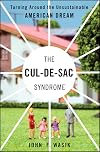
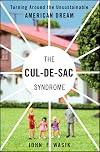
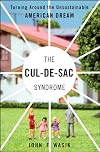
The Cul-de-Sac Syndrome: Turning Around the Unsustainable American Dream
by John F. Wasik
On This Page
Description
"The Cul-de-Sac Syndrome explores why homeownership has become a fractured dream and presents ways to revive it. Combining analysis with insights into cultural and economic myths, the book provides an incisive look at the consequences of unsustainable lifestyle, exposing its economic, cultural, and market-related roots and the larger effects on the community, economy, and environment"--Provided by publisher.Tags
Recommendations














Member Recommendations
Member Reviews
Bloomberg columnist Wasik usually doles out financial advice, but here he attempts to link the "worst housing bust in generations" with the American Dream's realization in the suburbs. This is not an easy task. The book reads like two parallel tracks -- economics and suburbia -- that only occasionally touch each other, though by the end of the book it is clear that the affordability that Americans hoped for in distant suburbs ("spurbs", as Wasik coins them) cannot last, subject to rising energy costs, ill health and other factors. Wasik's primary argument sees Americans' belief in the insoluble equity of their homes as the root of the housing bust. Blame goes to homeowners more than lenders and others who push the American Dream, but show more the privatization of expenses that accompanied house depreciation did not help matters, as people could not then afford their mortgages. Wasik's reporting on sustainable houses does not address this problem. He is enamored by engineering and technical solutions, going so far as to equate prefab house designer Michelle Kaufmann with Henry Ford and Thomas Edison. His solutions are a combination of homeowner-generated ones (green homes, energy production) and policies (transportation funding, adopting LEED in building codes, change real estate tax breaks) that ignore land use, density and other factors that would make living closer together the most sustainable solution of all.
(Note: the excerpt above is from a June 2009 review of The Cul-de-Sac Syndrome on my blog, which I paired with Building Suburbia by Dolores Hayden. I added it to LT after noticing my Early Reviewer review for the former was not showing up. Longer review can be read here: https://archidose.blogspot.com/2009/06/book-review-two-books-on-suburbia.html ) show less
 This review was written for LibraryThing Early Reviewers.
Synopsis:
Subtitled “Turning Around the Unsustainable American Dream,” this book analyzes the housing crisis and reflects upon ways that America can move forward with affordable, environmentally sustainable architecture.
Review:
The Cul-de-Sac Syndrome is a good companion piece to James Howard Kunstler’s A Geography of Nowhere. Author John F. Wasik offers a cogent overview of the current housing crisis along with an analysis of the unsustainability of the current fads in American housing. He explains trends in environmentally conscious architecture and building, and offers his ideas about what it will take to put the American dream back to rights.
I was most interested by his discussion of “spurbs,” housing clusters that are not show more connected to a metropolitan area, offer no public transportation, are not walkable, and are interspersed with strip malls and shopping centers. I grew up in a suburb of Baltimore and now I live in Queens, NY, so I’m not intimately familiar with these areas. They sound like nowhere I’d want to live. I love what I read about the New Urbanism, one of whose central tenets is “get people outside.” I love that I can walk everywhere–sure, it’s a 30 minute walk to the park but that’s great exercise, and it’s so fun to bump into people I know along the way. show less
Subtitled “Turning Around the Unsustainable American Dream,” this book analyzes the housing crisis and reflects upon ways that America can move forward with affordable, environmentally sustainable architecture.
Review:
The Cul-de-Sac Syndrome is a good companion piece to James Howard Kunstler’s A Geography of Nowhere. Author John F. Wasik offers a cogent overview of the current housing crisis along with an analysis of the unsustainability of the current fads in American housing. He explains trends in environmentally conscious architecture and building, and offers his ideas about what it will take to put the American dream back to rights.
I was most interested by his discussion of “spurbs,” housing clusters that are not show more connected to a metropolitan area, offer no public transportation, are not walkable, and are interspersed with strip malls and shopping centers. I grew up in a suburb of Baltimore and now I live in Queens, NY, so I’m not intimately familiar with these areas. They sound like nowhere I’d want to live. I love what I read about the New Urbanism, one of whose central tenets is “get people outside.” I love that I can walk everywhere–sure, it’s a 30 minute walk to the park but that’s great exercise, and it’s so fun to bump into people I know along the way. show less
This review was written for LibraryThing Early Reviewers.A new and timely book explores the housing crisis that has contributed to worldwide economic collapse over the past year. Wasik deals out a fair share of blame to Wall Street, banks, home buyers, and governments, but chalks up the main problem to the unsustainable nature of larger houses being built in ever-increasing numbers at greater distances from the urban core. The whole lifestyle of such homes is destructive to people's health and happiness, the earth, and our bank accounts. Much of the first part of the book is nothing new to anyone who has read anything about the destructive nature of suburbia and sprawl. The second part of the book is more interesting where Wasik describes some innovative ways of sustainable development, show more starting with how houses are constructed and reclaiming cities and near suburbs (while eschewing so-called "green" buildings). It's an interesting overview with some good ideas but it feels a bit rushed an incomplete. Granted though it is a continuing story. Hopefully Wasik will be able to add a happy coda to future editions. show less
This review was written for LibraryThing Early Reviewers.Wasik's book uses the metaphor of the "cul-de-sac" (dead end) to describe an array of unsustainable practices associated with the "American Dream", in particular the consumer-driven hedonism promoted during the post-war period as factories switched from war contracts to appliances, automobiles, and household goods.
Wasik's account of finance practices is very timely and convincing. He writes with a lot of authority and understanding of how unexamined and unsustainable instruments took on the trappings of securities. Unfortunately he extends his arguments well beyond the financial field and draws unlikely arguments from the history of architectural style and the practice of energy-efficient design. His authority there is suspect and, show more though he describes interesting fragments of primary data, would have benefitted from better secondary sources (Delores Hayden or Margaret Crawford spring to mind as scholars who have addressed the "dead end" of sprawling residential patterns effectively).
Ultimately it feels like Wasik extended a perfectly good article on one topic by making weak references to a variety of topics which, while clearly related in their effects, may not respond to the same lines of criticism. Readers interested in a knowledgeable recounting of the present crisis in home mortgage financing will appreciate Wasik's work, but I doubt they will find his forays into architecture and building technology to be as illuminating. Nevertheless, there are clearly some connections and, analysis aside, the recommendations Wasik makes to re-think aspects of domestic culture which may easily go unquestioned are sound ones. It seems it will fall to others to explore those relationships with more depth of knowledge. show less
Wasik's account of finance practices is very timely and convincing. He writes with a lot of authority and understanding of how unexamined and unsustainable instruments took on the trappings of securities. Unfortunately he extends his arguments well beyond the financial field and draws unlikely arguments from the history of architectural style and the practice of energy-efficient design. His authority there is suspect and, show more though he describes interesting fragments of primary data, would have benefitted from better secondary sources (Delores Hayden or Margaret Crawford spring to mind as scholars who have addressed the "dead end" of sprawling residential patterns effectively).
Ultimately it feels like Wasik extended a perfectly good article on one topic by making weak references to a variety of topics which, while clearly related in their effects, may not respond to the same lines of criticism. Readers interested in a knowledgeable recounting of the present crisis in home mortgage financing will appreciate Wasik's work, but I doubt they will find his forays into architecture and building technology to be as illuminating. Nevertheless, there are clearly some connections and, analysis aside, the recommendations Wasik makes to re-think aspects of domestic culture which may easily go unquestioned are sound ones. It seems it will fall to others to explore those relationships with more depth of knowledge. show less
This review was written for LibraryThing Early Reviewers.The first five chapters are a history of the recent housing bubble along with a critique of some the recently built suburbs. The main criticisms are the houses are too large, consume too much energy, and are too far away from work and shopping. These criticisms make the suburbs “unsustainable” in the opinion of the book’s author.
The next five chapters present the author's solution to the problem he perceives. The first solution is energy efficiency improvements to cut utility costs. He also favors carbon taxes. The second solution is redesigning suburbs or abandoning them and moving to the city. That means rebuilding the inner cities.
The last chapter is kind of rambling until he gets to a readable summary of what he wants done. show more Basically it is nine points of which six are leftist solutions. It is his blueprint for a “green sustainable economy”.
My impression is the book is too rambling. My opinions follow: Nothing is sustainable and the government shouldn’t try to make it so. Mistakes will happen, whether it is by individuals or by governments. Let peoplel solve their problems in their own way. Many small mistakes are better than one large mistake imposed by a central government.
Your political persuasion will determine if you like this book or not. I give it 3 stars simply because he does have a few interesting tidbits of information. show less
The next five chapters present the author's solution to the problem he perceives. The first solution is energy efficiency improvements to cut utility costs. He also favors carbon taxes. The second solution is redesigning suburbs or abandoning them and moving to the city. That means rebuilding the inner cities.
The last chapter is kind of rambling until he gets to a readable summary of what he wants done. show more Basically it is nine points of which six are leftist solutions. It is his blueprint for a “green sustainable economy”.
My impression is the book is too rambling. My opinions follow: Nothing is sustainable and the government shouldn’t try to make it so. Mistakes will happen, whether it is by individuals or by governments. Let peoplel solve their problems in their own way. Many small mistakes are better than one large mistake imposed by a central government.
Your political persuasion will determine if you like this book or not. I give it 3 stars simply because he does have a few interesting tidbits of information. show less
This review was written for LibraryThing Early Reviewers.Wasik overreached his mark in this lively but flawed summary in this marriage of the New Urbanism and the housing crisis. He does not appear to understand the real estate market, he does not quote or make reference to standard works in urban studies or architecture, and he uncritically reports that the current regime is effectively addressing the issues he describes. Wasik would be thrilled with measures such as Cap and Trade that seek to limit American prosperity. However, for years, Americans have promoted prosperity but have also seriously considered the environmental impact of their activities.
This review was written for LibraryThing Early Reviewers.An interesting idea, and one that I tend to agree with, that we have hard wired the suburbian lifestyle here in the United States and it may not be the best way for the future. The author covered most of the important points and generally backed his arguments with data but the overall organization of the work seemed a bit random and I had difficulty staying inspired at times. Worth a read but mostly for the already convinced.
This review was written for LibraryThing Early Reviewers.Members
- Recently Added By
Author Information

13 Works 227 Members
Common Knowledge
- Canonical title
- The Cul-de-Sac Syndrome: Turning Around the Unsustainable American Dream
Classifications
- Genres
- Economics, Nonfiction, Sociology, General Nonfiction, Art & Design, Business
- DDC/MDS
- 333.3380973 — Society, government, & culture Economics Economics of land and energy Private ownership Real Estate Investment, Buying & Selling Residential Properties
- LCC
- HD7287.82 .U6 .W37 — Social sciences Industries. Land use. Labor Industries. Land use. Labor Labor. Work. Working class
- BISAC
Statistics
- Members
- 51
- Popularity
- 593,221
- Reviews
- 13
- Rating
- (2.81)
- Languages
- English
- Media
- Paper, Ebook
- ISBNs
- 4
- ASINs
- 1