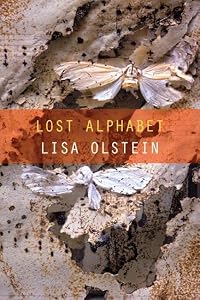
Lost Alphabet
by Lisa Olstein
On This Page
Description
In Lisa Olstein's daring new book, an unnamed lepidopterist-living in a hut on the edge of an unnamed village-is drawn ever deeper into the engrossing world of moths, light, and seeing. Structured as a naturalist's notebook, the four-part sequence of prose poems create a layered pilgrimage into the consequences of intensive study, the trials of being an outsider, and the process of metamorphosis. In an interview, Olstein once said, "I don't want poetry to limit itself to reflecting or show more recapitulating experience; I want it to be an experience." I have learned to peer at specimens through a small crack at the center of my fist. It's a habit herders use for distance: vision is concentrated, the crude tunnel brings into focus whatever small expanse lies on the other side, something in the narrowing magnifies what remains. At the table, my hand tires of clenching, my left eye of closing, my right of its squint, but the effect: a blurred carpet of wing becomes a careful weave of eyelashes colored, curved, exquisitely laid . . . show lessTags
Recommendations














Member Reviews
Culture asks much of the writer: filter the cacophony, exceed vernacular, deliver art. The writer may use familiar language to build an extraordinary world, to make an unusual character an analog for the self, to transform that self into a friend. She may excel at documentation, recording observations in exquisite lines that juxtapose agricultural ritual with scientific discovery, interior reflection with external reproach. Poet Lisa Olstein is this writer. In “Lost Alphabet” (Copper Canyon, 2009) she gives readers a collection of moths, a mysterious companion, a dark hut in an unusual country, and the eyes of a lepidoptrist asking perennial questions: What does it mean to know? Are there limits to understanding? Even in company are show more we anything but alone?
Each poem is an illustrated plate colored by detail — the work of writer as collector. We learn that Vladimir Nabokov’s “Speak, Memory” brushes against the atmosphere of Marco Polo’s travel diaries, that Olstein was captivated by a landscape of moth wings. Holding a hand to the eye and rounding the fingers, the speaker of “Lost Alphabet” acts as the writer acts: narrowing focus, targeting detail.
In her new poems, myriad voices extend Olstein’s investigation. Mentions of medical experiments appear beside anecdotes of space travel. Reflection is compelled by fact, doubt undergirds perception.
Thus Olstein asks us to consider knowledge as ephemeral, relational. She critiques certainty, exposes fact. These are important poems. They walk us to the borderline of what we take for granted and stand unflinching at the chasm, compelling us to wonder what it’s possible to know.
~Carlin M. Wragg, Editor, Open Loop Press show less
Slowly, the absence of pain arrives like
snow falling. It was on a day like this when, visiting, Ilya
decided to stay. At least, never left. It is customary here to
accompany the wounded. Whoever is able, and near.
Each poem is an illustrated plate colored by detail — the work of writer as collector. We learn that Vladimir Nabokov’s “Speak, Memory” brushes against the atmosphere of Marco Polo’s travel diaries, that Olstein was captivated by a landscape of moth wings. Holding a hand to the eye and rounding the fingers, the speaker of “Lost Alphabet” acts as the writer acts: narrowing focus, targeting detail.
I want nothing to end, not a single observation,
despite longing for what remains unknown. For one thing:
weight. Another: ratio. Flight’s beat, beat, glide. And
constantly, the interruption: sometimes circling for days, a
wary insistent stray.
In her new poems, myriad voices extend Olstein’s investigation. Mentions of medical experiments appear beside anecdotes of space travel. Reflection is compelled by fact, doubt undergirds perception.
Either the mute child spoke
in full sentences alone in the dark
or the monitors picked up ghosts
of deliverymen and pelicans
streaming over the bridge.
Thus Olstein asks us to consider knowledge as ephemeral, relational. She critiques certainty, exposes fact. These are important poems. They walk us to the borderline of what we take for granted and stand unflinching at the chasm, compelling us to wonder what it’s possible to know.
~Carlin M. Wragg, Editor, Open Loop Press show less
Ratings
Members
- Recently Added By
Author Information

8+ Works 130 Members
Lisa Olstein puts her signature prismatic lens to profound use in her fourth collection. Future-haunted and disaster veering, Late Empire inhabits the complexities of the present moment. Staked at the troubled intersection of our public and private lives, these intimate and brutal poems expose a dailiness shaped by political absurdity and show more implicate a language disfigured by persistent war. Wonderfully tender, syntactically dazzling, and defiantly funny in the face of terror, Lato Empire speaks just in time, signaling that hope and fear are closer than we know, and they face in the same direction. show less
Awards and Honors
Awards
Classifications
Statistics
- Members
- 23
- Popularity
- 1,144,855
- Reviews
- 1
- Rating
- (3.25)
- Languages
- English
- Media
- Paper, Ebook
- ISBNs
- 2