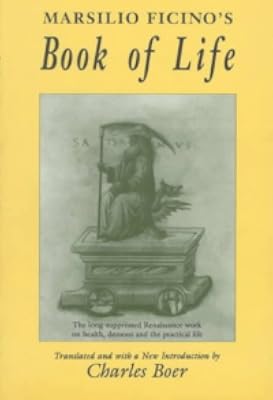
Three Books on Life
by Marsilio Ficino
On This Page
Description
This is the first English translation ever of Marsilio Ficino's underground classic of the Italian Renaissance, THE BOOK OF LIFE. Long suppressed because of Ficino's approach to images, demons & planets in relation to mental health, THE BOOK OF LIFE told politicians, thinkers, businessmen & artists of the Italian Renaissance the secrets of food, the pleasures of life, the antidotes to depression & a lot of other things that had been lost for centuries. In this charming & exact translation, show more Ficino's Book of Life is the Renaissance as you never heard it before! show lessTags
Recommendations










Member Reviews
This a health text I read in Latin at the British Library; it includes some Salernitan medicine, proverbs which I studied for the paper I gave at the Villa Vergiliana Italian Medicine conference (largely on baths) at Cuma in 2001. In the intro Ficino talks of poets celebrating wine for health and salubrious outlook; when poets are melancholy, they've spent too much time studying, reasoning about the heavens.
Aristotle and Democritus agree men tend toward melancholy, though Democritus fought it with laughter. Avicenna disagrees that wine is salubrious: Quippe si vinum vl nimium vel nimis calidum vehemenque fuerit caput humoribus pessimisque fumis implebit. Too much wine, or too hot wine, both fill the head with the worst vapors and show more humors.
Shun melancholia--black bile, the humor responsible--by meat and sauce dijonaise (sinapis/white mustard).
For headache (dolor capitis): roses in oil-- “oleo rosaceo tunsis.”
For low energy ("phlegmatic" like Jeb Bush): aromatic roses "aromatico rosaceo vtere."
or upset stomach, honey mixed with cinnamon: "mixto melle rosaceo cum cinamo."
Sir Francis Bacon also wrote his own "Historia vitae et mortis" about two centuries after Ficino, observing in Intention #iv, "the things which conduce to health do not always conduce to longevity."
#xxv, "Of spirits retaining their youth": "The Turks use likewise [with opium] a kind of herb, called "coffee," which they dry, grind to a powder, and drink in warm water. They affirm that it gives no small vigor to their courage and their wit. Yet this to have in large quantities will excite and disturb the mind; which shows it to be of a similar nature to opiates."
#lxxviii: "Lettuce and violets and a glass of cold water at bedtime compse the spirits for sleep."
Bacon on hypnosis: "If voluntary trances--I know nothing certain…Of these make further inquiry."
On psychosoma, how "affectus mentis" effects "motus spiritus."
Nota bene: "Metus graviores vitam abbreviant." Great fears shorten life--though we may add, in the year of Trump, lengthen political careers.
Hope is the best for long life: "Admiratio, et levis contempliva," such as study of nature or rhetoric, yield longevity. Light contmplation, Bacon emphasizes, for subtle thought shortens life:
"inquisitio subtilis et acuta et acris vitam abbreviant; spiritum enim lassat et carpit." For such thought tires the spirit. show less
Aristotle and Democritus agree men tend toward melancholy, though Democritus fought it with laughter. Avicenna disagrees that wine is salubrious: Quippe si vinum vl nimium vel nimis calidum vehemenque fuerit caput humoribus pessimisque fumis implebit. Too much wine, or too hot wine, both fill the head with the worst vapors and show more humors.
Shun melancholia--black bile, the humor responsible--by meat and sauce dijonaise (sinapis/white mustard).
For headache (dolor capitis): roses in oil-- “oleo rosaceo tunsis.”
For low energy ("phlegmatic" like Jeb Bush): aromatic roses "aromatico rosaceo vtere."
or upset stomach, honey mixed with cinnamon: "mixto melle rosaceo cum cinamo."
Sir Francis Bacon also wrote his own "Historia vitae et mortis" about two centuries after Ficino, observing in Intention #iv, "the things which conduce to health do not always conduce to longevity."
#xxv, "Of spirits retaining their youth": "The Turks use likewise [with opium] a kind of herb, called "coffee," which they dry, grind to a powder, and drink in warm water. They affirm that it gives no small vigor to their courage and their wit. Yet this to have in large quantities will excite and disturb the mind; which shows it to be of a similar nature to opiates."
#lxxviii: "Lettuce and violets and a glass of cold water at bedtime compse the spirits for sleep."
Bacon on hypnosis: "If voluntary trances--I know nothing certain…Of these make further inquiry."
On psychosoma, how "affectus mentis" effects "motus spiritus."
Nota bene: "Metus graviores vitam abbreviant." Great fears shorten life--though we may add, in the year of Trump, lengthen political careers.
Hope is the best for long life: "Admiratio, et levis contempliva," such as study of nature or rhetoric, yield longevity. Light contmplation, Bacon emphasizes, for subtle thought shortens life:
"inquisitio subtilis et acuta et acris vitam abbreviant; spiritum enim lassat et carpit." For such thought tires the spirit. show less
BOOK OF LIFE
"The first translation ever into English of this underground classic of the Italian Renaissance. Marsilio Ficino's Book of life was once supressed for Ficino's approach to images, daemons, and planets in relation to health. The book in this fluent, amusing and exact translation by Charles Boer is a guide to food, drink, sleep, mood, sexuality, song and countless herbal and vegetable concoctions for maintaining the balance of soul, body and spirit. A fouding text of archetypal psychology, it has long been an important source for image-oriented thought.
"The first translation ever into English of this underground classic of the Italian Renaissance. Marsilio Ficino's Book of life was once supressed for Ficino's approach to images, daemons, and planets in relation to health. The book in this fluent, amusing and exact translation by Charles Boer is a guide to food, drink, sleep, mood, sexuality, song and countless herbal and vegetable concoctions for maintaining the balance of soul, body and spirit. A fouding text of archetypal psychology, it has long been an important source for image-oriented thought.
Jul 30, 2024Spanish
Ratings
Members
- Recently Added By
Author Information

91+ Works 1,049 Members
The leading figure in the Renaissance revival of Platonism, Marsilio Ficino profoundly influenced the philosophical thought of his own and following centuries. Born near Florence, Italy, the son of a physician, Ficino received his early training in philosophy, medicine, and theology and devoted himself to the study of Greek. His learning attracted show more the attention of one of his father's eminent patients, Cosimo de' Medici, of the powerful Florentine banking family, and in 1462 Cosimo established him at a villa and supplied him with Greek manuscripts for translation. Here Ficino set up his famous Florentine Academy, devoted to the study and celebration of Plato's teachings. He continued to receive the active support of the Medici until their expulsion from Florence in 1494. Ficino's labors as a translator provided his Greekless contemporaries with access to the greatest works of the ancient Platonic tradition. His Latin version of the dialogues of Plato, published in 1484, made the entirety of Plato available for the first time in translation. Ficino also prepared translations of other important sources, such as the Neoplatonist Plotinus, Proclus, Iamblichus, Pseudo-Dionysius the Areopagite, and the Greek works attributed to Hermes Trismegistus, a fabled Egyptian priest supposedly contemporary with Moses. To Ficino, the Platonic tradition represented an ongoing heritage of divinely inspired ancient wisdom reconcilable with Christian revelation. His reading of Plato in the light of late Neoplatonists, such as Plotinus and Proclus, survived long after the Renaissance and remained the prevalent interpretation of Plato's thought until comparatively recent times. His chief philosophical work, Platonic Theology (1482), represents an attempt to demonstrate the immortality of the human soul on Platonic grounds in a way that was consistent with Christian doctrine. It represents reality as a hierarchy, from God down to material bodies, with rational soul, the level proper to humans, as a mean that participates in the characteristics of both higher and lower beings. This scheme derived with important modifications from Plotinus was to influence many later Platonists including Ficino's younger friend and colleague Giovanni Pico della Mirandola. Ficino's devotion to Platonism must thus be seen within the context of his Christianity. He was ordained a priest in 1437 and later served as a canon of the Florentine cathedral. His intellectual synthesis of Platonism and Christianity, however, so powerfully appealing to the Medici circle, was a far cry from the reformist zeal of Savonarola, whose rise to power in 1494 saw Ficino enter into a quiet retirement until his death. (Bowker Author Biography) show less
Some Editions
Series
Belongs to Publisher Series
Common Knowledge
- Canonical title
- Three Books on Life
- Original title
- De triplici vita
Classifications
- Genres
- Nonfiction, Religion & Spirituality, Philosophy, General Nonfiction
- DDC/MDS
- 615.8 — Applied science & technology Medicine & health Pharmacology and therapeutics Specific therapies and kinds of therapies
- LCC
- BF1680 .F5513 — Philosophy, Psychology and Religion Psychology Occult sciences Astrology
- BISAC
Statistics
- Members
- 140
- Popularity
- 234,311
- Reviews
- 2
- Rating
- (4.00)
- Languages
- English, Latin
- Media
- Paper
- ISBNs
- 3