On This Page
Description
Carlos Castanada was a student of anthropology when he met Don Juan Matus, a Yaqui shaman and the inspiration for Castanada's The Teachings of Don Juan. In this controversial work, Castanada relays his experiences being challenged by his mentor on his perception of the world and all living things in it.Tags
Recommendations
















Member Reviews
I read this book in the 1970s and have recently re-read it.
Carlos Castaneda (1925-1998) wrote a series of twelve books about Mexican sorcery. They remain controversial because some think that Castaneda made it all up, but he maintained that this is a true account of his experiences as an apprentice and, later, a sorcerer.
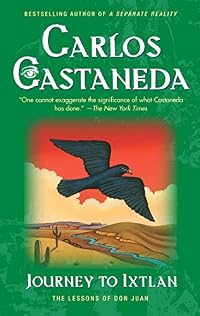
“Journey to Ixtlan” is the third book in the series after “The Teachings of Don Juan: A Yaqui Way of Knowledge” and “A Separate Reality: Further Conversations with Don Juan.” The first book describes Castaneda’s attempt in the early 1960s to study Native American use of psychotropic plants, working with don Juan Matus (1892?-1972?). The premise of “Journey” is that, by the early ’70s, Castaneda show more realized that he left out of the earlier books too much of what don Juan taught him, so he sets the record straight.
In his introduction, Castaneda claims that he never said that Juan Matus’ system of magic was linked to the traditions of the Yaqui tribe. It turns out to be a shared system that transcends tribal affiliation. Castaneda’s critics had pointed out that nothing in don Juan’s teachings fit with what is generally known about Yaqui tribal tradition. Castaneda’s rejoinder belies the fact that he did subtitle his first book “A Yaqui Way of Knowledge,” an implicit claim that don Juan’s teachings belong to this tribe. IMHO, Castaneda should have admitted that, when he published his first book in 1968, he made an honest if embarrassing mistake in attributing what don Juan taught him to Yaqui tradition.
A standard practice of anthropologists is to choose an informant from the community under study to help explain the customs and structure of the society from the inside. As “Journey” demonstrates, don Juan was an uncooperative informant, refusing to answer basic questions that might have cleared up the misunderstandings that bedevil Castaneda’s scholarship. Don Juan and Carlos (Castaneda is conventionally referred to by his first name when he becomes a character in his own books) are comically at cross purposes from the start. While the anthropologist is trying to recruit don Juan as his informant, the sorcerer is trying to recruit Carlos as his apprentice.
In hindsight, Carlos should have known that he was being recruited. He feels that don Juan is hectoring him about changing his lifestyle, and there is no reason for it other than that it is a necessary condition of their association and, besides, it is somehow for Carlos’ own good.
In Don Juan’s world, people not only must defend themselves from the familiar physical dangers – natural disasters, accidents, dangerous animals and bad people – but also from dangerous spirits and other unseen, malevolent forces. It turns out that there are no safe spaces in eternity (or “infinity” as Castaneda and don Juan call it). Interestingly, don Juan tames and uses “allies” or spirits similarly to ancient Greek and Persian magicians I have read about. Rituals and spells are means to gain control over spirits which are then used to enhance the magician’s power.
In don Juan’s universe, you don’t attain immortality by leading a good life but by leading an “impeccable” one, seeking knowledge and power, putting aside all considerations that are extraneous to that goal. Though there does seem to be some sort of karmic justice: it is better to be good than evil (For example, the sorcerer is said to be harmed by his own hatreds.), but being careless with the supernatural is worse than being a bad person.
“Journey” is about the preparations for leaving behind the mundane world. To expose oneself to supernatural power, which can be invigorating and terrifying all at once, the would-be sorcerer must learn to focus only on what matters, facing the fact of one's mortality and responsibility for one's own actions. Each chapter introduces a different component of this task. In exercising these disciplines, the line between the social, natural and supernatural blurs; the sorcerer must be just as inaccessible to people who would sap his vitality as to supernatural forces that would do the same or worse.
Along the way, don Juan evinces great flexibly in his teaching methods. When teaching Carlos about plants is not working, don Juan instead teaches him about hunting animals, to which the apprentice proves to be better suited. Don Juan is a master hunter, stalking prey with detailed knowledge of their habits, building traps from sticks and stones he finds in the semi-arid plains and mountains, cleaning and cooking what he catches. He is able to live off the land with an ease that would make any graduate of survival training jealous. He drops tidbits of wisdom such as that the hunter must have fewer bad habits than the prey; when animals elude otherwise powerful predators, it is often because the prey are less predictable than the predators.
The concept of “seeing” in the special sense in which a “man of knowledge” such as don Juan “sees” was introduced in “A Separate Reality” where don Juan taught Carlos that “seeing” is more than merely looking. In order “to see,” one must "not-do" or “stop the world,” that is, end the routine mental habits of perception handed to us since childhood. This is Carlos’ quest in this book as his incredulity is eroded by experiences with the supernatural. In one sequence, he spends a night surrounded by fog, rain, thunder and lightning, plus the utter blackness between lightning bolts. In the morning he awakens to find himself in a forest that is altogether different from the place where he fell asleep. Did don Juan carry him there? Was the dried meat he was eating the day before laced with a drug that made him imagine the place where he thought he fell asleep the previous night? Or did something magical actually take place?
Later in the book, don Juan turns Carlos over to don Genaro Flores, who was introduced in, “A Separate Reality.” Don Genaro makes Carlos begin to let go of his doubts. The distinction is made between Carlos’ body, which wises up under don Genaro’s manipulation, and his mind, which is still doubtful. When Carlos’ body is thus readied, don Juan orders him to go into the hills and not come back until his mind catches up with his body. Bravely, Carlos goes, despite having no idea what he must do. On his second day in the wilderness, he has three strange experiences: 1) he communicates telepathically with a friendly coyote; 2) he sees a phantom man out of the corner of his eye; and 3) he has a vision of the landscape covered with glowing lines.
Don Juan later tells him that the coyote is now Carlos’ special companion, which, he adds, is unfortunate because coyotes are tricksters and liars. Otherwise, Carlos is told that he did very well. His vision of the glowing filaments was a kind of "seeing." The “man” that he almost saw was an ally or spirit. The next step in Carlos’ apprenticeship will be to tackle the ally and acquire power from him. At the end of the book, Carlos must decide for himself whether he is ready or not to attempt this. Before he decides, don Genaro tells him a story about the first time that he overpowered an ally. Afterward, Genaro felt imbued with magical power, but the price he paid was never being able to find his way back to the town of Ixtlan, and that is the meaning of the title of this book. As Thomas Wolf might say, once you have changed, you can’t go home again. show less
Carlos Castaneda (1925-1998) wrote a series of twelve books about Mexican sorcery. They remain controversial because some think that Castaneda made it all up, but he maintained that this is a true account of his experiences as an apprentice and, later, a sorcerer.
“Journey to Ixtlan” is the third book in the series after “The Teachings of Don Juan: A Yaqui Way of Knowledge” and “A Separate Reality: Further Conversations with Don Juan.” The first book describes Castaneda’s attempt in the early 1960s to study Native American use of psychotropic plants, working with don Juan Matus (1892?-1972?). The premise of “Journey” is that, by the early ’70s, Castaneda show more realized that he left out of the earlier books too much of what don Juan taught him, so he sets the record straight.
In his introduction, Castaneda claims that he never said that Juan Matus’ system of magic was linked to the traditions of the Yaqui tribe. It turns out to be a shared system that transcends tribal affiliation. Castaneda’s critics had pointed out that nothing in don Juan’s teachings fit with what is generally known about Yaqui tribal tradition. Castaneda’s rejoinder belies the fact that he did subtitle his first book “A Yaqui Way of Knowledge,” an implicit claim that don Juan’s teachings belong to this tribe. IMHO, Castaneda should have admitted that, when he published his first book in 1968, he made an honest if embarrassing mistake in attributing what don Juan taught him to Yaqui tradition.
A standard practice of anthropologists is to choose an informant from the community under study to help explain the customs and structure of the society from the inside. As “Journey” demonstrates, don Juan was an uncooperative informant, refusing to answer basic questions that might have cleared up the misunderstandings that bedevil Castaneda’s scholarship. Don Juan and Carlos (Castaneda is conventionally referred to by his first name when he becomes a character in his own books) are comically at cross purposes from the start. While the anthropologist is trying to recruit don Juan as his informant, the sorcerer is trying to recruit Carlos as his apprentice.
In hindsight, Carlos should have known that he was being recruited. He feels that don Juan is hectoring him about changing his lifestyle, and there is no reason for it other than that it is a necessary condition of their association and, besides, it is somehow for Carlos’ own good.
In Don Juan’s world, people not only must defend themselves from the familiar physical dangers – natural disasters, accidents, dangerous animals and bad people – but also from dangerous spirits and other unseen, malevolent forces. It turns out that there are no safe spaces in eternity (or “infinity” as Castaneda and don Juan call it). Interestingly, don Juan tames and uses “allies” or spirits similarly to ancient Greek and Persian magicians I have read about. Rituals and spells are means to gain control over spirits which are then used to enhance the magician’s power.
In don Juan’s universe, you don’t attain immortality by leading a good life but by leading an “impeccable” one, seeking knowledge and power, putting aside all considerations that are extraneous to that goal. Though there does seem to be some sort of karmic justice: it is better to be good than evil (For example, the sorcerer is said to be harmed by his own hatreds.), but being careless with the supernatural is worse than being a bad person.
“Journey” is about the preparations for leaving behind the mundane world. To expose oneself to supernatural power, which can be invigorating and terrifying all at once, the would-be sorcerer must learn to focus only on what matters, facing the fact of one's mortality and responsibility for one's own actions. Each chapter introduces a different component of this task. In exercising these disciplines, the line between the social, natural and supernatural blurs; the sorcerer must be just as inaccessible to people who would sap his vitality as to supernatural forces that would do the same or worse.
Along the way, don Juan evinces great flexibly in his teaching methods. When teaching Carlos about plants is not working, don Juan instead teaches him about hunting animals, to which the apprentice proves to be better suited. Don Juan is a master hunter, stalking prey with detailed knowledge of their habits, building traps from sticks and stones he finds in the semi-arid plains and mountains, cleaning and cooking what he catches. He is able to live off the land with an ease that would make any graduate of survival training jealous. He drops tidbits of wisdom such as that the hunter must have fewer bad habits than the prey; when animals elude otherwise powerful predators, it is often because the prey are less predictable than the predators.
The concept of “seeing” in the special sense in which a “man of knowledge” such as don Juan “sees” was introduced in “A Separate Reality” where don Juan taught Carlos that “seeing” is more than merely looking. In order “to see,” one must "not-do" or “stop the world,” that is, end the routine mental habits of perception handed to us since childhood. This is Carlos’ quest in this book as his incredulity is eroded by experiences with the supernatural. In one sequence, he spends a night surrounded by fog, rain, thunder and lightning, plus the utter blackness between lightning bolts. In the morning he awakens to find himself in a forest that is altogether different from the place where he fell asleep. Did don Juan carry him there? Was the dried meat he was eating the day before laced with a drug that made him imagine the place where he thought he fell asleep the previous night? Or did something magical actually take place?
Later in the book, don Juan turns Carlos over to don Genaro Flores, who was introduced in, “A Separate Reality.” Don Genaro makes Carlos begin to let go of his doubts. The distinction is made between Carlos’ body, which wises up under don Genaro’s manipulation, and his mind, which is still doubtful. When Carlos’ body is thus readied, don Juan orders him to go into the hills and not come back until his mind catches up with his body. Bravely, Carlos goes, despite having no idea what he must do. On his second day in the wilderness, he has three strange experiences: 1) he communicates telepathically with a friendly coyote; 2) he sees a phantom man out of the corner of his eye; and 3) he has a vision of the landscape covered with glowing lines.
Don Juan later tells him that the coyote is now Carlos’ special companion, which, he adds, is unfortunate because coyotes are tricksters and liars. Otherwise, Carlos is told that he did very well. His vision of the glowing filaments was a kind of "seeing." The “man” that he almost saw was an ally or spirit. The next step in Carlos’ apprenticeship will be to tackle the ally and acquire power from him. At the end of the book, Carlos must decide for himself whether he is ready or not to attempt this. Before he decides, don Genaro tells him a story about the first time that he overpowered an ally. Afterward, Genaro felt imbued with magical power, but the price he paid was never being able to find his way back to the town of Ixtlan, and that is the meaning of the title of this book. As Thomas Wolf might say, once you have changed, you can’t go home again. show less
One of my favourite Castaneda books. Freeing himself from the grip of drugs and self-imposed feelings of oppression, he begins to review the field notes he took so assiduously during his first period of apprenticeship. He is startled to discover a coherent teaching buried in the mass of data and reportage - that Don Juan had been attempting to guide him all along in what it really means to become 'impeccable', en route to evolving into a man of knowledge.
This is the clearest and most straightforward exposition yet of Don Juan's teachings, and many readers - unaware of Castaneda - might do a lot worse than to begin the odyssey here. He divides what he perceives of the teaching into discrete sections or chapters, each providing a show more different facet or insight into the 'sorcerer's way'.
However, just when the reader hits a comfort zone and is nodding wisely ("ah, so THAT's what that part was all about"), Castaneda brings the reportage up to the minute at the end of the book. Here his mind and his so-called sanity is brought right to the brink, by the truly scary, yet also utterly hilarious, antics of Don Juan and Don Genaro, as they attempt to re-align his perceptions and bring him to a closer relationship with the hidden reality that is properly the world of the sorcerer. show less
This is the clearest and most straightforward exposition yet of Don Juan's teachings, and many readers - unaware of Castaneda - might do a lot worse than to begin the odyssey here. He divides what he perceives of the teaching into discrete sections or chapters, each providing a show more different facet or insight into the 'sorcerer's way'.
However, just when the reader hits a comfort zone and is nodding wisely ("ah, so THAT's what that part was all about"), Castaneda brings the reportage up to the minute at the end of the book. Here his mind and his so-called sanity is brought right to the brink, by the truly scary, yet also utterly hilarious, antics of Don Juan and Don Genaro, as they attempt to re-align his perceptions and bring him to a closer relationship with the hidden reality that is properly the world of the sorcerer. show less
Si se lee como un libro más de superación personal mística, no importa. Su medio-filosofía new age me parece inofensiva. Sólo espero que nadie lo lea como un trabajo antropológico que representa las creencias y tradiciones de los pueblos indígenas. Porque, de verdad, esto tiene de literatura periodística-documental lo que yo de carmelita descalzo.
Reading this after A Seperate Reality was what made this treatment the most satisfying. Further with Don Juan. The Yaqui Shaman is very much a character, introducing Castaneda to local workers, witches and totem spirits. The Native American spirit is superlatively revealed in this jovial search for a oneness with the surrounding universe, while at the same time, figuratively winking at the quest for the unity of mankind. Very Fun Read.
I find all of Castaneda’s books unique, fascinating and engrossing, and this one is no exception,
We are told about how Carlos met Juan Matus in a bus station in Arizona, and that this was the start of a ten-year apprenticeship.
Carlos first learns about the importance of erasing one’s personal history since this makes us free from the encumbering thoughts of other people. One can erase personal history by not revealing what one really does, and by leaving everyone who knows one well. A fog will thus be built up around oneself.
It is also important to lose self-importance. In another book it is explained that in order to “dream” we need energy, and self-importance uses much energy, so therefore it is best to rid ourselves of it in show more order to preserve as much energy as possible.
Carlos also learns that death is our eternal companion and our most important adviser, and is always to our left, at an arm’s length away. Awareness of our impending death helps us to “drop the cursed pettiness that belongs to men that live their lives as if death will never tap them.”
We must take responsibility for all that we do, we must know why we are doing things, no matter what, and then must proceed with our actions without having doubts or remorse about them.
Don Juan seems to be able to read Carlos’s mind and knows about things that happened in his childhood and youth without having been told of them.
Carlos tells Don Juan that they are equals, while in actual fact he feels that as a sophisticated university student he is superior to him, who is an Indian. He is dumbfounded when the latter informs him that they are not equals - “I am a hunter and a warrior, and you are a pimp.”
The world is a mysterious place, especially in the twilight. The wind can follow one, make one tired or even kill one. It is looking for Carlos. Carlos learns about being inaccessible. He has previously made himself too available, especially in his relationship with a particular “blond girl”. One must make sure not to squeeze one’s world out of shape, but instead tap lightly, stay for as long as one needs to, and then swiftly move away leaving hardly a mark.
A hunter should know the routines of his prey and, most importantly, have no routines oneself. Carlos himself eats lunch every single day at twelve o’clock, as Don Juan keeps pointing out.
These are but a few of the topics that Don Juan teaches Carlos about. He also learns about becoming accessible to power, experiences a battle of power and learns about a warrior’s last stand. He learns the gait of power and the tricky art of not-doing.
Finally, he learns about the ring of power and meets a dangerous, “worthy” opponent, a sorceress going by the name of La Catalina.
Towards the end Carlos meets Don Genaro, another powerful sorcerer, and he and Don Juan make Carlos’s car disappear into thin air.
Carlos is sent out into the mountains by himself and “stops the world”. He has a conversation with a coyote who speaks both English and Spanish (!). Carlos sees “the lines of the world”.
We understand that Carlos’ time with Don Juan has come to an end, since it is time for the latter to leave this world. Carlos’ sadness is overwhelming, and so is that of the reader.
This is an amazing book. The information/knowledge presented is fascinating and absorbing. Castaneda presents the information in great, satisfying detail. The book is well-expressed, though the content is difficult to grasp. (Carlos himself makes no secret of the fact that he finds it nigh impossible to understand Don Juan’s “concepts and methods” since “the units of his description were alien and incompatible with those of my own”.)
I am really going to miss reading this author’s works when I’ve got through them all, but luckily I still have many left to read. The “separate reality” portrayed in these books is quite different from our daily reality, so it is an amazing journey for the reader to delve into these books and access this other reality, or world.
I strongly recommend that you read this mind-expanding book! show less
We are told about how Carlos met Juan Matus in a bus station in Arizona, and that this was the start of a ten-year apprenticeship.
Carlos first learns about the importance of erasing one’s personal history since this makes us free from the encumbering thoughts of other people. One can erase personal history by not revealing what one really does, and by leaving everyone who knows one well. A fog will thus be built up around oneself.
It is also important to lose self-importance. In another book it is explained that in order to “dream” we need energy, and self-importance uses much energy, so therefore it is best to rid ourselves of it in show more order to preserve as much energy as possible.
Carlos also learns that death is our eternal companion and our most important adviser, and is always to our left, at an arm’s length away. Awareness of our impending death helps us to “drop the cursed pettiness that belongs to men that live their lives as if death will never tap them.”
We must take responsibility for all that we do, we must know why we are doing things, no matter what, and then must proceed with our actions without having doubts or remorse about them.
Don Juan seems to be able to read Carlos’s mind and knows about things that happened in his childhood and youth without having been told of them.
Carlos tells Don Juan that they are equals, while in actual fact he feels that as a sophisticated university student he is superior to him, who is an Indian. He is dumbfounded when the latter informs him that they are not equals - “I am a hunter and a warrior, and you are a pimp.”
The world is a mysterious place, especially in the twilight. The wind can follow one, make one tired or even kill one. It is looking for Carlos. Carlos learns about being inaccessible. He has previously made himself too available, especially in his relationship with a particular “blond girl”. One must make sure not to squeeze one’s world out of shape, but instead tap lightly, stay for as long as one needs to, and then swiftly move away leaving hardly a mark.
A hunter should know the routines of his prey and, most importantly, have no routines oneself. Carlos himself eats lunch every single day at twelve o’clock, as Don Juan keeps pointing out.
These are but a few of the topics that Don Juan teaches Carlos about. He also learns about becoming accessible to power, experiences a battle of power and learns about a warrior’s last stand. He learns the gait of power and the tricky art of not-doing.
Finally, he learns about the ring of power and meets a dangerous, “worthy” opponent, a sorceress going by the name of La Catalina.
Towards the end Carlos meets Don Genaro, another powerful sorcerer, and he and Don Juan make Carlos’s car disappear into thin air.
Carlos is sent out into the mountains by himself and “stops the world”. He has a conversation with a coyote who speaks both English and Spanish (!). Carlos sees “the lines of the world”.
We understand that Carlos’ time with Don Juan has come to an end, since it is time for the latter to leave this world. Carlos’ sadness is overwhelming, and so is that of the reader.
This is an amazing book. The information/knowledge presented is fascinating and absorbing. Castaneda presents the information in great, satisfying detail. The book is well-expressed, though the content is difficult to grasp. (Carlos himself makes no secret of the fact that he finds it nigh impossible to understand Don Juan’s “concepts and methods” since “the units of his description were alien and incompatible with those of my own”.)
I am really going to miss reading this author’s works when I’ve got through them all, but luckily I still have many left to read. The “separate reality” portrayed in these books is quite different from our daily reality, so it is an amazing journey for the reader to delve into these books and access this other reality, or world.
I strongly recommend that you read this mind-expanding book! show less
This book moved me. Much rather, I should say, the very last chapter moved me and nearly had me expressing tears.
This is my first book of the Don Juan series of philosophy and shaman ways, but I am told it is the most accessible, which I would agree with so far: the book was very engaging, and did not seem bogged down with philosophy.
Although, I was, as I am sure many readers would be, torn as to how much of this story to believe actually happened. It is classified as a book of nonfiction, and it is written as a first person account as to what Carlos says he experienced. However…well, there's a lot of fantastic magic that takes place in front of this eye-witness.
In spite of all of that, I feel as though I picked up a lot from show more reading it, and I felt as though much of what I go through in my own life has only been confirmed by Don Juan's teachings to Carlos. I liked that.
But, the last chapter, the confession of knowing once you make this transformation, there's no turning back, and one is still human once conquering their "ally" and seeing the other worlds…and one cannot go back to the place they once called home in spite of taking the rest of their life to journey back. That was heartbreaking to me, and, it would seem, heartbreaking to Carlos as well. show less
This is my first book of the Don Juan series of philosophy and shaman ways, but I am told it is the most accessible, which I would agree with so far: the book was very engaging, and did not seem bogged down with philosophy.
Although, I was, as I am sure many readers would be, torn as to how much of this story to believe actually happened. It is classified as a book of nonfiction, and it is written as a first person account as to what Carlos says he experienced. However…well, there's a lot of fantastic magic that takes place in front of this eye-witness.
In spite of all of that, I feel as though I picked up a lot from show more reading it, and I felt as though much of what I go through in my own life has only been confirmed by Don Juan's teachings to Carlos. I liked that.
But, the last chapter, the confession of knowing once you make this transformation, there's no turning back, and one is still human once conquering their "ally" and seeing the other worlds…and one cannot go back to the place they once called home in spite of taking the rest of their life to journey back. That was heartbreaking to me, and, it would seem, heartbreaking to Carlos as well. show less
Another slim volume, thick with impressions... Again one is struck by the very personal tone of Castaneda, as he allows don Juan to reveal the author's weaknesses and personal failures – and to be books about a sorcerer's (unwilling) apprentice, they show a very fragile and un-heroic apprentice. This is one of the aspects that makes it seem so genuine.
Members
- Recently Added By
Lists

Read This Next
120 works; 3 members

Publisher's Weekly NON-Fiction list - 1912 - 1975
486 works; 4 members

1970s
657 works; 23 members

Magic Realism
371 works; 52 members
Author Information

35+ Works 16,115 Members
Some Editions
Awards and Honors
Distinctions
Series

Belongs to Publisher Series
Work Relationships
Common Knowledge
- Canonical title
- Journey to Ixtlan
- Original title
- Journey to Ixtlan
- Original publication date
- 1972
- First words
- I understand you know a great deal about plants, sir, I said to the old Indian in front of me. • • PART ONE - "Stopping the World" / 1. Reaffirmations from the World Around Us
On Saturday, May 22, 1971, I went to Sonora, Mexico, to see don Juan Matus, a Yaqui Indian sorcerer, with whom I had been associated since 1961. • • Introduction - Last words
- (Click to show. Warning: May contain spoilers.)I know that it was not my time, yet.
- Blurbers
- Corbert, Barry
- Original language
- English
Classifications
Statistics
- Members
- 2,301
- Popularity
- 8,579
- Reviews
- 22
- Rating
- (3.72)
- Languages
- 18 — Czech, Danish, Dutch, English, Estonian, Finnish, French, German, Greek, Hungarian, Italian, Japanese, Portuguese, Romanian, Serbian, Spanish, Swedish, Turkish
- Media
- Paper, Audiobook, Ebook
- ISBNs
- 62
- ASINs
- 26