
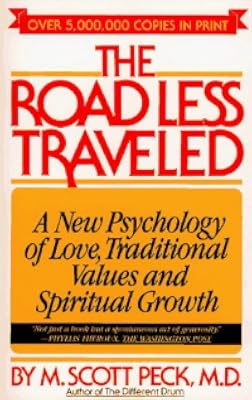
The Road Less Traveled: A New Psychology of Love, Traditional Values, and Spiritual Growth
by M. Scott Peck
On This Page
Description
Now featuring a new introduction by Dr. M. Scott Peck, the twenty-fifth anniversary edition of the classic bestseller The Road Less Traveled, celebrated by The Washington Post as "not just a book but a spontaneous act of generosity."Perhaps no book in this generation has had a more profound impact on our intellectual and spiritual lives than The Road Less Traveled. With sales of more than seven million copies in the United States and Canada, and translations into more than twenty-three show more languages, it has made publishing history, with more than ten years on the New York Times bestseller list.
Written in a voice that is timeless in its message of understanding, The Road Less Traveled continues to help us explore the very nature of loving relationships and leads us toward a new serenity and fullness of life. It helps us learn how to distinguish dependency from love; how to become a more sensitive parent; and ultimately how to become one's own true self.
Recognizing that, as in the famous opening line of his book, "Life is difficult" and that the journey to spiritual growth is a long one, Dr. Peck never bullies his readers, but rather guides them gently through the hard and often painful process of change toward a higher level of self-understanding. show less
Tags
Recommendations









Member Reviews
Interesting book about spiritual growth. Written from the point of view of a psychotherapist it primarily looks at what we mean by love in its broadest sense. There's an overview of various psychological conditions, and a look at how some people manage to overcome them, with or without the help of a therapist.
Fascinating insights, often thought-provoking in the earlier chapters. Towards the end the author looks at the subject of 'grace' from a pseudo-Christian perspective. He gives rational and logical reasons for the existence of God, but then suggests (in somewhat New Age style) that God is the sum total of our unconscious minds, and that our most important aim in life is not so much to become like God, but to become part of him. show more
Worth reading despite now being twenty-five years out of date; could make interesting discussion material. show less
Fascinating insights, often thought-provoking in the earlier chapters. Towards the end the author looks at the subject of 'grace' from a pseudo-Christian perspective. He gives rational and logical reasons for the existence of God, but then suggests (in somewhat New Age style) that God is the sum total of our unconscious minds, and that our most important aim in life is not so much to become like God, but to become part of him. show more
Worth reading despite now being twenty-five years out of date; could make interesting discussion material. show less
I found the book shelved in "Self Help" in the Barnes and Noble bookstore. Yet The Road Less Traveled is on The Ultimate Reading List for "inspirational non-fiction." For that read "spiritual" and most often "Christian." That's fitting, because although the author was a practicing psychiatrist, it's obvious that the spiritual theme is to the fore just from a perusal of the section titles: I. Discipline II. Love III. Growth and Religion and IV. Grace. In his Preface Peck states he makes "no distinction between the mind and the spirit, between the process of achieving spiritual growth and achieving mental growth. They are one and the same." He claims that "mental illness occurs when the conscious will of the individual deviates show more substantially from the will of God, which is the individual's own unconscious will." It's easy to see why this book would be popular among those who follow Twelve-Step Programs, where accepting a "higher power" is one of the steps. Regardless, that doesn't mean you have to be religious to get anything out of the book. I'm not. But I thought the book had interesting insights into the process of maturity, growth and change and though Peck is Christian, the book cites tenets not just of Christianity but Buddhism and Hinduism. His very first sentence is "life is difficult" and he connects this to the central belief of Buddhism that life is suffering. In other words, that a fulfilling life takes work--discipline--that neurosis is often an effort to avoid necessary suffering. Reportedly Random House turned the book down as "too Christ-y," but I think even the last parts on religion and grace could be put into secular terms--although it would be a bit of a strain, and I admit the second half didn't really speak to me and is a major reason I didn't rate this book higher. Nevertheless, Peck reads as non-dogmatic and as psychologically and spiritually eclectic.
I found his examination of romantic love particularly interesting. He doesn't believe in what he calls the destructive "myth" of romantic love. He feels that falling in love is always a temporary, fleeting sensation involving a seeming collapse of ego boundaries. That "true love involves an extension of the self rather than a sacrifice of the self" and is an action, decision and choice more than a feeling. Love as he defines it is the "will to extend one's self for the purpose of nurturing one's own or another's spiritual growth."
This is pop psychology, no question, but his book is not all "just love yourself" pablum. I have to admit, having known people who have spent years in psychotherapy, I'm skeptical of Peck's claims for it, and at times he himself comes across as a bit self-aggrandizing, especially in his 25th Anniversary Introduction--in that it's-not-me-but-God-wrote-it-way. He controversially wrote in the original edition that if having sex with a patient would help, he'd do it. And given at least one anecdote, I get the distinct impression Peck considers homosexuality disordered. (Remember, this book was published in 1978. The American Psychiatric Association had declassified homosexuality as a mental disorder only five years before that.) So I don't read this book as if I'm a believer reading scripture. But he's thought-provoking, was an experienced working psychotherapist and his ideas are worth considering. The first book I ever read by him and still on my book shelf was actually People of the Lie which I picked up precisely because evil is a subject few psychologists seem to take seriously, and I found his examination of the subject fascinating. show less
I found his examination of romantic love particularly interesting. He doesn't believe in what he calls the destructive "myth" of romantic love. He feels that falling in love is always a temporary, fleeting sensation involving a seeming collapse of ego boundaries. That "true love involves an extension of the self rather than a sacrifice of the self" and is an action, decision and choice more than a feeling. Love as he defines it is the "will to extend one's self for the purpose of nurturing one's own or another's spiritual growth."
This is pop psychology, no question, but his book is not all "just love yourself" pablum. I have to admit, having known people who have spent years in psychotherapy, I'm skeptical of Peck's claims for it, and at times he himself comes across as a bit self-aggrandizing, especially in his 25th Anniversary Introduction--in that it's-not-me-but-God-wrote-it-way. He controversially wrote in the original edition that if having sex with a patient would help, he'd do it. And given at least one anecdote, I get the distinct impression Peck considers homosexuality disordered. (Remember, this book was published in 1978. The American Psychiatric Association had declassified homosexuality as a mental disorder only five years before that.) So I don't read this book as if I'm a believer reading scripture. But he's thought-provoking, was an experienced working psychotherapist and his ideas are worth considering. The first book I ever read by him and still on my book shelf was actually People of the Lie which I picked up precisely because evil is a subject few psychologists seem to take seriously, and I found his examination of the subject fascinating. show less
I had deliberately ignored this book since it was published to great acclaim many years ago, as I don't read self-help books, but it was there on the shelf in the beach house and I got curious. Two thirds of it was, I thought, a very thoughtful description of the manner in which psychotherapy can help a patient, although some of the casual assumptions of gender roles were howlers from 35 years ago, and Peck is writing from a perspective before the great advances in brain imaging and understanding of the physical and chemical processes of the brain.
That said, I still detected a bit of preening from time to time, a self-commendation for his great skill.
The last third was a bit more trying for me, as it deals with the relationship of show more spiritual growth (which he equates with mental growth) to a relationship with God. He tries hard to allow all versions of this relationship with God - as a world view it is very useful. But he is clearly a believer (and I am not) and his later text has that proselytizing feel underneath.
When I brought it up to Jim, he was of the opinion that Peck said nothing new, but I thought he said it gracefully, with only the appropriate number of examples, unlike most of the self-help books these days, which are flooded with them. So it was an ok read for me, and I'm glad I know what the fuss has been about. show less
That said, I still detected a bit of preening from time to time, a self-commendation for his great skill.
The last third was a bit more trying for me, as it deals with the relationship of show more spiritual growth (which he equates with mental growth) to a relationship with God. He tries hard to allow all versions of this relationship with God - as a world view it is very useful. But he is clearly a believer (and I am not) and his later text has that proselytizing feel underneath.
When I brought it up to Jim, he was of the opinion that Peck said nothing new, but I thought he said it gracefully, with only the appropriate number of examples, unlike most of the self-help books these days, which are flooded with them. So it was an ok read for me, and I'm glad I know what the fuss has been about. show less
This book was just what I needed when it was given to me long ago. I'm not really a self-help sort of guy since most guys wont even ask for directions when they're lost. But reading this book felt like the author knew me personally which was both comforting and kinda creepy. If you live life like a jazz musician...that is, you're playing it by ear...this might be the charts you need to get through that difficult bridge section.
First of all, this book wasn't what I expected at all. From the title, I thought it was going to be very religion-oriented. I would say that only about 5 percent of the book addresses religion, other than the fact that he says early on that he uses the terms "mind" and "spirit" interchangeably. He's also extremely critical of organized religion and the negative effects it can have on people. It's mostly a description about how and why people go through psychoanalytic therapy and what it is, exactly.
I really loved this book, except for a couple of annoyances that prevented me from giving it 5 stars. There was one sentence in the book that displays the fact that it was written 30 years ago. He offhandedly mentions that a man in therapy show more with "homosexual tendencies" was able to "get the courage to ask a girl out." Everyone should know by now that homosexuality can't be and shouldn't be "cured." In his final section about religion, he also clumsily attempts to discuss science, miracles, and other things that appear to be way out of his depth as a psychoanalyst, although I did mostly agree with him about the importance of grace.
All in all, though, I really enjoyed reading it, and it made me think a great deal about the mental lengths everyone goes to in order to deceive themselves and others, mostly to avoid the short term pain and suffering of inconvenient truths. show less
I really loved this book, except for a couple of annoyances that prevented me from giving it 5 stars. There was one sentence in the book that displays the fact that it was written 30 years ago. He offhandedly mentions that a man in therapy show more with "homosexual tendencies" was able to "get the courage to ask a girl out." Everyone should know by now that homosexuality can't be and shouldn't be "cured." In his final section about religion, he also clumsily attempts to discuss science, miracles, and other things that appear to be way out of his depth as a psychoanalyst, although I did mostly agree with him about the importance of grace.
All in all, though, I really enjoyed reading it, and it made me think a great deal about the mental lengths everyone goes to in order to deceive themselves and others, mostly to avoid the short term pain and suffering of inconvenient truths. show less
I read this book slowly and enjoyed immensely, as it contained so many nuggets of wisdom and food for thought.
Dr. Peck was not stingy with references and further reading tips. There is a lot to think about if you read the material with an open mind.
I like his interpretation of the original sin in the chapter on faith. But I also like his section on love, and how he defines it as the will to extend one's self for the spiritual evolution of oneself or another person. The ideas of this book will remain with me for a long time and guide me further in my reading on spiritual evolution.
Dr. Peck was not stingy with references and further reading tips. There is a lot to think about if you read the material with an open mind.
I like his interpretation of the original sin in the chapter on faith. But I also like his section on love, and how he defines it as the will to extend one's self for the spiritual evolution of oneself or another person. The ideas of this book will remain with me for a long time and guide me further in my reading on spiritual evolution.
This was an interesting read. Lots of "psychobabble" and reinterpreting fundamental biblical concepts (e.g., sin = laziness, "grace" is earned). But it was motivating and thought-provoking.
Members
- Recently Added By
Published Reviews
ThingScore 100
This book is truly a classic in the field of psycho therapy. It deals in n insightful way with the causes and solutions of neurosis among other problems we all deal with in our lives. It gave me an insight to why my 22 and 21 years old are like they are. I could have been a better father who had more consideration of how my personality affected them. I learn more about myself everytime I read show more it. It is written in a manner that is entertaining rather than dry.
I am happy I have read this wonderful book. show less
I am happy I have read this wonderful book. show less
added by stephenrosenzweig
Lists

Best Self Help Books
87 works; 18 members

Books on My Journey
18 works; 1 member

Blue Pyramid 1,276 Best Books of All Time
1,248 works; 32 members

Top 100 to Read before you Die
109 works; 7 members

Spiritual Growth/Philosophy/Self-Help
15 works; 1 member

Books mentioned in bell hooks' All About Love
70 works; 1 member

Books That Changed Our Perspective
423 works; 168 members

spirituality and self growth
84 works; 1 member
Author Information

81+ Works 15,422 Members
M. Scott Peck was born on May 22, 1936 in New York City. He attended Phillips Exeter Academy and was attending Middlebury College before being expelled for refusing to attend mandatory R.O.T.C. sessions. He transferred to Harvard University, where he received a bachelor's degree in 1958, and then received a medical degree in 1963 from Case Western show more Reserve University School of Medicine. He was a psychiatrist in the United States Army for nearly 10 years, was the director of the New Milford Hospital Mental Health Clinic, and worked in a private psychiatric practice in Connecticut. In 1984, he helped establish the Foundation for Community Encouragement, whose mission is to promote and teach the principles of Community. He was among the founding fathers of the self-help genre of books. His works include The Road Less Traveled, Further Along the Road Less Traveled, The Road Less Traveled and Beyond, People of the Lie, and The Different Drum. He also wrote a novel entitled A Bed by the Window. He received the 1984 Kaleidoscope Award for Peacemaking, the 1994 Temple International Peace Prize, and the Learning, Faith and Freedom Medal from Georgetown University in 1996. He died from complications of pancreatic and liver duct cancer on September 25, 2005 at the age of 69. (Bowker Author Biography) show less
Awards and Honors
Series
Belongs to Publisher Series
Common Knowledge
- Original title
- The Road Less Traveled: A New Psychology of Love, Traditional Values, and Spiritual Growth
- Original publication date
- 1978
- Epigraph
- Four Noble Truths of Buddah
- Dedication
- To my parents, Elizabeth and David, whose discipline and love gave me the eyes to see grace.
- First words
- Life is difficult.
- Last words
- (Click to show. Warning: May contain spoilers.)What more can we ask?
- Original language
- English
- Canonical DDC/MDS
- 158'.1; 158.1; 158
Classifications
Statistics
- Members
- 6,827
- Popularity
- 1,748
- Reviews
- 53
- Rating
- (3.87)
- Languages
- 15 — Chinese, Czech, Dutch, English, French, German, Greek, Hungarian, Italian, Norwegian (Bokmål), Polish, Portuguese, Serbian, Spanish, Swedish
- Media
- Paper, Audiobook, Ebook
- ISBNs
- 76
- UPCs
- 1
- ASINs
- 51