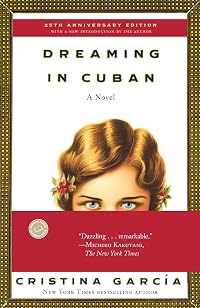
Dreaming in Cuban
by Cristina García
On This Page
Description
A vivid and funny first novel about three generations of a Cuban family divided by conflicting loyalties over the Cuban revolution, set in the world of Havana in the 1970s and '80s and in an emigre neighborhood of Brooklyn. It is a story of immense charm about women and politics, women and witchcraft, women and their men.Tags
Recommendations








Member Reviews
Garcia illustrates a binary world of New York and Cuba, democracy and communism, rational and superstitious, and, fortunately, never takes sides. Instead the characters and their choices/circumstances are stand-ins for social arguments. There is some beautiful prose here. Unfortunately, there is not a small portion of voice among the many (too many) characters. Also, I found many of the characters to be strangely mean without motivation.
I really hated this book the first time I read it. I've been reading it a second time, and challenging myself to find valid reasons not to like it. I've half succeeded--I think it's entirely too accepting, if not exalting, of certain basic socioeconomic realities of the world we live in--, but I've also enjoyed it more than the first time around. Pilar is a likable and relatable character, and her coming of age as it plays out in these pages is compelling and, I've concluded, altogether worth my time. It's also a good book to relate back to the Latin American Boom novels, since Garcia herself affirmed that she kept One Hundred Years of Solitude on her desk as she wrote this. It's obviously more "easy" or "accessible" than some of those show more novels, but maybe it wouldn't have really made sense to write a high modernist novel in 1992 either. So yes, I continue to have my issues with Dreaming in Cuban, but I've enjoyed trying to get to the bottom of some of those issues through this book. I guess the main reason I don't like it is that Pilar seems to "sell out" a bit more than even the author wants to believe she has, or to embrace the ways of the world for what they are because she's too tired to fight them any longer, when she's only 21 years old when the book ends. show less
" I become convinced that you have to live in the world to say anything meaningful about it."
"One thing hasn't changed: the men are still in charge. Fixing that is going to take a lot longer than twenty years."
"...the most accidental gestures can lead to precise conclusions."
This story centers around four women; Celia, Lourdes, Felicia, and Pilar. Their heartbreaks, their past, their desires, their endless search for meaning and belonging. It takes a really good author to be able to change narratives and have the story flow seamlessly.
I can't believe I didn't stumble upon this author sooner but I am looking forward to reading her other works.
"One thing hasn't changed: the men are still in charge. Fixing that is going to take a lot longer than twenty years."
"...the most accidental gestures can lead to precise conclusions."
This story centers around four women; Celia, Lourdes, Felicia, and Pilar. Their heartbreaks, their past, their desires, their endless search for meaning and belonging. It takes a really good author to be able to change narratives and have the story flow seamlessly.
I can't believe I didn't stumble upon this author sooner but I am looking forward to reading her other works.
I love it when a book is not only enjoyable, but brings me to a new understanding about myself, or of something I had not known, or been aware of before.
Dreaming In Cuban by Cristina García introduced me to a genre of which I knew little. The term magical realism would come up repeatedly when I read other reviews of this book. It is a term and concept I had not given much thought to previously, but as I continued reading, I could hardly keep it out of my mind.
According to García, this book began as a poem that quickly grew into a something else:
"Dreaming in Cuban actually started out as a poem and slowly grew. After about a hundred pages, I realized that what I was working on was a novel. Nobody was more surprised than I."
Her initial show more efforts are evident by the beautiful language used when developing her settings and characters:
"At the far end of the sky, where daylight begins, a dense radiance like a shooting star breaks forth. It weakens as it advances, as its outline takes shape in the ether. Her husband emerges from the light and comes toward her, taller than the palms, walking on water in this white summer suit and Panama hat."
However, there was much more to what was being said and described by the author. I wanted to understand so I could better appreciate her words and story. Thus I took it upon myself to do some research and find out what this genre was and its impact on literature. It was then that I discovered an essay written by John Christie titled Magical Realism (The Magic in the Real). In it he gave an excellent definition:
"…put simply, [it] refers to when an artist blends the fantastic with the real, or mixes the bizarre with the logical and plausible."
I cannot tell you how much this helped when reading García’s novel.
On its surface, Dreaming In Cuban is the story of three generations of women who are dealing with the physical and emotional challenges to their identities as well as their relationships. The story spans eighteen years and takes place in Cuba, New York City, and Florida. Yes the principal characters are Cuban, and this does have a strong influence upon what takes place between them. However, I found the following within the book, and it seemed to me the most accurate way to describe what I was reading:
"I’ve been reading the plays of Molière and wondering what separates suffering from imagination. Do you know?"
I feel that the author actually succeeds in integrating suffering with imagination. Her beautiful prose shows this in the characterization of Celia del Pino:
"Celia cannot decide which is worse, separation or death. Separation is familiar, but Celia is uncertain she can reconcile it with permanence."
and
"Death was alluring, seductive, and Celia longed to die in the thrill of it over and over again."
This book touches a lot upon the suffering of its main characters, but not in a way that makes this a depressing book. Somehow, the struggles of each woman, swirls in and around their imaginations, feelings, and memories in a way that makes this a much more interesting read.
The author said it best when asked about what kind of role memory plays in the novel:
"Memory is more a point of departure than a repository of facts. It’s a product of both necessity and imagination, of my characters’ needs to reinvent themselves and invest themselves in narratives of their own devising. Each of them needs to be a heroine, to believe she is doing the right thing, choosing the only path to a kind of personal redemption."
This statement, as much as any, speaks of what I liked about this book. However, it is not for everyone, as some readers may not be comfortable with the surrealistic quality of many of the passages.
I am going to give this novel a 4 Star rating. I can honestly say that as much as I enjoyed it, it was not one I could, or would read voraciously in one sitting. There is too much about it, and within it, that deserves that its reader spends more time enjoying it. show less
Dreaming In Cuban by Cristina García introduced me to a genre of which I knew little. The term magical realism would come up repeatedly when I read other reviews of this book. It is a term and concept I had not given much thought to previously, but as I continued reading, I could hardly keep it out of my mind.
According to García, this book began as a poem that quickly grew into a something else:
"Dreaming in Cuban actually started out as a poem and slowly grew. After about a hundred pages, I realized that what I was working on was a novel. Nobody was more surprised than I."
Her initial show more efforts are evident by the beautiful language used when developing her settings and characters:
"At the far end of the sky, where daylight begins, a dense radiance like a shooting star breaks forth. It weakens as it advances, as its outline takes shape in the ether. Her husband emerges from the light and comes toward her, taller than the palms, walking on water in this white summer suit and Panama hat."
However, there was much more to what was being said and described by the author. I wanted to understand so I could better appreciate her words and story. Thus I took it upon myself to do some research and find out what this genre was and its impact on literature. It was then that I discovered an essay written by John Christie titled Magical Realism (The Magic in the Real). In it he gave an excellent definition:
"…put simply, [it] refers to when an artist blends the fantastic with the real, or mixes the bizarre with the logical and plausible."
I cannot tell you how much this helped when reading García’s novel.
On its surface, Dreaming In Cuban is the story of three generations of women who are dealing with the physical and emotional challenges to their identities as well as their relationships. The story spans eighteen years and takes place in Cuba, New York City, and Florida. Yes the principal characters are Cuban, and this does have a strong influence upon what takes place between them. However, I found the following within the book, and it seemed to me the most accurate way to describe what I was reading:
"I’ve been reading the plays of Molière and wondering what separates suffering from imagination. Do you know?"
I feel that the author actually succeeds in integrating suffering with imagination. Her beautiful prose shows this in the characterization of Celia del Pino:
"Celia cannot decide which is worse, separation or death. Separation is familiar, but Celia is uncertain she can reconcile it with permanence."
and
"Death was alluring, seductive, and Celia longed to die in the thrill of it over and over again."
This book touches a lot upon the suffering of its main characters, but not in a way that makes this a depressing book. Somehow, the struggles of each woman, swirls in and around their imaginations, feelings, and memories in a way that makes this a much more interesting read.
The author said it best when asked about what kind of role memory plays in the novel:
"Memory is more a point of departure than a repository of facts. It’s a product of both necessity and imagination, of my characters’ needs to reinvent themselves and invest themselves in narratives of their own devising. Each of them needs to be a heroine, to believe she is doing the right thing, choosing the only path to a kind of personal redemption."
This statement, as much as any, speaks of what I liked about this book. However, it is not for everyone, as some readers may not be comfortable with the surrealistic quality of many of the passages.
I am going to give this novel a 4 Star rating. I can honestly say that as much as I enjoyed it, it was not one I could, or would read voraciously in one sitting. There is too much about it, and within it, that deserves that its reader spends more time enjoying it. show less
Dreaming in Cuban — what a colorful book, it is saturated with color — sunlight — life — it is a dream. I started reading this during the week my mother passed away, read it during the wee hours I spent at her bedside during that long vigil in the Comfort Room — this beautiful book carried me through the toughest two weeks of my life and I was sad to come to its end, but I’m happy to know that I can read it again at any time, even if I pick it up and open to a random page and read it for a few minutes, this is a book that is easy to become immersed into and fall in love with all over again. As with many beloved books on my bookshelves, there are several dog-eared pages to revisit — the language is supple and written so show more lovingly — it has a sorrow that can break your heart and make it sing with joy at the same time. A classic beauty. show less
Beautifully written, if a bit heavy with the flowery and dreamy descriptions at times. But even those don't seem out of place when you're talking about that colorful, bright part of the world. I didn't feel this was so much a story about politics as it was a story about families and relationships within families: fathers and daughters; mothers and sons; daughters and mothers. About holding on to dreams, living out your passions. The context of the Cuban culture and revolution offers a unique, interesting and touching perspective. I didn't rate it higher because I was hoping for something a little more historical.
I think the title is very fitting - I really felt like I was dreaming in Cuban. I was reading the book on Kindle and I tend to read my Kindle books late with lights often already off (I love the screen light and night mode!). It took me very long to get into the book and I was often rereading whole passages either because I didn't remember what happened or I was not sure whether it was in the book or already in my dream. Even after finishing the book, it feels a bit like a dream with big parts I remember only vaguely. It feels like it's made up of glimpses and a lot is left out for us to guess or ponder about. It also leaves a lot of loose threads and doesn't provide any satisfying reconciliations and closures.
The portrayal of santería show more in the novel was one of the most novel aspects for me. It was interesting to learn about the Yoruba deities and religious rituals and how they spread to Cuba together with slaves and mingled with the Catholic religious traditions and beliefs of Christianity. show less
The portrayal of santería show more in the novel was one of the most novel aspects for me. It was interesting to learn about the Yoruba deities and religious rituals and how they spread to Cuba together with slaves and mingled with the Catholic religious traditions and beliefs of Christianity. show less
Members
- Recently Added By
Lists

500 Great Books by Women
507 works; 60 members
National Book Award Finalists - Fiction
377 works; 12 members

College Reads (Lit Edition)
75 works; 5 members

Florida's Book Bans and Challenges
311 works; 4 members

AP Lit
363 works; 6 members

B-B to Get
131 works; 1 member
Author Information

17+ Works 3,133 Members
Cristina Garcia was born in Cuba, but soon moved with her family to New York City. Her first novel, Dreaming in Cuban, a nominee for a National Book award, is a story about a Cuban family enduring three generations of life experiences. She has received a Guggenheim Scholarship, a Hodder fellowship from Princeton, and a Whiting Writers' Award. show more Garcia has written a second novel, The Aguero Sisters. (Bowker Author Biography) show less
Awards and Honors
Series
Belongs to Publisher Series
Work Relationships
Is contained in
Has as a student's study guide
Common Knowledge
- Original title
- Dreaming in Cuban
- Original publication date
- 1992
- People/Characters
- Celia del Pino
- Important places
- Cuba; Havana, Cuba; New York, USA; New York, New York, USA
Classifications
Statistics
- Members
- 1,706
- Popularity
- 13,087
- Reviews
- 33
- Rating
- (3.62)
- Languages
- 8 — Danish, Dutch, English, German, Italian, Portuguese, Russian, Spanish
- Media
- Paper, Audiobook, Ebook
- ISBNs
- 33
- ASINs
- 6