
Works of Love
by Søren Kierkegaard
On This Page
Description
Howard V. Hong, the former Director of the Howard and Edna Hong Kierkegaard Library at St. Olaf College, is the General Editor of Kierkegaard's Writings. Edna H. Hong is a poet, writer, and translator who has collaborated with Professor Hong on other English translations of Kierkegaard's works. The various kinds and conditions of love are a common theme for Kierkegaard, beginning with his early Either/Or, through "The Diary of the Seducer" and Judge William's eulogy on married love, to his show more last work, on the changelessness of God's love. Works of Love, the midpoint in the series, is also the monumental high point, because of its penetrating, illuminating analysis of the forms and sources of love. Love as feeling and mood is distinguished from works of love, love of the lovable from love of the unlovely, preferential love from love as the royal law, love as mutual egotism from triangular love, and erotic love from self-giving love. This work is marked by Kierkegaard's Socratic awareness of the reader, both as the center of awakened understanding and as the initiator of action. Written to be read aloud, the book conveys a keenness of thought and an insightful, poetic imagination that make such an attentive approach richly rewarding. Works of Love not only serves as an excellent place to begin exploring the writings of Kierkegaard, but also rewards many rereadings. "The definitive edition of the Writings. The first volume . . . indicates the scholarly value of the entire series: an introduction setting the work in the context of Kierkegaard's development; a remarkably clear translation; and concluding sections of intelligent notes.". show lessTags
Recommendations

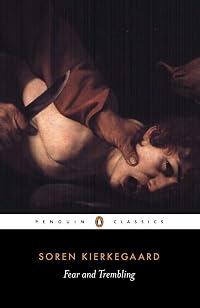


















Member Reviews
Warning! Here you will find a person of limited intelligence commenting on the writings of a burning genius. Consider yourself warned.
Kierkegaard is considered the father of existentialism. In a word, if I understand it correctly (and who really does understand existentialism?), this means that he was the first philosopher to incorporate into his philosophy the idea that life is happening right now, and cannot be treated like a static thing. Kierkegaard is a meticulous thinker who is both subtle and bold. He knows how to take a preconception and worry it to death with the tenacity of a pit bull. I admire him and have learned a great deal from reading his book.
However, I have multiple criticisms of his ideas. I won't say that I hate or show more dislike him or his philosophy. (It would be ironic to say that about someone who writes a tome on love). But if I met him in person, I think I would experience a strong desire to punch him in the nose, lovingly. Here's why:
1. He is a Christian exclusivist to the point of idolatry
2. He embraces a divine-command meta-ethic. I don't have a problem with revelation, but I do have a problem with people who pretend to understand the mind of God. If revelation alone were enough, then why did God give us reason? This type of moral framework has been used, historically and in the present, to justify all kinds of atrocity. The recent waves of violence coming from the Islamic fundamentalists is based in divine-command meta-ethic. Kierkegaard's idea of the "teleological suspension of the ethical" (in Fear and Trembling) is truly horrific.
3. A puritanical rejection of art
4. He proposes to replace human nature with an artificial ideal, just like communism does. He is the communist of love. I think his ideas would work about as well in real life as political communism does.
5. The ideal of love he proposes seems hellish to me: everything not forbidden is compulsory
6. He makes the same mistake as the poets he criticizes: championing one idea of love and denigrating others.
7. By championing an impossible ideal that is contrary to human nature, he forces his followers to be hypocrites
8. He speaks in riddles, like the poets he criticizes. But he is much more prolix than a poet.
9. He is difficult to pin down to a point of view. His declarative statements have so many qualifications that his philosophy "dies the death of a thousand qualifications"
10. He seems to think that Christianity invented love, and makes no comment on love in other societies other than to dismiss them as "paganism" (um, Plato?) show less
Kierkegaard is considered the father of existentialism. In a word, if I understand it correctly (and who really does understand existentialism?), this means that he was the first philosopher to incorporate into his philosophy the idea that life is happening right now, and cannot be treated like a static thing. Kierkegaard is a meticulous thinker who is both subtle and bold. He knows how to take a preconception and worry it to death with the tenacity of a pit bull. I admire him and have learned a great deal from reading his book.
However, I have multiple criticisms of his ideas. I won't say that I hate or show more dislike him or his philosophy. (It would be ironic to say that about someone who writes a tome on love). But if I met him in person, I think I would experience a strong desire to punch him in the nose, lovingly. Here's why:
1. He is a Christian exclusivist to the point of idolatry
2. He embraces a divine-command meta-ethic. I don't have a problem with revelation, but I do have a problem with people who pretend to understand the mind of God. If revelation alone were enough, then why did God give us reason? This type of moral framework has been used, historically and in the present, to justify all kinds of atrocity. The recent waves of violence coming from the Islamic fundamentalists is based in divine-command meta-ethic. Kierkegaard's idea of the "teleological suspension of the ethical" (in Fear and Trembling) is truly horrific.
3. A puritanical rejection of art
4. He proposes to replace human nature with an artificial ideal, just like communism does. He is the communist of love. I think his ideas would work about as well in real life as political communism does.
5. The ideal of love he proposes seems hellish to me: everything not forbidden is compulsory
6. He makes the same mistake as the poets he criticizes: championing one idea of love and denigrating others.
7. By championing an impossible ideal that is contrary to human nature, he forces his followers to be hypocrites
8. He speaks in riddles, like the poets he criticizes. But he is much more prolix than a poet.
9. He is difficult to pin down to a point of view. His declarative statements have so many qualifications that his philosophy "dies the death of a thousand qualifications"
10. He seems to think that Christianity invented love, and makes no comment on love in other societies other than to dismiss them as "paganism" (um, Plato?) show less
There is a 2009 ed by HarperCollins of this exact title.
Ratings
Members
- Recently Added By
Lists

In Our Time books
4,934 works; 2 members
Author Information

635+ Works 33,265 Members
Born in Copenhagen, Denmark, Søren Kierkegaard was the son of a wealthy middle-class merchant. He lived all his life on his inheritance, using it to finance his literary career. He studied theology at the University of Copenhagen, completing a master's thesis in 1841 on the topic of irony in Socrates. At about this time, he became engaged to a show more woman he loved, but he broke the engagement when he decided that God had destined him not to marry. The years 1841 to 1846 were a period of intense literary activity for Kierkegaard, in which he produced his "authorship," a series of writings of varying forms published under a series of fantastic pseudonyms. Parallel to these, he wrote a series of shorter Edifying Discourses, quasi-sermons published under his own name. As he later interpreted it in the posthumously published Point of View for My Work as an Author, the authorship was a systematic attempt to raise the question of what it means to be a Christian. Kierkegaard was persuaded that in his time people took the meaning of the Christian life for granted, allowing all kinds of worldly and pagan ways of thinking and living to pass for Christian. He applied this analysis especially to the speculative philosophy of German idealism. After 1846, Kierkegaard continued to write, publishing most works under his own name. Within Denmark he was isolated and often despised, a man whose writings had little impact in his own day or for a long time afterward. They were translated into German early in the twentieth century and have had an enormous influence since then, on both Christian theology and the existentialist tradition in philosophy. (Bowker Author Biography) show less
Series
Belongs to Publisher Series
Work Relationships
Common Knowledge
- Original title
- Kærlighedens gerninger
- Original publication date
- 1847
- People/Characters
- Søren Kierkegaard
- Original language
- Danish
Classifications
Statistics
- Members
- 1,293
- Popularity
- 18,909
- Reviews
- 2
- Rating
- (4.23)
- Languages
- 10 — Chinese, Danish, Dutch, English, Finnish, German, Italian, Slovenian, Spanish, Swedish
- Media
- Paper, Ebook
- ISBNs
- 47
- ASINs
- 16