On This Page
Description
Fantasy. Fiction. Thriller. HTML:Symir -- the Drowning City. home to exiles and expatriates, pirates and smugglers. And violent revolutionaries who will stop at nothing to overthrow the corrupt Imperial government.For Isyllt Iskaldur, necromancer and spy, the brewing revolution is a chance to prove herself to her crown. All she has to do is find and finance the revolutionaries, and help topple the palaces of Symir. But she is torn between her new friends and her duties, and the longer she show more stays in this monsoon-drenched city, the more intrigue she uncovers -- even the dead are plotting.
As the waters rise and the dams crack, Isyllt must choose between her mission and the city she came to save. show less
Tags
Recommendations



















Member Recommendations

Member Reviews
I picked this up on a whim at Barnes and Noble. It then sat on my shelf for ages. I'm glad. Because when I finally read it, two more were published and I was able to gobble them all up! I enjoyed the character if Isyllt: unsure, but confident; prone to rash choices with her heart but wise choices for her job, broken but strong, and complex. The world building was fantastic. Symir reminded me of a jungly Venice. I could almost smell the water, the trees, the heat and death. The magic, the politics, the scoop - it was imaginative, intriguing, finely crafted and layered. Told from the viewpoint of three women, the story moves at a good pace, sucking one in and not letting go. I highly recommend!
Symir, the Drowning City. A lush subtropical port, home to exiles and expatriates, pirates and smugglers. And violent revolutionaries who'll stop at nothing to overthrow the corrupt Imperial government. Isyllt Iskaldur, necromancer and spy, has been sent to Symir to stir the pot and help the revolutionaries out. Unfortunately the longer Isyllt stays in the city the more dangerous it becomes. Will she choose between her mission or saving the lives of millions?
The Drowning City is the first in The Necromancer Chronicles and the first book by Amanda Downum. There is a definite Asian/Arabic influence to the world building. I enjoyed reading about the city itself and the steamy jungle. The characters even eat a a sushi cafe at one point. The show more magic system is also interesting. It is more shamanistic, spirit and ghost based, quite different than anything I've read recently.
What drew me to checking the book out was the fact that the main character is both a necromancer and a spy. Here is where the story fell short for me. Isyllt wasn't very spy-like in my opinion.Several of the books revelations occurred with our her by secondary characters. In fact, more time was spent with secondary characters than with Isyllt, which was both interesting and odd. Interesting because the characters we fun to read about but odd that the heroine wasn't allowed to shine more.
For a first novel it shows promise. There is a good amount of action and political intrigue. It's also nice to see several strong female protagonists. I hope in future books the magic system is played up more and a glossary would be a good addition if "foreign" words within the context of the world will be common. show less
The Drowning City is the first in The Necromancer Chronicles and the first book by Amanda Downum. There is a definite Asian/Arabic influence to the world building. I enjoyed reading about the city itself and the steamy jungle. The characters even eat a a sushi cafe at one point. The show more magic system is also interesting. It is more shamanistic, spirit and ghost based, quite different than anything I've read recently.
What drew me to checking the book out was the fact that the main character is both a necromancer and a spy. Here is where the story fell short for me. Isyllt wasn't very spy-like in my opinion.
For a first novel it shows promise. There is a good amount of action and political intrigue. It's also nice to see several strong female protagonists. I hope in future books the magic system is played up more and a glossary would be a good addition if "foreign" words within the context of the world will be common. show less
This is the debut novel by author Amanda Downum and also the first in a fantasy trilogy. It does however work as a standalone with a satisfying conclusion to the story. Perhaps the strongest aspect of this book and what really makes it stand out from the crowd is the lush, tropical south-east asian inspired setting. The world building is excellent - the city of Symir growing restless under the yoke of a foreign empire - as well as the larger world and the political rivalries between empires and kingdoms are well realized. So is the role of magic in the world which relies heavily on the use of charms, gems and the binding of spirits and ghosts - it is both unusual and memorable The flora and fauna and geography of Symir and its show more surrounding jungles and swamps are all vividly described and add to the dense, cloying, riotous atmosphere of the story. All of it adds up to give the world great depth in which the story can unfold.
The characters too are memorable. The main protagonist is a young necromancer and spy, Isylt Iskuldur who has been sent to Symir with arms and money to see if she can stir the brewing discontent in to open revolt in the hopes of disrupting Symir's crucial trade in gemstones (which are important components in the working of magic), thereby distracting the Emperor of the Assari Empire away from plans of Imperial expansion in the north. However Symir's rebels are themselves divided in to factions, some of whom see any foreigners, even those who come bearing gifts, as a threat to be eliminated. To make matters more complicated, elements of the Imperial government also seem to be working to cross purposes and Isylt has to navigate the murky waters of internecine conflict while the lines between who is ally and enemy get increasingly blurred.
My description may make the whole thing sound like an incredibly convoluted thrill-a-minute ride but in fact the story unfolds in a stately manner. The author takes her time in introducing characters and letting plots and subplots unfold. If there is a criticism to be made it is that at time Isylt seems somewhat passive (not in her actions but in her decision-making) and her motivations not always entirely clear. At different times it is other characters who are much more the author of events and Isylt seems to be content to go along with things which one might expect she would balk from given her mission. The secondary characters are also interesting and well-realized - in some cases perhaps more well realized than Isylt.
Despite this criticism, all in all this was a satisfying and entertaining read. The world-building once again stands out and as soon as I was finished I picked up the sequel, not because the story was left unfinished (as mentioned earlier the story comes to a satisfying conclusion) but because the world and the characters were so intriguing that I wanted to spend more time with them. show less
The characters too are memorable. The main protagonist is a young necromancer and spy, Isylt Iskuldur who has been sent to Symir with arms and money to see if she can stir the brewing discontent in to open revolt in the hopes of disrupting Symir's crucial trade in gemstones (which are important components in the working of magic), thereby distracting the Emperor of the Assari Empire away from plans of Imperial expansion in the north. However Symir's rebels are themselves divided in to factions, some of whom see any foreigners, even those who come bearing gifts, as a threat to be eliminated. To make matters more complicated, elements of the Imperial government also seem to be working to cross purposes and Isylt has to navigate the murky waters of internecine conflict while the lines between who is ally and enemy get increasingly blurred.
My description may make the whole thing sound like an incredibly convoluted thrill-a-minute ride but in fact the story unfolds in a stately manner. The author takes her time in introducing characters and letting plots and subplots unfold. If there is a criticism to be made it is that at time Isylt seems somewhat passive (not in her actions but in her decision-making) and her motivations not always entirely clear. At different times it is other characters who are much more the author of events and Isylt seems to be content to go along with things which one might expect she would balk from given her mission. The secondary characters are also interesting and well-realized - in some cases perhaps more well realized than Isylt.
Despite this criticism, all in all this was a satisfying and entertaining read. The world-building once again stands out and as soon as I was finished I picked up the sequel, not because the story was left unfinished (as mentioned earlier the story comes to a satisfying conclusion) but because the world and the characters were so intriguing that I wanted to spend more time with them. show less
The Drowning City is a promising debut that overcomes its few hiccups by the conclusion of the book. Downum is definitely one to watch.
Isyllt is a necromancer spy, sent to the steamy south to sow trouble in a rival empire. But on arrival, she realises she's stepped into a colonised city on the precipice. Can she push it over the edge without taking herself with it?
I struggled a little with the start of this book - I am not alone, judging from some reviews. Downum pops you straight into her city, and she fills her story with new terms, names, cultures. The political situation is not complex (an empire, their colonised kingdom, another rival kingdom/empire far to the north) but when it's served up all at once, the info dump was a little show more intense, especially coupled with constant allusions to what's happening offscreen and multiple protagonists.
This is compounded by Downum's rather heady prose. I don't know if I got used to it, or if she scaled it back a little bit as the book progressed, but either way I was fine with it by the end.
The setting is a kind of pan-Asian setting. It works very well in some places, and not so well in others, as Downum is happy to mix up syntax and cultural norms from very different Asian countries (eg Indonesia, Thailand, Vietnam/Laos, India etc) to make her setting, and for me it was both a bit confusing, and also skirted the line of orientalism for me. I know her fantasy country is not meant to be analogous to one particular Asian country, but this kind of blending felt a bit haphazard - I felt she just wanted it to feel exotic and "Asian".
However, these weaknesses were far outweighed by the novel's strengths, first of which was its mature and engrossing plot. I love tales of intrigue, and Downum has a good one here - and one that escalates steadily, avoiding a tit-for-tat feel that Game of Thrones imitators can have. There is a sense of things being at stake in The Drowning City, and also progression.
Whilst the multiple protagonists were confusing at first, as their stories matured and developed I really started to appreciate them. Characters I had written off as one dimensional and shallow came to life, with more complexity than I had given them credit for.
This goes for our main protagonist, Isyllt, as well. Downum stuffs her with backstory and it really does add a lot of depth.
The climax, when it comes, is a superb collation of these separate threads. None of it felt forced or rushed to me, and I finished the book with a feeling of great satisfaction. A promising debut; I bought the sequel immediately. show less
Isyllt is a necromancer spy, sent to the steamy south to sow trouble in a rival empire. But on arrival, she realises she's stepped into a colonised city on the precipice. Can she push it over the edge without taking herself with it?
I struggled a little with the start of this book - I am not alone, judging from some reviews. Downum pops you straight into her city, and she fills her story with new terms, names, cultures. The political situation is not complex (an empire, their colonised kingdom, another rival kingdom/empire far to the north) but when it's served up all at once, the info dump was a little show more intense, especially coupled with constant allusions to what's happening offscreen and multiple protagonists.
This is compounded by Downum's rather heady prose. I don't know if I got used to it, or if she scaled it back a little bit as the book progressed, but either way I was fine with it by the end.
The setting is a kind of pan-Asian setting. It works very well in some places, and not so well in others, as Downum is happy to mix up syntax and cultural norms from very different Asian countries (eg Indonesia, Thailand, Vietnam/Laos, India etc) to make her setting, and for me it was both a bit confusing, and also skirted the line of orientalism for me. I know her fantasy country is not meant to be analogous to one particular Asian country, but this kind of blending felt a bit haphazard - I felt she just wanted it to feel exotic and "Asian".
However, these weaknesses were far outweighed by the novel's strengths, first of which was its mature and engrossing plot. I love tales of intrigue, and Downum has a good one here - and one that escalates steadily, avoiding a tit-for-tat feel that Game of Thrones imitators can have. There is a sense of things being at stake in The Drowning City, and also progression.
Whilst the multiple protagonists were confusing at first, as their stories matured and developed I really started to appreciate them. Characters I had written off as one dimensional and shallow came to life, with more complexity than I had given them credit for.
This goes for our main protagonist, Isyllt, as well. Downum stuffs her with backstory and it really does add a lot of depth.
The climax, when it comes, is a superb collation of these separate threads. None of it felt forced or rushed to me, and I finished the book with a feeling of great satisfaction. A promising debut; I bought the sequel immediately. show less
I'm too jaded and cynical to pay much regard to blurbs anymore; but when I visit an author's website and find her just-published first novel praised by Elizabeth Bear, Sarah Monette and Jacqueline Carey, then I'm still naive enough that it *does* get my attention.
And fortunately so, in this case, for I liked "The Drowning City" a lot. Every fantasy novel that swerves from the still mostly standard European, pseudo-medieval setting does get bonus points from me, and all the more if it is as vividly evoked as Symir, the drowned city of the novel's title - a large and bustling port town in the Asian-influenced country of Sivahra, built close to a volcano and surrounded by swamp and jungle. Sivahra is occupied by the noticeably show more Arabian-themed Empire, whichin turn is the reason is the reason why the novel's main protagonist, necromancer Isyllt Iskandur, is sent to Symir as a spy from the northern realm of Selafia, to help foment rebellion against the Empire.
Confused yet? There is a lot of intrigue and politicking going on in this novel, and Amanda Downum obviously spend some time and effort to imagine a richly detailed world. She rigorously avoids infodumps, though, and slips all the information necessary to understand what is going on into the multiple POV narratives.
This keeps the novel at a brisk pace and the reader from getting bored, it also means that it is easy to miss something important if one lets one's attention flag. Which I personally tend to consider a good thing, but your mileage may vary. The plot construction is a bit creaky at times, some things hinge rather too much on chance encounters for my taste, and there is at least one character (an agent of the Empire working against the Emperor) who doesn't seem to fulfill any function I could discern.
But then, this *is* a first novel, and some awkwardness is to be expected. On the plus side are the character, of which there are quite a few for what counts as a comparative slim novel these days - all the POV characters are well developed, and there is always a sense of people doing what they do because they believe is the right thing to do, and not because the plot needs a villain.
And the setting those characters move in is just as well-developed, imaginative and fascinating to read about, whether it's the tribal culture of the Sivahran natives, the various intrigues playing out in Symir to finally come to an explosive and gruesome climax, or the necromantic magic Isyllt wields - it all weaves together to a rich and varied tapestry that left me curious for more tales from this world.
Where the novel really shines, though, is its language. I have not read a fantasy novel that was this well written in quite some time, and Amanda Downum's ability to evoke the brooding fetid atmosphere of the drowning city, to bring a character to life
or to vividly render an action scene with just a few brushstrokes is impressive to say the least. There are no lengthy descriptions in this novel, but Amanda Downum achieves with just a few well-selected words, a handful of well-placed metaphors to make her world with its colours, sounds and smells, her characters with their emotions and hurts come more vividly alive than any verbose description going on across the pages.
While it stands perfectly well on its own, "The Drowning City" is the first novel in a planned trilogy called "The Necromancer Chronicles," and I for one can't wait to read the second installment which will be called "The Bone Palace" and is scheduled for release in 2010. show less
And fortunately so, in this case, for I liked "The Drowning City" a lot. Every fantasy novel that swerves from the still mostly standard European, pseudo-medieval setting does get bonus points from me, and all the more if it is as vividly evoked as Symir, the drowned city of the novel's title - a large and bustling port town in the Asian-influenced country of Sivahra, built close to a volcano and surrounded by swamp and jungle. Sivahra is occupied by the noticeably show more Arabian-themed Empire, whichin turn is the reason is the reason why the novel's main protagonist, necromancer Isyllt Iskandur, is sent to Symir as a spy from the northern realm of Selafia, to help foment rebellion against the Empire.
Confused yet? There is a lot of intrigue and politicking going on in this novel, and Amanda Downum obviously spend some time and effort to imagine a richly detailed world. She rigorously avoids infodumps, though, and slips all the information necessary to understand what is going on into the multiple POV narratives.
This keeps the novel at a brisk pace and the reader from getting bored, it also means that it is easy to miss something important if one lets one's attention flag. Which I personally tend to consider a good thing, but your mileage may vary. The plot construction is a bit creaky at times, some things hinge rather too much on chance encounters for my taste, and there is at least one character (an agent of the Empire working against the Emperor) who doesn't seem to fulfill any function I could discern.
But then, this *is* a first novel, and some awkwardness is to be expected. On the plus side are the character, of which there are quite a few for what counts as a comparative slim novel these days - all the POV characters are well developed, and there is always a sense of people doing what they do because they believe is the right thing to do, and not because the plot needs a villain.
And the setting those characters move in is just as well-developed, imaginative and fascinating to read about, whether it's the tribal culture of the Sivahran natives, the various intrigues playing out in Symir to finally come to an explosive and gruesome climax, or the necromantic magic Isyllt wields - it all weaves together to a rich and varied tapestry that left me curious for more tales from this world.
Where the novel really shines, though, is its language. I have not read a fantasy novel that was this well written in quite some time, and Amanda Downum's ability to evoke the brooding fetid atmosphere of the drowning city, to bring a character to life
or to vividly render an action scene with just a few brushstrokes is impressive to say the least. There are no lengthy descriptions in this novel, but Amanda Downum achieves with just a few well-selected words, a handful of well-placed metaphors to make her world with its colours, sounds and smells, her characters with their emotions and hurts come more vividly alive than any verbose description going on across the pages.
While it stands perfectly well on its own, "The Drowning City" is the first novel in a planned trilogy called "The Necromancer Chronicles," and I for one can't wait to read the second installment which will be called "The Bone Palace" and is scheduled for release in 2010. show less
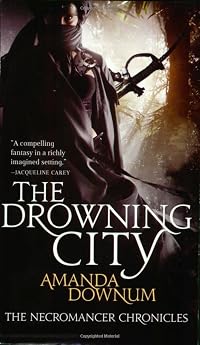
I picked this book up on impulse a while ago based on the excellent back blurb and a gorgeous cover, plus an endorsement from Jacqueline Carey, whose work I enjoy.
Isyllt Iskaldur is a necromancer and a spy sent to a neighbouring empire to stir a revolution, to keep the empire from turning its attention to her lands. She travels from her homeland to Symir with two companions: Adam and Xinai. They are traveling under the pretense that Isyllt is going to be training at the local mage haunt, the Kurun Tam. While at the Kurun Tam, she bumps heads with ghosts and Asheris, a mysterious and attractive fellow mage.
There are also several subplots: Xinai is from Symir and has to deal with returning to her homeland, a place she had to leave after show more her clan was killed. She reunites with old friends and gets drawn into one group of revolutionaries. Meanwhile, another group of revolutionaries, slightly less militant, are also stirring, aided by an apprentice at the Kurun Tam.
Amanda Downum has created a sumptuous fantasy world. I had to go over the first chapter a couple times because there was so much information and so many place names starting with S, and I started reading the book while I was sick, but it was well worth the effort. The world building is meticulous and rich and the characters all have unique personalities that emerge over the course of the novel. The storytelling is layered and takes lots of twists and turns, with an exciting ending.
There is a very real sense of cost in The Drowning City. Isyllt does not go through the novel unscathed, nor do other characters. There is a grittiness in Amanda Downum’s writing that makes everything feel quite present and true. I really loved it and can’t wait to read The Bone Palace.
http://ireadgood.wordpress.com show less
Isyllt Iskaldur is a necromancer and a spy sent to a neighbouring empire to stir a revolution, to keep the empire from turning its attention to her lands. She travels from her homeland to Symir with two companions: Adam and Xinai. They are traveling under the pretense that Isyllt is going to be training at the local mage haunt, the Kurun Tam. While at the Kurun Tam, she bumps heads with ghosts and Asheris, a mysterious and attractive fellow mage.
There are also several subplots: Xinai is from Symir and has to deal with returning to her homeland, a place she had to leave after show more her clan was killed. She reunites with old friends and gets drawn into one group of revolutionaries. Meanwhile, another group of revolutionaries, slightly less militant, are also stirring, aided by an apprentice at the Kurun Tam.
Amanda Downum has created a sumptuous fantasy world. I had to go over the first chapter a couple times because there was so much information and so many place names starting with S, and I started reading the book while I was sick, but it was well worth the effort. The world building is meticulous and rich and the characters all have unique personalities that emerge over the course of the novel. The storytelling is layered and takes lots of twists and turns, with an exciting ending.
There is a very real sense of cost in The Drowning City. Isyllt does not go through the novel unscathed, nor do other characters. There is a grittiness in Amanda Downum’s writing that makes everything feel quite present and true. I really loved it and can’t wait to read The Bone Palace.
http://ireadgood.wordpress.com show less
A solid book in the modern fantasy genre - We have a wonderful detailed world, with interesting cultures and well written characters. The heroine, Issylt, is interesting - and considerably more than a simple spy - she acts rationally, asks for help, and has humanity - a welcome change from the loner type heroine novels that are so frequent. That isn't to say she isn't kick-ass, but she works within the system (well, her country's system - she is a spy), uses her skills when necessary, but knows her weaknesses.
The supporting characters are equally well written - for example, the student/revolutionist might be idealistic - but is smart and steps up to the challenge, without losing who she is.
The book is slow - there is a lot of show more politics, world building, and wordy scenes - but it picks up speed in later chapters, and becomes a book that you can't put down.
So, to summarize - nice world building, interesting characters, but at times a bit slow. If you like your fantasy with more of politics than fighting - this is a book you should read. show less
The supporting characters are equally well written - for example, the student/revolutionist might be idealistic - but is smart and steps up to the challenge, without losing who she is.
The book is slow - there is a lot of show more politics, world building, and wordy scenes - but it picks up speed in later chapters, and becomes a book that you can't put down.
So, to summarize - nice world building, interesting characters, but at times a bit slow. If you like your fantasy with more of politics than fighting - this is a book you should read. show less
Members
- Recently Added By
Lists

Future Green Dragon Group Read Books
80 works; 6 members

Fantasy by Women Who Broke Away from Europe
144 works; 12 members
Author Information

15+ Works 1,448 Members
Some Editions
Awards and Honors
Series

Common Knowledge
- Canonical title
- The Drowning City
- Original publication date
- 2009-08-25
- People/Characters
- Isyllt Iskaldur; Adam; Xinai Lin; Vasilios Medeion; Kirilos Orfion; Zhirin Laii (show all 21); Fei Minh Laii; Anhai Xian-Mar; Vienh Xian; Deilin Xian; Jabbor Lhun; Riuh Xian; Selei Xian; Asheris al Seth; Faraj al Ghassan; Imran al Najid; Jodiya al Sarith; Siddir Bashari; Shaiyung Lin; Kwan Lhun; Izachar Teoma
- Important places
- Symir, Sivahra; Erisin, Selafai; Ta'ashlan, Assar
- Epigraph
- Drowning is not so pitiful
As the attempt to rise.
--Emily Dickinson
Hope lies in the smoldering rubble of empires.
-- Rage Against the Machine
("Calm Like a Bomb") - Dedication
- For New Orleans
- First words
- Symir.
- Last words
- (Click to show. Warning: May contain spoilers.)Isyllt opened the bag and laughed as a stream of opals poured free, gleaming with iridescent fire.
- Blurbers
- Carey, Jacqueline; Bear, Elizabeth
Classifications
Statistics
- Members
- 654
- Popularity
- 44,132
- Reviews
- 26
- Rating
- (3.54)
- Languages
- English, French
- Media
- Paper, Ebook
- ISBNs
- 6
- ASINs
- 2