On This Page
Description
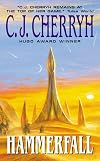
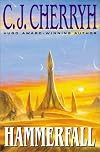
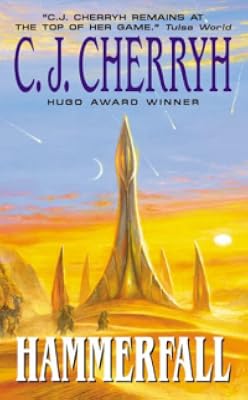
One of the most renowned figures in science fiction, C.J. Cherryh has been enthralling audiences for nearly thirty years with rich and complex novels. Now at the peak of her career, this three-time Hugo Award winner launches her most ambitious work in decades, Hammerfall, part of a far-ranging series, The Gene Wars, set in an entirely new universe scarred by the most vicious of future weaponry, nanotechnology. In this brilliant novel -- possibly Cherryh's masterwork -- the fate of billions show more has come down to a confrontation between two profoundly alien cultures on a single desert planet. "The mad shall be searched out and given to the Ila's messengers. No man shall conceal madness in his wife, or his son, or his daughter, or his father. Every one must be delivered up." -- The Book of the Ila's Au'it Marak has suffered the madness his entire life. He is a prince and warrior, strong and shrewd and expert in the ways of the desert covering his planet. In the service of his father, he has dedicated his life to overthrowing the Ila, the mysterious eternal dictator of his world. For years he has successfully hidden the visions that plague him -- voices pulling him eastward, calling Marak, Marak, Marak, amid mind-twisting visions of a silver tower. But when his secret is discovered, Marak is betrayed by his own father and forced to march in an endless caravan with the rest of his world's madmen to the Ila's city of Oburan. Instead of death, Marak finds in Oburan his destiny, and the promise of life -- if he can survive what is surely a suicidal mission. The Ila wants him to discover the source of the voices and visions that afflict the mad. Despite the danger sof the hostile desert, tensions within the caravan, and his own excruciating doubts, Marak miraculously reaches his goal -- only to be given another, even more impossible mission by the strange people in the towers. According to these beings who look like him yet act differently than anyone he has ever known, Marak has a slim chance to save his world's people from the wrath of Ila's enemies. But to do so, he must convince them all -- warring tribes, villagers, priests, young and old, as well as the Ila herself -- to follow him on an epic trek across the burning desert before the hammer of the Ila's foes falls from the heavens above. Written with deceptive simplicity and lyricism, this riveting, fast-paced epic of war, love, and survival in a brave new world marks a major achievement from the masterful C.J. Cherryh. show lessTags
Recommendations



Member Reviews
A good story and enjoyable read but oddly shallow lacking in depth and the greater explanation. If you can imagine Dune being told from the viewpoint of the Fremen, this would be like that. Apart from the desert world it's a totally different plot, but all the undercurrents in Dune happen through house politics that the Fremen are oblivious of, which makes the action and changes a mystery to them. This is the case in Hammerfall.
Marak is a desert tribesman. His life has been dominated by hiding the voices and visions in his head, and following his father on raids against the ruling Ila's caravans. Eventually his madness betrays him, his father disowns him, and the Ila gathers him in. Unbeknownest to Marak, there has been a gathering show more plague of madness, and Ila suspects the reason lies in the east. Marak is placed in charge of a caravan of similarly afflicted (plus a conventional guide and caravan master) to find out what is there. The journey is a struggle, but the person he meets is beyond all concepts of his world.
The prose is CJC's characteristic tight third person style. We only see, feel and hear what Marak does. He can speculate on the reasonings of others, but if their actions don't match his expectations we'll be blindsided until they reveal themselves to him. It's a device that works very well in maintaining surprise, which given the absense of action as such, is particularly good. The plot doesn't drag exactly, but other than Marak wandering across the desert not a lot really happens, until the end, which does get very tense. However it has a major downside, we has readers don't know what is going on in the wider universe. We can only speculate from the odd hints dropped to Marak, that he doens't understand.
The lack of background makes this feel very different from a usual Cherryh novel. Although often in SF and CJC's work one has to work out the universe assumptions., there are usually plenty of clues and even sometimes infodumps to help you. In Hammerfall there is nothing at all and it is quite odd. In respects because Marak doesn't have any technology it feels very much like a fantasy novel - the early Pern series for example. If you can put off your curiosity for the entire book, then the opening prologue of the sequel Forge of Heaven explains it all.
Worth reading for the story, and the sequel for the explanation!
..................................................................................................... show less
Marak is a desert tribesman. His life has been dominated by hiding the voices and visions in his head, and following his father on raids against the ruling Ila's caravans. Eventually his madness betrays him, his father disowns him, and the Ila gathers him in. Unbeknownest to Marak, there has been a gathering show more plague of madness, and Ila suspects the reason lies in the east. Marak is placed in charge of a caravan of similarly afflicted (plus a conventional guide and caravan master) to find out what is there. The journey is a struggle, but the person he meets is beyond all concepts of his world.
The prose is CJC's characteristic tight third person style. We only see, feel and hear what Marak does. He can speculate on the reasonings of others, but if their actions don't match his expectations we'll be blindsided until they reveal themselves to him. It's a device that works very well in maintaining surprise, which given the absense of action as such, is particularly good. The plot doesn't drag exactly, but other than Marak wandering across the desert not a lot really happens, until the end, which does get very tense. However it has a major downside, we has readers don't know what is going on in the wider universe. We can only speculate from the odd hints dropped to Marak, that he doens't understand.
The lack of background makes this feel very different from a usual Cherryh novel. Although often in SF and CJC's work one has to work out the universe assumptions., there are usually plenty of clues and even sometimes infodumps to help you. In Hammerfall there is nothing at all and it is quite odd. In respects because Marak doesn't have any technology it feels very much like a fantasy novel - the early Pern series for example. If you can put off your curiosity for the entire book, then the opening prologue of the sequel Forge of Heaven explains it all.
Worth reading for the story, and the sequel for the explanation!
..................................................................................................... show less
On an isolated desert planet, certain people find themselves experiencing strange voices and visions, along with a compulsion to go towards the east. But when an expedition of these "madmen" sets off in that direction to find the source of their affliction, the answer they find proves to be bad news for their entire world.
The basic set-up here has a lot of promise, as well as intriguing hints of a bigger picture that I'm sure is explored more in the sequel. And Cherryh does an effective job of conveying the hardship of multiple desert crossings realistically. Unfortunately, like those desert treks, this book is slow. Now, Cherryh in general is not exactly known for prioritizing a fast pace in her novels, but at her best, her stories are show more so packed with political and psychological intricacy that it's impossible not to get caught up in them, regardless. But this, sadly, is not her best. It really needed to be shorter, or deeper; either one would do.
I was also bothered by many of the plot details, which never quite came together in a way that made coherent sense to me. That includes a particular pet peeve of mine, which is all too common in science fiction: powerful and knowledgeable characters who for some reason, despite their own best interests, choose the most annoyingly cryptic and inefficient means possible of communicating and acting, together with less-powerful and less-knowledgeable characters who don't ask enough questions and don't push hard enough for answers.
It's not, I suppose, a bad book, but it is frustrating, because there is the core of something interesting here, and I know that Cherryh is capable of doing so much better. show less
The basic set-up here has a lot of promise, as well as intriguing hints of a bigger picture that I'm sure is explored more in the sequel. And Cherryh does an effective job of conveying the hardship of multiple desert crossings realistically. Unfortunately, like those desert treks, this book is slow. Now, Cherryh in general is not exactly known for prioritizing a fast pace in her novels, but at her best, her stories are show more so packed with political and psychological intricacy that it's impossible not to get caught up in them, regardless. But this, sadly, is not her best. It really needed to be shorter, or deeper; either one would do.
I was also bothered by many of the plot details, which never quite came together in a way that made coherent sense to me. That includes a particular pet peeve of mine, which is all too common in science fiction: powerful and knowledgeable characters who for some reason, despite their own best interests, choose the most annoyingly cryptic and inefficient means possible of communicating and acting, together with less-powerful and less-knowledgeable characters who don't ask enough questions and don't push hard enough for answers.
It's not, I suppose, a bad book, but it is frustrating, because there is the core of something interesting here, and I know that Cherryh is capable of doing so much better. show less
This is sf written very much like a fantasy. The technology might as well be magic, for the extent to which Marak Trin Tain and his companions understand it. What it really is, of course, is nanotechnology, and spaceships, and tossing asteroids and comets around as needed. Only a small portion of this world, the Lahkt, is really habitable, and that's due mainly to nanotechnology, and conditions are still at best very harsh.
Marak and most of his companions are mad, or what is called mad on the Lahkt. They see impossible things, and hear voices telling them to go east to a silver tower, and they heal very well. The ruler of their world, the Ila, orders all the mad rounded up and brought to her in the capital city, Oburan. Marak, the son show more of a village chieftain who staged a long but unsuccessful rebellion against the Ila, hopes that once in the city, he'll get a chance to kill his old enemy. He would have, too, if the Ila didn't have force fields and energy weapons to protect herself.
The Ila, in any case, has a different plan for Marak. She wants him to lead an expedition to the east, to find out what it is that's calling the mad, and report back to her. Marak agrees, with several conditions, one of them being that all of the ingathered mad go with him.
It's not a safe journey, and not everyone survives. Along the way, Marak acquires two wives amongst his fellow mad--which is an outrage to his village upbringing, but very much the Done Thing in the tribal culture that one of his wives comes from. And when they finally reach their destination, they find out that they have scarcely begun traveling. The people who have been calling the mad for thirty years want Marak to go back to Oburan and organize a much more difficult and dangerous expedition.
This is an interesting and mostly enjoyable book. I think that whether you enjoy Cherryh's fantasy is a better test of whether you're likely to enjoy this one than whether you enjoy her sf. I do have one serious complaint, and that's that Luz, the summoner of the "mad," is difficult and obscure, and much of the time it seems that she's being difficult and obscure because the plot requires it; Marak wouldn't make some of the decisions he makes if Luz were explaining things adequately and behaving in a manner that encouraged him to trust what she does say. This is a serious irritant from the point at which we first meet Luz.This is dangerously close to being an idiot plot, a plot in which critical events would not happen, if otherwise intelligent characters did not behave like idiots. show less
Marak and most of his companions are mad, or what is called mad on the Lahkt. They see impossible things, and hear voices telling them to go east to a silver tower, and they heal very well. The ruler of their world, the Ila, orders all the mad rounded up and brought to her in the capital city, Oburan. Marak, the son show more of a village chieftain who staged a long but unsuccessful rebellion against the Ila, hopes that once in the city, he'll get a chance to kill his old enemy. He would have, too, if the Ila didn't have force fields and energy weapons to protect herself.
The Ila, in any case, has a different plan for Marak. She wants him to lead an expedition to the east, to find out what it is that's calling the mad, and report back to her. Marak agrees, with several conditions, one of them being that all of the ingathered mad go with him.
It's not a safe journey, and not everyone survives. Along the way, Marak acquires two wives amongst his fellow mad--which is an outrage to his village upbringing, but very much the Done Thing in the tribal culture that one of his wives comes from. And when they finally reach their destination, they find out that they have scarcely begun traveling. The people who have been calling the mad for thirty years want Marak to go back to Oburan and organize a much more difficult and dangerous expedition.
This is an interesting and mostly enjoyable book. I think that whether you enjoy Cherryh's fantasy is a better test of whether you're likely to enjoy this one than whether you enjoy her sf. I do have one serious complaint, and that's that Luz, the summoner of the "mad," is difficult and obscure, and much of the time it seems that she's being difficult and obscure because the plot requires it; Marak wouldn't make some of the decisions he makes if Luz were explaining things adequately and behaving in a manner that encouraged him to trust what she does say. This is a serious irritant from the point at which we first meet Luz.This is dangerously close to being an idiot plot, a plot in which critical events would not happen, if otherwise intelligent characters did not behave like idiots. show less
In a world ruled by the Ila, a rebel against her is cast out of his father’s tribe when his madness is revealed—madness that sends visions of the East. Given over to the Ila, he’s ordered to lead a mission to the East to discover the source of his (and many others’) madness. As with much Cherryh, this is intricate and cold. The people are mostly rigid with honor. I didn’t understand why the source of the madness did so much damage—given the explanation, the extent to which the madness incapacitated people seemed counterproductive and unjustified within the narrative world, useful more for producing angst and tension than for doing what the source intended. So that lingering question made the book even harder for me to enjoy.
Very good, typical great job by CJ Cherryh.
Marak is a tribesman who was fighting with other rebel tribes against the established government, but now that the voices in his head and the visions he has seen have become known, he is cast out as a crazy person, and taken to the capital city for judgment.
Marak may be crazy, but instead of condemning him, the ruler gives him a task, a quest: to go past the last outpost of civilization and pursue what lies beyond, which appears to be part of his visions.
And then to return across the desert to report what he has seen.
Worth a reread? YES!
Worth buying? Absolutely!
Will I read the sequel? No doubt, I will!
Marak is a tribesman who was fighting with other rebel tribes against the established government, but now that the voices in his head and the visions he has seen have become known, he is cast out as a crazy person, and taken to the capital city for judgment.
Marak may be crazy, but instead of condemning him, the ruler gives him a task, a quest: to go past the last outpost of civilization and pursue what lies beyond, which appears to be part of his visions.
And then to return across the desert to report what he has seen.
Worth a reread? YES!
Worth buying? Absolutely!
Will I read the sequel? No doubt, I will!
Normally I'm a big Cherryh fan, but this book is not one of her best. Its technically a sci-fi book, because it is about humans on another planet, but there's not much science or fiction about it. Mostly its about people crossing the desert on camels. Slowly. Plodding across the desert. Slowly. Day after day. Same thing, day after day. Then back again. Then again. Yes, its plodding.
Rider at the Gate was a sci-fi western. Hammerfall is a sci-fi desert caravan adventure. see, sci-fi doesn't always have to be about robots and tribbles!
the main character, Marak Tain --- I kept reading his name as Mark Twain. which added yet another layer I'm sure. ;)
but here are the quotes already:
110. "It's my choice! It's become my choice, and I may not do choose what they want me to choose!"
340. He tried to call what he felt in his soul responsibility; but it was beyond any sense of responsibility: it was simply doing what he could do, as long as he could do it, like a man walking on his last strength.
the main character, Marak Tain --- I kept reading his name as Mark Twain. which added yet another layer I'm sure. ;)
but here are the quotes already:
110. "It's my choice! It's become my choice, and I may not do choose what they want me to choose!"
340. He tried to call what he felt in his soul responsibility; but it was beyond any sense of responsibility: it was simply doing what he could do, as long as he could do it, like a man walking on his last strength.
Members
- Recently Added By
Lists

Read in 2014
334 works; 11 members
Author Information

261+ Works 75,091 Members
A multiple award-winning author of more than thirty novels, C. J. Cherryh received her B.A. in Latin from the University of Oklahoma, and then went on to earn a M.A. in Classics from Johns Hopkins University. Cherryh's novels, including Tripoint, Cyteen, and The Pride of Chanur, are famous for their knife-edge suspense and complex, realistic show more characters. Cherryh won the John W. Campbell Award for Best New Writer in 1977. She was also awarded the Hugo Award for her short story Cassandra in 1979, and the novels Downbelow Station in 1982 and Cyteen in 1989. (Bowker Author Biography) show less
Some Editions
Awards and Honors
Series

Work Relationships
Is contained in
Common Knowledge
- Canonical title
- Hammerfall
- Original publication date
- 2001-07
- People/Characters
- Marak Trin Tain; Hati; Ila; Luz; Norit; Memnanan
- Important places
- Marak's world; Lakht
- First words
- Distance deceived the eye in the lakht, that wide red land of the First Descended, where legend said the ships had come down.
- Last words
- (Click to show. Warning: May contain spoilers.)Sunlight, if only for an instant, found its way through the clouds.
Classifications
Statistics
- Members
- 916
- Popularity
- 29,441
- Reviews
- 16
- Rating
- (3.48)
- Languages
- English
- Media
- Paper, Ebook
- ISBNs
- 6
- ASINs
- 4