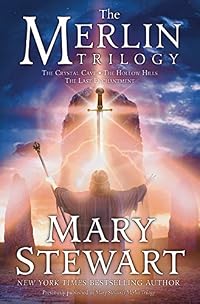
The Merlin Trilogy
by Mary Stewart
The Arthurian Merlin Saga (Collections and Selections — Omnibus 1-3)
On This Page
Description
The prophetic voice of Merlin, the mysterious enchanter of Arthurian legend, has completed his story. This book consists of Mary Stewart's three Arthurian novels one in volume.Tags
Recommendations

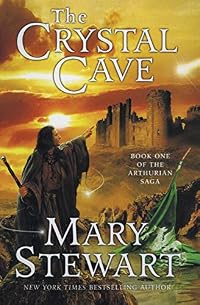
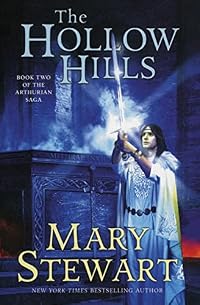

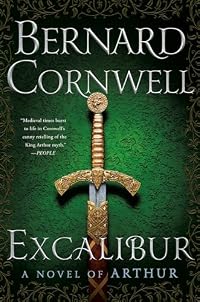

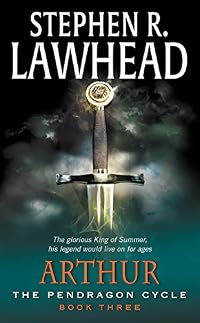


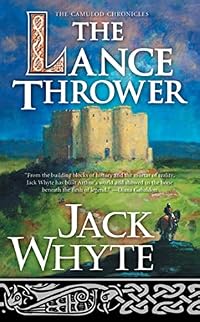
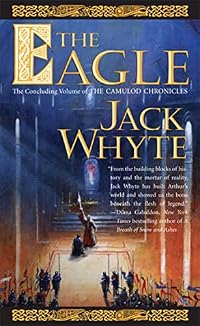




Member Reviews
With so many myths swirling around him, I enjoyed how Stewart portrays Merlin. On the one hand, he is a learned man who is one of the most widely traveled people of his time. The stories of Merlin’s
His skills include medicine, engineering and understanding many languages. These skills alone would make him standout. Then we come to Merlin’s magic – divination, magical defence and magical advice. With so many skills and abilities, it would be easy for Merlin to become a “deus ex machina” who can solve all problems. Fortunately, Stewart’s Merlin has magic from his god who is capricious and unpredictable. Merlin cannot always predict how or when his magic will come to him. This unpredictability was one of the best ways of portraying his abilities.
The novels are an engaging combination of historical fiction – there are many real places and some real people – and the fantastical. It deserves its reputation as one of the finest Arthurian retellings.
This is, rather surprisingly, a book that is most definitely better than the sum of its parts. In fact, looking at any one area would garner a mediocre review. The characterization is mostly bland, especially since most of the people Merlin meets serve a single purpose and then disappear (sometimes, though, they do reappear). Even Merlin himself is almost one-dimensional -- we know of all of his journeys through these three books, but only at the end do we get a general feeling about him. The plot is plodding and rarely seems to be going anywhere. Some of the more "traditional" parts of the Arthurian legends are left out, so it sometimes surprised me when we finally got past a particular moment (like the sword from the stone, or show more Merlin's final fate).
Yet this is unmistakeably one of the best retellings of the Arthurian legends, even though we pass the entire first book (The Crystal Cave) without him. Stewart draws on Geoffrey of Monmouth's cryptic (and probably fictitious) and terse description of a young Merlin, who barely uses "magic" here (he can see the future, but that's his only supernatural power; everything else is generally explainable). In the second book (The Hollow Hills), which starts minutes after the first book ends, Arthur is finally born, and then immediately hidden. Unfortunately, the book then loses a little steam as we wander around with Merlin just waiting for the boy to grow up. I think the series hits its best point as Arthur comes to the attention of all England, and is recognized as the heir to the throne. The final book (The Last Enchantment) was a big shock to me -- I thought I had read much about Arthur, but I guess I had only been exposed to the Disneyfied versions. There's the Herodian killing-of-the-innocents, and then one of Arthur's sisters steals his sword for power -- but by this point in this trilogy, those are mostly told as recollections, as Merlin has now found an apprentice and slowly moves towards the curse he knows awaits him.
I've been reading a lot of long books this year in the hopes of moving them on to better homes, but this is one I may keep and return to. It's a bit of work, only because of the long paragraphs about the flowers blooming or the description of the road to another tiny Welsh town, but it's an interesting -- at times funny, at times exciting, even though the battle scenes are somewhat a muddle -- take on how a mythical and mystical Merlin could have truly existed.
------------------
LT Haiku:
The myths of Arthur,
told in great detail by the
man who served him well. show less
Yet this is unmistakeably one of the best retellings of the Arthurian legends, even though we pass the entire first book (The Crystal Cave) without him. Stewart draws on Geoffrey of Monmouth's cryptic (and probably fictitious) and terse description of a young Merlin, who barely uses "magic" here (he can see the future, but that's his only supernatural power; everything else is generally explainable). In the second book (The Hollow Hills), which starts minutes after the first book ends, Arthur is finally born, and then immediately hidden. Unfortunately, the book then loses a little steam as we wander around with Merlin just waiting for the boy to grow up. I think the series hits its best point as Arthur comes to the attention of all England, and is recognized as the heir to the throne. The final book (The Last Enchantment) was a big shock to me -- I thought I had read much about Arthur, but I guess I had only been exposed to the Disneyfied versions. There's the Herodian killing-of-the-innocents, and then one of Arthur's sisters steals his sword for power -- but by this point in this trilogy, those are mostly told as recollections, as Merlin has now found an apprentice and slowly moves towards the curse he knows awaits him.
I've been reading a lot of long books this year in the hopes of moving them on to better homes, but this is one I may keep and return to. It's a bit of work, only because of the long paragraphs about the flowers blooming or the description of the road to another tiny Welsh town, but it's an interesting -- at times funny, at times exciting, even though the battle scenes are somewhat a muddle -- take on how a mythical and mystical Merlin could have truly existed.
------------------
LT Haiku:
The myths of Arthur,
told in great detail by the
man who served him well. show less
I read this as a child in three separate volumes and it was always a favourite, so I was pleased to receive a copy of the trilogy all together as a gift a few years back. Glad I finally found time to re-read it too. As always I think the first volume is my favourite, and the last my least, but I enjoyed all three right to the end. Would recommend especially to anyone who is at all fond of the Arthur story as this is a fascinating perspective on Merlin. A nice glimpse at the end of Roman Britain too.
This is one of my favorite books, consisting of three novels that follow the Arthurian legend through the eyes of Merlin. The first novel, The Crystal Cave was assigned to me in high school, as was Mary Renault's story about Theseus, The Bull from the Sea--what Renault did for Ancient Greece, Mary Stewart did for Dark Age Britain--bring it alive for me.
This has been described as fantasy, and there are touches of that, but much of Merlin's magic is rationalized--this is more historical fiction than fantasy, and as such made a big impression on me and felt all the more magical than any more fantasy-laden versions, because it made me feel, maybe it is real. For me this became the gold standard for Arthurian books, so when I read Whyte's show more or Bradley's versions of Arthur, these are the books I measured them against--and against which other versions seem wanting. The other thing is, compared to so many of the other versions, Stewart is just a fantastic storyteller with a beautiful evocative prose style, wonderful pacing, characterizations and sense of place.
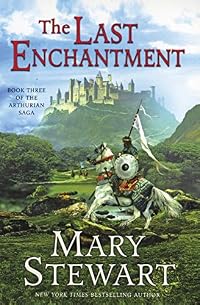
The Crystal Cave takes the reader from Merlin's childhood to the conception of Arthur. The second book, The Hollow Hills deals with the young Arthur up to the time he becomes king, and The Last Enchantment takes Merlin up to his death. I love the relationship between Arthur and Merlin in the last two books and each book is like a map of the stages of man: the first a coming of age tale, the second in a sense the main "career" and "fatherhood" and the last old age--fighting to still make a difference, coming to peace with your own mortality and resolve unfinished business.
Beautiful novels, all three of them, especially seen as a whole. There is one other Arthurian book in the series, The Wicked Day about Mordred, and I also recommend it, but I don't think it's quite as magical as the trilogy. show less
This has been described as fantasy, and there are touches of that, but much of Merlin's magic is rationalized--this is more historical fiction than fantasy, and as such made a big impression on me and felt all the more magical than any more fantasy-laden versions, because it made me feel, maybe it is real. For me this became the gold standard for Arthurian books, so when I read Whyte's show more or Bradley's versions of Arthur, these are the books I measured them against--and against which other versions seem wanting. The other thing is, compared to so many of the other versions, Stewart is just a fantastic storyteller with a beautiful evocative prose style, wonderful pacing, characterizations and sense of place.
The Crystal Cave takes the reader from Merlin's childhood to the conception of Arthur. The second book, The Hollow Hills deals with the young Arthur up to the time he becomes king, and The Last Enchantment takes Merlin up to his death. I love the relationship between Arthur and Merlin in the last two books and each book is like a map of the stages of man: the first a coming of age tale, the second in a sense the main "career" and "fatherhood" and the last old age--fighting to still make a difference, coming to peace with your own mortality and resolve unfinished business.
Beautiful novels, all three of them, especially seen as a whole. There is one other Arthurian book in the series, The Wicked Day about Mordred, and I also recommend it, but I don't think it's quite as magical as the trilogy. show less
I discovered this trilogy in the 90s when someone left The Hollow Hills (the middle book in the trilogy) at my house, face down and open to a page in the middle of the book. I took a glance as I picked up the book and read a few lines...then stood there reading until I got to the end. I couldn't put the book down. Then I got in the tub (with the book) and started at the beginning. Then I got dressed and went straight to the library for the first book in the trilogy. That's how good this is (if you love good writing and a tale that keeps you moving from one page to the next).
The story follows Merlin's life from childhood to old age. The Arthurian legend is told from his perspective, but in a way that's completely plausible and based on show more the realities of the times and practices of the era, from the Druids to the Romans. The settings and sensibilities not only ring true, but are educational to boot.
Since then I've read every Mary Stewart available, but nothing compares to this obvious labor of love and research that is the Merlin Trilogy. The review written by Lisa Maria Clark says most of everything else I wanted to say about the books. I will just add that Stewart's imagery is wonderful. She puts the reader in a believable scene with every descriptive phrase, and her characters ring true - flawed as humans are. Her story was so so compelling that when I had occasion to visit the British Isles for 14 months, I followed Merlin's journeys just as she described them - and all the places were there. The adventure was just as good as the books.
I agree the Wicked Day, the fourth book, is nowhere near as good. I think Stewart was channeling something that may really have come close to the truth when she was writing the first three. It's a masterpiece in the genre. Worth reading again every year or so. show less
The story follows Merlin's life from childhood to old age. The Arthurian legend is told from his perspective, but in a way that's completely plausible and based on show more the realities of the times and practices of the era, from the Druids to the Romans. The settings and sensibilities not only ring true, but are educational to boot.
Since then I've read every Mary Stewart available, but nothing compares to this obvious labor of love and research that is the Merlin Trilogy. The review written by Lisa Maria Clark says most of everything else I wanted to say about the books. I will just add that Stewart's imagery is wonderful. She puts the reader in a believable scene with every descriptive phrase, and her characters ring true - flawed as humans are. Her story was so so compelling that when I had occasion to visit the British Isles for 14 months, I followed Merlin's journeys just as she described them - and all the places were there. The adventure was just as good as the books.
I agree the Wicked Day, the fourth book, is nowhere near as good. I think Stewart was channeling something that may really have come close to the truth when she was writing the first three. It's a masterpiece in the genre. Worth reading again every year or so. show less
I have just finished reading Book 3 of this wonderful trilogy and feel totally exhilarated. Many years ago I read The Crystal Cave (Book 1) and The Hollow Hills (Book 2) but was unable to get The Last Enchantment (Book 3) but now I have and what a joy. If only I could write as Mary Stewart does. Her descriptions make places and people seem as real as if you were seeing them in front of you.
So what is the trilogy about? It is the story, in his own words, of Merlin the Enchanter, from boyhood to old age. You could call it an Arthurian legend, but Arthur does not enter the story until the end of Book 2. Mary Stewart has set the book just after the fall of the Roman Empire, and makes our hero a latter-day Roman himself. While Merlin is the show more King's Prophet, there is little magic in the story other than the magic of the author's own words. Merlin is totally believable, even during his fight at Tintagel when Arthur is conceived. Merlin is not portrayed as a superhuman, but just as an ordinary man with an extraordinary story. What romance there is comes across very well, and Merlin lives wonderfully through the story.
Please read these three books. You will surely enjoy them as much as I. show less
So what is the trilogy about? It is the story, in his own words, of Merlin the Enchanter, from boyhood to old age. You could call it an Arthurian legend, but Arthur does not enter the story until the end of Book 2. Mary Stewart has set the book just after the fall of the Roman Empire, and makes our hero a latter-day Roman himself. While Merlin is the show more King's Prophet, there is little magic in the story other than the magic of the author's own words. Merlin is totally believable, even during his fight at Tintagel when Arthur is conceived. Merlin is not portrayed as a superhuman, but just as an ordinary man with an extraordinary story. What romance there is comes across very well, and Merlin lives wonderfully through the story.
Please read these three books. You will surely enjoy them as much as I. show less
What a treat to read this again, all three books at once. I have read them many times before, the first time, I think, when I was 9 years old. I couldn't understand them much then, and I don't think I ever did much beyond skim the Last Enchantment and perhaps the last half of the Hollow Hills.
This is one of the best takes on Arthurian legend, and it's from Merlin's point of view. Not only is Mary Stewart's power of description beautifully strong, but she makes the shadowy, magical figure of Merlin into a man. A real, believable person. And I love the history.
I do find it hard to swallow the treatment of women in this -- I kept noticing this -- though I know it's only true to history. Still it's gratifying to have Merlin "replaced" by a show more woman -- whom he loves, this man who never thought much of them -- and Stewart's gracious treatment of Guinevere is kinder than most. show less
This is one of the best takes on Arthurian legend, and it's from Merlin's point of view. Not only is Mary Stewart's power of description beautifully strong, but she makes the shadowy, magical figure of Merlin into a man. A real, believable person. And I love the history.
I do find it hard to swallow the treatment of women in this -- I kept noticing this -- though I know it's only true to history. Still it's gratifying to have Merlin "replaced" by a show more woman -- whom he loves, this man who never thought much of them -- and Stewart's gracious treatment of Guinevere is kinder than most. show less
Members
- Recently Added By
Lists

Best Fantasy Novels
821 works; 358 members

Survey of Fantasy Classics
111 works; 23 members

Books Read in 2008
335 works; 8 members

XB-1: Osobnosti zanru doporucuji
67 works; 1 member
Author Information

51+ Works 40,210 Members
Mary Stewart was born on September 17, 1916 in Sunderland, County Durham, England. She received a First Class Honours B.A. in English from Durham University in 1938 and a teaching certificate in 1939. She taught in elementary school until 1941 when she was offered a post at Durham University. She taught there until 1945 and received a M.A. in show more English during that time. Her first book, Madam, Will You Talk?, was published in 1955. Her other works included My Brother Michael, Touch Not the Cat, This Rough Magic, Nine Coaches Waiting, Thornyhold, Rose Cottage, and the Merlin Trilogy. She also wrote children's books including Ludo and the Star Horse and A Walk in Wolf Wood. She died on May 9, 2014 at the age of 97. (Bowker Author Biography) show less
Series

The Arthurian Merlin Saga (Collections and Selections — Omnibus 1-3)
Work Relationships
Common Knowledge
- Original publication date
- 1980
- People/Characters
- Merlin
- Important places
- Benoic
- First words
- [The Crystal Cave] I am an old man now, but then I was already past my prime when Arthur was crowned King.
- Last words
- (Click to show. Warning: May contain spoilers.)[The Last Enchantment] And after this, the Lady of the Lake became the friend and guardian of King Arthur, in the stead of Merlin the enchanter.
Classifications
Statistics
- Members
- 1,032
- Popularity
- 24,921
- Reviews
- 17
- Rating
- (4.34)
- Languages
- English
- Media
- Paper, Audiobook
- ISBNs
- 5
- ASINs
- 7