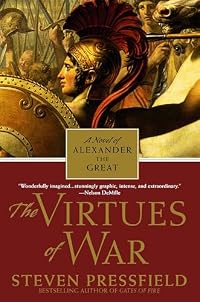
The Virtues of War: A Novel of Alexander the Great
by Steven Pressfield
Novel of Alexander the Great (Book 1)
On This Page
Description
I have always been a soldier. I have known no other life. So begins Alexander’s extraordinary confession on the eve of his greatest crisis of leadership. By turns heroic and calculating, compassionate and utterly merciless, Alexander recounts with a warrior’s unflinching eye for detail the blood, the terror, and the tactics of his greatest battlefield victories. Whether surviving his father’s brutal assassination, presiding over a massacre, or weeping at the death of a beloved show more comrade-in-arms, Alexander never denies the hard realities of the code by which he lives: the virtues of war. But as much as he was feared by his enemies, he was loved and revered by his friends, his generals, and the men who followed him into battle. Often outnumbered, never outfought, Alexander conquered every enemy the world stood against him–but the one he never saw coming. . . . show lessTags
Recommendations






Member Reviews
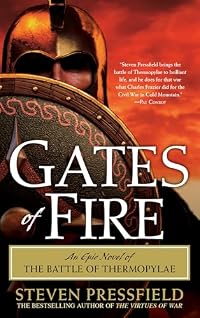
Although it's not as compelling as the superlative Gates of Fire, Steven Pressfield's The Virtues of War is never the less still very good indeed.
The first-person narration attempts to get inside the head of one of history's dominating figures, Alexander the Great, as he explodes onto the world stage after his father's death, and drives his conquering army from its Macedonian home right through the heart of Darius the Great's Persian empire, and on to the Hindu Kush and India itself.
Pressfield manages to give Alexander's voice some genuine strangeness -- an accomplishment, because his ways of thinking and values are really so distant from our own, although they are faintly echoed in western thought to this day. Yet there's still too show more much contemporizing here; to make Alexander more sympathetic, I think Pressfield downplays his thirst for pure glory, and possibly overemphasizes his empathy and compassion at points. It's hard to put aside our world's therapeutic lameness, even consciously, since it's now rotting our culture at the deepest levels.
But I shouldn't complain too much -- this is still a good read, especially the battle accounts. The heart of the story, Alexander's victory over Darius at Gaugamela, is related in taut, vivid prose, and is on its own worth the time to read the book. show less
The first-person narration attempts to get inside the head of one of history's dominating figures, Alexander the Great, as he explodes onto the world stage after his father's death, and drives his conquering army from its Macedonian home right through the heart of Darius the Great's Persian empire, and on to the Hindu Kush and India itself.
Pressfield manages to give Alexander's voice some genuine strangeness -- an accomplishment, because his ways of thinking and values are really so distant from our own, although they are faintly echoed in western thought to this day. Yet there's still too show more much contemporizing here; to make Alexander more sympathetic, I think Pressfield downplays his thirst for pure glory, and possibly overemphasizes his empathy and compassion at points. It's hard to put aside our world's therapeutic lameness, even consciously, since it's now rotting our culture at the deepest levels.
But I shouldn't complain too much -- this is still a good read, especially the battle accounts. The heart of the story, Alexander's victory over Darius at Gaugamela, is related in taut, vivid prose, and is on its own worth the time to read the book. show less
Wouldn't it be neat to have an interview with Alexander the Great in which he tells of his life as a soldier in a very introspective manner. Short of a time machine, this novel provides the next best thing thanks to Stephen Pressfield's ability to crawl inside the mind of the world's greatest conqueror. The story as told in Alexander's voice covers the spectrum of language from noble rhetoric to earthy solder's vernacular as it narrates the stories of horror and triumph. The battles are described vividly and concisely. The flow of the narrative congers up within the reader the visceral excitement and fear of an outnumbered military force confident of their ability to prevail in spite of impossible odds.
Their subsequent problems related show more to trying to govern the conquered territories is also told in a most engaging way. It's interesting to note that some of the problems Alexander faced in the areas we today call Iraq, Iran, and Afghanistan had vague similarities to current difficulties in those regions. The winner of the military battles often times is overwhelmed by the subsequent political and cultural conflicts.
How can there be any virtue in something as terrible as war? That was my first response to the book's title. There's enough gore and cruelty described in this book for a 21st Century reader to find it to be an anti-war tale. After the victory over Persia, it was difficult for Alexander to maintain the moral of his army. The virtue of war as seen from his perspective is that it gives men a sense of purpose and a goal to work toward. I think his thinking is summarized in the following quotation from the book in which Alexander reflects on the Battle of Hydaspes, his last major victory.
'Let me speak instead to the significance of the fight. What it meant to me and to the army. It was everything we needed---a contest of heroic scale against a foe who stood his ground and dueled with honor. At conflict's end, the field was ours, indeed, but, far more important, we had preserved our antagonist Porus's life and the lives of as many of his Ksatriyas as possible; we had been able to act toward him and them with integrity and restraint; and we had conquered not only a stubborn and manful foe but our own factious and recalcitrant selves.'
A case can be made that Alexander the Great made the greatest impact on human history of any single person. It's difficult to imagine the history of Western Civilization without his exploits. The golden age of Greek may very well have been lost to history if Alexander hadn't made Greek culture the standard for Western Civilization. Without the foundation of Greek culture the Roman Empire may have never existed, at least not as we know it. And without the Roman Empire, what would have been the history of the western world? In that regard, Alexander was successful based on his own goals. The following quote from the book is of Alexander scolding his troops for plundering after the Battle of Issus.
'Do we march for plunder, brothers? Is gold our aim, Like merchants? By Zeus, I will cut my own throat if you tell me you believe that. It is enough to rout the foe, to prove ourselves the greater Brutes? Then build my pyre. I will kindle it myself before yielding to such want of imagination and such deficit of desire. Fame Imperishable and glory that will never die -- that is what we march for! To light that flame that death itself cannot quench. That I will achieve, and by the sword of Almighty Zeus, you will work it with me, every one of you! '
In Mr. Pressfield's parlance, Alexander felt within himself the existence of a 'daimon.' Alexander's voice returns to reflect on his inner daimon numerous times during the book's narrative. I have subsequently researched that term to try to see what the author, through Alexander's voice, was trying to say with it. It is true that 'daimon' is the Greek derivative for the English word 'demon.' However, in the context of ancient Greek culture it was more likely considered to be an intermediary spirit between humans and the gods. Therefore, Alexander would have perceived it as an inner spirit that provided divine guidance telling him when he needed to take action on certain issues.
One thing I appreciated about Mr. Pressfield is that he provided a 'Note to the Reader' at the beginning of the book where he acknowledged several places in the book where he deviated from recorded history. He explains that he did it in the interest of the theme and the storytelling. I think Alexander would agree with the changes. At the very least it saves the reader the need to worry about the deviations.
Alexander was very much a tyrant when judged by modern standards. It's interesting to note that the Greeks of Athens and Sparta didn't consider Alexander to be Greek. To them he was Macedonian. When Alexander left Greece to conquer the east, he needed to leave half is forces at home to maintain control of the home country. It's interesting to note how often the tyrant ends up being an outsider to the home country. Some recent examples are; (1) Napoleon was Corsican, (2) Stalin was Georgian, and (3) Hitler was Austrian. show less
Their subsequent problems related show more to trying to govern the conquered territories is also told in a most engaging way. It's interesting to note that some of the problems Alexander faced in the areas we today call Iraq, Iran, and Afghanistan had vague similarities to current difficulties in those regions. The winner of the military battles often times is overwhelmed by the subsequent political and cultural conflicts.
How can there be any virtue in something as terrible as war? That was my first response to the book's title. There's enough gore and cruelty described in this book for a 21st Century reader to find it to be an anti-war tale. After the victory over Persia, it was difficult for Alexander to maintain the moral of his army. The virtue of war as seen from his perspective is that it gives men a sense of purpose and a goal to work toward. I think his thinking is summarized in the following quotation from the book in which Alexander reflects on the Battle of Hydaspes, his last major victory.
'Let me speak instead to the significance of the fight. What it meant to me and to the army. It was everything we needed---a contest of heroic scale against a foe who stood his ground and dueled with honor. At conflict's end, the field was ours, indeed, but, far more important, we had preserved our antagonist Porus's life and the lives of as many of his Ksatriyas as possible; we had been able to act toward him and them with integrity and restraint; and we had conquered not only a stubborn and manful foe but our own factious and recalcitrant selves.'
A case can be made that Alexander the Great made the greatest impact on human history of any single person. It's difficult to imagine the history of Western Civilization without his exploits. The golden age of Greek may very well have been lost to history if Alexander hadn't made Greek culture the standard for Western Civilization. Without the foundation of Greek culture the Roman Empire may have never existed, at least not as we know it. And without the Roman Empire, what would have been the history of the western world? In that regard, Alexander was successful based on his own goals. The following quote from the book is of Alexander scolding his troops for plundering after the Battle of Issus.
'Do we march for plunder, brothers? Is gold our aim, Like merchants? By Zeus, I will cut my own throat if you tell me you believe that. It is enough to rout the foe, to prove ourselves the greater Brutes? Then build my pyre. I will kindle it myself before yielding to such want of imagination and such deficit of desire. Fame Imperishable and glory that will never die -- that is what we march for! To light that flame that death itself cannot quench. That I will achieve, and by the sword of Almighty Zeus, you will work it with me, every one of you! '
In Mr. Pressfield's parlance, Alexander felt within himself the existence of a 'daimon.' Alexander's voice returns to reflect on his inner daimon numerous times during the book's narrative. I have subsequently researched that term to try to see what the author, through Alexander's voice, was trying to say with it. It is true that 'daimon' is the Greek derivative for the English word 'demon.' However, in the context of ancient Greek culture it was more likely considered to be an intermediary spirit between humans and the gods. Therefore, Alexander would have perceived it as an inner spirit that provided divine guidance telling him when he needed to take action on certain issues.
One thing I appreciated about Mr. Pressfield is that he provided a 'Note to the Reader' at the beginning of the book where he acknowledged several places in the book where he deviated from recorded history. He explains that he did it in the interest of the theme and the storytelling. I think Alexander would agree with the changes. At the very least it saves the reader the need to worry about the deviations.
Alexander was very much a tyrant when judged by modern standards. It's interesting to note that the Greeks of Athens and Sparta didn't consider Alexander to be Greek. To them he was Macedonian. When Alexander left Greece to conquer the east, he needed to leave half is forces at home to maintain control of the home country. It's interesting to note how often the tyrant ends up being an outsider to the home country. Some recent examples are; (1) Napoleon was Corsican, (2) Stalin was Georgian, and (3) Hitler was Austrian. show less
I have long been a devotee of Alexander the Great (my son's middle name is Alexander), so looked forward to reading this novel. I was not disappointed! The story is told from Alexander's viewpoint as he is telling his story to his young brother-in-law. It is not a complete story of his life. He does start the story before the assassination of his father, Phillip. Most of the remainder of the story tells of his conquest of Persia. Pressfield, who has written several other historical novels based in the era of Ancient Greece, obviously does his research very well. The description of the battles is excellent. The book is quite accurate, the author knows his subject. Even better, the narration sounds like it would actually be Alexander show more speaking, and giving his version of the various battles and incidents of his life (which may differ from the historical record). I wish the book had been longer and included more of Alexander's other accomplishments, such as the siege of Tyre, the conquering of Egypt, etc. Alexander was fascinating and what he did in his short life (died at 32) is amazing, especially considering the time period it took place in. This novel takes you into that time period, and makes you feel like Alexander is talking to you, sitting by a campfire after a hard days march. show less
Incredible read. If we can go by what history says of this iconic and mythical figure then he was by far the most superior tactician the world has ever or probably ever will see. I understand this is a work of fiction and the writer does take some liberty with the material. Well written...the battles are intimate and intense while the glory is there, Alexander takes great care to convince his men that glory comes second, staying alive and winning is non-negotiable and paramount.
I am a Pressfield fan and was not disappointed with his treatment of Alexander the Great, although this would not be at the top of my list. It has been a long time since I studied this history and that of course was study, not "pleasure reading," so this was a "kind and gentle" way to reacquaint myself with the warrior king.
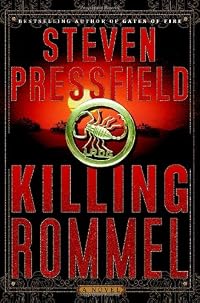
Of the three Pressfield books I have read Virtues of War would be my third choice. Gates of Fire offers a deeper appreciation of ancient culture, and Killing Rommel examines the strength of a generation thrust into war. That said, Virtues is a telling piece. In Alexander's own words he was driven by the constant pursuit of glory. As such the history here is a reminder that what may have begun as a noble enterprise show more can turn ignoble; the difference being not so much the rightness of an action but more so the motivation behind it. In this Pressfield paints a portrait of honor that bears the solitary burden of leadership, and feels the solitary crush of abandonment.
While some liberty is taken with the setting and timing of certain speeches this is acceptable in my view. It is not history he writes here, but historical fiction. The descriptions of foes sometimes feel glossed over, but the overall effect is good. It is a good read, written in a style of language that may or may not be literally correct, but is made to feel as if it is. Well done on that.
In sum, this will be an entertaining and enlightening read for those with casual interest in the history of the time, or who want to become acquainted with the lead character on a personal level. It is a first person account, you should not expect a critical treatment of the issues. show less
Of the three Pressfield books I have read Virtues of War would be my third choice. Gates of Fire offers a deeper appreciation of ancient culture, and Killing Rommel examines the strength of a generation thrust into war. That said, Virtues is a telling piece. In Alexander's own words he was driven by the constant pursuit of glory. As such the history here is a reminder that what may have begun as a noble enterprise show more can turn ignoble; the difference being not so much the rightness of an action but more so the motivation behind it. In this Pressfield paints a portrait of honor that bears the solitary burden of leadership, and feels the solitary crush of abandonment.
While some liberty is taken with the setting and timing of certain speeches this is acceptable in my view. It is not history he writes here, but historical fiction. The descriptions of foes sometimes feel glossed over, but the overall effect is good. It is a good read, written in a style of language that may or may not be literally correct, but is made to feel as if it is. Well done on that.
In sum, this will be an entertaining and enlightening read for those with casual interest in the history of the time, or who want to become acquainted with the lead character on a personal level. It is a first person account, you should not expect a critical treatment of the issues. show less
The Virtues of War is the perfect mix of fact and fiction to make a good book. The author clearly did his research and uses accurate details to form a fascinating picture of life around 320BC. However, as he states in the introduction, he’s also able to take liberties with the facts and put battles and speeches in the order which makes the best narrative. Best of all, the book is told as though Alexander is speaking to a nephew, leading to what I think are some of the major strengths of this book.
First, this book is barely fiction and reads a lot like narrative non-fiction. Alexander the Great was pretty awesome and it’s a lot of fun to get some insight into his motivation and emotions. It’s even more fun because the author’s show more speculation on Alexander is backed up by sources from Alexander’s time. At least that impression is given and an internet search supports that view, although no bibliography was included. The author also does a good job of integrating Alexander’s past with the current point in his campaign, which makes it feel as though Alexander himself is talking and seeing relations between earlier events in his life and his present. Something about it just makes the narrative feel natural. Finally, the actual quotes are worked in nicely and outside sources never make the narrative choppy.
The only problems I had with the book all relate to the battles, starting with the exacting level of detail in which they’re described. This is neat, but sometimes over done (unit listings, for example) and sometimes hard to follow (battlefield maps would have helped a lot). The battle descriptions don’t spare on the gore either, so to steal Jessica at Quirky Bookworm‘s question, no, I would not recommend it to your grandmother. It was barely this side of being too much for me to enjoy. Fortunately, unlike the battles, the gore was a small part of the book and everything else was superbly done.
Who should read it? history buffs, fans of narrative non-fiction, my friend with a man-crush on Alexander the Great, not your grandmother
This review first published on Doing Dewey. show less
First, this book is barely fiction and reads a lot like narrative non-fiction. Alexander the Great was pretty awesome and it’s a lot of fun to get some insight into his motivation and emotions. It’s even more fun because the author’s show more speculation on Alexander is backed up by sources from Alexander’s time. At least that impression is given and an internet search supports that view, although no bibliography was included. The author also does a good job of integrating Alexander’s past with the current point in his campaign, which makes it feel as though Alexander himself is talking and seeing relations between earlier events in his life and his present. Something about it just makes the narrative feel natural. Finally, the actual quotes are worked in nicely and outside sources never make the narrative choppy.
The only problems I had with the book all relate to the battles, starting with the exacting level of detail in which they’re described. This is neat, but sometimes over done (unit listings, for example) and sometimes hard to follow (battlefield maps would have helped a lot). The battle descriptions don’t spare on the gore either, so to steal Jessica at Quirky Bookworm‘s question, no, I would not recommend it to your grandmother. It was barely this side of being too much for me to enjoy. Fortunately, unlike the battles, the gore was a small part of the book and everything else was superbly done.
Who should read it? history buffs, fans of narrative non-fiction, my friend with a man-crush on Alexander the Great, not your grandmother
This review first published on Doing Dewey. show less
The Virtues of War is the perfect mix of fact and fiction to make a good book. The author clearly did his research and uses accurate details to form a fascinating picture of life around 320BC. However, as he states in the introduction, he’s also able to take liberties with the facts and put battles and speeches in the order which makes the best narrative. Best of all, the book is told as though Alexander is speaking to a nephew, leading to what I think are some of the major strengths of this book.
First, this book is barely fiction and reads a lot like narrative non-fiction. Alexander the Great was pretty awesome and it’s a lot of fun to get some insight into his motivation and emotions. It’s even more fun because the author’s show more speculation on Alexander is backed up by sources from Alexander’s time. At least that impression is given and an internet search supports that view, although no bibliography was included. The author also does a good job of integrating Alexander’s past with the current point in his campaign, which makes it feel as though Alexander himself is talking and seeing relations between earlier events in his life and his present. Something about it just makes the narrative feel natural. Finally, the actual quotes are worked in nicely and outside sources never make the narrative choppy.
The only problems I had with the book all relate to the battles, starting with the exacting level of detail in which they’re described. This is neat, but sometimes over done (unit listings, for example) and sometimes hard to follow (battlefield maps would have helped a lot). The battle descriptions don’t spare on the gore either, so to steal Jessica at Quirky Bookworm‘s question, no, I would not recommend it to your grandmother. It was barely this side of being too much for me to enjoy. Fortunately, unlike the battles, the gore was a small part of the book and everything else was superbly done. show less
First, this book is barely fiction and reads a lot like narrative non-fiction. Alexander the Great was pretty awesome and it’s a lot of fun to get some insight into his motivation and emotions. It’s even more fun because the author’s show more speculation on Alexander is backed up by sources from Alexander’s time. At least that impression is given and an internet search supports that view, although no bibliography was included. The author also does a good job of integrating Alexander’s past with the current point in his campaign, which makes it feel as though Alexander himself is talking and seeing relations between earlier events in his life and his present. Something about it just makes the narrative feel natural. Finally, the actual quotes are worked in nicely and outside sources never make the narrative choppy.
The only problems I had with the book all relate to the battles, starting with the exacting level of detail in which they’re described. This is neat, but sometimes over done (unit listings, for example) and sometimes hard to follow (battlefield maps would have helped a lot). The battle descriptions don’t spare on the gore either, so to steal Jessica at Quirky Bookworm‘s question, no, I would not recommend it to your grandmother. It was barely this side of being too much for me to enjoy. Fortunately, unlike the battles, the gore was a small part of the book and everything else was superbly done. show less
Members
- Recently Added By
Author Information

42+ Works 15,526 Members
Author Steven Pressfield was born in Port of Spain, Trinidad in September 1943. He graduated from Duke University in 1965 and joined the Marine Corps. Before becoming a full-time writer, he worked as a copy writer, taxi driver, bartender, tractor-trailer driver, fruit picker, and worked on oil rigs. He then moved to California and began writing show more screenplays. In 2000, his debut novel, The Legend of Bagger Vance, was made into a movie starring Matt Damon and Will Smith. He primarily writes military historical fiction set in classical antiquity. Most of his novels are told from the first-person perspective of the main character. (Bowker Author Biography) show less
Series

Common Knowledge
- Canonical title*
- Io Alessandro
- Original title
- The Virtues of War
- Original publication date
- 2005-10
- People/Characters
- Alexander III the Great, 326-253 BC; Antipater; Aristander; Aristotle, 384-322; Darius III; Hephaestion (show all 8); Parmenion (as Parmenio); Philotas
- Important places
- Ancient Greece
- Epigraph
- He ruled over these nations, even though they did not speak the same language as he, nor one nation the same as another; for all that, he was able to cover so vast a region with the fear which he inspired, that he struck all ... (show all)men with terror and no one tried to withstand him; and he was able to awaken in all so lively a desire to please him, that they always wished to be guided by his will.
--Xenophon, "The Education of Cyrus" - Dedication
- For Mike and Chrissy
- First words
- I have always been a soldier.
- Last words
- (Click to show. Warning: May contain spoilers.)He reined about and started for the camp, surrounded by his officers.
*Some information comes from Common Knowledge in other languages. Click "Edit" for more information.
Classifications
Statistics
- Members
- 878
- Popularity
- 30,692
- Reviews
- 29
- Rating
- (3.75)
- Languages
- 5 — Czech, English, Greek, Italian, Spanish
- Media
- Paper, Audiobook, Ebook
- ISBNs
- 21
- ASINs
- 7