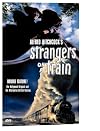
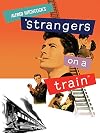
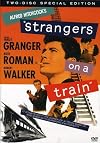
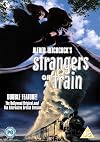
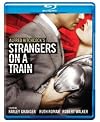
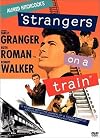
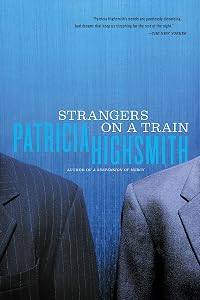
Strangers on a Train [1951 film]
by Alfred Hitchcock (Director), Raymond Chandler (Screenwriter), Czenzi Ormonde (Screenwriter)
On This Page
Description
Guy Haines, a tennis star who hates his wife, is approached on a train by a stranger, Bruno Anthony, who hates his father. Anthony offers a plan: each could kill the other's victim. No motive, no clue would link the two murders save the casual meeting of strangers on a train.Tags
Recommendations










Member Reviews
A crazy person murders a stranger's wife as a favor, and expects a murder in return.
Suspenseful. The ending is a bit disappointing; it turns into an action movie about 10 minutes from the end, which makes an exciting and memorable scene but it's not what the story needed.
Suspenseful. The ending is a bit disappointing; it turns into an action movie about 10 minutes from the end, which makes an exciting and memorable scene but it's not what the story needed.
A deranged socialite accosts a tennis star with his theory that if two strangers trade murders, they can disguise their motives and avoid suspicion.
(source: TMDb)
(source: TMDb)
The premise is fascinating, and the way this was directed made it easy for us to get into. Two gentleman meet on a train. One, Guy, latches on to the other and after a bit of conversation learns that he wants to divorce his wife and marry his mistress. Guy suggests that since he too has someone he would like to get rid of (his father) the perfect solution would be for each to murder the others nemesis--since each woud have no obvious motive there would be no way they would be suspected. The other gentleman passes this conversation off as Guy's drunken blather, but when Guy keeps contacting him after their chance meeting and then suddenly his wife dies he realizes that Guy really meant it--and that now ihe is in the worst trouble of his show more life. Guy's tremendous ability to sway this gentleman is brilliantly portrayed by Farley Granger, and the detailed musings of his character's inner angst were the most thrilling thing to watch in Robert Walker. If you love wordy introspection combined with suspense, give it a try! show less
Jun 23, 2025English (UK)
101 minutos
Feb 25, 2012Portuguese (Brazil)
Ratings
Members
- Recently Added By
Published Reviews
ThingScore 100
Hitchcock’s bizarre, malicious comedy, in which the late Robert Walker brought sportive originality to the role of the chilling wit, dear degenerate Bruno; it’s intensely enjoyable—in some ways the best of Hitchcock’s American films. The murder plot is so universally practical that any man may adapt it to his needs: Bruno perceives that though he cannot murder his father with impunity, show more someone else could; when he meets the unhappily married tennis player Guy (Farley Granger), he murders Guy’s wife for him and expects Guy to return the favor. Technically, the climax of the film is the celebrated runaway merry-go-round, but the high point of excitement and amusement is Bruno trying to recover his cigarette lighter while Guy plays a fantastically nerve-racking tennis match. Even this high point isn’t what we remember best—which is Robert Walker. It isn’t often that people think about a performance in a Hitchcock movie; usually what we recall are bits of “business” —the stump finger in The 39 Steps, the windmill turning the wrong way in Foreign Correspondent, etc. But Walker’s performance is what gives this movie much of its character and its peculiar charm. show less
added by SnootyBaronet
Author Information

Alfred Hitchcock was born on August 13, 1899 in London, England. He graduated from St. Ignatius College, where he studied engineering, and took art courses at the University of London. He worked briefly as a technical calculator for a cable company, but soon decided to focus on art, becoming an advertising layout draftsman for a London department show more store. In 1920, he got a job writing and illustrating title cards for silent pictures. He rose quickly, to script writer, art director and assistant director. By 1925, he had become a director, making a melodrama called The Pleasure Garden. In 1929, he directed Blackmail, Britain's first widely successful talking feature. The other movies he directed in England included The Lodger (U.S. title, The Case of Jonathan Drew), The Man Who Knew Too Much, The 39 Steps, and The Lady Vanishes. He was approached by producer David O. Selznick about directing in the United States, and he accepted so he could take advantage of the better-equipped American studios. His first American film, Rebecca, won the Academy Award for best picture. The other movies he directed in the United States included Shadow of a Doubt, Spellbound, Rear Window, Vertigo, Psycho, The Birds, Frenzy, and Family Plot. In 1979, he was awarded the American Film Institute Life Achievement Award. In 1980, he was knighted by Queen Elizabeth II. He died from liver failure and heart problems on April 29, 1980 at the age of 80. (Bowker Author Biography) show less

Raymond Chandler was born in Chicago, Illinois on July 23, 1888. Before becoming a professional writer in 1933, he worked as a reporter, an accountant, bookkeeper, and auditor. He wrote several novels featuring private detective Philip Marlowe including The Big Sleep, The High Window, The Lady in the Lake, The Little Sister, and The Long Goodbye. show more In addition to novels and short stories, he wrote screenplays. He won two academy awards, for Double Indemnity (1944) and The Blue Dahlia (1946). He died on March 26, 1959. (Bowker Author Biography) show less
All Editions
Awards and Honors
Awards
Work Relationships
Is contained in
Is an adaptation of
Has the adaptation
Has as a reference guide/companion
Common Knowledge
- Canonical title
- Strangers on a Train [1951 film]
- Original title
- Strangers on a Train
- Original publication date
- 1951-06-30
- People/Characters
- Guy Haines (Farley Granger); Anne Morton (Ruth Roman); Bruno Antony (Robert Walker)
- Important places
- Washington, D.C., USA
- Related movies
- Strangers on a Train (1951 | IMDb)
- Quotations
- Criss-cross.
- Original language
- English
- Disambiguation notice
- 1951 film
Classifications
Statistics
- Members
- 281
- Popularity
- 114,641
- Reviews
- 5
- Rating
- (3.95)
- Languages
- 5 — Bulgarian, English, French, Italian, Spanish
- ISBNs
- 11
- UPCs
- 6
- ASINs
- 13