On This Page
Description
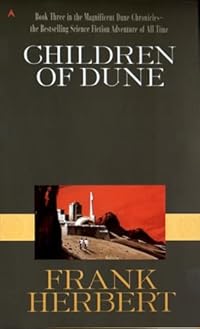
Frank Herbert's bestselling science fiction series of all time continues! In this third installment, the sand-blasted world of Arrakis has become green, watered and fertile. Old Paul Atreides, who led the desert Fremen to political and religious domination of the galaxy, is gone. But for the children of Dune, the very blossoming of their land contains the seeds of its own destruction. The altered climate is destroying the giant sandworms, and this in turn is disastrous for the planet's show more economy. Leto and Ghanima, Paul Atreides's twin children and his heirs, can see possible solutions—but fanatics begin to challenge the rule of the all-powerful Atreides empire, and more than economic disaster threatens.... show less
Tags
Recommendations


















Member Recommendations
Member Reviews
The events of Dune were a tentative step towards the superhuman. Paul Muad'Dib was the Messiah, gifted with prescient powers, trained to a razors edge, and rising from renegade ducal heir to conqueror of a galaxy. But his visions revealed something terrifying, something which lead to his defeat in Dune Messiah, and a dangerous pathway.
Children of Dune is a return to Dune, in a way that is both more rewarding than Messiah, but also a reflection of the initial book. Young Leto II Atreides has to find his own path, against the conspiracies of his Aunt, St. Alia of the Knife. Alia's regency has become corrupt and calcified, and Alia herself fallen into possession by an ancestor, a state both the Fremen and Bene Gesserit deem 'abomination', show more and correctly so, since her possessor is the Baron Harkonnen.
Whereas Dune was obsessed with the future, with the power of Paul's visions and the potential of the Fremen, Children is haunted by the past, most directly by the genetic ancestral ghosts that Leto, Alia, and Leto's twin sister Ghanima have access to. These genetic memories are a wellspring of experience, and a threat.
Leto escapes an assassination plot, and thought dead, falls in with the outcast Fremen of Jacurutu, reviled as ancestral water stealers. There he is tested with massive amounts of spice, confronts the mysterious Preacher, a charismatic blind prophet who rails against the deification of Muad'Dib, and embarks on the start of his Golden Path. Leto merges with the sandtrout, becoming a hybrid human sandworm. He will rule for thousands of years, a force which will make humanity evolve.
As a kid, I really loved the weird ambition of this book, and the fantasy of Leto's sandworm power armor. As an adult, well, it's Dune with more weird bits. show less
Children of Dune is a return to Dune, in a way that is both more rewarding than Messiah, but also a reflection of the initial book. Young Leto II Atreides has to find his own path, against the conspiracies of his Aunt, St. Alia of the Knife. Alia's regency has become corrupt and calcified, and Alia herself fallen into possession by an ancestor, a state both the Fremen and Bene Gesserit deem 'abomination', show more and correctly so, since her possessor is the Baron Harkonnen.
Whereas Dune was obsessed with the future, with the power of Paul's visions and the potential of the Fremen, Children is haunted by the past, most directly by the genetic ancestral ghosts that Leto, Alia, and Leto's twin sister Ghanima have access to. These genetic memories are a wellspring of experience, and a threat.
Leto escapes an assassination plot, and thought dead, falls in with the outcast Fremen of Jacurutu, reviled as ancestral water stealers. There he is tested with massive amounts of spice, confronts the mysterious Preacher, a charismatic blind prophet who rails against the deification of Muad'Dib, and embarks on the start of his Golden Path. Leto merges with the sandtrout, becoming a hybrid human sandworm. He will rule for thousands of years, a force which will make humanity evolve.
As a kid, I really loved the weird ambition of this book, and the fantasy of Leto's sandworm power armor. As an adult, well, it's Dune with more weird bits. show less
Herbert's way of writing characters and dialogue is halfway to being excerpts from an old religious text, which is of course in part the point, but it makes everyone involved an inhuman avatar of some concept or set of ideals instead of people. It's the ideas that matter, but finding a reason to care about the outcomes of the ideas depend on being invested in the Dune universe and cast of characters, so it's a recursive problem.
I stuck with this because I was assured by fans there's a payoff in God Emperor of Dune. I sure hope so.
I stuck with this because I was assured by fans there's a payoff in God Emperor of Dune. I sure hope so.
I enjoyed this third Dune novel well enough in terms of its plot and world-building. I also found the characters fascinating, although they were increasingly alien and unsympathetic. Even before the climax of the book inaugurated a new sort of post-humanity, I felt a lack of human limitations in a central cast of characters who were all trained as Mentats or Bene Gesserit, or bred by the latter for special powers, or "pre-born," or otherwise spice-empowered. The Fremen leader Stilgar, who had been an exotic and forbidding character in the first book, was one of the most pedestrian and relatable of the players in this one.
The earlier volumes had a clearer protagonist-antagonist division than this one, with hostile conspiracies set show more against Duke Leto and then Paul Muad'Dib. In Children the twin Atreides heirs Leto II and Ghanima are surrounded by multiple conspiracies, and it is often difficult to tell whether the conspirators are working against them or for their benefit, or whether the plots will truly help or hinder them.The twins themselves turn out to be the most cunning of the plotters. For those readers needing a clear villain, the return of Baron Vladimir Harkonnen's consciousness in the Abomination Alia seemed like ample consolation.
The trope of various secret cants and "battle languages" begun in Dune was sustained in this book. It was delectable that the twins used ancient Egyptian as their private language for cryptic communications, both knowing it from the memories of their distant progenitors.
Herbert continued his style of heading each chapter with an epigram supposedly drawn from histories, traditions, and sacred texts. Where Paul's eventual wife and historian Irulan predominated as the voice for these in the first book, this one has Leto's scribe Harq al-Ada. It struck me that one could edit quite an interesting and readable book out of these alone--drawing them from the whole six volumes of the series--and that they could be reorganized by their attributed sources.
For the first time in the series, the text quantified the capability of spice worm melange as a "geriatric drug." Users are supposed to be afforded at least four times the usual human lifespan. So, the elite of the interstellar polity are already enjoying three centuries per generation when "the worm turns" onto Leto's Golden Path.
Neither the Brian Herbert introduction nor the Frank Herbert "When I Was Writing Dune" postscript add anything of value to the book. Both come off as rather self-congratulatory--especially odd in the case of the former, where Brian admits to not even having read Dune when he encountered fans of the book in 1966. show less
The earlier volumes had a clearer protagonist-antagonist division than this one, with hostile conspiracies set show more against Duke Leto and then Paul Muad'Dib. In Children the twin Atreides heirs Leto II and Ghanima are surrounded by multiple conspiracies, and it is often difficult to tell whether the conspirators are working against them or for their benefit, or whether the plots will truly help or hinder them.
The trope of various secret cants and "battle languages" begun in Dune was sustained in this book. It was delectable that the twins used ancient Egyptian as their private language for cryptic communications, both knowing it from the memories of their distant progenitors.
Herbert continued his style of heading each chapter with an epigram supposedly drawn from histories, traditions, and sacred texts. Where Paul's eventual wife and historian Irulan predominated as the voice for these in the first book, this one has Leto's scribe Harq al-Ada. It struck me that one could edit quite an interesting and readable book out of these alone--drawing them from the whole six volumes of the series--and that they could be reorganized by their attributed sources.
For the first time in the series, the text quantified the capability of spice worm melange as a "geriatric drug." Users are supposed to be afforded at least four times the usual human lifespan. So, the elite of the interstellar polity are already enjoying three centuries per generation when "the worm turns" onto Leto's Golden Path.
Neither the Brian Herbert introduction nor the Frank Herbert "When I Was Writing Dune" postscript add anything of value to the book. Both come off as rather self-congratulatory--especially odd in the case of the former, where Brian admits to not even having read Dune when he encountered fans of the book in 1966. show less
The reread of the Dune series continues, and now that I’ve finished the Children of Dune I have the somewhat daunting prospect of God Emperor of Dune next on the list. To be fair, I remember enjoying that book on previous reads. But it is big. Children of Dune, however… follows on directly from Dune Messiah, but the two children born at the end of that book, Leto and Ghanima, are now nine years old. Herbert conceived all three books as one since he was interested in exploring how a messiah figure might bend a society out of shape and what might happen after the fall of said messiah. Despite claims to the contrary, I suspect the first book was conceived alone and the story arc of the trilogy imposed later. But certainly, Dune Messiah show more and Children of Dune follow a story arc that proceeds naturally from the end of Dune. Paul Atreides’s children are both the future of Paul’s empire – and the enemy of its current regent, Alia – and so a threat to all those who would wrest power from the Atreides. But Leto and Ghanima have their own plan for the future, the Golden Path, based in part on their vision of possible futures and what they think is best for humanity… It’s been interesting during this reread seeing what I find in the novel when compared to my memories of earlier reads. Leto’s transformation, which ends the book and sets up God Emperor of Dune, obviously. Plus Alia’s take-over – Abomination! – by the Baron Harkonnen. But in Dune Messiah, Paul Atreides, now the Preacher, had come across as something of a cipher, but here he is much better characterised. Unfortunately, the rest of the cast are not so well-drawn. There’s lots of politicking going on, as one of the old emperor’s daughters arranges for the assassination of Leto and Ghanima so her son can take the throne. But the twins have foreseen it all and… well, one of things that does annoy about Children of Dune is that the two protagonists are nine years old but behave like adults (and not just in dialogue, since Leto experiences “an adult beefswelling in his loins” at one point, which is totally WTF but also, are there cows on Arrakis?). True, the twins are “Pre-born” so they have genetic memories going back generations – although it’s not really clear how they manage to stay sane, despite frequent attempts in the text to explain it. Herbert’s views on government are also extremely annoying – at one point, Leto states that good government “does not depend upon law or precedent, but upon the personal qualities of whoever governs” – it’s even repeated as part of a chapter heading – which is complete bullshit; but exactly the sort of meretricious bullshit that science fiction fans and creators seem to believe, and have done since the genre’s beginnings. But then space opera is a right-wing mode of fiction, and even its left-leaning creators write the same tired old right-wing crap – which makes them little different to actual right-wing writers. Herbert was no Heinlein or Pournelle, of course, but he was American, so even if he was left-wing his politics would still be to the right of mine. Certainly, the whole Dune series is all about an authoritarian empire, with a rich and powerful nobility lording it over serfs, who have no freedom of movement (something Brits will shortly lose, and you have to wonder how many actually know what that means) – and if Herbert’s empire is not actually fascist, it does love its giant architecture, as both the Imperial Keep and Temple are apparently single buildings the size of small towns (they were built remarkably quickly, given their size). In fact, in Children of Dune, the furniture somewhat overwhelms the story. Clearly Herbert wanted his trappings of imperial rule to impress but it’s like the fleet of a million battleships – it’s too much, it just generates questions – practical questions (how did they build them? where did they get the crews?) – all of which detract from the intended effect. But that’s a common failing of space opera. Children of Dune closes off the original trilogy, but it struck me on this reread that, although it’s a better put-together book than Dune, with better prose, Children of Dune‘s story detracts from the first book’s universe and story… Not, it has to be said, in an especially damaging way, since most people don’t even bother to read the sequels. Their loss, of course; and those who actually liked Dune, it makes you wonder why they even bother reading novels that start series… I’m undecided about Children of Dune, and the final shape of the trilogy, but I’m looking forward to reading God Emperor of Dune. show less
Nine years have passed since the events of “Dune Messiah.” Leto II and Ghanima, twin children of Muad’Dib, await ascendancy to their father’s throne under the regency of Aunt Alia. But all is not well in an imperial theocracy sprawled across thousands of worlds and held together by Fremen legions and spice monopoly. With Alia besieged by ancestral darkness and Jessica Atreides returning to Arrakis with her own agenda, the twins balance on a crysknife’s edge between a past that would destroy them and a future that would destroy all.
I’m starting to get the rhythm of Frank Herbert’s “Dune” series: all you have to do is reset your expectations with each volume. That can be good or bad, and fans divide over which of show more Herbert’s many books are worthy and which make you want to take a fatal dose of melange. I wavered but wound up appreciating “Children of Dune” despite the slower pace and dense philosophical monologues.
To understand this entry, you must understand that Muad’Dib was never the good guy. Herbert often expressed frustration that readers mistook Paul Atreides for a tragic hero rather than a warning against messianic leadership. “Children of Dune” continues his deconstruction by attacking prescience.
To do this, Herbert leans into a Taoist conception of time as an eternally flowing present, neither a future to be grasped nor a past to be conserved. To commit to an envisioned future is to choose death by paralysis, insensate to fresh discoveries in the heart of each unfolding moment. This was Muad’Dib’s error, one that led to jihad and mass murder on a staggering scale.
But equally as deadly as a visionary leader is one determined to preserve a glorious past. This is the war waged for Alia’s soul by a familiar evil rising from deep within her pre-born consciousness. The past may promise greatness, but can only deliver decay. Those who fall back on the past to control the future choose death just as surely as those who sacrifice the present to a foreknown future.
Once I got my head around Herbert’s philosophy, I found “Children of Dune” enjoyable. Familiar friends such as Stilgar and Duncan Idaho reach satisfying ends to their arcs, though Alia’s is a hard one. I was pleasantly surprised by the introduction of the deposed emperor’s grandson as a worthy aspirant to the throne. I found myself rooting for a big comeback for House Corrino.
The characters that make the book for me, though, are the Atreides twins. They’re weird but sympathetic, all the more so since they alone understand that each faction trying to control the Imperium through them is just recycling their father’s sins — and that if they fail to find the golden path between a dead future and a dead past, their father’s greatest sin will be the extinction of the human race. show less
I’m starting to get the rhythm of Frank Herbert’s “Dune” series: all you have to do is reset your expectations with each volume. That can be good or bad, and fans divide over which of show more Herbert’s many books are worthy and which make you want to take a fatal dose of melange. I wavered but wound up appreciating “Children of Dune” despite the slower pace and dense philosophical monologues.
To understand this entry, you must understand that Muad’Dib was never the good guy. Herbert often expressed frustration that readers mistook Paul Atreides for a tragic hero rather than a warning against messianic leadership. “Children of Dune” continues his deconstruction by attacking prescience.
To do this, Herbert leans into a Taoist conception of time as an eternally flowing present, neither a future to be grasped nor a past to be conserved. To commit to an envisioned future is to choose death by paralysis, insensate to fresh discoveries in the heart of each unfolding moment. This was Muad’Dib’s error, one that led to jihad and mass murder on a staggering scale.
But equally as deadly as a visionary leader is one determined to preserve a glorious past. This is the war waged for Alia’s soul by a familiar evil rising from deep within her pre-born consciousness. The past may promise greatness, but can only deliver decay. Those who fall back on the past to control the future choose death just as surely as those who sacrifice the present to a foreknown future.
Once I got my head around Herbert’s philosophy, I found “Children of Dune” enjoyable. Familiar friends such as Stilgar and Duncan Idaho reach satisfying ends to their arcs, though Alia’s is a hard one. I was pleasantly surprised by the introduction of the deposed emperor’s grandson as a worthy aspirant to the throne. I found myself rooting for a big comeback for House Corrino.
The characters that make the book for me, though, are the Atreides twins. They’re weird but sympathetic, all the more so since they alone understand that each faction trying to control the Imperium through them is just recycling their father’s sins — and that if they fail to find the golden path between a dead future and a dead past, their father’s greatest sin will be the extinction of the human race. show less
I have to admit, I was really looking forward to the concluding book of Herbert's original trilogy (and, in my opinion, where the whole damn thing really should have ground to a halt).
But, interestingly, in this version, it's illuminating that Brian Herbert, untalented son of Frank and destroyer of Dune, talked at length in the first books intro about Dune, and again, talked about how Dune Messiah was the most misunderstood of the Dune novels. In the intro to this one, Brian...talks about his dad. He doesn't really talk about this book at all, as though even he doesn't know what to say about it.
Is this one a hot mess? Yes. Does it feel like Frank is trying to pull back all of the key players from the first book? Yes. Does he forsake show more action for talking, talking, thinking, talking, and more talking for about the first 75% of this novel? Also yes. But is it interesting talk? Sometimes, yes, but not always. Much of the time it's dense and dreadfully boring.
But now, here's where it actually got interesting for me. As I was going through this one, I kept thinking that this book was failing because Dune wasn't really Dune anymore. Much of the land was not supporting plants. Fremen were turning their backs on the old ways. Stillsuits are fashion items now. And there's not a sandworm to be seen in the first half of the novel.
The more I look at it, though, and the more I got into the second half, the more there was a push for a revolution, for a return to the old ways. Leto II actually does a lot in the last bit to achieve that. And there's sandworms.
The second half of the book actually does feel successful. I wonder if this was what Herbert was doing. "You're not gonna dig the first half, because Dune isn't Dune. But hold on..."
By the end of it, I was actually quite enjoying this novel. And Herbert pointed the way to where it was headed. Which really doesn't hold a lot of charms for me, having read the next three follow-ups a couple of times.
So, this is where I'll stop, happy with how it ends. show less
But, interestingly, in this version, it's illuminating that Brian Herbert, untalented son of Frank and destroyer of Dune, talked at length in the first books intro about Dune, and again, talked about how Dune Messiah was the most misunderstood of the Dune novels. In the intro to this one, Brian...talks about his dad. He doesn't really talk about this book at all, as though even he doesn't know what to say about it.
Is this one a hot mess? Yes. Does it feel like Frank is trying to pull back all of the key players from the first book? Yes. Does he forsake show more action for talking, talking, thinking, talking, and more talking for about the first 75% of this novel? Also yes. But is it interesting talk? Sometimes, yes, but not always. Much of the time it's dense and dreadfully boring.
But now, here's where it actually got interesting for me. As I was going through this one, I kept thinking that this book was failing because Dune wasn't really Dune anymore. Much of the land was not supporting plants. Fremen were turning their backs on the old ways. Stillsuits are fashion items now. And there's not a sandworm to be seen in the first half of the novel.
The more I look at it, though, and the more I got into the second half, the more there was a push for a revolution, for a return to the old ways. Leto II actually does a lot in the last bit to achieve that. And there's sandworms.
The second half of the book actually does feel successful. I wonder if this was what Herbert was doing. "You're not gonna dig the first half, because Dune isn't Dune. But hold on..."
By the end of it, I was actually quite enjoying this novel. And Herbert pointed the way to where it was headed. Which really doesn't hold a lot of charms for me, having read the next three follow-ups a couple of times.
So, this is where I'll stop, happy with how it ends. show less
This the second time I have read this book. The first time was in the 1979s when I was in high school. Back then I didn’t appreciate or understand what Frank Herbert was trying to do. I think I understand a little bit better rereading it now as an adult.
Dune is the classic Hero’s journey. Dune Messiah is the hero struggling to manage the results of the journey. This book, Children of Dune, details how the people around the hero work to redirect the result of that original hero’s journey.
This makes Children of Dune a very challenging read because the nature of the characters changes. The aims and aspirations of the characters are different in Children of Dune than they were in Dune. In addition, the nature of the past voices in show more those characters who partake in the drug melange makes it difficult, but not impossible, to follow the nature of the character’s desires. Indeed, one (or two) characters purposefully lie to themselves in order to protect their own sanity. This makes it difficult to follow whose aims we are following with so many of the first-person narratives being potentially unreliable. But this is what makes the reading challenge worthwhile because to some extent it reflects real life: we are all the unreliable narrators of our own lives.
One of the other things that I found make Children of Dune a difficult but still interesting read is that many of the characters sometimes seem like they may be protagonists but then end up working against other protagonists. Often times simply because they do not know what those around them know and are thinking. In addition, some protagonists do reprehensible things all in the name of a god, of a faith, and an assumption that the ends justify the means. And I wonder if that is one of the issues that Frank Herbert was investigating when he wrote his Dune Chronicles. The nature of religion as seen in history seems to be that awful acts are justified as doing the will of a god or a messiah or charismatic leader. That seems to be a good reflection on the current state our world. Frank Herbert is still relevant 40 years after publishing these books. show less
Dune is the classic Hero’s journey. Dune Messiah is the hero struggling to manage the results of the journey. This book, Children of Dune, details how the people around the hero work to redirect the result of that original hero’s journey.
This makes Children of Dune a very challenging read because the nature of the characters changes. The aims and aspirations of the characters are different in Children of Dune than they were in Dune. In addition, the nature of the past voices in show more those characters who partake in the drug melange makes it difficult, but not impossible, to follow the nature of the character’s desires. Indeed, one (or two) characters purposefully lie to themselves in order to protect their own sanity. This makes it difficult to follow whose aims we are following with so many of the first-person narratives being potentially unreliable. But this is what makes the reading challenge worthwhile because to some extent it reflects real life: we are all the unreliable narrators of our own lives.
One of the other things that I found make Children of Dune a difficult but still interesting read is that many of the characters sometimes seem like they may be protagonists but then end up working against other protagonists. Often times simply because they do not know what those around them know and are thinking. In addition, some protagonists do reprehensible things all in the name of a god, of a faith, and an assumption that the ends justify the means. And I wonder if that is one of the issues that Frank Herbert was investigating when he wrote his Dune Chronicles. The nature of religion as seen in history seems to be that awful acts are justified as doing the will of a god or a messiah or charismatic leader. That seems to be a good reflection on the current state our world. Frank Herbert is still relevant 40 years after publishing these books. show less
Members
- Recently Added By
Lists

NPRs your picks: top 100 Sci-Fi/Fantasy books
297 works; 79 members

Series That Jumped The Shark
25 works; 15 members

Space Colonization
100 works; 26 members

Epic Science Fiction
15 works; 4 members

Speculative Fiction to Read
706 works; 32 members

Books Read in 2020
17 works; 1 member

Tagged by Tim or Meh!
91 works; 9 members

Books Read in 2022
5,164 works; 113 members

Read in 2006
140 works; 1 member

Les 100 principaux titres de la science-fiction (1981)
126 works; 3 members
Science Fiction books to read
3 works; 1 member

Books Read in 2006
421 works; 8 members

Books Read in 2024
4,623 works; 126 members
Science Fiction and Fantasy
63 works; 4 members

Mind Expanding Books by hackerkid
581 works; 8 members

Books Read in 2011
684 works; 20 members

Books with Twins
175 works; 12 members

Unread books
1,063 works; 83 members

Books Read in 2020
4,379 works; 123 members

Books Read in 2016
4,666 works; 199 members

Swinging Seventies
255 works; 16 members

Books Read in 2026
1,752 works; 62 members

Slipstream or Interstitial Fiction
160 works; 19 members
Author Information

Frank Herbert was born Franklin Patrick Herbert, Jr. in Tacoma, Washington on October 8, 1920. He worked originally as a journalist, but then turned to science fiction. His Dune series has had a major impact on that genre. Some critics assert that Herbert is responsible for bringing in a new branch of ecological science fiction. He had a personal show more interest in world ecology, and consulted with the governments of Vietnam and Pakistan about ecological issues. The length of some of Herbert's novels also helped make it acceptable for science fiction authors to write longer books. It is clear that, if the reader is engaged by the story---and Herbert certainly has the ability to engage his readers---length is not important. As is usually the case with popular fiction, it comes down to whether or not the reader is entertained, and Herbert is, above all, an entertaining and often compelling writer. His greatest talent is his ability to create new worlds that are plausible to readers, in spite of their alien nature, such as the planet Arrakis in the Dune series. Frank Herbert died of complications from pancreatic cancer on February, 11, 1986, in Madison, Wisconsin. He was 65. (Bowker Author Biography) show less
Some Editions
Awards and Honors
Awards
Series

Belongs to Publisher Series
Pocket (5167)
Heyne Science Fiction & Fantasy (06/3615)
Work Relationships
Is contained in
Has the adaptation
Common Knowledge
- Canonical title
- Children of Dune
- Original title
- Children of Dune
- Original publication date
- 1976 (Analog SF Jan, Feb, Mar) (Analog SF Jan, Feb, Mar); 1976-04
- People/Characters
- Leto Atreides II; Ghanima Atreides; Jessica Atreides; Duncan Idaho; Alia Atreides; Irulan Corrino (show all 15); Princess Wensicia; Stilgar; Farad'n Corrino; the Prophet; Gurney Halleck; Javid; Namri; Paul Atreides; Vladimir Harkonnen
- Important places
- Caladan; Arrakis (Dune); Salusa Secundus; Jacurutu; Dune; Arrakeen, Arrakis
- Related movies
- Children of Dune (2003 | IMDb)
- Dedication
- For Bev: Out of the wonderful commitment of our love and to share her beauty and her wisdom for she truly inspired this book.
- First words
- A spot of light appeared on the deep red rug which covered the raw rock of the cave floor.
- Last words
- (Click to show. Warning: May contain spoilers.)"One of us had to accept the agony," she said, "and he was always the stronger."
(Click to show. Warning: May contain spoilers.)-Uno de nosotros dos debía aceptar la larga agonía -dijo-, y él siempre ha sido el más fuerte. - Publisher's editor
- Hartwell, David G.
- Original language
- English
- Canonical DDC/MDS
- 813.087625
Classifications
- Genres
- Science Fiction, Fiction and Literature
- DDC/MDS
- 813.087625 — Literature & rhetoric American literature in English American fiction in English By type Genre fiction Adventure fiction Speculative fiction Science fiction Space opera
- LCC
- PS3558 .E63 .C49 — Language and Literature American literature American literature Individual authors 1961-
- BISAC
Statistics
- Members
- 16,521
- Popularity
- 407
- Reviews
- 131
- Rating
- (3.76)
- Languages
- 18 — Catalan, Chinese, Czech, Danish, Dutch, English, Estonian, Finnish, French, German, Greek, Hungarian, Italian, Polish, Romanian, Spanish, Turkish, Portuguese (Brazil)
- Media
- Paper, Audiobook, Ebook
- ISBNs
- 143
- UPCs
- 1
- ASINs
- 72