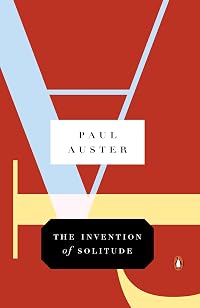
The Invention of Solitude
by Paul Auster
On This Page
Description
The first section, "Portrait of an Invisible Man," reveals Auster's memories and feelings after the death of his father, a distant, undemonstrative, almost cold man. As he attends to his father's business affairs and sifts through his effects, Auster uncovers a sixty-year-old family murder mystery that sheds light on his father's elusive character. In "The Book of Memory," the perspective shifts from Auster's identity as son to his role as father. Through a mosaic of images, coincidences, show more and associations, the narrator, "A," contemplates his separation from his son, his dying grandfather, and the solitary nature of storytelling and writing.-Back cover. show lessTags
Recommendations








Member Reviews
The Invention of Solitude contains two exquisite essays/memoirs, "Portrait of an Invisible Man," Auster's reminiscences about his difficult-to-pin-down father, and "The Book of Memory," an intoxicating longer memoir about memory, writing and experience. In both cases, but especially in the latter work, the prose is often somewhat dense and quite often dreamlike in nature, but at the same time almost impossibly precise, as if it were necessary for Auster to first blur the lens before sharpening the view to hone in directly on his point. I found myself frequently astonished. There were a dozen passages that made me think, while I was reading them, "I'll quote that." But I'll just quote this one:
". . . For a man to remember so precisely show more things he had seen only once, things which could not have had any bearing on his life except for a fleeting instant, struck A. with all the force of a supernatural act. He realized that for Ponge there was no division between the work of writing and the work of seeing. For no word can be written without first having been seen, and before it finds its way to the page it must first have been part of the body, a physical presence that one has lived with in the same way one lives with one's heart, one's stomach, and one's brain. Memory, then, not so much as the past contained within us, but as proof of our life in the present. If a man is to be truly present among his surroundings, he must be thinking not of himself, but of what he sees. He must forget himself in order to be there. And from that forgetfulness arises the power of memory. It is a way of living one's life so that nothing is ever lost." show less
". . . For a man to remember so precisely show more things he had seen only once, things which could not have had any bearing on his life except for a fleeting instant, struck A. with all the force of a supernatural act. He realized that for Ponge there was no division between the work of writing and the work of seeing. For no word can be written without first having been seen, and before it finds its way to the page it must first have been part of the body, a physical presence that one has lived with in the same way one lives with one's heart, one's stomach, and one's brain. Memory, then, not so much as the past contained within us, but as proof of our life in the present. If a man is to be truly present among his surroundings, he must be thinking not of himself, but of what he sees. He must forget himself in order to be there. And from that forgetfulness arises the power of memory. It is a way of living one's life so that nothing is ever lost." show less
I agree with the other reviewers that I enjoyed the first section better than the second. Perhaps this is because the ideas are knitted together by the story of his father's life. However, I found the ideas expressed in the second part very thought provoking. I read this book with the hope that it would give me a better insight into "Moon Palace." The connections to the theme of solitude in Moon Palace are obvious. While Part 2 is challenging reading, I highly recommend this book for readers who want a deeper insight into Auster's thoughts.
In "Portrait of an Invisible Man", the first part of Paul Auster's fascinating memoir "Invention of Solitude", Auster writes about his father's life as a means of helping himself come to terms with his father's death. Auster remembers his father as an elusive figure in his life, emotionally detached and disconnected from family and life itself ("he had managed to keep himself at a distance from life"). To Auster, it seemed that the world's attempts to embrace his father simply bounced off him without ever making a breakthrough - it was impossible to enter his solitude. The theme of Solitude runs powerfully through this disturbing, mesmerising memoir.
Auster is conscious of how little knowledge he actually has of his father's early show more childhood years, how unenlightened he is with regard to his father's inner life, how few clues he has to his father's character and how little understanding of the underlying reasons for his father's immunity from the world at large. Through an amazing co-incidence involving his cousin, Auster learns of a terrible secret buried deep in his father's childhood past - the story was splashed across old newspaper reports of the time, sixty years before - of a shocking family tragedy that shattered his father's childhood world and could have seriously affected his mental outlook during his formative years, accounting for the solitariness and elusiveness that characterised the "invisible man" of Auster's childhood. Excellent, compelling writing! Dramatic revelations from a grim, distant past finally brought to light! Highly recommended!
In the second part, "The Book of Memory", there is a marked shift of perspective (away from the point of view of Auster, as son, writing about his feelings and memories of his father's life, after his death) to an autobiographical account of Auster's own experience, now himself as father, writing about his son. More abstract in content and style than "Portrait of an Invisible Man", "The Book of Memory" comprises autobiographical segments interspersed with commentaries on the nature of chance interspersed with ruminations on solitude and exploration of language. As a confirmed Auster-holic, my favourite Auster book to-date is "Moon Palace". show less
Auster is conscious of how little knowledge he actually has of his father's early show more childhood years, how unenlightened he is with regard to his father's inner life, how few clues he has to his father's character and how little understanding of the underlying reasons for his father's immunity from the world at large. Through an amazing co-incidence involving his cousin, Auster learns of a terrible secret buried deep in his father's childhood past - the story was splashed across old newspaper reports of the time, sixty years before - of a shocking family tragedy that shattered his father's childhood world and could have seriously affected his mental outlook during his formative years, accounting for the solitariness and elusiveness that characterised the "invisible man" of Auster's childhood. Excellent, compelling writing! Dramatic revelations from a grim, distant past finally brought to light! Highly recommended!
In the second part, "The Book of Memory", there is a marked shift of perspective (away from the point of view of Auster, as son, writing about his feelings and memories of his father's life, after his death) to an autobiographical account of Auster's own experience, now himself as father, writing about his son. More abstract in content and style than "Portrait of an Invisible Man", "The Book of Memory" comprises autobiographical segments interspersed with commentaries on the nature of chance interspersed with ruminations on solitude and exploration of language. As a confirmed Auster-holic, my favourite Auster book to-date is "Moon Palace". show less
"Impossible, I realize, to enter another’s solitude. If it is true that we can ever come to know another human being, even to a small degree, it is only to the extent that he is willing to make himself known. A man will say: I am cold. Or else he will say nothing, and we will see him shivering. Either way, we will know that he is cold. But what of the man who says nothing and does not shiver?"
The second section, "The Book of Memory", was a very interesting thing to read. I found myself switching within a page from maddening boredom (luckily i read most of it on a plane) to intense interest (i wished i was in a library so i could chase down some of the allusions) and back. Overall, it felt like the author was slowly wading through the bog of his own loss and pity, trying to think himself back out to normality.
It's a self-referential, introspective, literate, personal investigation of memory, identity, maturity (and childhood), solitude, art, Pinocchio, Jonah, Rembrandt, Van Gaugh, baseball, magic ... When it intersected with my own interests it was really great, lots to consider, to quote, to remember. But when he lost me, show more he lost me quicker than any writer i can remember, sometimes mid-paragraph. show less
It's a self-referential, introspective, literate, personal investigation of memory, identity, maturity (and childhood), solitude, art, Pinocchio, Jonah, Rembrandt, Van Gaugh, baseball, magic ... When it intersected with my own interests it was really great, lots to consider, to quote, to remember. But when he lost me, show more he lost me quicker than any writer i can remember, sometimes mid-paragraph. show less
Granted, the first section dealing with the death of his father was nothing short of amazing. I loved it as have most who have read it and felt it necessary to say something about their personal experience. And yes, the second section, The Book of Memory did focus on his son Daniel and I think he used Daniel as a conduit in which to enable his own act of recollection. The second section dealt with his marriage and divorce from his first wife, his time living in France, the mirrors and rhymes of his life that seemed to be reflected more often than not. The section bogged down on me early but only because I believed Auster might resort to a pitiful voice I have heard in some of his later works, that being too much involved in the show more sentimental and his even acting silly about it at times. But that wasn't the case at all. It was philosophically moving, it was based on memory and recollection, it was a vehicle in which he could try his hand at writing something besides poems and translations. Auster was learning for himself on the page what it meant to be a writer. He was saving himself. He was looking for the uncanny in his life, the unheimliche, and he quoted Freud and others in the process of his demonstrating to us his seriousness in getting to the bottom of this writing craft.
From Wikipedia: The uncanny (Ger. Das Unheimliche - "the opposite of what is familiar") is a Freudian concept of an instance where something can be familiar, yet foreign at the same time, resulting in a feeling of it being uncomfortably strange or uncomfortably familiar. Because the uncanny is familiar, yet strange, it often creates cognitive dissonance within the experiencing subject due to the paradoxical nature of being attracted to, yet repulsed by an object at the same time. This cognitive dissonance often leads to an outright rejection of the object, as one would rather reject than rationalize.
I was wrong about my thinking the second section of this book was of measure less than the first. It was a very good memoir, an important attempt for Auster in which to begin his long, literary accomplishment. We should all wish to be so lucky. show less
From Wikipedia: The uncanny (Ger. Das Unheimliche - "the opposite of what is familiar") is a Freudian concept of an instance where something can be familiar, yet foreign at the same time, resulting in a feeling of it being uncomfortably strange or uncomfortably familiar. Because the uncanny is familiar, yet strange, it often creates cognitive dissonance within the experiencing subject due to the paradoxical nature of being attracted to, yet repulsed by an object at the same time. This cognitive dissonance often leads to an outright rejection of the object, as one would rather reject than rationalize.
I was wrong about my thinking the second section of this book was of measure less than the first. It was a very good memoir, an important attempt for Auster in which to begin his long, literary accomplishment. We should all wish to be so lucky. show less
Non si tratta di narrativa ma Auster esce allo scoperto con il suo interesse per indagine, caso ed "esperimenti di verità" rivolgendolo alla propria vita e alla propria famiglia. Fra le due parti preferisco la prima, dedicata a ricostruire la vita del padre: nonostante la cupezza dei toni, in breve ci si ritrova nella vicenda. Al contrario, la seconda parte risulta un po' spezzettata.
Members
- Recently Added By
Author Information

106+ Works 65,112 Members
Paul Auster was born on February 3, 1947, in Newark, New Jersey. He received a B.A. and a M.A. in English and Comparative Literature from Columbia University. In addition to his career as a writer, Auster has been a census taker, tutor, merchant seaman, little-league baseball coach, and a telephone operator. He started his writing career as a show more translator. He soon gained popularity for the detective novels that make up his New York Trilogy. His other works include The Invention of Solitude; Leviathan; Moon Palace; Facing the Music; In the Country of Last Things; The Music of Chance; Mr. Vertigo; and The Brooklyn Follies. His latest novels are entitled, Invisible and Sunset Park. In addition to his novels, Auster has written screenplays and directed several films. He is the recipient of a fellowship from the National Endowment for the Arts and a French Prix Medicis for Foreign Literature. (Bowker Author Biography) show less
Some Editions
Series
Belongs to Publisher Series
Work Relationships
Common Knowledge
- Canonical title
- The Invention of Solitude
- Original title
- The Invention of Solitude
- Original publication date
- 1982
- Epigraph
- Etsiessäsi totuutta valmistaudu odottamattomaan,
sillä sitä on vaikea löytää ja löytyessään se hämmentää.
— Herakleitos
In searching out the truth be ready for the unexpected, for it is difficult to find and puzzling when you find it.
- Heraclitus - First words
- One day there is a life. A man, for example, in the best of health, not even old, with no history of illness. Everything is as it was, as it will always be.
- Last words
- (Click to show. Warning: May contain spoilers.)It was. It will never be again. Remember.
- Original language
- English
Classifications
Statistics
- Members
- 1,930
- Popularity
- 11,093
- Reviews
- 19
- Rating
- (3.73)
- Languages
- 19 — Arabic, Catalan, Danish, Dutch, English, Finnish, French, German, Greek, Hebrew, Italian, Japanese, Norwegian (Bokmål), Norwegian, Polish, Portuguese, Spanish, Swedish, Turkish
- Media
- Paper, Ebook
- ISBNs
- 60
- ASINs
- 18