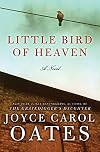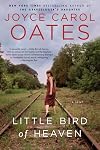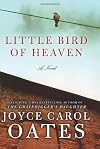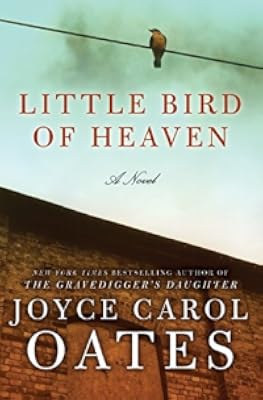
Little Bird of Heaven
by Joyce Carol Oates
On This Page
Description
When a young wife and mother named Zoe Kruller is found brutally murdered, the Sparta police target two primary suspects, her estranged husband, Delray Kruller, and her longtime lover, Eddy Diehl. In turn, the Krullers' son, Aaron, and Eddy Diehl's daughter, Krista, become obsessed with each other, each believing the other's father is guilty until they meet again as adults, ready to exorcise the ghosts of the past and come to terms with their legacy of guilt, misplaced love, and redemptive show more yearning. show lessTags
Recommendations






Member Reviews
The waitress and singer Zoe has been murdered and two men are the prime suspects, Eddie Diehl, her lover, and Delray Kruller, her husband, from whom she had recently separated. However, this is not a crime novel per se. It is the story of the key players and how they all become the victims in this violent crime.
This novel is narrated from two different vantage points which overlap at different times; and in each, at multiple different times in the narrators lives. Each narrator is the child of one of the suspects in of the murder. Aaron is Zoe and Delray’s son. Krista is the daughter of Zoe’s lover Eddie.
This novel, for the most part has little momentum until its closing pages, however its slow, almost painful progress gives the show more sensation of living the lives of Krista and Aaron. What Oates does incredibly well is make you feel each of the ages of these characters, what they feel, how they perceive, what they see and notice, about the ‘big incident’ that marks their lives, but also the ‘here and now’ of each age. Sometimes the repetition gives the sensation of standing on the spot, or perhaps standing in a river where the water over time begins to rise, and yet you are looking at the same landscape. Just experiencing it differently.
This is not a simple or straightforward story, but an attempt at cutting through the carcass and exploring the layers that make up lived lives. Not everything is visible and the floor is bloody. Oates is a challenging writer of curiosity and vision. She is also an innate storyteller and experimentalist. She has written in multiple genres, styles and times and appears always to be ‘pushing the envelope’ one imagines both in order not to bore herself or her readers. Little in Oates is formulaic.
However, if there is a problem with some of Joyce Carol Oates’ novels, it is, for me, that whilst appreciating her innate crafts-womanship, skill, breadth of interests and knowledge, sometimes it is hard, if not impossible to say you like or love the piece of work. As with the ‘Tattooed Girl’ I found with this novel, I could not enjoy the experience. Whilst I was in it, I was appreciating its intensions, and wanting to know more. But I wasn’t driven back to it when I had set it down.
But perhaps pleasure is and/or should not always be the point of a novel, and this may be what Joyce Carol Oates wishes also to explore. Not only her characters, but the purpose of fiction, of reading, and the impact it has upon us. show less
This novel is narrated from two different vantage points which overlap at different times; and in each, at multiple different times in the narrators lives. Each narrator is the child of one of the suspects in of the murder. Aaron is Zoe and Delray’s son. Krista is the daughter of Zoe’s lover Eddie.
This novel, for the most part has little momentum until its closing pages, however its slow, almost painful progress gives the show more sensation of living the lives of Krista and Aaron. What Oates does incredibly well is make you feel each of the ages of these characters, what they feel, how they perceive, what they see and notice, about the ‘big incident’ that marks their lives, but also the ‘here and now’ of each age. Sometimes the repetition gives the sensation of standing on the spot, or perhaps standing in a river where the water over time begins to rise, and yet you are looking at the same landscape. Just experiencing it differently.
This is not a simple or straightforward story, but an attempt at cutting through the carcass and exploring the layers that make up lived lives. Not everything is visible and the floor is bloody. Oates is a challenging writer of curiosity and vision. She is also an innate storyteller and experimentalist. She has written in multiple genres, styles and times and appears always to be ‘pushing the envelope’ one imagines both in order not to bore herself or her readers. Little in Oates is formulaic.
However, if there is a problem with some of Joyce Carol Oates’ novels, it is, for me, that whilst appreciating her innate crafts-womanship, skill, breadth of interests and knowledge, sometimes it is hard, if not impossible to say you like or love the piece of work. As with the ‘Tattooed Girl’ I found with this novel, I could not enjoy the experience. Whilst I was in it, I was appreciating its intensions, and wanting to know more. But I wasn’t driven back to it when I had set it down.
But perhaps pleasure is and/or should not always be the point of a novel, and this may be what Joyce Carol Oates wishes also to explore. Not only her characters, but the purpose of fiction, of reading, and the impact it has upon us. show less
With "Little Bird of Heaven," Joyce Carol Oates returns again to depictions of life in Sparta, N.Y., "the doomed city on the Black River." In this latest offering, the fading blue-collar burg has been rocked by the grisly murder of one Zoe Kruller, a troubled but charismatic country singer with a taste for seedy pleasures.
Zoe was found beaten and strangled in her bed in a run-down apartment on the wrong side of town. Estranged from her husband, she had been living in squalid semi-prostitution, and the feeling among the shabby-genteel townspeople, who are a little too close to Zoe's milieu for empathy or compassion, is that she somehow got what she deserved. The police investigating the crime are certain she died at the hands of her show more lover or her ex-husband. When the investigation stalls over lack of evidence, however, the murder remains unsolved, effectively casting the families of those involved into an endless purgatory of suspicion.
The fallout from the unhappy woman's demise falls largely on the shoulders of Aaron, her anomic son, and Krista Diehl, the daughter of the local roustabout with whom Zoe was having an affair. Both children believe that the other's father is responsible for the murder, setting up crosscurrents of sin and stain that reverberate throughout the narrative, which jumps back and forth across the passage of two decades in the lives of these death-haunted characters.
This is a powerful novel. Oates's feel for the rhythms of hardscrabble life and its sour mix of alcoholism, suicide, drug abuse, adultery and murder is as keen as ever. In Sparta she has created a fictional universe to stand beside Faulkner's Yoknapatawpha County or Cheever's Shady Hill. Her descriptions of the geography of urban decay -- the rusted bridges, tangled back alleys and trash-strewn lots -- are as vivid as any naturalist's portrayal of more felicitous scenes. Her unsentimental language makes a high-lonesome kind of poetry out of otherwise sordid and unremarkable circumstance.
ad_icon
This is not to say that "Little Bird of Heaven" is without flaws; its pacing is, shall we say, stately, and at times the author lingers over descriptive passages that could have been dispatched more crisply. A book that starts out as a standard police procedural but fizzles into uncertainty and stasis may be realistic, but it will frustrate readers with more conventional expectations.
By now, however, most readers probably have settled ideas about Oates anyway, and "Little Bird of Heaven" is unlikely to change any minds. Despite her long and prestigious career, in certain circles she suffers from the perception that her superheated realism is not sufficiently literary or experimental. There are three reasons for this canard:
The first is the staggering volume of Oates's output. While some of her work can feel either rushed or recycled, it is worth noting that James, Thackeray, Dickens and Trollope, to name a few, produced an equivalent amount of fiction. But critics, especially male ones, are in love with the idea of the author as heroic artiste, a reclusive mystic whose triumphal verbal artifacts are the product of a decade or more of tortured cogitation. This is a purely 20th-century invention. The idea that writing is a craft, that it is work and, like baking or washing dishes or painting houses, can be done daily and well, is anathema to the hoary "great man" theory of literature.
The second reason for the disdain Oates sometimes provokes is that she eschews postmodernism gamesmanship, and it is difficult to think of a writer less burdened with irony -- the kudzu vine of contemporary fiction. Fashion aside, novels like "Little Bird of Heaven," with its mixture of the Gothic and the fatalistic, mark Oates as our closest contemporary analogue to Hawthorne: lyrical, moral, unforgiving.
And finally, there's the poverty, economic and intellectual, of Oates's subjects. Like everyone else, literary critics enjoy reading about characters who resemble themselves, but Oates's narratives are markedly free of eccentric academics, hipster smart-alecks and entry-level publishing ingenues. For Raymond Carver or Cormac McCarthy to write scenes with unshaven characters drinking from the bottle in boardinghouse rooms with stained and faded floral wallpaper registers as noble and bitter and true. To do so as a woman, as a spiritual descendant of Austen and Woolf and Wharton, however, looks to the inflexible-minded as slightly out of focus, as though she were slumming or trying to be something she's not. But Oates's refusal to write soggy family sagas or dating-life confessionals is its own form of toughness. What else would you expect her to do? She's the original Girl From the North Country.
From the Washington Post, September 13, 2009 show less
Zoe was found beaten and strangled in her bed in a run-down apartment on the wrong side of town. Estranged from her husband, she had been living in squalid semi-prostitution, and the feeling among the shabby-genteel townspeople, who are a little too close to Zoe's milieu for empathy or compassion, is that she somehow got what she deserved. The police investigating the crime are certain she died at the hands of her show more lover or her ex-husband. When the investigation stalls over lack of evidence, however, the murder remains unsolved, effectively casting the families of those involved into an endless purgatory of suspicion.
The fallout from the unhappy woman's demise falls largely on the shoulders of Aaron, her anomic son, and Krista Diehl, the daughter of the local roustabout with whom Zoe was having an affair. Both children believe that the other's father is responsible for the murder, setting up crosscurrents of sin and stain that reverberate throughout the narrative, which jumps back and forth across the passage of two decades in the lives of these death-haunted characters.
This is a powerful novel. Oates's feel for the rhythms of hardscrabble life and its sour mix of alcoholism, suicide, drug abuse, adultery and murder is as keen as ever. In Sparta she has created a fictional universe to stand beside Faulkner's Yoknapatawpha County or Cheever's Shady Hill. Her descriptions of the geography of urban decay -- the rusted bridges, tangled back alleys and trash-strewn lots -- are as vivid as any naturalist's portrayal of more felicitous scenes. Her unsentimental language makes a high-lonesome kind of poetry out of otherwise sordid and unremarkable circumstance.
ad_icon
This is not to say that "Little Bird of Heaven" is without flaws; its pacing is, shall we say, stately, and at times the author lingers over descriptive passages that could have been dispatched more crisply. A book that starts out as a standard police procedural but fizzles into uncertainty and stasis may be realistic, but it will frustrate readers with more conventional expectations.
By now, however, most readers probably have settled ideas about Oates anyway, and "Little Bird of Heaven" is unlikely to change any minds. Despite her long and prestigious career, in certain circles she suffers from the perception that her superheated realism is not sufficiently literary or experimental. There are three reasons for this canard:
The first is the staggering volume of Oates's output. While some of her work can feel either rushed or recycled, it is worth noting that James, Thackeray, Dickens and Trollope, to name a few, produced an equivalent amount of fiction. But critics, especially male ones, are in love with the idea of the author as heroic artiste, a reclusive mystic whose triumphal verbal artifacts are the product of a decade or more of tortured cogitation. This is a purely 20th-century invention. The idea that writing is a craft, that it is work and, like baking or washing dishes or painting houses, can be done daily and well, is anathema to the hoary "great man" theory of literature.
The second reason for the disdain Oates sometimes provokes is that she eschews postmodernism gamesmanship, and it is difficult to think of a writer less burdened with irony -- the kudzu vine of contemporary fiction. Fashion aside, novels like "Little Bird of Heaven," with its mixture of the Gothic and the fatalistic, mark Oates as our closest contemporary analogue to Hawthorne: lyrical, moral, unforgiving.
And finally, there's the poverty, economic and intellectual, of Oates's subjects. Like everyone else, literary critics enjoy reading about characters who resemble themselves, but Oates's narratives are markedly free of eccentric academics, hipster smart-alecks and entry-level publishing ingenues. For Raymond Carver or Cormac McCarthy to write scenes with unshaven characters drinking from the bottle in boardinghouse rooms with stained and faded floral wallpaper registers as noble and bitter and true. To do so as a woman, as a spiritual descendant of Austen and Woolf and Wharton, however, looks to the inflexible-minded as slightly out of focus, as though she were slumming or trying to be something she's not. But Oates's refusal to write soggy family sagas or dating-life confessionals is its own form of toughness. What else would you expect her to do? She's the original Girl From the North Country.
From the Washington Post, September 13, 2009 show less
I first discovered Joyce Carol Oates about ten years ago, when I read one of her short stories (“Where Are You Going, Where Have You Been?” It’s a MUST read, by the way). I fell in love with her stories and novels because of the subject matter; Oates’s novels usually deal with obsession usually of the sexual kind (them is a perfect example of this). Oates’s novels are always dark and gritty, never easy reading but somehow satisfying nonetheless. Little Bird of Heaven is Oates at her best.
The setting is a working-class town in upstate New York (typical Oates) in the 1980s. The story isn’t told linearly, but unfolds gradually over time. Some of the information we’re given is repeated, but each time the story is told from a show more different point of view. Krista Diehl is the daughter of Eddy Diehl, suspected of but never charged with the murder of a local singer named Zoe Kruller, with whom he was romantically involved. On the other side of the coin is Aaron Kruller, the woman’s son. Both he and Krista become obsessed with the murder of his mother—and, by extension, with each other, in a weird way. The first half of the book is told from Krista’s perspective, the second from Aaron’s.
Part of the beauty of Oates’s novels is a common theme that runs throughout: obsession. Krista and Aaron are of course obsessed with Zoe Kruller’s murder; Eddy Diehl is obsessed with clearing his name and having his life returned to normal. Another thing I loved about this book is the not-knowing; the reader never really knows until the end for sure who killed Zoe Kruller, and that’s part of what kept me turning the pages. And yet Eddy Diehl certainly does keep acting guilty, doesn’t he? I certainly think he does feel guilt, in a way, but maybe he didn’t really do it?
Another thing I love about Oates’s novels is her prose. I’m pretty sure that, if you plugged one of her sentences into Microsoft Word, it would flag that sentence as a run on; but Joce Carol Oates’s writing is pure poetry. She breaks the rules of writing in a way that only she can. Sure, she does use a fair bit of profanity, which can be a bit disturbing. It’s also exhausting at times to read, but well worth the effort of doing so. The only thing I didn’t really get was Aaron Kruller’s voice, especially as a child; I doubt that a boy of eleven, especially one with a bad reputation, would call his parents “Mommy” and “Daddy.” Also, Oates goes a little bit overboard on the Elvis comparisons (it seems that a lot of people in Sparta, New York look like him!) But other than that, I highly recommend this book. show less
The setting is a working-class town in upstate New York (typical Oates) in the 1980s. The story isn’t told linearly, but unfolds gradually over time. Some of the information we’re given is repeated, but each time the story is told from a show more different point of view. Krista Diehl is the daughter of Eddy Diehl, suspected of but never charged with the murder of a local singer named Zoe Kruller, with whom he was romantically involved. On the other side of the coin is Aaron Kruller, the woman’s son. Both he and Krista become obsessed with the murder of his mother—and, by extension, with each other, in a weird way. The first half of the book is told from Krista’s perspective, the second from Aaron’s.
Part of the beauty of Oates’s novels is a common theme that runs throughout: obsession. Krista and Aaron are of course obsessed with Zoe Kruller’s murder; Eddy Diehl is obsessed with clearing his name and having his life returned to normal. Another thing I loved about this book is the not-knowing; the reader never really knows until the end for sure who killed Zoe Kruller, and that’s part of what kept me turning the pages. And yet Eddy Diehl certainly does keep acting guilty, doesn’t he? I certainly think he does feel guilt, in a way, but maybe he didn’t really do it?
Another thing I love about Oates’s novels is her prose. I’m pretty sure that, if you plugged one of her sentences into Microsoft Word, it would flag that sentence as a run on; but Joce Carol Oates’s writing is pure poetry. She breaks the rules of writing in a way that only she can. Sure, she does use a fair bit of profanity, which can be a bit disturbing. It’s also exhausting at times to read, but well worth the effort of doing so. The only thing I didn’t really get was Aaron Kruller’s voice, especially as a child; I doubt that a boy of eleven, especially one with a bad reputation, would call his parents “Mommy” and “Daddy.” Also, Oates goes a little bit overboard on the Elvis comparisons (it seems that a lot of people in Sparta, New York look like him!) But other than that, I highly recommend this book. show less
Zoe Kruller, a beautiful young mother and bluegrass singer, is found brutally murdered in her apartment which she shared with a woman friend. Taken into custody and questioned as "persons of interest" are her estranged husband, Delray, and her married lover, Eddie Diehl. As the investigation continues, neither are arrested and charged with the murder, and a cloud of suspicious hangs over both men which shapes their lives from thereon in.
JCO loves tragedy, she considers it the highest form of art, and here again she explores it, like a knife probing an open wound. Not everyone is up for such a read, but I find her stories a bit like the equivalent for the brain, of rubbing a crisp, fresh, cotton towel across my skin - it's rough and show more hurts a bit, but ultimately is refreshing and invigorating.
Little Bird of Heaven is told in basically two parts. The first is by Krista Diehl, now grown daughter of the murdered woman's lover. She tells the story beginning well before the murder and her voice seems to move back and forth from the little girl who adoringly loves her daddy to a teenager and back to adult. (Oates often tells her stories from the viewpoint of children and teens, it's an interesting discussion point... why?). While reading this I could not help but think about how unreliable our memories are, how we shape them and rewrite as we grow older.
The other half of the book is told by Aaron Kruller, the son of the murdered woman and Delray, the other suspect. It is Aaron who finds his mother's naked dead body in the apartment and in his shock covers it with talcum powder. Aaron also begins his story well before the murder, and we see how the little boy Aaron becomes the troubled teen know as "Krull." It is a story of the fathers, the families, but it is more a story of the two children, imo, and both of these stories are mesmerizing in themselves. Despite each child being convinced that the other man, not their father, was the murderer, I found myself shifting my suspicion back and forth between the men. Both men's lives are slowly worn down and destroyed by just that, constant suspicion.
There's so much in this book one could talk about. As I mentioned before, reading this is a lot like probing an open wound. There is violence and passion and oftentimes the two are so mixed as to be indistinguishable. The tragedy of the story seems almost classical, the ending cathartic. The reader cannot help be shaken — and stirred. show less
JCO loves tragedy, she considers it the highest form of art, and here again she explores it, like a knife probing an open wound. Not everyone is up for such a read, but I find her stories a bit like the equivalent for the brain, of rubbing a crisp, fresh, cotton towel across my skin - it's rough and show more hurts a bit, but ultimately is refreshing and invigorating.
Little Bird of Heaven is told in basically two parts. The first is by Krista Diehl, now grown daughter of the murdered woman's lover. She tells the story beginning well before the murder and her voice seems to move back and forth from the little girl who adoringly loves her daddy to a teenager and back to adult. (Oates often tells her stories from the viewpoint of children and teens, it's an interesting discussion point... why?). While reading this I could not help but think about how unreliable our memories are, how we shape them and rewrite as we grow older.
The other half of the book is told by Aaron Kruller, the son of the murdered woman and Delray, the other suspect. It is Aaron who finds his mother's naked dead body in the apartment and in his shock covers it with talcum powder. Aaron also begins his story well before the murder, and we see how the little boy Aaron becomes the troubled teen know as "Krull." It is a story of the fathers, the families, but it is more a story of the two children, imo, and both of these stories are mesmerizing in themselves. Despite each child being convinced that the other man, not their father, was the murderer, I found myself shifting my suspicion back and forth between the men. Both men's lives are slowly worn down and destroyed by just that, constant suspicion.
There's so much in this book one could talk about. As I mentioned before, reading this is a lot like probing an open wound. There is violence and passion and oftentimes the two are so mixed as to be indistinguishable. The tragedy of the story seems almost classical, the ending cathartic. The reader cannot help be shaken — and stirred. show less
Little Bird of Heaven is vintage Joyce Carol Oates, so much so, in fact, that fans of her writing will immediately recognize the novel’s setting and tone. Krista Diehl, the young girl whose father Eddie is suspected of the brutal murder of his mistress, is beginning to realize just how dangerous the world can be for a girl fast approaching sexual maturity. She is both repelled and fascinated by the boys and men with whom she is beginning to come into contact, and what her father is accused of having done leads her to the conclusion that men are dangerous beings. When her father one day emotionally grabs her by the wrist, her first thought is “Always you are astonished. Their size, their height. Their strength. That they could hurt show more you so easily without meaning to.”
Zoe Kruller was somewhat of a minor celebrity in little Sparta, New York. She was the best thing that her bluegrass band had going for it and any performance of theirs at the local park was guaranteed to attract the attention of a large number of male admirers, men who found it difficult to resist Zoe’s charms. To Krista, however, Zoe was the woman who served her ice cream at the local dairy and always remembered her name. She was Krista’s friend. That she was also her father’s mistress and that he would be accused of her bloody murder would change Krista’s life forever.
Also changed forever by Zoe’s murder would be her son Aaron, a boy whose own father is believed to be the most logical suspect in the murder if Eddie Diehl can prove that he is not the killer. Aaron, already on somewhat of a downward spiral of his own, is as certain that his father is not guilty of the crime as Krista is sure that her own father did not do it. Krista’s determination to find the truth about her father and his relationship with Zoe Kruller leads her to become as obsessed with Aaron Kruller as her father had been obsessed with the boy’s mother.
Oates tells her story from two distinct points-of-view. The first half of the book is filtered through the eyes of Krista Diehl who is really too young to understand everything that she discovers about the murder. This part of the book focuses on the gradual disintegration of the Diehl family which results from everything that happens to them following the murder. Aaron Kruller narrates the second half of the book and, since he is older than Krista, he fills in some of the blanks of Krista’s version of the events before and after his mother’s murder. Inevitably, these two young people have so much in common that their paths cannot help but cross – in a way that neither of them could have imagined and from which each are lucky to come out whole.
Little Bird of Paradise is a novel about self-discovery, pain, loss and how children so often have to pay for the sins of their parents. It is well written, as is almost always the case in a Joyce Carol Oates novel, but it is sometimes not easy to read because one feels, almost from the start, that its two narrators are doomed to repeat the mistakes of their fathers. This sense of impending doom will, however, keep readers turning the pages all the way to the end.
Rated at: 5.0 show less
Zoe Kruller was somewhat of a minor celebrity in little Sparta, New York. She was the best thing that her bluegrass band had going for it and any performance of theirs at the local park was guaranteed to attract the attention of a large number of male admirers, men who found it difficult to resist Zoe’s charms. To Krista, however, Zoe was the woman who served her ice cream at the local dairy and always remembered her name. She was Krista’s friend. That she was also her father’s mistress and that he would be accused of her bloody murder would change Krista’s life forever.
Also changed forever by Zoe’s murder would be her son Aaron, a boy whose own father is believed to be the most logical suspect in the murder if Eddie Diehl can prove that he is not the killer. Aaron, already on somewhat of a downward spiral of his own, is as certain that his father is not guilty of the crime as Krista is sure that her own father did not do it. Krista’s determination to find the truth about her father and his relationship with Zoe Kruller leads her to become as obsessed with Aaron Kruller as her father had been obsessed with the boy’s mother.
Oates tells her story from two distinct points-of-view. The first half of the book is filtered through the eyes of Krista Diehl who is really too young to understand everything that she discovers about the murder. This part of the book focuses on the gradual disintegration of the Diehl family which results from everything that happens to them following the murder. Aaron Kruller narrates the second half of the book and, since he is older than Krista, he fills in some of the blanks of Krista’s version of the events before and after his mother’s murder. Inevitably, these two young people have so much in common that their paths cannot help but cross – in a way that neither of them could have imagined and from which each are lucky to come out whole.
Little Bird of Paradise is a novel about self-discovery, pain, loss and how children so often have to pay for the sins of their parents. It is well written, as is almost always the case in a Joyce Carol Oates novel, but it is sometimes not easy to read because one feels, almost from the start, that its two narrators are doomed to repeat the mistakes of their fathers. This sense of impending doom will, however, keep readers turning the pages all the way to the end.
Rated at: 5.0 show less
This book was a wonder to me. A wonder that I enjoyed it so much, bearing in mind that the pivotal event is handed, pre-announced, to the reader. The rest of the book circles around this event, delivered mostly in two narratives that move in towards it, away from it and then meeting back up at the end. I gave Testimony by Anita Shreve a low score and that followed a similar format. Why then is Little Bird of Heaven by Joyce Carol Oates a more enjoyable read?
I found the author’s style off-putting for the first few pages. This was the first of her books that I’ve read and the constant use of dashes for pauses and italics for emphasis nearly made me put it down. I’m glad that I didn’t. It soon became a book that I looked forward show more to picking up every chance I had.
Krista Diehl’s first person narrative is very touching. She recalls events over the course of several years, admitting her own naivety and showing how her intuition developed into perception during that time. Her absolute, unwavering faith in and love for her father is something that any man could only hope for. That man is on a clear path to doom and Oates tells the reader on the first page that Eddy Diehl will die in a hail of police bullets. What is gripping is the emotional turmoil the characters endure as the Diehl family is ripped apart by infidelity and false accusation. Sections of narrative are introduced e.g. a section from Eddy Diehl’s perspective during his initial police interrogation, that give valuable insight into his state of mind and the mistakes he makes.
Oates uses concentric story circles of two men, Eddy and Delray, hell-bent on self-destruction through their attraction to the ill-fated Zoe who ultimately betrays them both and leaves a poison legacy of suspicion. Outside of these two men run the stories of Eddie’s daughter, Krista, and Delray’s son, Aaron. Krista is described through her own thoughts and words. Aaron is described more in the physical sense initially. His dominant presence is tangible and Krista’s attraction to him seems terrible but logical.
As Aaron becomes older, his persona turns into Krull and this character comes to life through his actions and reflections. As he, in effect, loses his father, the character becomes more sympathetic and he moves into a similar space as Krista. Both he and she have lost their fathers and Jacky DeLucca’s confession brings them together years later. This reunification is also telegraphed early on by Oates, giving credence to what otherwise might seem an improbable turn of events.
I did have a problem with the Jacky DeLucca character. When Krista meets her for the first time, Jacky’s dialogue is very heavy and I felt like the story was being delivered through her mouth. The same with her confession at the end. She seemed too eloquent and I just wanted her to stop. It was obvious that the killer was one of Zoe’s murkier lovers and Jacky’s lengthy disclosure didn’t sound like a woman dying of liver cancer. That’s my only complaint.
To end on a high point, this has to be the first book I’ve read that ends with a sex scene and well done it is too. The requiting of eighteen years of lust is a fitting climax and it’s bittersweet. I’ll definitely try more from this author. show less
I found the author’s style off-putting for the first few pages. This was the first of her books that I’ve read and the constant use of dashes for pauses and italics for emphasis nearly made me put it down. I’m glad that I didn’t. It soon became a book that I looked forward show more to picking up every chance I had.
Krista Diehl’s first person narrative is very touching. She recalls events over the course of several years, admitting her own naivety and showing how her intuition developed into perception during that time. Her absolute, unwavering faith in and love for her father is something that any man could only hope for. That man is on a clear path to doom and Oates tells the reader on the first page that Eddy Diehl will die in a hail of police bullets. What is gripping is the emotional turmoil the characters endure as the Diehl family is ripped apart by infidelity and false accusation. Sections of narrative are introduced e.g. a section from Eddy Diehl’s perspective during his initial police interrogation, that give valuable insight into his state of mind and the mistakes he makes.
Oates uses concentric story circles of two men, Eddy and Delray, hell-bent on self-destruction through their attraction to the ill-fated Zoe who ultimately betrays them both and leaves a poison legacy of suspicion. Outside of these two men run the stories of Eddie’s daughter, Krista, and Delray’s son, Aaron. Krista is described through her own thoughts and words. Aaron is described more in the physical sense initially. His dominant presence is tangible and Krista’s attraction to him seems terrible but logical.
As Aaron becomes older, his persona turns into Krull and this character comes to life through his actions and reflections. As he, in effect, loses his father, the character becomes more sympathetic and he moves into a similar space as Krista. Both he and she have lost their fathers and Jacky DeLucca’s confession brings them together years later. This reunification is also telegraphed early on by Oates, giving credence to what otherwise might seem an improbable turn of events.
I did have a problem with the Jacky DeLucca character. When Krista meets her for the first time, Jacky’s dialogue is very heavy and I felt like the story was being delivered through her mouth. The same with her confession at the end. She seemed too eloquent and I just wanted her to stop. It was obvious that the killer was one of Zoe’s murkier lovers and Jacky’s lengthy disclosure didn’t sound like a woman dying of liver cancer. That’s my only complaint.
To end on a high point, this has to be the first book I’ve read that ends with a sex scene and well done it is too. The requiting of eighteen years of lust is a fitting climax and it’s bittersweet. I’ll definitely try more from this author. show less
(8.5) This book is told in the two narrative voices of Krista and Aaron, the offspring of the two suspected of the murder. They tell of the terrible impact and trauma suffered by their families. As to be expected from this author it is a gripping read.
Members
- Recently Added By
Published Reviews
ThingScore 50
Den intressanta berättelsen som skulle kunna öppna för många perspektiv försvinner i ordmassorna, där praktiskt taget allt skall med, på det där nästan maniska sättet som präglar Oates när hon inte kan hejda sig. Men jag ser fram emot nästa roman av Oates och hoppas att hon då är i bästa form.
added by Jannes
“Little Bird of Heaven” starts with the urgency of a thriller, then turns into something more existential as the years (and pages) go by with no developments in the case. This is a tragedy on a classical scale.
added by jlelliott
Lists

International IMPAC Dublin Literary Award
179 works; 6 members

Llibres que he llegit el 2010
35 works; 1 member
Author Information

473+ Works 63,232 Members
Joyce Carol Oates was born on June 16, 1938 in Lockport, New York. She received a bachelor's degree in English from Syracuse University and a master's degree in English from the University of Wisconsin. She is the author of numerous novels and collections of short stories. Her works include We Were the Mulvaneys, Blonde, Bellefleur, You Must show more Remember This, Because It Is Bitter, Because It Is My Heart, Solstice, Marya : A Life, and Give Me Your Heart. She has received numerous awards including the National Book Award for Them, the PEN/Malamud Award for Excellence in Short Fiction, and the F. Scott Fitzgerald Award for Lifetime Achievement in American Literature. She was a finalist for the 2015 Pulitzer Prize for Fiction with her title Lovely, Dark, Deep. She also wrote a series of suspense novels under the pseudonym Rosamond Smith. In 2015, her novel The Accursed became listed as a bestseller on the iBooks chart. She worked as a professor of English at the University of Windsor, before becoming the Roger S. Berlind Distinguished Professor of Humanities at Princeton University. She and her late husband Raymond J. Smith operated a small press and published a literary magazine, The Ontario Review. (Bowker Author Biography) Joyce Carol Oates is one of the most eminent and prolific literary figures and social critics of our times. She has won the National Book Award and several O. Henry and Pushcart prizes. Among her other awards are an NEA grant, a Guggenheim fellowship, the PEN/Malamud Lifetime Achievement Award, and the F. Scott Fitzgerald Award for Lifetime Achievement in American Literature. (Publisher Provided) show less
Awards and Honors
Awards
Distinctions
Common Knowledge
- Canonical title
- Little Bird of Heaven
- Original title
- Little Bird of Heaven
- Original publication date
- 2009-09-15
- Original language
- English
Classifications
Statistics
- Members
- 670
- Popularity
- 43,010
- Reviews
- 39
- Rating
- (3.42)
- Languages
- 8 — Danish, English, French, German, Italian, Portuguese (Portugal), Spanish, Swedish
- Media
- Paper, Audiobook, Ebook
- ISBNs
- 36
- ASINs
- 11