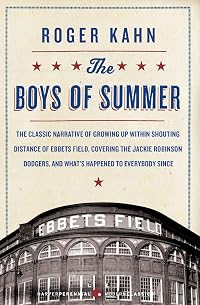
The Boys of Summer
by Roger Kahn
On This Page
Description
This is a book about young men who learned to play baseball during the 1930s and 1940s, and then went on to play for one of the most exciting major-league ball clubs ever fielded, the team that broke the color barrier with Jackie Robinson. It is a book by and about a sportswriter who grew up near Ebbets Field, and who had the good fortune in the 1950s to cover the Dodgers for the Herald Tribune. This is a book about what happened to Jackie, Carl Erskine, Pee Wee Reese, and the others when show more their glory days were behind them. In short, it is a book about America, about fathers and sons, prejudice and courage, triumph and disaster, and told with warmth, humor, wit, candor, and love. show lessTags
Recommendations













Member Recommendations
Member Reviews
Eloquently-written memoir of a time and place, as Roger Kahn takes us through his career in writing in relation to his affection for the Brooklyn Dodgers and the game of baseball. He starts with memories of his childhood, attending baseball games at Ebbets field with his dad, establishing the foundation for his life-long love of the game. He then takes us through his brief but memorable time as a sportswriter for the Brooklyn Dodgers, getting to know the team members personally, and how they and others reacted to the introduction of black players. (Some of this treatment was appalling – I’d like to think we’ve come a long way as a society since those days). Finally, he expands into book-writing, and brings the story full-circle by show more traveling to visit many of the Dodger players of the early 50’s, and providing a glimpse into their post-baseball lives.
I was impressed with the author’s fluid, poetic style, and his flair for story-telling. I could visualize the places to which he traveled. Although it was not a page-turner for me, I enjoyed it when I picked it up. Contains locker room language and commentary of the time-period (e.g., using the term mongoloid for a person with Downs Syndrome, and showing women in mostly subservient roles). It is filled with episodes of melancholy, tenderness, roughness, and humor. One of my favorite humorous asides was when Kahn describes reading Joyce aloud with his family on Wednesday nights and imagining the reactions of his Dodger buddies. Highly recommended for baseball fans, especially those interested in baseball history or the history of the Dodgers.
Favorite quotes:
“You may glory in a team triumphant, but you fall in love with a team in defeat.”
“Losing after great striving is the story of man, who was born to sorrow, whose sweetest songs tell of saddest thought, and who, if he is a hero, does nothing in life as becomingly as leaving it.”
“Choker and hero are two masks for the same plain face.”
“To disregard color, even for an instant, is to step away from the old prejudices, the old hatred. That is not a path on which many double back.” show less
I was impressed with the author’s fluid, poetic style, and his flair for story-telling. I could visualize the places to which he traveled. Although it was not a page-turner for me, I enjoyed it when I picked it up. Contains locker room language and commentary of the time-period (e.g., using the term mongoloid for a person with Downs Syndrome, and showing women in mostly subservient roles). It is filled with episodes of melancholy, tenderness, roughness, and humor. One of my favorite humorous asides was when Kahn describes reading Joyce aloud with his family on Wednesday nights and imagining the reactions of his Dodger buddies. Highly recommended for baseball fans, especially those interested in baseball history or the history of the Dodgers.
Favorite quotes:
“You may glory in a team triumphant, but you fall in love with a team in defeat.”
“Losing after great striving is the story of man, who was born to sorrow, whose sweetest songs tell of saddest thought, and who, if he is a hero, does nothing in life as becomingly as leaving it.”
“Choker and hero are two masks for the same plain face.”
“To disregard color, even for an instant, is to step away from the old prejudices, the old hatred. That is not a path on which many double back.” show less
When my friend selected this book last month for our reading group, I was surprised to realize I'd never read it. The Boys of Summer is a classic of the genre of sports memoirs, at least in the U.S., not counting memoirs written by the athletes themselves. A day or two after my friend announced the selection, I ran into him in town and asked him, "Are all the guys in the group baseball fans?" I was pretty sure at least a couple of the group weren't. He replied that the book is well enough written, and deals with enough issues other than baseball itself, that even the non-baseball fans in the group would enjoy it. As I began reading, I realized how right he was.
Roger Kahn grew up in Brooklyn during the Depression, the son of Jewish show more immigrants, intellectuals who were frustrated in not being able to make use of their love of learning and literature professionally, but made sure there was a strong intellectual atmosphere in the household. (Even in adulthood, Kahn attends weekly sessions with his parents during which they all take turns reading aloud from Ulysses.) Kahn describes his childhood lovingly, but without sparing the families frustrations or the tragedy of his sister's polio. Kahn then takes us into his early days as a journalist, including apprenticeship as a copy boy at the New York Herald Tribune and his first tentative writing assignments and the tough mentorship he receives from some of the experienced writers and editors. Soon enough, Kahn, at only 24, manages to land the prized assignment as daily beat writer covering the Brooklyn Dodgers. As Kahn describes his years cover the Dodgers, he concentrates on writing about the personalities and inter-team relationships of the most memorable players. Most fascinating, of course, is Kahn's relating of the drama of Jackie Robinson's entry into the Dodger clubhouse and the trials he had to go through as Major League Baseball's first black player. Some of the players, such as Pee Wee Reese, the shortstop and team captain, and pitcher Carl Erskine, supported Robinson from the beginning, especially as Robinson was such a talented and fearsome player. Other were resistant. But the Robinson story is not the only player's tale that Kahn weaves into the narrative, and we get a close-up view of the multi-faceted relationships within a 25-man team as well as the pressures of competition, of the daily failures and success, and how they are handled differently by the diverse personalities of the ballclub.
Kahn admits in the book that he never had much objectivity when it came to the team and their fortunes. He'd grown up a Dodger fan and remained one as a writer. But still he was able to write negative stories when he needed to, stories about on-field failures and less than admirable remarks. It was a different era in sportswriting, however, in which writers would more or less respect the players' privacy and to a certain extent protect their reputations as well. Kahn was able to walk those lines, and earned the respect and in many cases the friendship of quite a few of the famous Dodger players of those teams of the early to mid-1950s. Significantly, Kahn does a good job of describing the often vicious prejudice experienced by Robinson and the other black players the Dodgers soon added, both from other players and from fans, and this theme is a constant throughout the book.
Eventually Kahn tired and/or grew out of the daily grind of the baseball beat writer and turned to freelance magazine writing and other outlets. Around 15 years later, Kahn developed the idea of visiting as many of the key members of those by then legendary Dodger teams to see how life had treated them after their playing days. This section takes up, more or less, the book's second half. You don't need to care about any of these men as baseball stars to find these post-career portraits compelling. Kahn renders them with sensitivity and, yes, love. Many of the players have gone back to their childhood towns in the midwest or the Ozarks, removed from public life. Some remember their baseball years as the highlight of their lives and relish the memory of the relationships and fun of the clubhouse and the splendor of playing ball for a living. Others remember more the intense pressure they felt of trying to survive as major leaguers and perform well on the field. Some think of their baseball years as, more or less, part of their training for adulthood. One or two are bitter about how they were treated by the businessmen atop the Dodger corporate ladder. All in all we get a series vivid portraits of these men whose fame as athletes entailed the built-in obsolescence of youth. And it's important to remember that this as all before the era when a 5-year baseball career could set a person up financially for life. These men, in one way or another, simply went back to work in some other fashion, from bartenders to business executive in companies like Greyhound. Luckily, Kahn's relationship with Robinson was a good one of mutual respect. Robinson was already ailing from diabetes and other problems when Kahn went to interview him, and the story of that visit is largely taken up with a description of the man through the lens of his sorrows over the problems his oldest son was having with substance abuse. Over the years between ballpark and interviews, the 50s had become the 60s. Robinson himself died not very long after Kahn visited him.
So, as you can see, Kahn crammed a lot into these 456 pages, but he did it with grace and style and substance. As far as the quality of the writing is concerned, I'll finish up here by quoting this final paragraph from Kahn's chapter on Gil Hodges, the Dodger first baseman known of his quiet strength as a player. Hodges went on to manage in the major leagues, most famously leading the 1969 Miracle Mets to the teams first World Series championship, but died from a heart attack only three years later at the age of 47.
" . . . We parted, and in the large empty ball park I tried to imagine how this job and night and life felt to a man with mine deaths in his past and a heart condition in his present and I missed a sense of joy. He has been close to the peaks of baseball for a quarter century and, though he has gained things he wanted, Hodges has paid. He had seemed more tranquil as a player struggling to hit Maglie than as a pennant-winning manager. In the empty ball park, where my footfalls on cement made the only sound, I wondered whether Gil Hodges truly was better off with the satisfactions and fierce strains of his success or whether sometimes he envied his older brother Bob, who always talked a better game, but disappeared into the chasm of corporate life during the 1940s when all his talk and scheming ended with a dead arm on a Class D ball club playing in West Central Georgia. And here it was, only May." show less
Roger Kahn grew up in Brooklyn during the Depression, the son of Jewish show more immigrants, intellectuals who were frustrated in not being able to make use of their love of learning and literature professionally, but made sure there was a strong intellectual atmosphere in the household. (Even in adulthood, Kahn attends weekly sessions with his parents during which they all take turns reading aloud from Ulysses.) Kahn describes his childhood lovingly, but without sparing the families frustrations or the tragedy of his sister's polio. Kahn then takes us into his early days as a journalist, including apprenticeship as a copy boy at the New York Herald Tribune and his first tentative writing assignments and the tough mentorship he receives from some of the experienced writers and editors. Soon enough, Kahn, at only 24, manages to land the prized assignment as daily beat writer covering the Brooklyn Dodgers. As Kahn describes his years cover the Dodgers, he concentrates on writing about the personalities and inter-team relationships of the most memorable players. Most fascinating, of course, is Kahn's relating of the drama of Jackie Robinson's entry into the Dodger clubhouse and the trials he had to go through as Major League Baseball's first black player. Some of the players, such as Pee Wee Reese, the shortstop and team captain, and pitcher Carl Erskine, supported Robinson from the beginning, especially as Robinson was such a talented and fearsome player. Other were resistant. But the Robinson story is not the only player's tale that Kahn weaves into the narrative, and we get a close-up view of the multi-faceted relationships within a 25-man team as well as the pressures of competition, of the daily failures and success, and how they are handled differently by the diverse personalities of the ballclub.
Kahn admits in the book that he never had much objectivity when it came to the team and their fortunes. He'd grown up a Dodger fan and remained one as a writer. But still he was able to write negative stories when he needed to, stories about on-field failures and less than admirable remarks. It was a different era in sportswriting, however, in which writers would more or less respect the players' privacy and to a certain extent protect their reputations as well. Kahn was able to walk those lines, and earned the respect and in many cases the friendship of quite a few of the famous Dodger players of those teams of the early to mid-1950s. Significantly, Kahn does a good job of describing the often vicious prejudice experienced by Robinson and the other black players the Dodgers soon added, both from other players and from fans, and this theme is a constant throughout the book.
Eventually Kahn tired and/or grew out of the daily grind of the baseball beat writer and turned to freelance magazine writing and other outlets. Around 15 years later, Kahn developed the idea of visiting as many of the key members of those by then legendary Dodger teams to see how life had treated them after their playing days. This section takes up, more or less, the book's second half. You don't need to care about any of these men as baseball stars to find these post-career portraits compelling. Kahn renders them with sensitivity and, yes, love. Many of the players have gone back to their childhood towns in the midwest or the Ozarks, removed from public life. Some remember their baseball years as the highlight of their lives and relish the memory of the relationships and fun of the clubhouse and the splendor of playing ball for a living. Others remember more the intense pressure they felt of trying to survive as major leaguers and perform well on the field. Some think of their baseball years as, more or less, part of their training for adulthood. One or two are bitter about how they were treated by the businessmen atop the Dodger corporate ladder. All in all we get a series vivid portraits of these men whose fame as athletes entailed the built-in obsolescence of youth. And it's important to remember that this as all before the era when a 5-year baseball career could set a person up financially for life. These men, in one way or another, simply went back to work in some other fashion, from bartenders to business executive in companies like Greyhound. Luckily, Kahn's relationship with Robinson was a good one of mutual respect. Robinson was already ailing from diabetes and other problems when Kahn went to interview him, and the story of that visit is largely taken up with a description of the man through the lens of his sorrows over the problems his oldest son was having with substance abuse. Over the years between ballpark and interviews, the 50s had become the 60s. Robinson himself died not very long after Kahn visited him.
So, as you can see, Kahn crammed a lot into these 456 pages, but he did it with grace and style and substance. As far as the quality of the writing is concerned, I'll finish up here by quoting this final paragraph from Kahn's chapter on Gil Hodges, the Dodger first baseman known of his quiet strength as a player. Hodges went on to manage in the major leagues, most famously leading the 1969 Miracle Mets to the teams first World Series championship, but died from a heart attack only three years later at the age of 47.
" . . . We parted, and in the large empty ball park I tried to imagine how this job and night and life felt to a man with mine deaths in his past and a heart condition in his present and I missed a sense of joy. He has been close to the peaks of baseball for a quarter century and, though he has gained things he wanted, Hodges has paid. He had seemed more tranquil as a player struggling to hit Maglie than as a pennant-winning manager. In the empty ball park, where my footfalls on cement made the only sound, I wondered whether Gil Hodges truly was better off with the satisfactions and fierce strains of his success or whether sometimes he envied his older brother Bob, who always talked a better game, but disappeared into the chasm of corporate life during the 1940s when all his talk and scheming ended with a dead arm on a Class D ball club playing in West Central Georgia. And here it was, only May." show less
Eloquently-written memoir of a time and place, as Roger Kahn takes us through his career in writing in relation to his affection for the Brooklyn Dodgers and the game of baseball. He starts with memories of his childhood, attending baseball games at Ebbets field with his dad, establishing the foundation for his life-long love of the game. He then takes us through his brief but memorable time as a sportswriter for the Brooklyn Dodgers, getting to know the team members personally, and how they and others reacted to the introduction of black players. (Some of this treatment was appalling – I’d like to think we’ve come a long way as a society since those days). Finally, he expands into book-writing, and brings the story full-circle by show more traveling to visit many of the Dodger players of the early 50’s, and providing a glimpse into their post-baseball lives.
I was impressed with the author’s fluid, poetic style, and his flair for story-telling. I could visualize the places to which he traveled. Although it was not a page-turner for me, I enjoyed it when I picked it up. Contains locker room language and commentary of the time-period (e.g., using the term mongoloid for a person with Downs Syndrome, and showing women in mostly subservient roles). It is filled with episodes of melancholy, tenderness, roughness, and humor. One of my favorite humorous asides was when Kahn describes reading Joyce aloud with his family on Wednesday nights and imagining the reactions of his Dodger buddies. Highly recommended for baseball fans, especially those interested in baseball history or the history of the Dodgers.
Favorite quotes:
“You may glory in a team triumphant, but you fall in love with a team in defeat.”
“Losing after great striving is the story of man, who was born to sorrow, whose sweetest songs tell of saddest thought, and who, if he is a hero, does nothing in life as becomingly as leaving it.”
“Choker and hero are two masks for the same plain face.”
“To disregard color, even for an instant, is to step away from the old prejudices, the old hatred. That is not a path on which many double back.” show less
I was impressed with the author’s fluid, poetic style, and his flair for story-telling. I could visualize the places to which he traveled. Although it was not a page-turner for me, I enjoyed it when I picked it up. Contains locker room language and commentary of the time-period (e.g., using the term mongoloid for a person with Downs Syndrome, and showing women in mostly subservient roles). It is filled with episodes of melancholy, tenderness, roughness, and humor. One of my favorite humorous asides was when Kahn describes reading Joyce aloud with his family on Wednesday nights and imagining the reactions of his Dodger buddies. Highly recommended for baseball fans, especially those interested in baseball history or the history of the Dodgers.
Favorite quotes:
“You may glory in a team triumphant, but you fall in love with a team in defeat.”
“Losing after great striving is the story of man, who was born to sorrow, whose sweetest songs tell of saddest thought, and who, if he is a hero, does nothing in life as becomingly as leaving it.”
“Choker and hero are two masks for the same plain face.”
“To disregard color, even for an instant, is to step away from the old prejudices, the old hatred. That is not a path on which many double back.” show less
Mom gave The Boys of Summer to Dad as a gift when it was first out. Dad read it, then my brother, then me; Mom, at last, after I warned her off the chapters with profanity she wouldn't like.
Dad was a Dodger fan when they were in Brooklyn and Mom went to games with him after they started dating. (Her favorite player was Pee Wee.) My brother and I grew up as Mets fans. This is the foundation story, like Gilgamesh or the Icelandic Sagas: this is baseball in New York.
I've read it at least three times. Some parts more.
The chapter about Jackie made me angry (all over again, as it always does). The chapters about Gil and Campy make me tear up. The first time I read it Furillo's language made me cringe; now I read about him working to build show more the World Trade Center and I tear up. (Not to self: I need to buy my own copy, because the next time I read it, it will be a tear-stained mess.)
Roger Kahn's writing, of course, is superb.
NOTE: This is a newer edition, probably bought by my brother. (There's a new epilogue.) Don't know where Dad's original copy is, but we probably wore it out. Four people read it, three of us multiple times. show less
Dad was a Dodger fan when they were in Brooklyn and Mom went to games with him after they started dating. (Her favorite player was Pee Wee.) My brother and I grew up as Mets fans. This is the foundation story, like Gilgamesh or the Icelandic Sagas: this is baseball in New York.
I've read it at least three times. Some parts more.
The chapter about Jackie made me angry (all over again, as it always does). The chapters about Gil and Campy make me tear up. The first time I read it Furillo's language made me cringe; now I read about him working to build show more the World Trade Center and I tear up. (Not to self: I need to buy my own copy, because the next time I read it, it will be a tear-stained mess.)
Roger Kahn's writing, of course, is superb.
NOTE: This is a newer edition, probably bought by my brother. (There's a new epilogue.) Don't know where Dad's original copy is, but we probably wore it out. Four people read it, three of us multiple times. show less
I came to The Boys of Summer knowing two things about it: That it was about the fabled Brooklyn Dodgers teams of the early 1950s, and that it had a reputation for being beautifully written. The second is, without a doubt, true; the first is also true, but only incidentally. This is not a book about the Dodgers: It’s a book about growing up, growing old, and other Big Issues, for which the Dodgers act as a touchstone.
The book is divided into three unequal acts: a kaleidoscopic memoir of a Brooklyn childhood; a shorter, tighter narrative of Kahn’s days as a journeyman sportswriter, covering the team for the New York Herald Tribune; and a series of chapter-length stories about Kahn re-visiting the Dodger players he once knew, a decade show more or more after their playing days had ended. There is, as a result, more Kahn and less baseball here than the book’s reputation as a classic baseball book would suggest. What baseball there is comes as glimpses, rather than games (much less series). Having read all of the first two sections, and some of the third, I know the man -- but not his team, or the game -- better. Kahn gave me reason to think about fathers, about heroes, about growing up and growing old, and about the second acts that Fitzgerald denied Americans could have in their lives. He did little, though, for my grasp of of Duke Snider’s hitting, Preacher Roe’s spitball, or Jackie Robinson’s base-running.
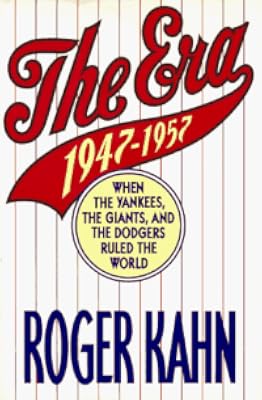
No matter. Kahn, I discover, has written a book about the trio of New York ball clubs that dominated the game from 1947 to 1957. If it’s written with the same eye for unexpected detail, and ear for an elegant phrase, as this one, it’ll be a delight to read. show less
The book is divided into three unequal acts: a kaleidoscopic memoir of a Brooklyn childhood; a shorter, tighter narrative of Kahn’s days as a journeyman sportswriter, covering the team for the New York Herald Tribune; and a series of chapter-length stories about Kahn re-visiting the Dodger players he once knew, a decade show more or more after their playing days had ended. There is, as a result, more Kahn and less baseball here than the book’s reputation as a classic baseball book would suggest. What baseball there is comes as glimpses, rather than games (much less series). Having read all of the first two sections, and some of the third, I know the man -- but not his team, or the game -- better. Kahn gave me reason to think about fathers, about heroes, about growing up and growing old, and about the second acts that Fitzgerald denied Americans could have in their lives. He did little, though, for my grasp of of Duke Snider’s hitting, Preacher Roe’s spitball, or Jackie Robinson’s base-running.
No matter. Kahn, I discover, has written a book about the trio of New York ball clubs that dominated the game from 1947 to 1957. If it’s written with the same eye for unexpected detail, and ear for an elegant phrase, as this one, it’ll be a delight to read. show less
The legendary status of "The Boys of Summer" is well-deserved - it is unquestionably one of the finest non-fiction sports books ever written. However, be aware: It is the very opposite of a "feel good" read. In fact, I can scarcely remember a book that is so suffocatingly sad. The players of the Brooklyn Dodgers of the early Fifties (as well as a number of others associated with the team in various ways) experienced an unusually high number of foreshortened careers, personal tragedies (especially involving sons), and early deaths. It doesn't make for a cheerful book.
Is professional sports inherently a tragic enterprise? Kahn suggests as much. It may not really be that desirable to hit the peak of your life at age 25, with the skills for show more which you are valued in inevitable decline after that, and your ability to do what you do at all almost certainly over by age 40. Maybe the money makes up for this, and of course the money is better now than it used to be, but you wonder.
It could be that Kahn makes just a little too much of the aging issue, partly because of the fact that he is focusing on athletes, partly because attitudes were different then. He persistently describes a man's forties as a kind of middle-aged twilight, and I don't think that we look at it that way anymore (which is a good change!). Athletes still age out of their sports, of course, but a lot of them are thinking about that inevitability early on, planning their future careers in sports management or broadcasting or other businesses or even politics. One gets the sense that the old-time ballplayers didn't look ahead in that way, and faded back into ordinary life without much mental preparation. Some wound up doing OK, but many did not. show less
Is professional sports inherently a tragic enterprise? Kahn suggests as much. It may not really be that desirable to hit the peak of your life at age 25, with the skills for show more which you are valued in inevitable decline after that, and your ability to do what you do at all almost certainly over by age 40. Maybe the money makes up for this, and of course the money is better now than it used to be, but you wonder.
It could be that Kahn makes just a little too much of the aging issue, partly because of the fact that he is focusing on athletes, partly because attitudes were different then. He persistently describes a man's forties as a kind of middle-aged twilight, and I don't think that we look at it that way anymore (which is a good change!). Athletes still age out of their sports, of course, but a lot of them are thinking about that inevitability early on, planning their future careers in sports management or broadcasting or other businesses or even politics. One gets the sense that the old-time ballplayers didn't look ahead in that way, and faded back into ordinary life without much mental preparation. Some wound up doing OK, but many did not. show less
Really three books in one. The first - what it was like to grow up a Jewish baseball fan in Brooklyn in the 30's and 40's. I enjoyed reading this much more than I had expected. The second - what it was like to cover the Dodgers during their Brooklyn heydey of 1952-53 as a reporter for the New York Herald Tribune. This section is what brought me to read the book and it only disappointed due to its brevity - but the writing is fantastic. The third section - what happened to all those old great ballplayers twenty years after the glory days. This section is the longest and what really sets the book apart from other baseball writing. Amazing what these guys had to go through after their careers were over - imagine Carl Furillo working as an show more Otis Elevator installer during the construction of the World Trade Center. Boggles the mind. These ballplayers had fought World War II, played in the World Series, and lived full lives after their playing days were done, and I'm glad I got to know them a little bit. Thanks, Mr.Kahn. show less
Members
- Recently Added By
Lists

Sports Illustrated's The Top 100 Sports Books of All Time
51 works; 7 members

Best Baseball Books
42 works; 20 members

Books about sports
65 works; 3 members

Tablet Magazine's List of 101 Great Jewish Books
103 works; 9 members

The Art of Manliness' 100+ Books Every Man Should Read
108 works; 2 members

Mustich's 1000 Books to Read Before You Die: A Life Changing List
1,001 works; 19 members
Author Information

28+ Works 3,056 Members
Roger Kahn is a visiting lecturer on creative writing at the State University of New York at New Paltz.
Some Editions
Awards and Honors
Series
Belongs to Publisher Series
Common Knowledge
- Original title
- The Boys of Summer
- Original publication date
- 1972
- People/Characters
- Jackie Robinson; Gil Hodges; Pee Wee Reese; Duke Snider; Joe Black; Carl Erskine (show all 12); Roy Campanella; Preacher Roe; Carl Furillo; Billy Cox; Walter O'Malley; George Shuba
- Important places
- Ebbets Field, Brooklyn, New York, USA
- Epigraph
- I see the boys of summer in their ruin
Lay the gold tithings barren,
Setting no store by harvest, freeze the soils.
--Dylan Thomas - Dedication
- In Memoriam: G.J.K., 1901-1953
- First words
- At a point in life when one is through with boyhood, but has not yet discovered how to be a man, it was my fortune to travel with the most marvelously appealing of teams.
- Last words
- (Click to show. Warning: May contain spoilers.)And then it was time to start uphill toward another morning and another home.
Classifications
- Genres
- Sports and Leisure, Nonfiction, General Nonfiction, History, Biography & Memoir
- DDC/MDS
- 796.357 — Arts & recreation Recreation, sports, and performing arts Athletic and outdoor sports and games Ball sports Ball and stick sports Baseball
- LCC
- GV875 .B7 .K3 — Geography, Anthropology and Recreation Recreation. Leisure Recreation. Leisure Sports Ball games: Baseball, football, golf, etc.
- BISAC
Statistics
- Members
- 1,338
- Popularity
- 17,906
- Reviews
- 23
- Rating
- (4.11)
- Languages
- English, Japanese
- Media
- Paper, Audiobook, Ebook
- ISBNs
- 24
- UPCs
- 1
- ASINs
- 18