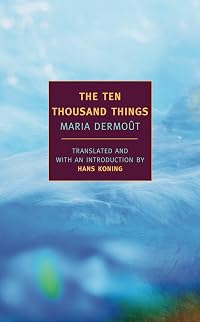
The Ten Thousand Things
by Maria Dermoût
On This Page
Description
"The Ten Thousand Things is a novel of shimmering strangeness -- the story of Felicia, who returns with her baby son from Holland to the Spice Islands of Indonesia, to the house and garden that were her birthplace, over which her powerful grandmother still presides. There Felicia finds herself wedded to an uncanny and dangerous world, full of mystery and violence, where objects tell tales, the dead come and go, and the past is as potent as the present. First published in Holland in 1955, show more Maria Dermoût's novel was immediately recognized as a magical work, like nothing else Dutch -- or European -- literature had seen before. The Ten Thousand Things is an entranced vision of a far-off place that is as convincingly real and intimate as it is exotic, a book that is at once a lament and an ecstatic ode to nature and life"--Publisher's description. show lessTags
Recommendations






















Member Recommendations
Dawn by Élie Wiesel
by inge87

Member Reviews
Maria Dermoût’s The Ten Thousand Things had the strangest effect on me as I read it. Just a few paragraphs and I relaxed into the story. I felt at peace reading the story, even when it explored the many murders that Mrs. Small Garden, or Felicia, honored one night of the year. Perhaps it is the detailed descriptions of the fauna, the old folklore and mythology associated with the shells and landmarks, or the easy comfort with ghosts who hang around the family home. I don’t know why, but it is a book that made me happy.
That’s sort of an odd thing because Grandmother did not much care for happiness. She was unhappy when her granddaughter was named Felicia, but her daughter-in-law carried the day as she always did, to the point of show more taking Felicia and her husband away, leaving the Grandmother alone in the small bay with the servants and the curiosities.
Years later and Felicia returns with her son, Willem. He becomes one of the murdered whose death she honors every year, along with several people from the Outer Bay. The heart of the story though is the Small Garden and the women who tend it, grandmother and Felicia and how they keep on living.
This is one of those magical stories where it feels like nothing is happening, but really everything is happening. There are several murders that are recounted, not because there is a mystery, but because the dead should be honored. This is not a book about murder, it’s about remembering, about enumerating the hundred times a hundred things that make not just a life, but a garden, a bay and an island.
As the philosopher Ts’en Shen said, “When the ten thousand things have been seen in their unity, we return to the beginning and remain where we have always been.”
I loved this book, but trying to tell you what it is about is foolish, it is about ten thousand things.
https://tonstantweaderreviews.wordpress.com/2016/06/05/the-ten-thousand-things-b... show less
That’s sort of an odd thing because Grandmother did not much care for happiness. She was unhappy when her granddaughter was named Felicia, but her daughter-in-law carried the day as she always did, to the point of show more taking Felicia and her husband away, leaving the Grandmother alone in the small bay with the servants and the curiosities.
Years later and Felicia returns with her son, Willem. He becomes one of the murdered whose death she honors every year, along with several people from the Outer Bay. The heart of the story though is the Small Garden and the women who tend it, grandmother and Felicia and how they keep on living.
This is one of those magical stories where it feels like nothing is happening, but really everything is happening. There are several murders that are recounted, not because there is a mystery, but because the dead should be honored. This is not a book about murder, it’s about remembering, about enumerating the hundred times a hundred things that make not just a life, but a garden, a bay and an island.
As the philosopher Ts’en Shen said, “When the ten thousand things have been seen in their unity, we return to the beginning and remain where we have always been.”
I loved this book, but trying to tell you what it is about is foolish, it is about ten thousand things.
https://tonstantweaderreviews.wordpress.com/2016/06/05/the-ten-thousand-things-b... show less
It is a mess, but it is a beautiful mess. I feel the book but I don't know what it is saying exactly. That is the best kind. The structure is unconventional; reading it, I had no idea how to read it, which is a nice feeling: it is the feeling of reading the very first novel. And then there are the things from the title, the imbued significance (though, thankfully, not symbolism) of things, the aura and magic, the legends and rumors, the history and narrative: the things that compose a life. And the emotions that these things build up with each repetition, each repetition weighing more because it has soaked up more in its path.
This book was outstanding. I literally could hardly put it down. I read it in two sittings! This author does not describe things, she paints you a clear and vivid picture. You are not an observer of the island, you are there. You are not hearing of the characters, you know them intimately. Just when you think she has taken you on to another story, she brings it all together and ties them together with a neat little piece of sea grass. You shiver with the foreshadowing. You rebuke, but forgive. You mourn and empathize. Your heart fills with understanding. And in the end, you reluctantly put the book down and "try to go on living."
The trouble began with words, really.
No longer was something a thing in essence. For neither world nor time has the patience for lists of reinvention, a praxis on praxis where the slightest shift required a churning and blooming of sui generis for that one birth, that one core. World and time, so long as human muddies up the lines in hasty life and mortal unease, needs condense.
But also stretch, for both world and time are vast unknowns dripping with fragrant allurements for the passing human, all too prone to settling and all too weak in the face of fate and its realities. And when world and time carry their different settlers across one another, oh. The madness of reconciliation. Love, religion, colonialism. Death, murder, show more headhunting. A paradise bound in poison, sweet for the ones who suckle on the strains of sugar and blood. Too complex.
Too beautiful, you mean. Too beautiful? Beauty in the failed effort to save a life, yes yes. Beauty in the jewels and shells and cultured stone, yes yes. Beauty in the pace of living with everyone in their place, yes yes. Beauty in the mizzen sails, small and sailing jewels across in fluttered thousands, across the blue and green and boundless light of ocean bright, yes yes. But, poison in their trailing tips. Ah, so no poison. Then. Beauty in a mass-murderer crying over the unsaved death? Beauty in the cultured stone torn from graves? Beauty in the buying and selling of fellow humanity? Beauty so long as all, say, good? Then, tell, what is beauty?
Humans and their words and easy consolidations. Love the rich sheen of garnered wealth, loathe the merchant in their different faith. Feel passionate in the pursuit of knowledge in the purest form, feel uneasiness in the presence of an expert and all their foreign trappings. Cherish the murdered son bred on the gains of slavery and exploitation, condemn the murderer fulfilling the honorable traditions of their people. Incorporate with ease the culture of the outsiders around you to your liking, reject with ease the rest. Is that it?
Good with evil? Evil with good? Too mixed and murky, to go by such labels that no one can come to terms or to grips with, each breaking off with their own nature fitted with whatever nurturing comes to them by fact and fortune of birth. Too complicated when far off peoples come into contact with one another and find fascination, one with the other, but also fear. And always, always the other.
Better to stick with more concrete terms. Life, and its goings. Death, and its copings. A tiny jellyfish with its venom sting, a luscious island with its haunted grounds, a day of murdered and murderers bound by whatever attractive light led them on to their dooms. No matter the means or misconceptions, there is the end of an existence, and those who continue on. On with remembrance, on with ghosts, on with a single word that, perhaps, has some use in all these muddled and one-and-the-other of all this inexplicable happenings of such exquisite sorrow and horrendous attraction.
Grief. Yes. Avoid all reconciliation, all intersection, all encounters with something both self and other, and still the living have their dead. There, the hand is forced, the die is cast, and the rest of words fade back into incomprehensible graspings. One hundred things, ten thousand things, whatever is enough, is enough. And there, within all those number of things, lies the disparate cords of humanity and all its discordant strains across world and time, woven into, what?
What else?
No longer was something a thing in essence. For neither world nor time has the patience for lists of reinvention, a praxis on praxis where the slightest shift required a churning and blooming of sui generis for that one birth, that one core. World and time, so long as human muddies up the lines in hasty life and mortal unease, needs condense.
But also stretch, for both world and time are vast unknowns dripping with fragrant allurements for the passing human, all too prone to settling and all too weak in the face of fate and its realities. And when world and time carry their different settlers across one another, oh. The madness of reconciliation. Love, religion, colonialism. Death, murder, show more headhunting. A paradise bound in poison, sweet for the ones who suckle on the strains of sugar and blood. Too complex.
Too beautiful, you mean. Too beautiful? Beauty in the failed effort to save a life, yes yes. Beauty in the jewels and shells and cultured stone, yes yes. Beauty in the pace of living with everyone in their place, yes yes. Beauty in the mizzen sails, small and sailing jewels across in fluttered thousands, across the blue and green and boundless light of ocean bright, yes yes. But, poison in their trailing tips. Ah, so no poison. Then. Beauty in a mass-murderer crying over the unsaved death? Beauty in the cultured stone torn from graves? Beauty in the buying and selling of fellow humanity? Beauty so long as all, say, good? Then, tell, what is beauty?
Humans and their words and easy consolidations. Love the rich sheen of garnered wealth, loathe the merchant in their different faith. Feel passionate in the pursuit of knowledge in the purest form, feel uneasiness in the presence of an expert and all their foreign trappings. Cherish the murdered son bred on the gains of slavery and exploitation, condemn the murderer fulfilling the honorable traditions of their people. Incorporate with ease the culture of the outsiders around you to your liking, reject with ease the rest. Is that it?
Good with evil? Evil with good? Too mixed and murky, to go by such labels that no one can come to terms or to grips with, each breaking off with their own nature fitted with whatever nurturing comes to them by fact and fortune of birth. Too complicated when far off peoples come into contact with one another and find fascination, one with the other, but also fear. And always, always the other.
Better to stick with more concrete terms. Life, and its goings. Death, and its copings. A tiny jellyfish with its venom sting, a luscious island with its haunted grounds, a day of murdered and murderers bound by whatever attractive light led them on to their dooms. No matter the means or misconceptions, there is the end of an existence, and those who continue on. On with remembrance, on with ghosts, on with a single word that, perhaps, has some use in all these muddled and one-and-the-other of all this inexplicable happenings of such exquisite sorrow and horrendous attraction.
Grief. Yes. Avoid all reconciliation, all intersection, all encounters with something both self and other, and still the living have their dead. There, the hand is forced, the die is cast, and the rest of words fade back into incomprehensible graspings. One hundred things, ten thousand things, whatever is enough, is enough. And there, within all those number of things, lies the disparate cords of humanity and all its discordant strains across world and time, woven into, what?
What else?
"Rumphius says that they're quite beautiful."show less
"Yes," said the officer, "a strange poisonous green, with long blue streamers, and the sails are sort of transparent with a coloured edge."
"A crystal sail edged with purple or violet."
"Yes," the officer agreed, a bit astonished.
"Like a jewel, Rumphius said."
"Yes," there was a flicker of enthusiasm in the blue eyes, "yes, that's true!"
Glorious, someone said.
And Suprapto continued, " I guess the sails aren't very big–"
"Now, how could they be big? Without the streamers these jellyfish aren't big themselves–the sails aren't bigger than–" the officer looked around for something to compare them with: his own firm hand, and then the slim dark hand which the Javanese held on his knee. He didn't touch it, but he pointed at it, his fingers moving under the knuckles, "a bit larger than the width of your hand perhaps."
Suprapto looked where the other had pointed–his own thin hand.
"Yes," he said in his even, toneless voice, "I realized that those sails are small–not big,"
For a short moment it caused him an almost inhuman pain.
This is quite simply one of the most beautifully written books I've ever read. I am not usually a person for whom excellent writing can compensate for a scant plot (and it must be admitted that the plot of The Ten Thousand Things is slight and slow-moving); however, Dermoût's prose kept me hooked in a way that is, for me, unprecedented. I wanted to keep reading this book, not to find out what happened, but simply to be reading. I wanted to wallow in it, to make it last. I am sure there are people who always read that way. Myself, I am usually racing through, wanting to know, impatient for events to unfold. I often catch myself skimming or skipping entire paragraphs or even pages in my thirst for plot (which, incidentally, is also show more probably why I enjoy rereading so much: there is always something I missed the first time through). With this book I slowed down. I read and savored every word. And every word seemed worth savoring, each one carefully chosen, each sentence constructed like a work of art.
It's mesmerizing: every time I dipped back into the book to try to find quotes to illustrate what I mean, I ended up just reading on from wherever I started. This is writing like an enchantment. You start to read and you are bespelled: you forget what you were doing and why. You want only to keep reading.
This is part of a longer review published on my blog, Around the World in 2000 Books. show less
It's mesmerizing: every time I dipped back into the book to try to find quotes to illustrate what I mean, I ended up just reading on from wherever I started. This is writing like an enchantment. You start to read and you are bespelled: you forget what you were doing and why. You want only to keep reading.
This is part of a longer review published on my blog, Around the World in 2000 Books. show less
"Of all the houses not one was standing whole; they had collapsed with an earthquake and been cleared away. Here and there a piece of an old house had remained: a wing, a wall only, and later people built against it, usually just a few shabby rooms.
What was left of all the glory?
Yet something seemed to have lingered in those gardens of the old, the past, of the so-very-long-ago."
It took me a while to get through the first half of this book. A month, in fact, to read 80 pages. But I didn't want to quit it, the writing was so evocative, so beautiful and captivating, so...unique. Her imagery, and style, is just, something else entirely. Even though the story, at this point, is very slow-paced and mostly in Felicia's thoughts and show more observations, there is simply something magical in the way Dermoût expresses everything. There is a style and a rhythm to her writing that you just want to lounge in. I adored the writing, I just wasn't pulled in to the story yet.
"He did like the curiosities cabinet, because it belonged to the Garden—and he loved the Garden.
He loved it in his own way—without much ado, as it was, as it had been for seven years for the two children Domingoes and Himpies. They had never just looked at it, they had never seen that the Garden was "beautiful" and so terribly far away and quiet, they had not seen the fear in the Garden. Together they had never been afraid."
But the second half is no longer just The Woman of the Small Garden, the second half has much more going on, and I read it in a single sitting. In these sections there are other stories that are loosely intertwined with her own, which take the forefront up until the end, when they are weaved smoothly back in together with the Lady. These stories have more happening in them; rather than long stretches of time passing slowly, they are fast glimpses.
"When the moon rose above the inner bay, which lay as quiet as a lake, and shone over the foliage of the trees and palms on the beach, it seemed almost day. The small leaves of the many palms gleamed as if wet, as if the moonlight would roll off them in silver drops and trickles. The trunks of the plane trees lighted up gray and silvery white, the foliage took on a hard, almost metallic gleam.
...
The species of lobster with the single, monstrously enlarged claw which was constantly moving up and down would be somewhere near the water, waving at the moon—that's what they did."
It's a difficult book to describe. Not very much happens, especially not with the central character. She lives, she learns, she ages. But it's a brilliant, moving, enchanting piece of work that everyone should experience. Highly recommended.
"Sjeba and her husband, Henry, who was still cowherd, stayed with her. Slowly they had become the only ones left from the past, the only ones who knew everything, had gone through everything—anyway, the cows had to be milked." show less
What was left of all the glory?
Yet something seemed to have lingered in those gardens of the old, the past, of the so-very-long-ago."
It took me a while to get through the first half of this book. A month, in fact, to read 80 pages. But I didn't want to quit it, the writing was so evocative, so beautiful and captivating, so...unique. Her imagery, and style, is just, something else entirely. Even though the story, at this point, is very slow-paced and mostly in Felicia's thoughts and show more observations, there is simply something magical in the way Dermoût expresses everything. There is a style and a rhythm to her writing that you just want to lounge in. I adored the writing, I just wasn't pulled in to the story yet.
"He did like the curiosities cabinet, because it belonged to the Garden—and he loved the Garden.
He loved it in his own way—without much ado, as it was, as it had been for seven years for the two children Domingoes and Himpies. They had never just looked at it, they had never seen that the Garden was "beautiful" and so terribly far away and quiet, they had not seen the fear in the Garden. Together they had never been afraid."
But the second half is no longer just The Woman of the Small Garden, the second half has much more going on, and I read it in a single sitting. In these sections there are other stories that are loosely intertwined with her own, which take the forefront up until the end, when they are weaved smoothly back in together with the Lady. These stories have more happening in them; rather than long stretches of time passing slowly, they are fast glimpses.
"When the moon rose above the inner bay, which lay as quiet as a lake, and shone over the foliage of the trees and palms on the beach, it seemed almost day. The small leaves of the many palms gleamed as if wet, as if the moonlight would roll off them in silver drops and trickles. The trunks of the plane trees lighted up gray and silvery white, the foliage took on a hard, almost metallic gleam.
...
The species of lobster with the single, monstrously enlarged claw which was constantly moving up and down would be somewhere near the water, waving at the moon—that's what they did."
It's a difficult book to describe. Not very much happens, especially not with the central character. She lives, she learns, she ages. But it's a brilliant, moving, enchanting piece of work that everyone should experience. Highly recommended.
"Sjeba and her husband, Henry, who was still cowherd, stayed with her. Slowly they had become the only ones left from the past, the only ones who knew everything, had gone through everything—anyway, the cows had to be milked." show less
Chances are you haven’t heard of Maria Dermoût before, especially if you don’t read Dutch. She left behind a small body of work -- two novels, both published when she was in her 60s, and five short story collections. It appears that throughout most of her life, writing was something she engaged in for herself, perhaps a way to maintain a sense of stability in a life full of motion. It is fortunate for us that she finally published her work, as her writing is atmospheric, mysterious, balanced precariously between the class- and race-conscious world of Dutch colonialists, and the spiritual and traditional world of the indigenous Indonesians. As Hans Koning writes in the introduction to the NYRB edition of his English translation of show more the novel, "Dermoût was sui generis, a case all her own. She did not write about her Indies as a Dutch woman, or as a Javanese or an Ambonese. Hers was a near-compassionate disdain for the dividing lines, the hatreds and the fears ... She painted landscapes, still lifes and people in a world of myth and mystery." (viii-ix) Her novel The Ten Thousand Things, generally considered to be her masterpiece, is a work of memory and loss, of a world of haunted ruins, secret rituals, lapping water, and mist-shrouded forests.
Maria Dermoût (1888-1962)
Born in 1888 on a sugar plantation on Java, Dutch East Indies, Dermoût was educated in Holland, but she returned to Java afterwards and married a jurist. Her travels with her husband led her throughout Indonesia, where she lived in Java, Celebes, and the Moluccas, moving between the colonial world of plantations and towns and the indigenous communities in more remote villages. She later returned to Holland, but she appears to have carried the ghosts of Indonesia with her.
The Molucca Islands, Indonesia
The Ten Thousand Things has a simple structure. The first section, “The Island,” provides a brief but sensuous description of the Moluccan island that is the site for the story. We are immediately introduced to a sense of the distance between the present and a past when the islands were dotted with spice gardens, when grand plantation houses stood proudly. Now all that remain are ruins, collapsed walls, overgrown gardens, and traces of the past: “The remembrance of a human being, of something that happened, can remain in a place, tangible almost--perhaps there is someone left who knows about it and thinks about it sometimes.” Dermoût immediately moves to more specific ghostly images:
Did two lovers once hold each other here and whisper -- forever -- or did they let each other go between the little nutmeg trees and say -- goodbye?
Did a child play with her doll on the window sill?
Who was standing on the beach then, staring over the three little waves of the surf? and over the bay? at what?
A silence like an answer, a silence of both resignation and expectation, a past and not past.
There was not much else left.
Two of the gardens were haunted.
In a little garden at the outer bay, close to the town, a drowned man walked, but that was of not so long ago, of now, so to speak. And in another garden at the inner bay there were, from far time, three little girls. (6)
The Molucca Islands, Indonesia
As she continues through the rest of this section, Dermoût leads the reader on a virtual tour of the island. The graves of the three girls remain a landmark, but she devotes equal attention to the landscape that surrounds them:
A small straight lane--going nowhere--of cassowarinas, high firs with long drooping needles, as smooth and straight as the feathers of a cassowary, stirred by every breeze from the inner bay -- rustling, lisping, as if they were standing there whispering together. The singing trees they were called.
A water-clear brook ran through the wood, higher up part of it was led through a hollow tree trunk to a stone reservoir marked by a sculptured lion’s head with a mossy green mane. From the gaping mouth several spouts of water arched across each other, down into a dug-out stone cistern: a large yet shallow cistern with a wide edge of masonry to sit upon.
All this was in the shade: the cistern, the reservoir with its sculpture, the tree trunks, the ground, all was moist, thickly covered by moss or molded with black and dark-green spots--only the surface of the water held the light in its clarity, in the transparent ripples which swept across it. (8)
Spice garden, Bali, Indonesia
Throughout the novel, Dermoût excels at this kind of description. She drew me into the shadowy, mossy forests, the blue, clear water of the bay with proas gliding across them, ferrying people from one side of the bay to the other. Her skills at description are not limited to scenery. She also conveys the lives of the islanders from a past when they followed traditions marking life and death. One of these rituals introduces us to the meaning behind the novel’s title:
Someone sang a love song in the moonlight: “the evening is too long, beloved, and the road too far”-- others clapped their hands with it--a single bamboo flute, languishing.
A lullaby for a child, or a story sung to it, battle songs of the wild Alfuras, head-hunters of Ceram. And sometimes, very rarely, the old heathen lament (careful, don’t let the schoolteacher hear it) for one who has just died. “The hundred things” was the name of the lament--the hundred things of which the dead one is reminded, which are asked him, told him.
Not only the people in his life: this girl, this woman and that one, that child, your father, your mother, a brother or sister, the grandparents, a grandchild, a friend, a comrade-in-arms; or his possessions: your beautiful house, your china dishes hidden in the attic, the swift proa, your sharp knife, the little inlaid shield from long ago, the two silver rings on your right hand, on index finger and thumb, the tamed pigeon; but also: hear, how the wind blows!--how white-crested the waves come running from the high sea!--the fishes jump out of the water and play with each other--look how the shells gleam on the beach--remember the coral gardens under water, and how they are colored--and the bay!--the bay!--please never forget the bay! And then they said: oh soul of so-and-so, and ended with a long-held melancholy ee-ee-ee! ee-ee-ee! over the water. (13-14)
The novel itself is one prolonged song for the dead, one which connects lost loved ones to the landscape, the houses, the people, the treasures, the laments and songs of celebration that make up a life. Dermoût identifies power in trees and water, in shells and jewels, in zealously-guarded family recipes for powerful potions, used for good or for evil. In many ways, the novel also traces the deterioration of belief in these traditional means of balancing the power of the universe with the dreams and fears of humans, as islanders became more distant from these old ways under the influence of the colonial West. Dermoût does not write any explicit attacks or defences of the old ways, but she does write of them with respect, while also conveying a growing sense of skepticism on the part of some characters.
The novel next is divided into two longer sections, “At the Inner Bay” and “At the Outer Bay.” In each section, Dermoût delves deeper into the history of the ghosts she introduces in the first section. She remains focused on the family and experiences of a character she introduces in the first section, the lady of the Small Garden, who has lost all her family, and remains alone with her ghosts. Particularly in the second section, “At the Inner Bay,” Dermoût describes the childhood of the lady of the Small Garden, Felicia, and her experiences living with her grandmother as a childand later as an abandoned mother . Throughout this section, we are introduced to Felicia’s family, the Indonesian servants who serve as an extended family, and the myths and legends they all live with and by. Throughout, Dermoût maintains a focus on the power of things, particularly as she describes the antique cabinet full of treasures that her grandmother assembled and watched over, a tradition she passes on to Felicia.
English postcard showing an Indonesian sugar plantation, c. 1900
Throughout the rest of the novel, Dermoût weaves the stories of the dead, the legends of the island, and the personal history of Felicia and her family into a tapestry of memory, love, and loss. Vestiges of the past surround those who stop, listen carefully, and remain open to their echoes. She concludes the novel with a fourth section, again titled “The Island,” which provides a memorable conclusion to Felicia’s story, as well as to the other stories we have read.
With her two children, Ettie and Hans, in 1912
Dermoût knew loss intimately. Her son Hans died in a Japanese prisoner-of-war camp. She does not write directly of her loss in this novel, but she uses her personal understanding of her grief for the loss of her son to create a moving picture of a mother's mourning. She tries to assuage loss and grief by recounting some of the ten thousand things that made up life on the islands she knew so well. Perhaps by writing this beautiful, strange, mysterious novel, she found some peace for herself.
Maria Dermoût in her living room in Noordwijk in 1958
Indonesia show less
Maria Dermoût (1888-1962)
Born in 1888 on a sugar plantation on Java, Dutch East Indies, Dermoût was educated in Holland, but she returned to Java afterwards and married a jurist. Her travels with her husband led her throughout Indonesia, where she lived in Java, Celebes, and the Moluccas, moving between the colonial world of plantations and towns and the indigenous communities in more remote villages. She later returned to Holland, but she appears to have carried the ghosts of Indonesia with her.
The Molucca Islands, Indonesia
The Ten Thousand Things has a simple structure. The first section, “The Island,” provides a brief but sensuous description of the Moluccan island that is the site for the story. We are immediately introduced to a sense of the distance between the present and a past when the islands were dotted with spice gardens, when grand plantation houses stood proudly. Now all that remain are ruins, collapsed walls, overgrown gardens, and traces of the past: “The remembrance of a human being, of something that happened, can remain in a place, tangible almost--perhaps there is someone left who knows about it and thinks about it sometimes.” Dermoût immediately moves to more specific ghostly images:
Did two lovers once hold each other here and whisper -- forever -- or did they let each other go between the little nutmeg trees and say -- goodbye?
Did a child play with her doll on the window sill?
Who was standing on the beach then, staring over the three little waves of the surf? and over the bay? at what?
A silence like an answer, a silence of both resignation and expectation, a past and not past.
There was not much else left.
Two of the gardens were haunted.
In a little garden at the outer bay, close to the town, a drowned man walked, but that was of not so long ago, of now, so to speak. And in another garden at the inner bay there were, from far time, three little girls. (6)
The Molucca Islands, Indonesia
As she continues through the rest of this section, Dermoût leads the reader on a virtual tour of the island. The graves of the three girls remain a landmark, but she devotes equal attention to the landscape that surrounds them:
A small straight lane--going nowhere--of cassowarinas, high firs with long drooping needles, as smooth and straight as the feathers of a cassowary, stirred by every breeze from the inner bay -- rustling, lisping, as if they were standing there whispering together. The singing trees they were called.
A water-clear brook ran through the wood, higher up part of it was led through a hollow tree trunk to a stone reservoir marked by a sculptured lion’s head with a mossy green mane. From the gaping mouth several spouts of water arched across each other, down into a dug-out stone cistern: a large yet shallow cistern with a wide edge of masonry to sit upon.
All this was in the shade: the cistern, the reservoir with its sculpture, the tree trunks, the ground, all was moist, thickly covered by moss or molded with black and dark-green spots--only the surface of the water held the light in its clarity, in the transparent ripples which swept across it. (8)
Spice garden, Bali, Indonesia
Throughout the novel, Dermoût excels at this kind of description. She drew me into the shadowy, mossy forests, the blue, clear water of the bay with proas gliding across them, ferrying people from one side of the bay to the other. Her skills at description are not limited to scenery. She also conveys the lives of the islanders from a past when they followed traditions marking life and death. One of these rituals introduces us to the meaning behind the novel’s title:
Someone sang a love song in the moonlight: “the evening is too long, beloved, and the road too far”-- others clapped their hands with it--a single bamboo flute, languishing.
A lullaby for a child, or a story sung to it, battle songs of the wild Alfuras, head-hunters of Ceram. And sometimes, very rarely, the old heathen lament (careful, don’t let the schoolteacher hear it) for one who has just died. “The hundred things” was the name of the lament--the hundred things of which the dead one is reminded, which are asked him, told him.
Not only the people in his life: this girl, this woman and that one, that child, your father, your mother, a brother or sister, the grandparents, a grandchild, a friend, a comrade-in-arms; or his possessions: your beautiful house, your china dishes hidden in the attic, the swift proa, your sharp knife, the little inlaid shield from long ago, the two silver rings on your right hand, on index finger and thumb, the tamed pigeon; but also: hear, how the wind blows!--how white-crested the waves come running from the high sea!--the fishes jump out of the water and play with each other--look how the shells gleam on the beach--remember the coral gardens under water, and how they are colored--and the bay!--the bay!--please never forget the bay! And then they said: oh soul of so-and-so, and ended with a long-held melancholy ee-ee-ee! ee-ee-ee! over the water. (13-14)
The novel itself is one prolonged song for the dead, one which connects lost loved ones to the landscape, the houses, the people, the treasures, the laments and songs of celebration that make up a life. Dermoût identifies power in trees and water, in shells and jewels, in zealously-guarded family recipes for powerful potions, used for good or for evil. In many ways, the novel also traces the deterioration of belief in these traditional means of balancing the power of the universe with the dreams and fears of humans, as islanders became more distant from these old ways under the influence of the colonial West. Dermoût does not write any explicit attacks or defences of the old ways, but she does write of them with respect, while also conveying a growing sense of skepticism on the part of some characters.
The novel next is divided into two longer sections, “At the Inner Bay” and “At the Outer Bay.” In each section, Dermoût delves deeper into the history of the ghosts she introduces in the first section. She remains focused on the family and experiences of a character she introduces in the first section, the lady of the Small Garden, who has lost all her family, and remains alone with her ghosts. Particularly in the second section, “At the Inner Bay,” Dermoût describes the childhood of the lady of the Small Garden, Felicia, and her experiences living with her grandmother as a child
English postcard showing an Indonesian sugar plantation, c. 1900
Throughout the rest of the novel, Dermoût weaves the stories of the dead, the legends of the island, and the personal history of Felicia and her family into a tapestry of memory, love, and loss. Vestiges of the past surround those who stop, listen carefully, and remain open to their echoes. She concludes the novel with a fourth section, again titled “The Island,” which provides a memorable conclusion to Felicia’s story, as well as to the other stories we have read.
With her two children, Ettie and Hans, in 1912
Dermoût knew loss intimately. Her son Hans died in a Japanese prisoner-of-war camp. She does not write directly of her loss in this novel, but she uses her personal understanding of her grief for the loss of her son to create a moving picture of a mother's mourning. She tries to assuage loss and grief by recounting some of the ten thousand things that made up life on the islands she knew so well. Perhaps by writing this beautiful, strange, mysterious novel, she found some peace for herself.
Maria Dermoût in her living room in Noordwijk in 1958
Indonesia show less
Members
- Recently Added By
Lists

Recommend the 20 best books you've read in the last five years
2,168 works; 606 members

EU Fiction: 1950-2022
223 works; 68 members

1950s
340 works; 22 members

SF & Fantasy in Translation
95 works; 18 members

Speculative Fiction from around the World
610 works; 18 members

Reading Globally
136 works; 16 members

Books written in uncommon languages
97 works; 8 members

Books Read in 2024
4,623 works; 126 members
Author Information

14+ Works 760 Members
Some Editions
Awards and Honors
Distinctions
Series
Belongs to Publisher Series
Work Relationships
Is contained in
Common Knowledge
- Canonical title
- The Ten Thousand Things
- Original title
- De tienduizend dingen
- Original publication date
- 1958
- People/Characters
- Felicia; the grandmother; Himpies; Domingoes; the commissioner; Constance (show all 9); Pauline; Raden Mas Suprapto; Professor McNeill
- Important places
- Molucca Islands, Dutch East Indies
- Epigraph
- When the ten thousand things have been
seen in their unity, we return to the beginning
and remain where we have always been.
Ts'en Shen - First words
- I was on my way back to the U.S. - by ship, for this was more than forty years ago - and I was sitting on deck, reading the galleys of a Dutch novel which Alice van Eugen-Van Nahuys, the editor of the Dutch publishing house Q... (show all)uerido, had given me "to read on your voyage."... Those galleys I was reading were The Ten Thousand Things, by Maria Dermoût....It was long ago, but I remember it like yesterday: the ship, a high wind as always blowing over the North Sea, and tears running down my face. That was one of the most beautiful, and saddest, stories I had ever read. -Introduction, Hans Konig
On the islands of the Moluccas there were a few gardens left from the great days of spice growing and "spice parks"--a few only. There had been many, and on this island they had even long ago been called not "parks" but "gard... (show all)ens." -Chapter One, The Island - Quotations
- Was seeing necessary? As long as she could remember, she had heard about them; they belonged, they had a fixed place in her garden on the island in the Moluccas, and also in her own life.
In one, carefully wrapped in a piece of cloth, a "snakestone" was kept. It was tricky to keep the snakestones straight, there were so many kinds. There were little white stones which snakes sucked on to quench their thirst;... (show all) then there was the Carbuncle stone which a certain kind of snake wore in its forehead and which gave a red glow in the dark, but that was a very rare one. You couldn't kill the snake to get it, because then the glow of the stone vanished immediately and forever. Occasionally the snake left the stone somewhere as a gift; and when it went to drink or bathe it took it out - the stone must not get wet. That was your opportunity to find it and keep it. But it was no use to anybody else: the Carbuncle stone could not be traded, bought or sold, for then again the glow would vanish. Find it yourself, or get it as a gift.
The very small stone was the child of the other stone. First it had not been there: the larger one had been "all alone" in the box - and one morning the child was lying next to it, "born in the night," grandmother said, and ... (show all)put the top back on the box.
They were there to guard the treasure; grandmother was always careful to get some new ones from the beach regularly. As long as the treasure was guarded by living sentinels no thief would dare touch it, and as long as the tr... (show all)easure was lying in the drawer the house of the Small Garden would be protected against misfortune, and disease, and poverty, and venom, and other unmentionable things; and all who lived there would be - happy, grandmother would never say - not too unhappy, the Lord willing...
Every time has its own evil, but a human being can still be good
There were those who say, see with your eyes, hear with your ears, but know, know without seeing or hearing; none of that was given to her - never, not once - she did not even meet him in a dream any more. - Last words
- (Click to show. Warning: May contain spoilers.)Then the lady of the Small Garden whose name was Felicia stood up from her chair obediently and without looking around at the inner bay in the moonlight - it would remain there, always - she went with them, under the trees and indoors, to drink her cup of coffee and try again to go on living.
- Original language
- Dutch
- Canonical DDC/MDS
- 839.31364
- Canonical LCC
- PT5830.D434 T513
Classifications
- Genres
- General Fiction, Fiction and Literature
- DDC/MDS
- 839.31364 — Literature & rhetoric German & related literatures Other Germanic literatures Netherlandish literatures Dutch Dutch fiction 20th Century 1945-1999
- LCC
- PT5830 .D434 .T513 — Language and Literature German, Dutch and Scandinavian literatures Dutch literature Individual authors or works 1800-1960
- BISAC
Statistics
- Members
- 612
- Popularity
- 47,666
- Reviews
- 17
- Rating
- (4.07)
- Languages
- 6 — Chinese, Dutch, English, German, Indonesian, Spanish
- Media
- Paper, Ebook
- ISBNs
- 18
- ASINs
- 5