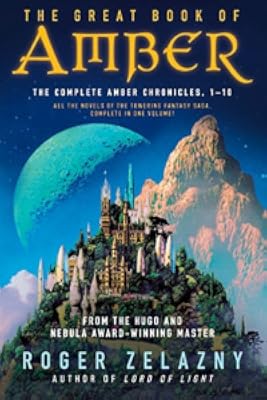
The Great Book of Amber
by Roger Zelazny
Chronicles of Amber (Collections and Selections — Complete, 1-10)
On This Page
Description
Showcases the epic struggle for dimension-wide supremacy. "All ten of Roger Zelzany's classic Amber fantasy novels in one book! Join Corwin, Merlin and the others in wild adventures in the lands of Amber, Earth, and the Courts of Chaos, where the powers of Amber and Chaos constantly battle for supremacy through intrigue and adventure. Revisit Amber, the land of mystery, adventure and romance. Amber, the one true world. All other worlds, including our Earth, are merely Shadows."--Publisher show more description. show lessTags
Recommendations

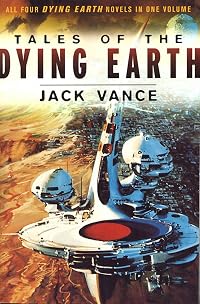
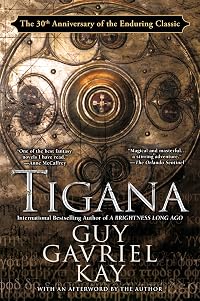
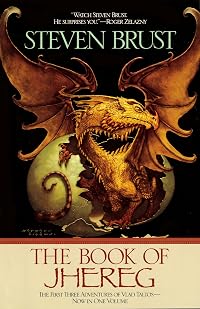
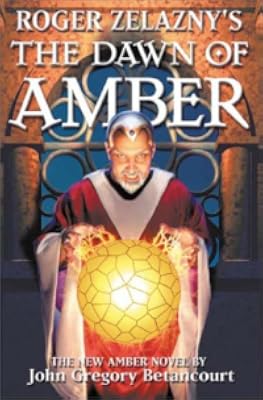


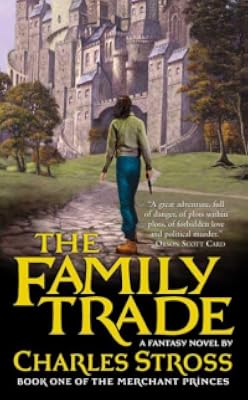
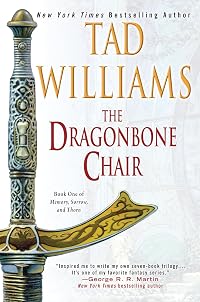
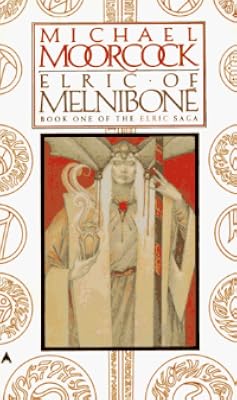
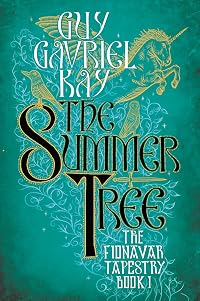


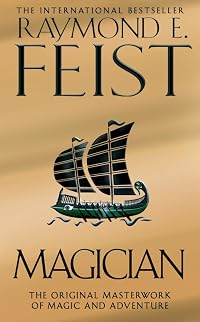
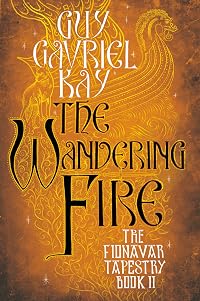
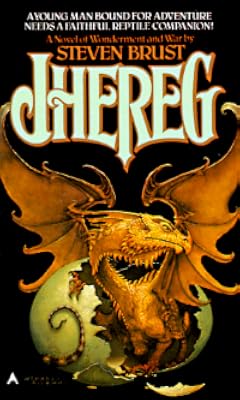
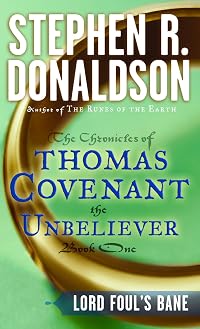

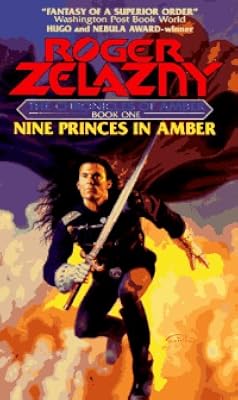

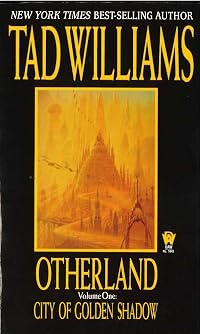
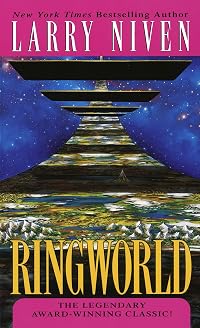

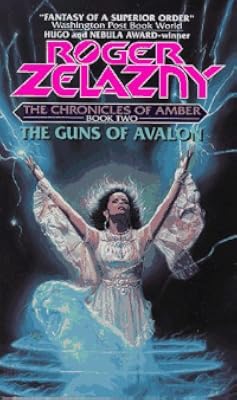
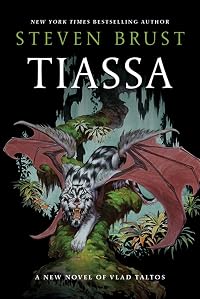


Member Recommendations
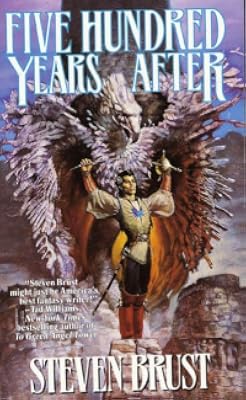
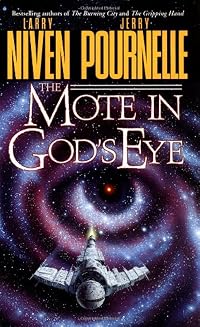
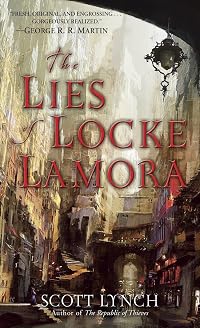
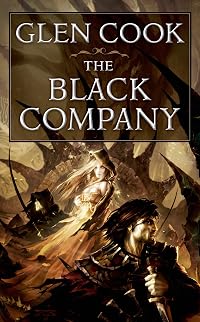
ryvre Both are fantasy books with lots of politics and intrigue among the royal families.


Member Reviews
ORIGINALLY POSTED AT Fantasy Literature.
Roger Zelazny's Amber series is one of the best sci-fi/fantasy epics ever written. Not only was it highly imaginative and original when it was published (in the 70s and 80s), but it remains so -- there's nothing else like it.
Corwin and his brothers and sisters are clever, sophisticated, sarcastic, and extremely ambitious. They constantly scheme and plot to outmaneuver each other as they vie for political power. If you knew these people in real life, you'd probably hate them, but in Zelazny's hands they're charming (especially Corwin). Zelazny's writing style is solid: fast-paced, exciting, and witty. Plot twists and cliff-hangers make it hard to stop reading.
With all that praise, I must mention show more two little problems:
1. The Merlin Cycle is not as good as The Corwin Cycle. Corwin is just more interesting than his son.
2. The story never quite wraps up because Zelazny died before finishing it.
Bottom Line: Read The Corwin Cycle (the first half). If you're hooked, keep going.
Read this review in context at Fantasy Literature show less
Roger Zelazny's Amber series is one of the best sci-fi/fantasy epics ever written. Not only was it highly imaginative and original when it was published (in the 70s and 80s), but it remains so -- there's nothing else like it.
Corwin and his brothers and sisters are clever, sophisticated, sarcastic, and extremely ambitious. They constantly scheme and plot to outmaneuver each other as they vie for political power. If you knew these people in real life, you'd probably hate them, but in Zelazny's hands they're charming (especially Corwin). Zelazny's writing style is solid: fast-paced, exciting, and witty. Plot twists and cliff-hangers make it hard to stop reading.
With all that praise, I must mention show more two little problems:
1. The Merlin Cycle is not as good as The Corwin Cycle. Corwin is just more interesting than his son.
2. The story never quite wraps up because Zelazny died before finishing it.
Bottom Line: Read The Corwin Cycle (the first half). If you're hooked, keep going.
Read this review in context at Fantasy Literature show less
(This review is for the first book in the collection, Nine Princes in Amber. There's no inducing me to read any more of them, I'm afraid.)
Corwin is suffering from amnesia, which he thinks is a result of a near-fatal car accident, which he also thinks was not exactly an accident at all. As he fakes his way through conversations with one sister and a brother, he slowly puts together a backstory for himself, and it doesn't always feature Earth as the setting.
Hoo boy. This 1970s first-in-a-series fantasy has some issues. Honestly, I think Zelazny couldn't quite decide what he wanted his book to be: it starts out as High Fantasy suffering from memory loss and thinking it's a noir detective novel, and from there the inconsistencies pile up, show more including a waffling between 'normal' vernacular and the thees and thous of fantafancy speak. It's...grating. It also seems to fall (probably via one of the many plot holes) into the pit of writers who've read and loved Tolkien and decide that, "Hey, I can write a massive world-building epic series, too!" and who, tragically, can't. The plot just seems to be one part tagged onto another tagged onto another, with no real flow or logic between the episodes: "and THEN...and THEN...AND THEN..." with each scene more comically cartoonish than the last. Overall story-arcs matter, folks, and should be more than a flimsy excuse to attach weird worlds and underwater mirror cities and sex with green-haired ladies to the plot. Yoicks. show less
Corwin is suffering from amnesia, which he thinks is a result of a near-fatal car accident, which he also thinks was not exactly an accident at all. As he fakes his way through conversations with one sister and a brother, he slowly puts together a backstory for himself, and it doesn't always feature Earth as the setting.
Hoo boy. This 1970s first-in-a-series fantasy has some issues. Honestly, I think Zelazny couldn't quite decide what he wanted his book to be: it starts out as High Fantasy suffering from memory loss and thinking it's a noir detective novel, and from there the inconsistencies pile up, show more including a waffling between 'normal' vernacular and the thees and thous of fantafancy speak. It's...grating. It also seems to fall (probably via one of the many plot holes) into the pit of writers who've read and loved Tolkien and decide that, "Hey, I can write a massive world-building epic series, too!" and who, tragically, can't. The plot just seems to be one part tagged onto another tagged onto another, with no real flow or logic between the episodes: "and THEN...and THEN...AND THEN..." with each scene more comically cartoonish than the last. Overall story-arcs matter, folks, and should be more than a flimsy excuse to attach weird worlds and underwater mirror cities and sex with green-haired ladies to the plot. Yoicks. show less
I wanna be a Prince of Amber! (Suddenly have unrelated Queen song flashes!)
The way I fell in love with Zelazny, especially in the ballsy way he wrote the thing, 'let's just see what happens, shall we?'
Effortless. Stylish. The kind of poetic fantasy that mooshes every world religion and kitchen appliance together and *works!* --What DC and Marvel super Us wish they could achieve!
The way I fell in love with Zelazny, especially in the ballsy way he wrote the thing, 'let's just see what happens, shall we?'
Effortless. Stylish. The kind of poetic fantasy that mooshes every world religion and kitchen appliance together and *works!* --What DC and Marvel super Us wish they could achieve!
I am cheating a bit and just writing one review for this omnibus. I wrote up the first book's review and then realized that I was flying through the books and since each one had a cliffhanger ending, I decided to just read through the whole series.
First of all, the Corwin Cycle was miles better than the Merlin Cycle. I probably should have stopped after the Corwin Cycle books, but I couldn't help myself and ending up binge reading.
The Corwin Cycle was really just fantastic because each section had its own importance. It ranged from figuring out the world, to trying to gain allies, to almost a who-dun-it type of plot, to save-the-world direction. I really admire the Zelazny for being able to write in so many different directions show more because too often a book series gets redundant. But each part was different enough to make it interesting, yet vital to the conclusion of the book.
I also am a fan of the Amberites. These conniving, sneaky bastards and bastardettes all trying to simultaneously kill each other and figure out what each other are up to. It's all intrigue and dark fun with purpose. I like it. Especially because you never know who you can trust. It's always a gamble. That's why first person perspective works so well here. We really only know what's going on from Corwin's perspective, which makes the reader try to guess what is happening as well.
The closing book was pretty great too. Especially with the reveal of hidden characters and who was moving the strings behind the scenes the whole time. It's great. I loved the ending too. That sort of open-ended finale was perfect.
I would probably give just the Corwin Cycle 4 stars.
Unfortunately I went straight into Merlin's Cycle and got progressively disenchanted.
Maybe because I have a really hard time adjusting to the next generation in books, I didn't really like any of the plot or the characters. And I just kept waiting for Corwin to reappear for at least a tiny cameo.
I thought it was interesting that Zelazny chose to weave in a lot of elements from old legends of Merlin and Arthur (like the crystal cave as a prison, or the lady of the lake, or being a sorcerer, etc.) It was a little jarring because I kept catching peeks of the mythology when it was never done before in the Corwin cycle.
I really did not like the plot device of Ghostwheel. I felt like he was a cheap way to get over some plot bumps. And an even cheaper way to resolve the entire series's balance issue with the Jewel of Judgement.
I guess my biggest problem with Merlin's Cycle is that it felt like there was no direction. Things just happened to him rather than Merlin trying to make things happen towards his own goal. Sure, there's some mystery in who is that masked sorcerer or who is trying to kill him, but that's not really a direction. So I was just flipping pages trying to figure out what the end goal was supposed to be like.
Maybe it's because I didn't care for the main characters. Merlin is a decent protagonist. And I give props to Zelazny for making him not sound exactly like Corwin even though it was all still in first person. Well done. But I didn't like Luke or any of the side characters. It was sometimes fun to see Random and Fiona, but it's not like they had a major part in the book for the most part. We're just following Merlin around as he tries to find people and things.
I'd probably give the Merlin Cycle 2 stars. It was okay.
So overall, three stars for these two chronicles.
But definitely recommended for anyone who likes science fiction! But maybe just stick to the Corwin Cycle. show less
First of all, the Corwin Cycle was miles better than the Merlin Cycle. I probably should have stopped after the Corwin Cycle books, but I couldn't help myself and ending up binge reading.
The Corwin Cycle was really just fantastic because each section had its own importance. It ranged from figuring out the world, to trying to gain allies, to almost a who-dun-it type of plot, to save-the-world direction. I really admire the Zelazny for being able to write in so many different directions show more because too often a book series gets redundant. But each part was different enough to make it interesting, yet vital to the conclusion of the book.
I also am a fan of the Amberites. These conniving, sneaky bastards and bastardettes all trying to simultaneously kill each other and figure out what each other are up to. It's all intrigue and dark fun with purpose. I like it. Especially because you never know who you can trust. It's always a gamble. That's why first person perspective works so well here. We really only know what's going on from Corwin's perspective, which makes the reader try to guess what is happening as well.
The closing book was pretty great too. Especially with the reveal of hidden characters and who was moving the strings behind the scenes the whole time. It's great. I loved the ending too. That sort of open-ended finale was perfect.
I would probably give just the Corwin Cycle 4 stars.
Unfortunately I went straight into Merlin's Cycle and got progressively disenchanted.
Maybe because I have a really hard time adjusting to the next generation in books, I didn't really like any of the plot or the characters. And I just kept waiting for Corwin to reappear for at least a tiny cameo.
I thought it was interesting that Zelazny chose to weave in a lot of elements from old legends of Merlin and Arthur (like the crystal cave as a prison, or the lady of the lake, or being a sorcerer, etc.) It was a little jarring because I kept catching peeks of the mythology when it was never done before in the Corwin cycle.
I really did not like the plot device of Ghostwheel. I felt like he was a cheap way to get over some plot bumps. And an even cheaper way to resolve the entire series's balance issue with the Jewel of Judgement.
I guess my biggest problem with Merlin's Cycle is that it felt like there was no direction. Things just happened to him rather than Merlin trying to make things happen towards his own goal. Sure, there's some mystery in who is that masked sorcerer or who is trying to kill him, but that's not really a direction. So I was just flipping pages trying to figure out what the end goal was supposed to be like.
Maybe it's because I didn't care for the main characters. Merlin is a decent protagonist. And I give props to Zelazny for making him not sound exactly like Corwin even though it was all still in first person. Well done. But I didn't like Luke or any of the side characters. It was sometimes fun to see Random and Fiona, but it's not like they had a major part in the book for the most part. We're just following Merlin around as he tries to find people and things.
I'd probably give the Merlin Cycle 2 stars. It was okay.
So overall, three stars for these two chronicles.
But definitely recommended for anyone who likes science fiction! But maybe just stick to the Corwin Cycle. show less
Roger Zelazny's books have three things in common: a flawed hero who sometimes fails, endlessly surprising plot twists, and a blend of lyricism, literary allusions, and sly puns that makes the pages fly. The Great Book of Amber, collecting all 10 Amber novels, is vintage Zelazny. Despite some irritating typographical errors, it's invaluable for anyone who wants to read or reread the tales of Corwin and his son, Merlin.
Corwin is a prince of Amber, the "immortal city from which every other city has taken its shape." All other worlds, including Earth, are shadows of that reality. Corwin has spent centuries on Earth as an amnesiac. But when someone in the family tries to kill him there, Corwin begins a search for his past. He quickly learns show more that his family has some very unusual powers. They can travel between Amber, its shadows, and Chaos by manipulating reality; use magical playing cards to communicate and travel instantaneously; and are able to walk the Pattern that created Amber. Corwin regains his memory, solves the mystery of his father Oberon's disappearance, and fulfills his destiny--only to disappear into Chaos.
Merlin searches for Corwin and his destiny as a son of both Amber and the Courts of Chaos. His story parallels Corwin's, answering many questions about Amber, Chaos, and the next generation in the family.
Many readers have complained that the series goes on too long and the ending is disappointing. None, however, would deny that it's filled with fascinating ideas, complex characters, and action-adventure. Don't miss a chance to make up your own mind. --Nona Vero show less
Corwin is a prince of Amber, the "immortal city from which every other city has taken its shape." All other worlds, including Earth, are shadows of that reality. Corwin has spent centuries on Earth as an amnesiac. But when someone in the family tries to kill him there, Corwin begins a search for his past. He quickly learns show more that his family has some very unusual powers. They can travel between Amber, its shadows, and Chaos by manipulating reality; use magical playing cards to communicate and travel instantaneously; and are able to walk the Pattern that created Amber. Corwin regains his memory, solves the mystery of his father Oberon's disappearance, and fulfills his destiny--only to disappear into Chaos.
Merlin searches for Corwin and his destiny as a son of both Amber and the Courts of Chaos. His story parallels Corwin's, answering many questions about Amber, Chaos, and the next generation in the family.
Many readers have complained that the series goes on too long and the ending is disappointing. None, however, would deny that it's filled with fascinating ideas, complex characters, and action-adventure. Don't miss a chance to make up your own mind. --Nona Vero show less
Note: I reviewed each book within the omnibus as I finished it.
Nine Princes in Amber:
What an odd little book. Odd, because I was reared on the epic fantasy of the 80s and 90s, and the late-sixties early seventies approach to fantasy is a new one for me. Little, because at less than 200 pages (in the omnibus, at least) it's probably the shortest epic fantasy I've ever read.
But I liked it, all the more for being different than what I'm used to. I'm not used to a campaign against an evil king, that spans months and costs hundreds of thousands of lives and culminates in an enormous battle, to be handled in a chapter or two. That just doesn't happen. But it does when that battle is not what the book is about, and that's a good thing here.
The show more book is all about the character of the protagonist, his search for self identity and what he is willing to do to achieve his goals. By the end of the book, I was full invested in Corwin's quest, and only the exhaustion of a really long day kept me from launching immediately into the sequel.
4 stars
*****
The Guns of Avalon:
There is a reason that in trilogies of superhero movies, the second one is almost always my favorite. It's because the first one deals with origins, and the last with endings, while the second concentrates on just telling a good story.
So it was with this volume, which opens where the last novel left off. Our hero resumes his quest for the throne, meeting old friends along the way, and encountering the enemies that he will (almost certainly) face at the end of his quest.
The book divides neatly in half, with the first half netting him an ally out of an old enemy, and the second half giving him a new enemy in the form of one who he thought was a friend. The twists and turns of the plot were engaging, as always, with an ending that took me by surprise.
There was no denouement, no time to appreciate the climax. But this matters little to me, as I have the next volume waiting for me.
4.5 stars
*****
The Sign of the Unicorn:
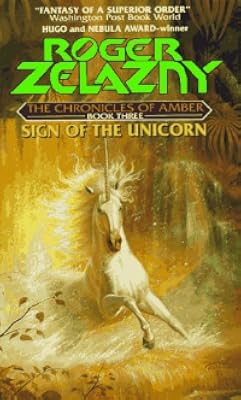
This one has middle book syndrome something awful. Whenever a fantasy series stretches past three volumes, there's often one that progresses the story without being a satisfying read by itself. "The Sign of Unicorn" is that book for Amber. It's tempting for me, having just finished it, to say that nothing happened, but that's not true. Plenty of stuff happened.
However, the stuff that happened was not really arranged into the story structure of rising action and climax. There really WAS no climax, and neither the eerie portents or the revelation that ended the book were enough to satisfy my need for one.
Forcing myself to review each book as I finish it has made me consider the series not as a single work, but rather as a collection of individual works. I would have been kinder to "The Sign of the Unicorn" if it were simply a middle chapter of the longer work.
3 Stars
*****
The Hand of Oberon:
Now that's what I'm talking about.
Everything I said about the last book was reversed here. In fact, the two flow together so much that I can't help but feel that they were two halves of a longer work. Neither works without the other, but all of the meat and payoff of the two happened in this one. Everything I love about this series appeared here.
5 stars
*****
The Courts of Chaos:
This book is a great example of why series that change in genre from book to book are often less successful, and why the last book in a series can often disappoint long time fans.
This book was the last in the first cycle, and the conclusion (as I understand it) of Corwin's story. Whereas most of the preceding books were almost procedural mysteries, this book was straight out adventure, with none of the twists and turns of plot that we have come to expect. If The Sign of the Unicorn was all setup and The Hand of Oberon was all payoff, then The Courts of Chaos was the big setpiece battle at the end. That means no mysteries, and all action.
Now, that's not to say that the action was bad. It was a very engaging read as usual, although the final confrontation with the villain was somewhat lacking in drive. I feel like Zelazny had already exposed all of the past that there was to expose, and all that remained was to end the story.
I am less disappointed than I might otherwise be, knowing that there are five more books to come. Zelazny did a great routine, but he didn't quite stick the landing.
3.5 stars
*****
Trumps of Doom
And so it begins again. Here we have Merlin, son of Corwin, whose narrative voice is essentially identical to his father's. That is somewhat surprising, given their very different upbringings, but I get the idea that the voice belongs to Zelazny, not to his characters.
Really, though, that's my only real gripe with this book, which reintroduces the mystery element that was sadly lacking in the final volume of the first series. The twist at the end wasn't particularly surprising, but it was still satisfying. Once again, the ending of the book serves merely as a way to set up the remainder of the series--in fact, it ends in a manner not entirely unlike the first volume of the first series.
If Zelazny is about to repeat himself, though, I won't worry too much. The first series was thoroughly enjoyable, and if the second series is simply a variation on the theme, I will still enjoy it.
4 stars
*****
Blood of Amber:
The correspondences between this series and the prion series are growing. We have a mysterious woman, an absentee father, long sequences of putting together clues followed by sudden attacks. These are not bad things, not by a long shot. In fact, I'm starting to think that they are intentional, with the first series representing the Pattern of Order, and the second the Logrus of Chaos.
That being said, this book tended to meander, without a clear goal that united the book. Oh, the minute by minute motivations were very clear, but there was nothing that distinguished this volume from the one before, or presumably the one after.
It advanced the story, and did so in an enjoyable way. On to the next.
4 stars
*****
Sign of Chaos:
From a rather confusing and (to me) contrived beginning, this one went really good places. I like the new characters that have been introduced, although it feels that Zelazny is trying to make Amber more "real" by giving it politics with its neighbors, a late edition to the series that didn't feel real to me. Still, the traditional last page revelation was a nice one, and propelled me quickly into the next book.
4 stars
*****
Knight of Shadows:
Whenever a series starts dealing with its own cosmology, it is easy to lose the characters in all of the power. Zelazny does a pretty good job of avoiding that fate. Once again, he has pretty much resolved all of the mysteries in this penultimate volume, which means that once again, the fifth book will be all moving forward. Unlike last time, though, I feel that I have a better understanding of the stakes, and the direction the book may go.
4 stars
*****
Prince of Chaos:
Not bad, but not a worthy conclusion to the series. It seems obvious that more Amber material would have been forthcoming had Zelazny not died a few years after this final book.
As a conclusion, the big cosmological questions are answered, but many of the personal, character questions are left open. As a result, I turned the last page knowing "what happened" and "how it all turned out" without feeling like I had left the characters in a satisfying place. It would definitely impact the rereadability of the series for me.
The final book also featured a sort of arms race of increasing magical power, whose limits were never clearly defined. As a result, the final climactic confrontation was wholly deus ex machina, and much less satisfying than it might otherwise have been.
3 stars
*****
Summary:
What an odd little series.
At its heart a mystery story, Amber was best when it remained true to those roots, small and personal in its narrative even when Great Deeds were being done. When it moved away from the layering and resolution of mysteries, it turned into an exercise in superpowered wish fulfillment--still enjoyable, but much emptier.
Perhaps modern epic fantasy has ruined me, made me expect my fantasy cultures to be grounded in realism. This is not that kind of book. It is, however, fantasy in the truest sense, and I am very glad to have read it.
Overall, 4 stars. show less
Nine Princes in Amber:
What an odd little book. Odd, because I was reared on the epic fantasy of the 80s and 90s, and the late-sixties early seventies approach to fantasy is a new one for me. Little, because at less than 200 pages (in the omnibus, at least) it's probably the shortest epic fantasy I've ever read.
But I liked it, all the more for being different than what I'm used to. I'm not used to a campaign against an evil king, that spans months and costs hundreds of thousands of lives and culminates in an enormous battle, to be handled in a chapter or two. That just doesn't happen. But it does when that battle is not what the book is about, and that's a good thing here.
The show more book is all about the character of the protagonist, his search for self identity and what he is willing to do to achieve his goals. By the end of the book, I was full invested in Corwin's quest, and only the exhaustion of a really long day kept me from launching immediately into the sequel.
4 stars
*****
The Guns of Avalon:
There is a reason that in trilogies of superhero movies, the second one is almost always my favorite. It's because the first one deals with origins, and the last with endings, while the second concentrates on just telling a good story.
So it was with this volume, which opens where the last novel left off. Our hero resumes his quest for the throne, meeting old friends along the way, and encountering the enemies that he will (almost certainly) face at the end of his quest.
The book divides neatly in half, with the first half netting him an ally out of an old enemy, and the second half giving him a new enemy in the form of one who he thought was a friend. The twists and turns of the plot were engaging, as always, with an ending that took me by surprise.
There was no denouement, no time to appreciate the climax. But this matters little to me, as I have the next volume waiting for me.
4.5 stars
*****
The Sign of the Unicorn:
This one has middle book syndrome something awful. Whenever a fantasy series stretches past three volumes, there's often one that progresses the story without being a satisfying read by itself. "The Sign of Unicorn" is that book for Amber. It's tempting for me, having just finished it, to say that nothing happened, but that's not true. Plenty of stuff happened.
However, the stuff that happened was not really arranged into the story structure of rising action and climax. There really WAS no climax, and neither the eerie portents or the revelation that ended the book were enough to satisfy my need for one.
Forcing myself to review each book as I finish it has made me consider the series not as a single work, but rather as a collection of individual works. I would have been kinder to "The Sign of the Unicorn" if it were simply a middle chapter of the longer work.
3 Stars
*****
The Hand of Oberon:
Now that's what I'm talking about.
Everything I said about the last book was reversed here. In fact, the two flow together so much that I can't help but feel that they were two halves of a longer work. Neither works without the other, but all of the meat and payoff of the two happened in this one. Everything I love about this series appeared here.
5 stars
*****
The Courts of Chaos:
This book is a great example of why series that change in genre from book to book are often less successful, and why the last book in a series can often disappoint long time fans.
This book was the last in the first cycle, and the conclusion (as I understand it) of Corwin's story. Whereas most of the preceding books were almost procedural mysteries, this book was straight out adventure, with none of the twists and turns of plot that we have come to expect. If The Sign of the Unicorn was all setup and The Hand of Oberon was all payoff, then The Courts of Chaos was the big setpiece battle at the end. That means no mysteries, and all action.
Now, that's not to say that the action was bad. It was a very engaging read as usual, although the final confrontation with the villain was somewhat lacking in drive. I feel like Zelazny had already exposed all of the past that there was to expose, and all that remained was to end the story.
I am less disappointed than I might otherwise be, knowing that there are five more books to come. Zelazny did a great routine, but he didn't quite stick the landing.
3.5 stars
*****
Trumps of Doom
And so it begins again. Here we have Merlin, son of Corwin, whose narrative voice is essentially identical to his father's. That is somewhat surprising, given their very different upbringings, but I get the idea that the voice belongs to Zelazny, not to his characters.
Really, though, that's my only real gripe with this book, which reintroduces the mystery element that was sadly lacking in the final volume of the first series. The twist at the end wasn't particularly surprising, but it was still satisfying. Once again, the ending of the book serves merely as a way to set up the remainder of the series--in fact, it ends in a manner not entirely unlike the first volume of the first series.
If Zelazny is about to repeat himself, though, I won't worry too much. The first series was thoroughly enjoyable, and if the second series is simply a variation on the theme, I will still enjoy it.
4 stars
*****
Blood of Amber:
The correspondences between this series and the prion series are growing. We have a mysterious woman, an absentee father, long sequences of putting together clues followed by sudden attacks. These are not bad things, not by a long shot. In fact, I'm starting to think that they are intentional, with the first series representing the Pattern of Order, and the second the Logrus of Chaos.
That being said, this book tended to meander, without a clear goal that united the book. Oh, the minute by minute motivations were very clear, but there was nothing that distinguished this volume from the one before, or presumably the one after.
It advanced the story, and did so in an enjoyable way. On to the next.
4 stars
*****
Sign of Chaos:
From a rather confusing and (to me) contrived beginning, this one went really good places. I like the new characters that have been introduced, although it feels that Zelazny is trying to make Amber more "real" by giving it politics with its neighbors, a late edition to the series that didn't feel real to me. Still, the traditional last page revelation was a nice one, and propelled me quickly into the next book.
4 stars
*****
Knight of Shadows:
Whenever a series starts dealing with its own cosmology, it is easy to lose the characters in all of the power. Zelazny does a pretty good job of avoiding that fate. Once again, he has pretty much resolved all of the mysteries in this penultimate volume, which means that once again, the fifth book will be all moving forward. Unlike last time, though, I feel that I have a better understanding of the stakes, and the direction the book may go.
4 stars
*****
Prince of Chaos:
Not bad, but not a worthy conclusion to the series. It seems obvious that more Amber material would have been forthcoming had Zelazny not died a few years after this final book.
As a conclusion, the big cosmological questions are answered, but many of the personal, character questions are left open. As a result, I turned the last page knowing "what happened" and "how it all turned out" without feeling like I had left the characters in a satisfying place. It would definitely impact the rereadability of the series for me.
The final book also featured a sort of arms race of increasing magical power, whose limits were never clearly defined. As a result, the final climactic confrontation was wholly deus ex machina, and much less satisfying than it might otherwise have been.
3 stars
*****
Summary:
What an odd little series.
At its heart a mystery story, Amber was best when it remained true to those roots, small and personal in its narrative even when Great Deeds were being done. When it moved away from the layering and resolution of mysteries, it turned into an exercise in superpowered wish fulfillment--still enjoyable, but much emptier.
Perhaps modern epic fantasy has ruined me, made me expect my fantasy cultures to be grounded in realism. This is not that kind of book. It is, however, fantasy in the truest sense, and I am very glad to have read it.
Overall, 4 stars. show less
Zelazny manages to create an entire parallel universe, and also describes a curiously elaborate (and magical) knack for going outside oneself. As Corwin and then his son Merlin tell their tales, the narrative is personal and intense - in a rather matter-of-fact way at times especially in the first five books - which are arguably more enjoyable than the second five.
Members
- Recently Added By
Lists

Introduction to Fantasy and Science Fiction (Proposed Reading List)
28 works; 6 members

Favourite Books
1,819 works; 308 members

Speculative Fiction to Read
706 works; 32 members
Author Information

338+ Works 72,768 Members
Roger Zelazny was born in Euclid, Ohio on May 13, 1937. After receiving a B.A. from Case Western Reserve University and a M.A. from Columbia University, he began publishing science fiction stories in 1962. He received six Hugo awards, three Nebula awards including one in 1966 for And Call Me Conrad and 2 Locus awards. He died of kidney failure show more secondary to colorectal cancer on June 14, 1995. (Bowker Author Biography) show less
Some Editions
Awards and Honors
Notable Lists
Series

Work Relationships
Contains
Has as a reference guide/companion
Common Knowledge
- Canonical title
- The Great Book of Amber
- Original title
- The Great Book of Amber: The Complete Amber Chronicles, 1-10
- Original publication date
- 1999 (compilation) (compilation)
- People/Characters
- Corwin; Merlin
- Important places
- Amber (Fictional); Avalon
- Dedication
- To Bob and Phyllis Roxman (The Guns of Avalon)
For Judawin and his Demiurge, not to forget Kickaha. (Sign of the Unicorn)
To Jay Haldeman,
of fellowship and artichokes. (The Hand of Oberon)
To Carl Yoke, First Reader—
From Lucetania to Euclid Park,
Sarcobatus Flats to Cygnus X-1—
May you live another ten thousand years.
May your lair be safe from trendeltiles.
May the diminutive deities - First words
- It was starting to end, after what seemed like most of eternity to me. (Nine Princes in Amber)
I stood there on the beach and said, "Good-by Butterfly,"
and the ship slowly turned, then headed out toward deep water. (The Guns of Avalon)
I ignored the questions in the eyes of the groom as I lowered the grisly parcel and turned the horse in for care and maintenance. (Sign of the Unicorn)
A bright flash of insight, to match that peculiar sun... (The Hand of Oberon)
Amber: high and bright atop Kolvir in the middle of the day. (The Courts of Chaos)
It is a pain in the ass waiting around for someone trying to kill you. (Trumps of Doom) (show all 10)
My life had been relatively peaceful for eight years -- not counting April thirtieths, when someone invariably tried to kill me. (Blood of Amber)
I felt vaguely uneasy, though I couldn't say why. (Sign of Chaos)
Her name was Julia, and I'd been damn certain she was dead back on April 30 when it all began. (Knight of Shadows)
See one coronation and you've seen them all.(Prince of Chaos) - Last words
- (Click to show. Warning: May contain spoilers.)A demon wind propelled me east of the sun. (Nine Princes in Amber)
(Click to show. Warning: May contain spoilers.)We moved on through the cavern to the stairs where the dead men lay and went round and round above him in the dark. (The Guns of Avalon)
(Click to show. Warning: May contain spoilers.)"Yes", I said, "Yes it is." (Sign of the Unicorn)
(Click to show. Warning: May contain spoilers.)"I am pleased that you brought back my trinket. I'll be needing it soon." (The Hand of Oberon)
(Click to show. Warning: May contain spoilers.)Good-bye and hello, as always. (The Courts of Chaos)
(Click to show. Warning: May contain spoilers.)Perhaps the next tunnel, or the next ... (Trumps of Doom)
(Click to show. Warning: May contain spoilers.)The cat on the stool beside me just kept grinning. (Blood of Amber)
(Click to show. Warning: May contain spoilers.)Turning, I fled through the fire. (Sign of Chaos)
(Click to show. Warning: May contain spoilers.)"Do you two know each other?" (Knight of Shadows)
(Click to show. Warning: May contain spoilers.)I turned away from them, for the long walk back to Chaos. (Prince of Chaos) - Original language
- English
- Disambiguation notice
- Be careful to not combine this omnibus of all 10 Zelazny Amber novels with other omnibuses of the first 5 novels, or other works.
Classifications
Statistics
- Members
- 3,740
- Popularity
- 4,273
- Reviews
- 61
- Rating
- (4.17)
- Languages
- English, German, Russian
- Media
- Paper, Ebook
- ISBNs
- 3
- UPCs
- 2
- ASINs
- 7