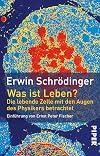
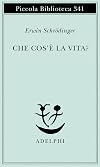
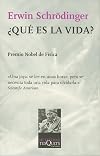
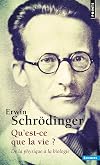
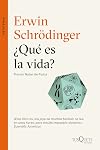
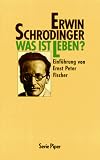
What Is Life?: The Physical Aspect of the Living Cell
by Erwin Schrödinger
On This Page
Description
Brought together with these two classics of scientific speculation are Erwin Schroedinger's autobiographical sketches, published and translated here for the first time, offering a fragmentary account of his life as a background to the scientific writings.Tags
Recommendations

















Member Reviews
Schrodinger was a very clever physicist, and he applied his intelligence and knowledge to the question of the title. His book first appeared in 1944, but Schrodinger's reasoning shows what kind of structure DNA must be, decades before its structure was discovered or observed. He wrote very clearly for non-scientists, but did not shy away from complex subjects. He does answer the question, in physical terms. He believes the genetic machinery is based on the physics which appears to operate in the rest of the universe, which is a fair assumption. He comes to some surprising conclusions about the individual and their relationship to each other and the universe. Very thought-provoking and still very readable and relevant today.
Starting from pretty basic thermodynamic assumptions, Schrödinger ends up speculating about the nature of personality and the 'self'. At the time of writing the DNA was not yet discovered but is nothing but directly predicted in this work. Overall this is a short and entertaining historical-scientific text that teaches you as much about genetics and entropy as about the way the mind of one of the great physical thinkers of his times worked.
¿QUE ES LA VIDA?
Schrodinger era un físico muy inteligente, y aplicó su inteligencia y conocimiento a la cuestión del título. Su libro apareció por primera vez en 1944, pero el razonamiento de Schrodinger muestra qué tipo de estructura debe ser el ADN, décadas antes de que su estructura fuera descubierta u observada. Escribió muy claramente para los no científicos, pero no rehuyó las cuestiones complejas. Él responde la pregunta, en términos físicos. Él cree que la maquinaria genética se basa en la física que parece funcionar en el resto del universo, lo cual es una suposición razonable. Él llega a algunas conclusiones sorprendentes sobre el individuo y su relación entre sí y con el universo. Muy estimulante y aún show more muy legible y relevante hoy. show less
Schrodinger era un físico muy inteligente, y aplicó su inteligencia y conocimiento a la cuestión del título. Su libro apareció por primera vez en 1944, pero el razonamiento de Schrodinger muestra qué tipo de estructura debe ser el ADN, décadas antes de que su estructura fuera descubierta u observada. Escribió muy claramente para los no científicos, pero no rehuyó las cuestiones complejas. Él responde la pregunta, en términos físicos. Él cree que la maquinaria genética se basa en la física que parece funcionar en el resto del universo, lo cual es una suposición razonable. Él llega a algunas conclusiones sorprendentes sobre el individuo y su relación entre sí y con el universo. Muy estimulante y aún show more muy legible y relevante hoy. show less
Mar 20, 2018Spanish
Ratings
Members
- Recently Added By
Lists

25 Greatest Science Books of All Time
33 works; 6 members

The r/AskScience Reading List
159 works; 3 members

Books Referenced by Izetbegovic's Islam Between East and West
233 works; 2 members

The Well-Educated Mind, Susan Wise Bauer, 2016
179 works; 3 members

Books That Changed Our Perspective
423 works; 168 members
Author Information

Born and educated in Vienna, Erwin Schrodinger received his Ph.D. in 1910 from the University of Vienna. He developed the theory of wave mechanics (1925--26). For this theory, which furnished a solid mathematical explanation of quantum theory, Schrodinger shared the Nobel Prize in 1933 with Paul Dirac. Schrodinger was dissatisfied with Niels show more Bohr's early quantum theory of the atom, objecting to the many arbitrary quantum rules imposed. Building on Louis-Victor De Broglie's idea that a moving atomic particle has a wave character, Schrodinger developed a famous wave equation that describes the behavior of an electron orbiting the nucleus of an atom. When applied to the hydrogen atom, the equation yielded all the results of Bohr and De Broglie, and was also used as a tool to solve a wide range of new problems in which quantization occurs. In 1927 Schrodinger succeeded Max Planck at the University of Berlin but resigned in 1933 when the Nazis came to power. He left then for England, becoming a guest professor at Oxford University. In 1936 he returned to Austria, but then fled in 1938 under the threat of Nazi arrest and was invited to Dublin's newly established Institute for Advanced Studies. He remained there from 1940 until his retirement in 1956, when he returned to his native Austria and to the University of Vienna, where he held his last chair in theoretical physics. In 1944 Schrodinger published What Is Life? The Physical Aspects of a Living Cell, a book that had a tremendous impact on a new generation of scientists. The book directed young physicists who were disillusioned by the Hiroshima bombing to an unexplored discipline free of military applications---molecular biology. Schrodinger proposed the existence of a molecular code as the genetic basis of life, inspiring an entire generation to explore this idea. (Bowker Author Biography) show less
Series
Belongs to Publisher Series
Work Relationships
Common Knowledge
- Canonical title
- What Is Life?: The Physical Aspect of the Living Cell
- Original title
- What Is Life? The Physical Aspect of the Living Cell
- Alternate titles
- What is Life?
- Original publication date
- 1944
- Disambiguation notice
- Please don't combine "What is life" with editions containing ALSO "Mind and matter" and/or "Autobiographical sketches". Thank you.
Classifications
Statistics
- Members
- 359
- Popularity
- 87,992
- Reviews
- 3
- Rating
- (3.99)
- Languages
- 6 — English, French, German, Italian, Portuguese, Spanish
- Media
- Paper, Audiobook, Ebook
- ISBNs
- 16
- UPCs
- 1
- ASINs
- 19