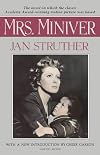
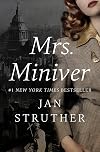
Mrs. Miniver
by Jan Struther
On This Page
Description
The beloved classic novel of an English housewife bravely enduring WWII-the basis for the Academy Award-winning film starring Greer Garson. Winston Churchill once remarked that Mrs. Miniver, the fictional British housewife featured in Jan Struther's newspaper columns about quotidian English life, did more for the Allied cause than a flotilla of battleships. As tensions rose across Europe, Mrs. Miniver's domestic concerns expanded from automobiles and Christmas shopping to include gas masks, show more keeping calm, and carrying on. An international sensation when it was first published, this novelized collection of those columns won America's heart-and broad public support for entering WWII. Mrs. Miniver's story was so essential to Allied morale that when William Wyler's film adaption was made, President Roosevelt ordered it rushed to theaters. show lessTags
Recommendations




























Member Recommendations


souloftherose Both are collections of short stories which show how the lives of the middle-class in Britain were changed by WWII. Mrs Miniver covers the period leading up to the outbreak of war whilst Good Evening Mrs Craven covers WWII itself.
Member Reviews
I absolutely love Mrs. Miniver. I've read it a dozen times at least, and it still make me laugh at bits and nearly cry at others and nod my head in recognition at nearly everything. She has a wonderful way of seeing things - of putting into words vague ideas or feelings that I've had but couldn't pin down. And for me, as for her, it's words that are necessary to make a feeling or memory real and solid and recoverable - however wonderful, a sensation that's only that will slip away. BTW, if you've seen or heard of the movie with Greer Garson - the only thing it has in common with the book is the name. Nothing wrong with it, but it's _not_ Mrs. Miniver.
A couple years ago, casting about for short fiction to teach in my class on British literature from 1890 to 1950, I took a friend's recommendation of this book, which chronicles the life of one family in the years leading up to World War II. I skimmed around it a bit, selected eight likely-looking chapters, scanned them, and assigned them to my class. Sometime later, as part of a project to watch all the films of every book I taught that semester, I watched the two films based on the book, Mrs. Miniver (1942) and The Miniver Story (1950). (The first one is pretty good; the second one not as much.) But I hadn't read the book, and that seemed like a thing I ought to do, and now I finally have.
Mrs. Miniver is, as Professor Tom Recchio show more calls Cranford, an "accidental novel." It was originally a single newspaper column, "Mrs. Miniver Comes Home," in the Times of London on October 6, 1937. It was successful enough to warrant further accounts of Mrs. Miniver and her upper-middle-class family in Chelsea (with a home in the country); there were a total of thirty-six columns published up to September 29, 1939, three weeks after the U.K. declared war on Germany. This, though, is what makes it fascinating. The war breaks in on this family by accident, much as it would have in real life. Mrs. Miniver did not begin life as a novel, and it did not begin life as a war story-- it was a simple series of domestic sketches. But it became a war story because as the 1930s rolled on, everyone's domestic story became a war story.
So there's no foreshadowing or anything. At the beginning, it's just domestic observations from Mrs. Miniver as her husband buys a new car, or Christmas day rolls around, or they see fireworks on Guy Fawkes day, or she tries to figure out how you deal with a married couple where you only like one of its members, or they drive up to Scotland to see the Highland Games. There are lots of cute observations on what marriage is like, or on what other people's marriages are like, or on the fact that if someone is "terribly fond of children," a kid never actually knows where they stand with such a person! I really like what Mrs. Miniver observes on the morning of Christmas 1937, as her children go at the contents of their stockings way too early in the morning: "There were sounds of movement in the house; they were within measurable distance of the blessed chink of early morning tea. Mrs. Miniver looked towards the window. The dark sky had already paled a little in its frame of cherry-pink chintz. Eternity framed in domesticity. Never mind. One had to frame it in something, to see it at all."
But then, all of a sudden it's September 28, 1938, Germany is about to annex the Sudetenland, it seems like war is imminent, and Mrs. Miniver has to take her children to get fitted for gas masks just in case. From that point on, the coming war is a shadow that hangs over the domestic life of the Minivers. You couldn't have planned this, and that's why it works so well. The previously idyllic life of the Minivers has been disturbed by a phenomenon they hadn't predicted, and Mrs. Miniver is hoping that this war can go better than the last one: "if the worst came to the worst, these children would at least know that we were fighting against an idea, and not against a nation"-- they need to guard against war-time's "slow, yellow, drifting corruption of the mind."
The war brings out the best in the nation, Mrs. Miniver argues, but in a way that's a bit disappointing. She writes in a letter to her sister-in-law, after the declaration of war: "I can think of a hundred ways already in which the war has 'brought us to our senses.' But it oughtn't to need a war to make a nation paint its kerbstones white, carry rear-lamps on its bicycles, and give all its slum children a holiday in the country. And it oughtn't to need a war to make us talk to each other in buses, and invent our own amusements in the evenings, and live simply, and eat sparingly, and recover the use of our legs, and get up early enough to see the sun rise. However, it has needed one: which is about the severest criticism our civilization could have." And it doesn't bring out the best in everyone, either; she recounts talking to a woman who won't promise to billet London children in her country house because it will upset the servants, who says, "Even if the worst does come to the worst, you must make it quite clear to the authorities that I can only accept Really Nice Children."
The book ends, as I said before, shortly after the declaration of war on Germany, with a letter from Mrs. Miniver to her sister-in-law. But apparently Jan Struther did continue to story of Mrs. Miniver and family, with five more dispatches published in the Times during the war, but as the edition I got from the library is from 1940, it doesn't include. You can read the whole book in an authorized e-edition, however, on the University of Pennsylvania website, and I should get around to reading those five later chapters soon.
The columns in the Times were wildly popular. When I was skimming the Times digital archive to examine the book in its original context, I found a number of letters from adoring fans. Many speculated on Mrs. Miniver's first name, which wasn't revealed until the 29 Sept. 1939 column. My favorite of the letters I found, however, was this one:
TO THE EDITOR OF THE TIMES
Sir.—I too have been hoping for another article by Mrs. Miniver, but for quite a different reason from your other writers. I pay a tribute to her creator when I say that I always think of Mrs. Miniver as a real person, and I hate her with an intense hatred. She is always so smug, so right, such a marvellous manager, and things always go so well for her. Well, nothing goes on like that for ever: something horrible must be going to happen to the lady soon, and I want to know her reactions.
I have no doubt Clem [Mrs. Miniver's husband] will become an A.R.P. warden, Vin [her eldest son] will join up, Mrs. M., assisted by her daughter, will cope in a wonderful manner with refractory billetees and run the hospital supply depôt in the manner born, and Toby [her youngest son] will join the Boy Scouts. It would be so much more helpful if Mrs. Miniver would tell us how she would behave if her husband had an affair with a pretty A.R.P. worker, if her son refused to join up, and if some of the workers at the hospital rose up in revolt and told the lady exactly where she got off. I expect she would cope with it all in a slightly hurt and surprised manner. No, I think the only thing for Mrs. Miniver is a direct hit from a bomb, and I am quite certain that within a month Clem would marry again a young and pretty, untidy woman, who never by any chance said or did the correct thing, and they would be enormously happy, and so should I.
Yours truly, M. F. SAVORY.
24, Arundel Court, Worthing.
The relationship between the book and the film is actually kind of weird, because the film begins shortly before the war and goes through its first couple years. In that way, it's actually more like a sequel to the book than an adaptation of it, because it's entirely about coping with wartime life. However, the details don't line up perfectly-- the Minivers' class status is downgraded in the film a bit, apparently to make things more palatable to American audiences. The Minivers ride out an attack in a bomb shelter, Mr. Miniver participates in the evacuation of Dunkirk, a downed German flier breaks into the Miniver home (the film Mrs. Miniver is less sympathetic to him than I think the novel one would be), and so on. The first film doesn't really line up with the second, either; one of the kids somehow hasn't got any older, another has got a lot older, and a third has completely vanished! But the first film is really good (it won six Academy Awards), and I highly recommend it. You'll also get to discover that Julian Fellowes plagiarized a Downton Abbey subplot from it.
Coda
About a week after I wrote this review, I read the five WWII-era installments of Mrs. Miniver on my Kindle. They're okay-- worth tracking down if your edition doesn't include them. The first is the best, a story of Mrs. Miniver working on her Christmas list, but this time there is a passel of refugee children along as well, many of whom never had a Christmas tree before. The other four are more letters from Mrs. Miniver to her sister-in-law; the worst of these is the last one, which is a very defensive over-explanation of her second-last letter, explaining why she was not overlooking members of the lower classes. I suspect Struther had received a lot of angry letters. show less
Mrs. Miniver is, as Professor Tom Recchio show more calls Cranford, an "accidental novel." It was originally a single newspaper column, "Mrs. Miniver Comes Home," in the Times of London on October 6, 1937. It was successful enough to warrant further accounts of Mrs. Miniver and her upper-middle-class family in Chelsea (with a home in the country); there were a total of thirty-six columns published up to September 29, 1939, three weeks after the U.K. declared war on Germany. This, though, is what makes it fascinating. The war breaks in on this family by accident, much as it would have in real life. Mrs. Miniver did not begin life as a novel, and it did not begin life as a war story-- it was a simple series of domestic sketches. But it became a war story because as the 1930s rolled on, everyone's domestic story became a war story.
So there's no foreshadowing or anything. At the beginning, it's just domestic observations from Mrs. Miniver as her husband buys a new car, or Christmas day rolls around, or they see fireworks on Guy Fawkes day, or she tries to figure out how you deal with a married couple where you only like one of its members, or they drive up to Scotland to see the Highland Games. There are lots of cute observations on what marriage is like, or on what other people's marriages are like, or on the fact that if someone is "terribly fond of children," a kid never actually knows where they stand with such a person! I really like what Mrs. Miniver observes on the morning of Christmas 1937, as her children go at the contents of their stockings way too early in the morning: "There were sounds of movement in the house; they were within measurable distance of the blessed chink of early morning tea. Mrs. Miniver looked towards the window. The dark sky had already paled a little in its frame of cherry-pink chintz. Eternity framed in domesticity. Never mind. One had to frame it in something, to see it at all."
But then, all of a sudden it's September 28, 1938, Germany is about to annex the Sudetenland, it seems like war is imminent, and Mrs. Miniver has to take her children to get fitted for gas masks just in case. From that point on, the coming war is a shadow that hangs over the domestic life of the Minivers. You couldn't have planned this, and that's why it works so well. The previously idyllic life of the Minivers has been disturbed by a phenomenon they hadn't predicted, and Mrs. Miniver is hoping that this war can go better than the last one: "if the worst came to the worst, these children would at least know that we were fighting against an idea, and not against a nation"-- they need to guard against war-time's "slow, yellow, drifting corruption of the mind."
The war brings out the best in the nation, Mrs. Miniver argues, but in a way that's a bit disappointing. She writes in a letter to her sister-in-law, after the declaration of war: "I can think of a hundred ways already in which the war has 'brought us to our senses.' But it oughtn't to need a war to make a nation paint its kerbstones white, carry rear-lamps on its bicycles, and give all its slum children a holiday in the country. And it oughtn't to need a war to make us talk to each other in buses, and invent our own amusements in the evenings, and live simply, and eat sparingly, and recover the use of our legs, and get up early enough to see the sun rise. However, it has needed one: which is about the severest criticism our civilization could have." And it doesn't bring out the best in everyone, either; she recounts talking to a woman who won't promise to billet London children in her country house because it will upset the servants, who says, "Even if the worst does come to the worst, you must make it quite clear to the authorities that I can only accept Really Nice Children."
The book ends, as I said before, shortly after the declaration of war on Germany, with a letter from Mrs. Miniver to her sister-in-law. But apparently Jan Struther did continue to story of Mrs. Miniver and family, with five more dispatches published in the Times during the war, but as the edition I got from the library is from 1940, it doesn't include. You can read the whole book in an authorized e-edition, however, on the University of Pennsylvania website, and I should get around to reading those five later chapters soon.
The columns in the Times were wildly popular. When I was skimming the Times digital archive to examine the book in its original context, I found a number of letters from adoring fans. Many speculated on Mrs. Miniver's first name, which wasn't revealed until the 29 Sept. 1939 column. My favorite of the letters I found, however, was this one:
TO THE EDITOR OF THE TIMES
Sir.—I too have been hoping for another article by Mrs. Miniver, but for quite a different reason from your other writers. I pay a tribute to her creator when I say that I always think of Mrs. Miniver as a real person, and I hate her with an intense hatred. She is always so smug, so right, such a marvellous manager, and things always go so well for her. Well, nothing goes on like that for ever: something horrible must be going to happen to the lady soon, and I want to know her reactions.
I have no doubt Clem [Mrs. Miniver's husband] will become an A.R.P. warden, Vin [her eldest son] will join up, Mrs. M., assisted by her daughter, will cope in a wonderful manner with refractory billetees and run the hospital supply depôt in the manner born, and Toby [her youngest son] will join the Boy Scouts. It would be so much more helpful if Mrs. Miniver would tell us how she would behave if her husband had an affair with a pretty A.R.P. worker, if her son refused to join up, and if some of the workers at the hospital rose up in revolt and told the lady exactly where she got off. I expect she would cope with it all in a slightly hurt and surprised manner. No, I think the only thing for Mrs. Miniver is a direct hit from a bomb, and I am quite certain that within a month Clem would marry again a young and pretty, untidy woman, who never by any chance said or did the correct thing, and they would be enormously happy, and so should I.
Yours truly, M. F. SAVORY.
24, Arundel Court, Worthing.
The relationship between the book and the film is actually kind of weird, because the film begins shortly before the war and goes through its first couple years. In that way, it's actually more like a sequel to the book than an adaptation of it, because it's entirely about coping with wartime life. However, the details don't line up perfectly-- the Minivers' class status is downgraded in the film a bit, apparently to make things more palatable to American audiences. The Minivers ride out an attack in a bomb shelter, Mr. Miniver participates in the evacuation of Dunkirk, a downed German flier breaks into the Miniver home (the film Mrs. Miniver is less sympathetic to him than I think the novel one would be), and so on. The first film doesn't really line up with the second, either; one of the kids somehow hasn't got any older, another has got a lot older, and a third has completely vanished! But the first film is really good (it won six Academy Awards), and I highly recommend it. You'll also get to discover that Julian Fellowes plagiarized a Downton Abbey subplot from it.
Coda
About a week after I wrote this review, I read the five WWII-era installments of Mrs. Miniver on my Kindle. They're okay-- worth tracking down if your edition doesn't include them. The first is the best, a story of Mrs. Miniver working on her Christmas list, but this time there is a passel of refugee children along as well, many of whom never had a Christmas tree before. The other four are more letters from Mrs. Miniver to her sister-in-law; the worst of these is the last one, which is a very defensive over-explanation of her second-last letter, explaining why she was not overlooking members of the lower classes. I suspect Struther had received a lot of angry letters. show less
This book is an absolute delight. It is a short series of vignettes in the life of Mrs. Miniver. She's a "typical" British wife and mother from the professional class. Her husband, an architect, makes enough that they can afford some servants and a house in the country, although life for them wasn't always so grand. The book takes place during the lead up to World War II. Initially, things are just "normal". Towards the end the upsets of the War begin to impinge on the lives of all British people, even those fairly well off.
The thing I rather liked about it was that even though the vignettes were built around common things, Christmas shopping, dinner parties, making lists, and so forth, Mrs. Miniver finds time to find hidden meaning in show more the common place. The book is also beautifully written so that one can feel the things described.
I only read this book because is showed up on a crossword puzzle my spouse was doing. I'd remembered the name, in part because it was later turned into a famous movie featuring Greer Garson, so I figured I should check it out. Life at the moment is getting increasingly weird, and I wanted something normal to help calm things down. This book managed that rather nicely. show less
The thing I rather liked about it was that even though the vignettes were built around common things, Christmas shopping, dinner parties, making lists, and so forth, Mrs. Miniver finds time to find hidden meaning in show more the common place. The book is also beautifully written so that one can feel the things described.
I only read this book because is showed up on a crossword puzzle my spouse was doing. I'd remembered the name, in part because it was later turned into a famous movie featuring Greer Garson, so I figured I should check it out. Life at the moment is getting increasingly weird, and I wanted something normal to help calm things down. This book managed that rather nicely. show less
"Words were the only net to catch a mood, the only sure weapon against oblivion"
By sally tarbox on 6 February 2017
Format: Kindle Edition
An absolute delight of a book; short episodes in the life of Mrs Miniver, an upper-middle class mother of two, on the cusp of WW2 and through into the early days of the conflict...
The first half of the book - before the war - gives glimpses into Firework Night, Christmas shopping, holidays at their second home in Kent - all seen through the thoughtful and astute eyes of Mrs Miniver. I found certain passages would so resound with me; thus her reluctance to go to stay with friends:
"It wasn't shyness. It was more like a form of claustrophobia - a dread of exchanging the freedom of her own self-imposed show more routine for the inescapable burden of somebody else's."
And I'm sure many will understand Mrs Miniver's change of heart after buying a cheap diary, when she runs back to swap it for the dearer lizard-skin one:
"An engagement-book is the most important of all those small adjuncts to life, that tribe of humble familiars which jog along beside one from year's end to year's end, apparently trivial, but momentous by reason of their terrible intimacy."
And then comes the onset of War; Mrs Miniver recalls the irrational hatred of all things German in the last war:
"feeling towards Dachshund puppies the uneasy tenderness of a devout churchwoman dandling her daughter's love-child."
But as life begins to change, Mrs Miniver still finds time to celebrate the beauties of Nature - and the social revolution that is taking place alongside war. Charming, touching, thought-provoking, humorous - certainly not a plot-driven work but poetic and utterly beautiful. show less
By sally tarbox on 6 February 2017
Format: Kindle Edition
An absolute delight of a book; short episodes in the life of Mrs Miniver, an upper-middle class mother of two, on the cusp of WW2 and through into the early days of the conflict...
The first half of the book - before the war - gives glimpses into Firework Night, Christmas shopping, holidays at their second home in Kent - all seen through the thoughtful and astute eyes of Mrs Miniver. I found certain passages would so resound with me; thus her reluctance to go to stay with friends:
"It wasn't shyness. It was more like a form of claustrophobia - a dread of exchanging the freedom of her own self-imposed show more routine for the inescapable burden of somebody else's."
And I'm sure many will understand Mrs Miniver's change of heart after buying a cheap diary, when she runs back to swap it for the dearer lizard-skin one:
"An engagement-book is the most important of all those small adjuncts to life, that tribe of humble familiars which jog along beside one from year's end to year's end, apparently trivial, but momentous by reason of their terrible intimacy."
And then comes the onset of War; Mrs Miniver recalls the irrational hatred of all things German in the last war:
"feeling towards Dachshund puppies the uneasy tenderness of a devout churchwoman dandling her daughter's love-child."
But as life begins to change, Mrs Miniver still finds time to celebrate the beauties of Nature - and the social revolution that is taking place alongside war. Charming, touching, thought-provoking, humorous - certainly not a plot-driven work but poetic and utterly beautiful. show less
The Mrs. Miniver by Jan Struthers that I just read has very little in common with the 1942 film of the same name starring Greer Garson. But looking a little closer, perhaps the film is the future for the Miniver family, what happened after the book closed. In any case, both the book and the movie paint a distinct picture of the stoic English upper middle class of the 1930’s.
First off I loved how the author set the scene, imprinting vividly the absolute Englishness of Mrs. Miniver and her family. The book is comprised of a series of essays, and whether it’s her gentle musings on her home, family and friends, or her razor-sharp observations on human nature in general, Mrs. Miniver is a joy to read. The war is very much in the show more background of this book, you sense it coming along on cat’s paws, first lightly mentioned in passing, then on to the fitting of gas masks, and eventually we find Mrs. Miniver planning her 1939 Christmas that will include her seven evacuee children and may not include her husband unless he is able to get leave from his unit to be with them.
The book is deceptively charming and sentimental, but underneath you can feel strength of purpose and steadfastness that the author is portraying, Mrs. Miniver was originally meant as a propaganda article and was published in the newspaper, nevertheless this is a literary piece that captures a certain type of woman in what will probably be her finest hour. show less
First off I loved how the author set the scene, imprinting vividly the absolute Englishness of Mrs. Miniver and her family. The book is comprised of a series of essays, and whether it’s her gentle musings on her home, family and friends, or her razor-sharp observations on human nature in general, Mrs. Miniver is a joy to read. The war is very much in the show more background of this book, you sense it coming along on cat’s paws, first lightly mentioned in passing, then on to the fitting of gas masks, and eventually we find Mrs. Miniver planning her 1939 Christmas that will include her seven evacuee children and may not include her husband unless he is able to get leave from his unit to be with them.
The book is deceptively charming and sentimental, but underneath you can feel strength of purpose and steadfastness that the author is portraying, Mrs. Miniver was originally meant as a propaganda article and was published in the newspaper, nevertheless this is a literary piece that captures a certain type of woman in what will probably be her finest hour. show less
A series of vignettes from Mrs Miniver's life with her husband and three children in (just barely) pre-WWII middle-class England, the book is full of keen observations about all sorts of things (marriage, children, motherhood, visiting, war, reading, springtime). It's nowhere near as twee as you fear it might be--I was consistently delighted while reading and was forever recognizing myself, or recognizing someone I hope I will be in ten or fifteen years. And when I did neither of those things, I wished desperately that Mrs Miniver would take it into her head to move in next door. Recommended.
Piquant balm; use sparingly. Barely over 100 pages but full of kindly, apt observations like an ultra-refined and gracious lunch companion. Originally light columns in the Times, one can see how they were instantly a hit, and the character of Mrs Miniver established. Her neat, concise epistles pulse with the aches of lost worlds both of comfortable domestic, social, and gender roles, and of those post-Munich, prewar, and phony war days of solidarity and closure and trepidation. The flavour has that odd and enjoyable sense of being nostalgic, even of events squarely in the present. Her elegant diction is clear and familiar, plain even, but still achieves beautiful, well-turned images: "The woods were just beginning to turn, the different show more trees springing into individuality again, demobilized from the uniform green of summer." show less
Members
- Recently Added By
Lists

Books About World War II
102 works; 29 members

Comfort Reads
221 works; 39 members

My Virago Modern Classics wish list
23 works; 3 members

Publisher's Weekly Bestsellers - Part II - 1940 - 1979
355 works; 6 members

Books referenced in A Very Great Profession: The Woman's Novel 1914-39
199 works; 6 members

Books Read in 2011
684 works; 20 members

Persephone
148 works; 3 members
Author Information

10+ Works 983 Members
Some Editions
Awards and Honors
Distinctions
Series
Belongs to Publisher Series
Work Relationships
Has the adaptation
Common Knowledge
- Canonical title*
- La signora Miniver
- Original publication date
- 1939
- People/Characters
- Mrs Miniver; Clem Miniver; Judy Miniver; Vin Miniver; Toby Miniver
- Important places
- Chelsea, London, England, UK
- Important events
- World War II
- Related movies
- Mrs. Miniver (1942 | IMDb); The Miniver Story (1950 | IMDb); Mrs. Miniver (1960 | TV | IMDb)
- Epigraph
- This book, while produced under wartime conditions, in full compliance with government regulations for the conservation of paper and other essential materials, is COMPLETE AND UNABRIDGED
- Dedication
- My thanks are due to the Proprietors and Editor of The Times, in which these articles originally appeared.
J.S. - First words
- It was lovely, thought Mrs. Miniver, nodding good-bye to the flower-woman and carrying her big sheaf of chrysanthemums down the street with a kind of ceremonious joy, as though it were a cornucopia; it was lovely, this settli... (show all)ng down again, this tidying away of the summer into its box, this taking up of the thread of one's life where the holidays (irrelevant interlude) had made one drop it.
- Quotations
- A single person is a manageable entity, whom you can either make friends with or leave alone. But half of a married couple is not exactly a whole human being: if the marriage is successful it is something a little more than t... (show all)hat; if unsuccessful, a little less. In either case, a fresh complication is added to the already intricate business of friendship: as Clem had once remarked, you might as well try to dance a tarantella with a Siamese twin.
... a letter from Vince at school - would she please send on his umbrella, his camera, and his fountain-pen, which leaked rather?
An engagement book is the most important of all those small adjuncts to life, that tribe of humble familiars which jog along beside one from year's end to year's end, apparently trivial, but momentous by reason of their terri... (show all)ble intimacy. A sponge, a comb, a tooth-brush, a spectacle-case, a fountain-pen - these are the things which need to be chosen with care. They become, in time, so much a part of one that they can scarcely be classed as inanimate. Insensitive, certainly - but so are one's nails and hair.
Mrs. Miniver resigned herself to the exquisite discomfort of the electric drill. It was a pity, she felt, that this instrument had been invented during a period when scientific images in poetry were out of favour. To the mode... (show all)rns, who had been brought up with it, it was presumably vieux jeu. They took it for granted ... But oh, what Donne could have made of it, if it had been invented in his time! With what delight he would have seized upon it, with what harsh jostling and grinding of consonants he would have worked out metaphor after metaphor, comparing its action to that of all the worst tormentors of the heart: to jealousy, to remorse, to the sharp gnawing of a bad conscience and the squalid nagging of debt.
She would write in longhand, leaning back with her feet up on a sofa, using fine-quality lined paper with a gold-embossed pen, In a lecture entitled "Pens, Ink and Paper", she said: "Genius can write on the backs of old envel... (show all)opes, but mere talent requires the very best stationery that money can buy.". - Last words
- (Click to show. Warning: May contain spoilers.)Yours ever, with much love, Caroline.
*Some information comes from Common Knowledge in other languages. Click "Edit" for more information.
Classifications
Statistics
- Members
- 747
- Popularity
- 37,923
- Reviews
- 31
- Rating
- (3.86)
- Languages
- English, French, Italian
- Media
- Paper, Audiobook, Ebook
- ISBNs
- 15
- UPCs
- 1
- ASINs
- 42