The Album
by Mary Roberts Rinehart
On This Page
Description
"Even in the early 1930s, Crescent Place is a neighborhood out of the past. The five Victorian mansions and the remote patch of pasture placed between them have the air of the 1890s, even as the city--once miles away from this idyllic retreat--encroaches and surrounds the enclave. But while these rarified residences may appear calm on the outside, their isolated interiors contain dark secrets, prolonged feuds, and generations of high-toned trouble. n these houses are a husband and wife who show more fight constantly, and another couple who hasn't spoken to each other in two decades. There is a widow in permanent mourning and a daughter whom the newspapers call psychotic. And there is a bedridden old woman who is about to be killed with an ax. When her murder shatters the well-mannered quiet of the cul-de-sac, the tabloids delight in trumpeting Crescent Place's peculiarities. But as the search for the killer intensifies, it becomes clear that the area's strangest secrets have yet to be revealed."-- show lessTags
Recommendations








Member Reviews
The Album may be my very favorite Mary Roberts Rinehart novel — and that’s high praise, indeed! In her day, she was more popular than Dame Agatha Christie, and I wonder that Mary Roberts Rinehart’s name isn’t equally well known.
Equal parts suspenseful mystery and sly social satire, The Album is narrated by 28-year-old spinster Louisa Hall, whose selfish mother ended Louisa’s engagement eight years earlier. Louisa lives in the well-to-do cul-de-sac called The Crescent, where the inhabitants of the five houses are as snobbish and as set in their ways as can be. How snobbish and old-fashioned, Louisa explains to a police inspector:
In other words, the Crescent practices twee 19th century manners even though it’s now the Great Depression and the early 1930s.
The Album opens with the axe murder of old Mrs. Lancaster, a long-time bedridden invalid who proved demanding and petulant. The servants and the police believe the house was shut up tight, and, therefore, suspect the husband or one of the two middle-aged spinster daughters. But was the murder really an inside job? Rinehart slips in plenty of twists and surprises to keep readers guessing.
Although released in 1933, this whodunit remains as gripping and slyly clever as it was then, and I believe readers will be loving this book just as much on its 100th anniversary. show less
Equal parts suspenseful mystery and sly social satire, The Album is narrated by 28-year-old spinster Louisa Hall, whose selfish mother ended Louisa’s engagement eight years earlier. Louisa lives in the well-to-do cul-de-sac called The Crescent, where the inhabitants of the five houses are as snobbish and as set in their ways as can be. How snobbish and old-fashioned, Louisa explains to a police inspector:
We are rather a repressed lot, I imagine. We see a good bit of each other, but no one isshow more
particularly intimate with anyone else. We still leave cards when we call after four o’clock….
In other words, the Crescent practices twee 19th century manners even though it’s now the Great Depression and the early 1930s.
The Album opens with the axe murder of old Mrs. Lancaster, a long-time bedridden invalid who proved demanding and petulant. The servants and the police believe the house was shut up tight, and, therefore, suspect the husband or one of the two middle-aged spinster daughters. But was the murder really an inside job? Rinehart slips in plenty of twists and surprises to keep readers guessing.
Although released in 1933, this whodunit remains as gripping and slyly clever as it was then, and I believe readers will be loving this book just as much on its 100th anniversary. show less
When Mrs. Lancaster is brutally murdered in the quiet community of Crescent Place where only five families reside, a wealth of motives comes to light, and when another murder occurs, Louisa Hall finds evidence the authorities have missed and realizes that she is the only one who can solve the crime.
Louisa is a likeable character who narrates the story. There are a lot of characters to follow and the story jumped around to them as bits and pieces were revealed. This was confusing at times. The story never grabbed me but it was interesting enough to keep me wanting to find out who the killer was.
Louisa is a likeable character who narrates the story. There are a lot of characters to follow and the story jumped around to them as bits and pieces were revealed. This was confusing at times. The story never grabbed me but it was interesting enough to keep me wanting to find out who the killer was.
January 29, 1999
The Album
Mary Roberts Rinehart
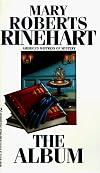
In cleaning out Mom’s library a few weekends ago, I came across half a dozen of the Mary Roberts Rinehart mysteries I’d bought years ago in NYC. Their primary attraction at the time had been their wonderfully detailed, grotesque covers! The same artist had done all of them. This one shows the bedroom of old Mrs. Lancaster on a chilly midnight blue background, with the severed head of a woman sitting in an otherwise empty birdcage! An axe is nearby. I checked on Amazon. Com and found that the latest reprints of her books have different covers now, so you can’t get these anymore.
The story itself is macabre, told by 28-year old Louise Hall. Five odd, isolated families live on a large plot show more of land called The Crescent, cut off from the rest of the world. One hot August afternoon, old Mrs. Lancaster is found murdered – with an axe, of course – in her bedroom, and from there goes many theories: the two devoted daughters who have given up marriage and family of their own to care for her; or Jim, a Crescent neighbor who was seen leaving the house…everyone is a suspect, and there’s a lot more murder to come before it’s all over. The butler, a daughter, a neighbor. In th end, the strange, ancient existence of The Crescent is irrevocably changed. show less
The Album
Mary Roberts Rinehart
In cleaning out Mom’s library a few weekends ago, I came across half a dozen of the Mary Roberts Rinehart mysteries I’d bought years ago in NYC. Their primary attraction at the time had been their wonderfully detailed, grotesque covers! The same artist had done all of them. This one shows the bedroom of old Mrs. Lancaster on a chilly midnight blue background, with the severed head of a woman sitting in an otherwise empty birdcage! An axe is nearby. I checked on Amazon. Com and found that the latest reprints of her books have different covers now, so you can’t get these anymore.
The story itself is macabre, told by 28-year old Louise Hall. Five odd, isolated families live on a large plot show more of land called The Crescent, cut off from the rest of the world. One hot August afternoon, old Mrs. Lancaster is found murdered – with an axe, of course – in her bedroom, and from there goes many theories: the two devoted daughters who have given up marriage and family of their own to care for her; or Jim, a Crescent neighbor who was seen leaving the house…everyone is a suspect, and there’s a lot more murder to come before it’s all over. The butler, a daughter, a neighbor. In th end, the strange, ancient existence of The Crescent is irrevocably changed. show less
I really enjoyed reading this quaint twisty-turny murder mystery.
90. The Album by Mary Roberts Rinehart (read in 1941) I know I really liked this book and I thought Mary Roberts Rinehart was a great author. When I read a book by her recently, K, I was underimpressed indeed.
Ratings
Members
- Recently Added By
Lists

Books mentioned in Julian Symons’ Bloody Murder
438 works; 6 members

Books Read in 2021
5,361 works; 114 members
Author Information

142+ Works 8,211 Members
Mary Roberts Rinehart was born in the City of Allegheny, Pennsylvania on August 12, 1876. While attending Allegheny High School, she received $1 each for three short stories from a Pittsburgh newspaper. After receiving inspiration from a town doctor who happened to be a woman, she developed a curiosity for medicine. She went on to study nursing at show more the Pittsburgh Training School for Nurses at Homeopathic Hospital. After graduating in 1896, she began her writing career. The first of her many mystery stories, The Circular Staircase (1908), established her as a leading writer of the genre; Rinehart and Avery Hopwood successfully dramatized the novel as The Bat (1920). Her other mystery novels include The Man in Lower Ten (1909), The Case of Jennie Brice (1914), The Red Lamp (1925), The Door (1930), The Yellow Room (1945), and The Swimming Pool (1952). Stories about Tish, a self-reliant spinster, first appeared in the Saturday Evening Post and were collected into The Best of Tish (1955). She wrote more than 50 books, eight plays, hundreds of short stories, poems, travelogues and special articles. Three of her plays were running on Broadway at one time. During World War I, she was the first woman war correspondent at the Belgian front. She died September 22, 1958 at the age of 82. (Bowker Author Biography) show less
Series
Belongs to Publisher Series
Work Relationships
Is contained in
Common Knowledge
- Canonical title
- The Album
- Original title
- The Album
- Original publication date
- 1933
- People/Characters
- Louisa Hall; Herbert Dean; Emily Lancaster; George Talbot
- Important places
- The Crescent (a community of five families living in close proximity)
- First words
- We had lived together so long, the five families in Crescent Place, that it never occurred to any of us that in our own way we were rather unique.
- Last words
- (Click to show. Warning: May contain spoilers.)And so we went.
Classifications
Statistics
- Members
- 227
- Popularity
- 144,119
- Reviews
- 5
- Rating
- (3.60)
- Languages
- English, German, Swedish
- Media
- Paper, Audiobook, Ebook
- ISBNs
- 12
- UPCs
- 1
- ASINs
- 18