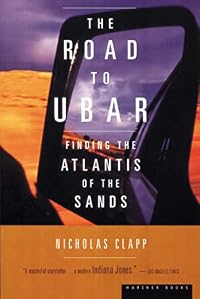
The Road to Ubar: Finding the Atlantis of the Sands
by Nicholas Clapp
On This Page
Description
The most fabled city in ancient Arabia was Ubar, described in the Koran as "the many-columned city whose like has not been built in the whole land." But like Sodom and Gomorrah, Ubar was destroyed by God for the sins of its people. Buried in the desert without a trace, it became the "Atlantis of the Sands." The story of its destruction was retold in The Arabian Nights Entertainments (first published in the New World in 1797 as The Oriental Moralist by an ancestor of Nicholas Clapp's). Over show more the centuries, many people searched unsuccessfully for the lost city, including the flamboyant Harry St. John Philby, and skepticism grew that there had ever been a real place called Ubar. Then in the 1980s Nicholas Clapp stumbled on the legend. Poring over medieval manuscripts, he discovered that a slip of the pen in A.D. 1460 had misled generations of explorers. In satellite images he found evidence of ancient caravan routes that were invisible on the ground. Finally he organized two expeditions to Arabia with a team of archaeologists, geologists, space scientists, and adventurers. After many false starts, dead ends, and weeks of digging, they uncovered the remains of a remarkable walled city with eight towers, thirty-foot walls, and artifacts dating back 4,000 years - they had found Ubar. show lessTags
Recommendations



















Member Reviews
The ancient city of Ubar is clouded in myth. It controlled the frankincense trade for the Arabian Peninsula and became quite a wealthy oasis. Then, as told in the Koran, it was smote from the Earth for favoring wealth over worship. The city of Ubar was gone forever. Nicholas Clapp’s The Road to Ubar weaves together history, archaeology, technology, and even a little luck to rediscover the history of the Arabian Peninsula. With the help of an archaeologist, a geologist, and a real-life adventurer, he travels through the vast Arabian Desert to take back what the desert hid for so long.
Clapp’s methodology here is quite fun. Many historical figures had traveled through this area of the Arabian Peninsula searching for archaeological show more insight, and Clapp uses both their insights and new technology to pinpoint the location of a buried city in the sands at Shisr in Oman. Unfortunately, a sinkhole has swallowed a fair chunk of the ruins, but much of the wall remained intact and his team dutifully catalogs the whole experience. After its discovery, he places the city in as much historical and mythical context as he can provide. Clapp’s team’s journey is fairly interesting and also provides a good deal of history on the Empty Quarter of the Arabian Peninsula. A very fun read. show less
Clapp’s methodology here is quite fun. Many historical figures had traveled through this area of the Arabian Peninsula searching for archaeological show more insight, and Clapp uses both their insights and new technology to pinpoint the location of a buried city in the sands at Shisr in Oman. Unfortunately, a sinkhole has swallowed a fair chunk of the ruins, but much of the wall remained intact and his team dutifully catalogs the whole experience. After its discovery, he places the city in as much historical and mythical context as he can provide. Clapp’s team’s journey is fairly interesting and also provides a good deal of history on the Empty Quarter of the Arabian Peninsula. A very fun read. show less
Generally contains three parts: 1) Myth 2) Expedition and 3) The Rise and Fall of Ubar. Being a plot-motivated reader, I enjoyed the expedition the best. Having done a little research myself, I can appreciate the desire to document it as Clapp has done in "Myth," however I found this tedious. Unlike some other books of this type, there is are excavations and findings associated with the expedition, which made it interesting. The text includes illustrations, maps, three appendices, notes, a bibliography, and index.
Excellent resource book. Easy to read and understand.
Ratings
Members
- Recently Added By
Lists

Top Five Books of 2013
1,562 works; 721 members

Books Read in 2013
1,629 works; 51 members
Author Information
9 Works 424 Members
Nicholas Clapp is both an award-winning filmmaker & a noted lecturer on archeology. His first book, "The Road to Ubar", was a New York Public Library "Book to Remember" for 1999. (Bowker Author Biography)
Awards and Honors
Distinctions
Notable Lists
Common Knowledge
- Canonical title*
- Die Stadt der Düfte
- People/Characters
- Nicholas Clapp; Juris Zarins
- Important places
- Oman; Empty Quarter; Rub' al Khali; Ubar
- Dedication
- For Kay, Cristina, Jenny, and Wil
- First words*
- Prolog: Boston, Massachusetts, Februar 1797 ... Als der Wagen schliesslich vor der Buchhandlung Ecke Proctor's Lane anhielt, war es bereits dunkel, und es schneite.
1.: Im Luftraum über dem Iran, Dezember 1980 ... Der kleine Frachttransporter flog hinein in die sternenübersäte, aber mondfinstere Nacht. - Last words*
- (Click to show. Warning: May contain spoilers.)Eigentlich sogar recht gut.
*Some information comes from Common Knowledge in other languages. Click "Edit" for more information.
Classifications
- Genres
- Anthropology, Nonfiction, Travel, General Nonfiction, History
- DDC/MDS
- 939.49 — History & geography History of ancient world (to ca. 499) Other parts of ancient world Syria
- LCC
- DS247 .O63 .C55 — History of Europe, Asia, Africa and Oceania Asia History of Asia Arabian Peninsula. Saudi Arabia Local history and description
- BISAC
Statistics
- Members
- 280
- Popularity
- 114,744
- Reviews
- 3
- Rating
- (3.68)
- Languages
- English, French, German, Italian
- Media
- Paper, Ebook
- ISBNs
- 12
- UPCs
- 2
- ASINs
- 3