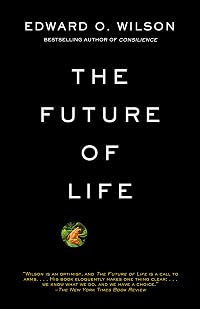
The Future of Life
by Edward O. Wilson
On This Page
Description
Examines the richness of the natural world, how it is currently being threatened, and what can be done to safeguard it.Tags
Recommendations






Member Reviews
There weren't very many surprises in this book for someone who considers themselves an environmentalist and follows environmental news. But the surprises that were there were whoppers. For instance, did you know that within a matter of decades, if current trends hold true, China will need to import more grain than is currently exported worldwide on an annual basis? Scary stuff. But there were some major disappointments in this book as well, particularly some perceived inconsistencies in his "hopes for the future."
More than an expert entomologist and socio-biologist, Edward Osborne Wilson is also a passionate environmentalist expert of everything about conservation biology. Displaying an incredible erudition, he delivers here a remarkable little book which is a must read for anyone interested in ecology.
In 'The Future of Life', he does more than showing us the wonders of our fragile planet, or, enthuse the reader with examples of coevolution and interconnections between various species. He also defends the preservation of our environment by adopting an attitude far from the caricature such debates are often reduced to. Indeed, scientific and technological progress, economical interest, and safeguarding of our biodiversity are not antinomic, and, show more if he knows how to remain cautious in avoiding the traps of scientism, he doesn't condemn neither our biotechnological advances nor our capitalistic system.
Such an outlook, such a passion, such an engagement make this short little book a fascinating read. Too bad it's so short! show less
In 'The Future of Life', he does more than showing us the wonders of our fragile planet, or, enthuse the reader with examples of coevolution and interconnections between various species. He also defends the preservation of our environment by adopting an attitude far from the caricature such debates are often reduced to. Indeed, scientific and technological progress, economical interest, and safeguarding of our biodiversity are not antinomic, and, show more if he knows how to remain cautious in avoiding the traps of scientism, he doesn't condemn neither our biotechnological advances nor our capitalistic system.
Such an outlook, such a passion, such an engagement make this short little book a fascinating read. Too bad it's so short! show less
Quite a good presentation of ecological thinking and how human decisions and actions ripple through. The viewpoint is surprisingly balanced between a recognition of what human’s want and take from the planet and what the planet and its layer of fauna and flora need to carry on. Not surprisingly, these two sides are counterposed at some level, but the real harm to efforts at addressing the problem reside in thinking of these sides as incompatible. Wilson convincingly explains how those viewpoints share common interests that help to reframe the discussion.
A strange book. A kind of cry of anguish and plea for sanity.
In my humble unsolicited opinion the problem and major shortcoming of environmentalists is that instead of advocating reasonable self-preservation they go on an on about the wonders of nature. They must know, or at least the realistic among them, that only a tiny fraction of people care about losing species, destroying natural habitats and making their kids' heritage so much poorer. On the other hand everyone cares about their standard of living and there are plenty of good conservationist arguments that could take advantage of that self-interest.
Alas, this book like all others I've read too often strays from this route and goes down the "isn't nature beautiful" dead-end. It show more is beautiful but no one cares and sadly this is not helping. show less
In my humble unsolicited opinion the problem and major shortcoming of environmentalists is that instead of advocating reasonable self-preservation they go on an on about the wonders of nature. They must know, or at least the realistic among them, that only a tiny fraction of people care about losing species, destroying natural habitats and making their kids' heritage so much poorer. On the other hand everyone cares about their standard of living and there are plenty of good conservationist arguments that could take advantage of that self-interest.
Alas, this book like all others I've read too often strays from this route and goes down the "isn't nature beautiful" dead-end. It show more is beautiful but no one cares and sadly this is not helping. show less
The author is knowledgeable and the book is well written. The topic is one-dimensional in that the basic concept is that humans are causing extinction of many species. He covers the magnitude of the problem, the causes, and the potential solutions. I appreciate and concur with his concerns. I believe that ongoing and future efforts at conservation of biodiversity will have beneficial effects but am skeptical that economic and developmental forces will be held in check. I suspect that we are more similar to a bacteria that grows until it runs out of food.
For a book published in 2002, it is good to see how much that was written about has come to pass; improved understanding of the environment, a desire to think big in terms of conservation areas, and looking at the biodiversity of regions.
That said there are areas that have not progressed. Along with animal extinctions, loss of rainforest, and other environmental disasters that have happened around the world.
The solutions that he proposes in the final chapter are still valid, and any government should look at implementing these given how business and corporations have managed to bring the world the the edge of the abyss, and still want more concessions.
That said there are areas that have not progressed. Along with animal extinctions, loss of rainforest, and other environmental disasters that have happened around the world.
The solutions that he proposes in the final chapter are still valid, and any government should look at implementing these given how business and corporations have managed to bring the world the the edge of the abyss, and still want more concessions.
A great "state of the planet" survey circa 2002 covering species extinctions and the environment. In the end Wilson is optimistic with solutions. I came away with the desire to buy a microscope and start exploring the micro-world - and I also immediately donated money to the three top environmental organizations: World Wildlife Fund, The Nature Conservancy and Conservation International. Wilson clarified some questions I had about how these organizations operate and their histories and accomplishments. I was also amazed to learn how relatively cheap it is to buy and protect large areas of wilderness. Overall a book of unflinching dark reality and a hopeful future.
Members
- Recently Added By
Author Information

72+ Works 17,983 Members
He was born in Birmingham, Alabama, in 1929. He is currently Pellegrino University Research Professor & Honorary Curator in Entomology of the Museum of Comparative Zoology at Harvard. He is on the Board of Directors of the Nature Conservancy, Conservation International & the American Museum of Natural History. He lives in Lexington, Massachusetts. show more (Bowker Author Biography) show less
Awards and Honors
Awards
Distinctions
Common Knowledge
- Epigraph
- In the end, our society will be defined not only by what we create, but by what we refuse to destroy.
John C. Sawhill (1936-2000), president,
The Nature Conservancy, 1990-2000 - Dedication
- [None]
- First words
- The totality of life, known as the biosphere to scientists and creation to theologians, is a membrane of organisms wrapped around Earth so thin it cannot be seen edgewise from a space shuttle, yet so internally complex that m... (show all)ost species comprising it remain undiscovered.
- Last words
- (Click to show. Warning: May contain spoilers.)A civilization able to envision God and to embark on the colonization of space will surely find the way to save the integrity of this planet and the magnificent life it harbors.
Classifications
- Genres
- Science & Nature, Nonfiction, General Nonfiction
- DDC/MDS
- 333.9522 — Society, government, & culture Economics Economics of land and energy Other natural resources Biofuel, biodiversity, wildlife refuges Aquatic Resources
- LCC
- QH75 .W535 — Science Natural history – Biology Natural history (General) General
- BISAC
Statistics
- Members
- 1,356
- Popularity
- 17,544
- Reviews
- 17
- Rating
- (3.99)
- Languages
- 10 — Dutch, English, Finnish, French, German, Hungarian, Italian, Korean, Spanish, Swedish
- Media
- Paper, Audiobook, Ebook
- ISBNs
- 20
- ASINs
- 6