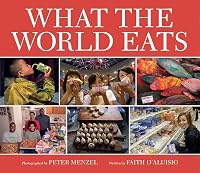
What the World Eats
by Peter Menzel (Photographer), Faith D'Aluisio (Author)
On This Page
Description
"A photographic collection exploring what the world eats featuring portraits of twenty-five families from twenty-one countries surrounded by a week's worth of food"--Provided by publisher.Tags
Recommendations






















Member Recommendations
Member Reviews
Mostly I found this appalling. So much meat... I have plenty of money for groceries and am an omnivore, but the amount of meat the rich countries' example families eat is incredible. And the lack of nourishing food in the less well-off homes is disturbing, of course, too (even discounting the refugee camp, which of course is unfair). I did not read every word, and I do not trust every evaluation, but it's still a wonderfully enlightening book. For all ages, especially adults, even though my library had it in Juvenile.
Most ppl in India still don't have indoor toilets! Ppl in Greenland still hunt for subsistence! Disability checks in Australia can support enough meat to feed an army!
I would like to know how the data for the week was show more calculated. I tried to figure out what ours would be, and I'm not sure that I could get it right even if we all three carried notebooks around. But I do know we eat hella less meat and hecka more beans, and are better off in wallet and on waist, for it. show less
Most ppl in India still don't have indoor toilets! Ppl in Greenland still hunt for subsistence! Disability checks in Australia can support enough meat to feed an army!
I would like to know how the data for the week was show more calculated. I tried to figure out what ours would be, and I'm not sure that I could get it right even if we all three carried notebooks around. But I do know we eat hella less meat and hecka more beans, and are better off in wallet and on waist, for it. show less
This is the kid's version of Hungry Planet: What the World Eats. It has the same photos and similar text to the adult version, so if you've read Hungry Planet you don't need to pick this one up. If you're shopping for an adult reader or an older teen, pick Hungry Planet up instead of this one. They are very, very similar.
The layout is the same as Hungry Planet: A photo of a family with a week's worth of groceries, a text list of their grocery bill, and a passage discussing the role of food in their lives. Sprinkled throughout the book are recipes from the featured families.The highlight of this book for me were all the beautiful photos. It's certainly pretty enough to be a "coffee table book."
All in all, this book is food writing, show more cookery, travel writing, and a sociological study all rolled into one. Half a star off for some typological errors. A visually appealing book, wonderful for a child curious about the world and its people. show less
The layout is the same as Hungry Planet: A photo of a family with a week's worth of groceries, a text list of their grocery bill, and a passage discussing the role of food in their lives. Sprinkled throughout the book are recipes from the featured families.The highlight of this book for me were all the beautiful photos. It's certainly pretty enough to be a "coffee table book."
All in all, this book is food writing, show more cookery, travel writing, and a sociological study all rolled into one. Half a star off for some typological errors. A visually appealing book, wonderful for a child curious about the world and its people. show less
Fascinating look at what the world eats. I was amazed by the places where they are feeding huge families on almost no money. Comparing how much pre-packaged food we eat in the US to places like Bhutan where almost everything is home grown was really enlightening. It seems unfortunate to me that our Western way of eating is seen as normal, with our tons of soda and everything full of sugar, salt, and preservatives.
A fascinating and thought provoking book that would make an excellent resource for researching and discussing global differences in health and food resources. The contrasts between the countries is astounding, particularly when looking at the photographs of a weeks' worth of food and its cost. The list of books and websites for further reading at the end is particularly good. This is a must have resource for all school libraries!
As a coffee table book, What the World Eats was an interesting look at eating habits around the globe, but it was rather stereotypical (and ultimately geared toward telling Americans how poorly we eat).
The pictures of families from around the world with their week’s worth of food and the short accounts of their eating habits were interesting. In the end, however, I felt Menzel’s book was forcing a social problem on the reader, and it seemed to further contribute to stereotypes of eating habits around the world. Because Menzel represented each country with just one apparently randomly selected family (with a few exceptions), it seemed to reinforce stereotype rather than build any understanding of the world’s eating habits. Further, show more Menzel seemed to set out to prove that a lifestyle of fast food and processed food, the stereotypical lifestyle of Americans, is bad. Does any one argue with that? Every statistic and story he shared seemed to support his argument, rather than allowing the readers to make our own determinations about world eating habits.
Between the stories, Menzel did provide statistics for the represented countries relating to average caloric intake, average sugar consumption per person per year, and other food-related statistics. This was a nice touch, and I may have appreciated it more if I hadn’t felt Menzel was trying to force his message through the accompanying stories.
Menzel’s stereotypes may be rather accurate in general. However, I felt his book generated the wrong message overall because it only built on the stereotypes rather than showing that each country has many varying ways of eating.
More detailed review on my blog show less
The pictures of families from around the world with their week’s worth of food and the short accounts of their eating habits were interesting. In the end, however, I felt Menzel’s book was forcing a social problem on the reader, and it seemed to further contribute to stereotypes of eating habits around the world. Because Menzel represented each country with just one apparently randomly selected family (with a few exceptions), it seemed to reinforce stereotype rather than build any understanding of the world’s eating habits. Further, show more Menzel seemed to set out to prove that a lifestyle of fast food and processed food, the stereotypical lifestyle of Americans, is bad. Does any one argue with that? Every statistic and story he shared seemed to support his argument, rather than allowing the readers to make our own determinations about world eating habits.
Between the stories, Menzel did provide statistics for the represented countries relating to average caloric intake, average sugar consumption per person per year, and other food-related statistics. This was a nice touch, and I may have appreciated it more if I hadn’t felt Menzel was trying to force his message through the accompanying stories.
Menzel’s stereotypes may be rather accurate in general. However, I felt his book generated the wrong message overall because it only built on the stereotypes rather than showing that each country has many varying ways of eating.
More detailed review on my blog show less
I loved this book. It was fascinating. The author traveled around the world and took pictures of people in their kitchens with their entire pantry spread around them and then discussed the family. Some kitchens were familiar enough - Australia, Great Britain, and even Saudi Arabia. Others were very foreign such as the refugee camp in Africa (and that was very sad)and some Asian countries. I had fun picking out the food brands I knew from the pictures (and was often surprised). Highly recommended.
What the World Eats is a read-aloud informational book that follows more than twenty families from around the world and their weekly eating habits. A compilation of photographs, grocery lists, health statistics and societal and cultural characteristics make this text informative and engaging. The author compares and contrasts families from different cultures to accurately depict how differently people from around the world buy, cook, consume and ration their food. I found this book to be a wonderful non-fiction resource for cultural awareness.
Members
- Recently Added By
Lists

Ambleside Online Year 4
46 works; 1 member
Author Information

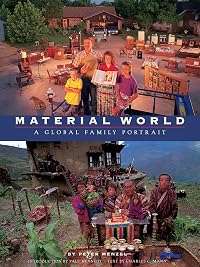
Peter Menzel is an internationally known photojournalist who writes many of his books in collaboration with his wife, Faith D'Aluisio. Titles of some include "Material World: A Global Family Portrait," "Man Eating Bugs: The Art and Science of Eating Insects" (the writing of which required the two to actually devour bugs), and "Women in the show more Material World." (Bowker Author Biography) show less

Some Editions
Awards and Honors
Awards
Distinctions
Common Knowledge
- Canonical title
- What the World Eats
- Original publication date
- 2008
- Original language
- English
- Disambiguation notice
- Title/ISBN mismatch: ISBN belongs to 'The Cricket in Times Square' by George Selden
Classifications
Statistics
- Members
- 741
- Popularity
- 37,999
- Reviews
- 17
- Rating
- (4.11)
- Languages
- English, French
- Media
- Paper
- ISBNs
- 4
- ASINs
- 3