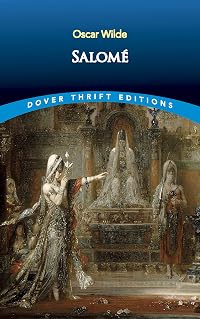
Salomé
by Oscar Wilde 
On This Page
Description
Salome is a tragic play written by Oscar Wilde, which tells the biblical story of Salome. Salome dances the Dance of the Seven Veils so well that she receives a boon from her stepfather Herod Antipas. Much to his dismay and her mother's delight she requests the head of John the Baptist on a silver platter. Though John is a favorite of Herod and under his protection, Herod cannot rescind his boon.Wilde originally wrote the play in French, and it was translated three years later into English.
.
Tags
Recommendations

























Member Reviews
Salome is my second-favorite play by Oscar Wilde, and it's a world apart from his other dramas. Recreating the death of John the Baptist, it's moody and fantastical, a far cry from the whimsy of The Importance of Being Earnest or even the melodrama of A Woman of No Importance. But it's easy to get swept up in this strange other world, full of people talking about the beauty of the moon and prophets declaring doom and young women who captivate everyone who sees them. Like so many dramas, I want to see it performed: done right, it would be utterly captivating.
The real star of my edition, though, is Aubrey Beardsley's lavish illustrations. I had read Wilde's Salome before, but I had never seen it paired with the illustrations. Beardsley's show more illustrations are strikingly grotesque, especially his female figures-- though his male ones do not fair much better. The women's faces are harsh and unfriendly. The men's genitalia are small and shriveled yet projecting. Why, in the illustrations for a play about the seductive power of an intensely attractive woman, is Salome herself depicted so revoltingly? This is the question that the illustrations provoked in me this time around.
One of my favorite moments in John Berger's Ways of Seeing where he is discussing the depiction of female nudity in art. In commenting on the painting Vanity by Hans Memling in the 15th century, he says, "You painted a naked woman because you enjoyed looking at her, you put a mirror in her hand and you called the painting Vanity, thus morally condemning the woman whose nakedness you had depicted for your own pleasure." A strategy often used in art (in its most general sense) is to depict something ostensibly improper-- female nudity in this case-- and condemn the source of it even though the viewer is intended to take pleasure in it. I think you see this in movies a lot: many of the female characters in Mean Girls are depicted as shallow and obsessed with their appearances and condemned for this, yet the viewer still gets to watch them in short skirts and tight shirts. (Or you see it in comic books. When Supergirl is brainwashed by Darkseid in Jeph Loeb's excruciating Superman Batman: Supergirl, she dons this dominatrix-type outfit that really shows off her butt in tight leather pants. At the same time the viewer is repulsed by Darkseid's evil, he (obviously the viewer is a he) also gets to ogle Supergirl. Princess Leia's metal bikini might be a more mainstream example.)
But in Salome-- a story that definitely villainizes the title character for using her sexuality to get what she wants-- there is nothing like this. Her breasts bulge through her outfit in many of the pictures, but they are not alluring. At what should be her most attractive moment, the Dance of the Seven Veils, her face scowls and her body contorts unnaturally as a disgusting imp-figure plays fiercely in the corner. Her breasts once again protrude. Also grotesque are all the pictures where Salome interacts with the decapitated head of Iokanaan. The rest of Herod's court fares even worse.
This visual depiction, however, is consistent with the text, which displays the court of Herod as a place of sexual and moral grotesqueness. Herod breaks his solemn word for the sake of a dance, inviting condemnation from Iokanaan, who is decapitated for his pleasure. For the people here to be attractive-- and especially for the Dance of the Seven Veils to be genuinely seductive to the reader-- would have been morally hypocritical, as Berger identifies. How can we condemn Salome for her dance if we take pleasure in it?
What's really interesting, though, is that it's unlikely the dance would have been depicted this way in any other medium. The introduction to my edition says that Sarah Bernhardt would have played Salome; I doubt that this famous beauty would have been rendered unattractive, and I especially doubt that the Dance of the Seven Veils would have been anything other than captivating. In some ways, this renders Beardsley's illustrations for Salome more faithful to the meaning of Wilde's text than any performance could have been, even if it could never actually appear on stage this way. show less
The real star of my edition, though, is Aubrey Beardsley's lavish illustrations. I had read Wilde's Salome before, but I had never seen it paired with the illustrations. Beardsley's show more illustrations are strikingly grotesque, especially his female figures-- though his male ones do not fair much better. The women's faces are harsh and unfriendly. The men's genitalia are small and shriveled yet projecting. Why, in the illustrations for a play about the seductive power of an intensely attractive woman, is Salome herself depicted so revoltingly? This is the question that the illustrations provoked in me this time around.
One of my favorite moments in John Berger's Ways of Seeing where he is discussing the depiction of female nudity in art. In commenting on the painting Vanity by Hans Memling in the 15th century, he says, "You painted a naked woman because you enjoyed looking at her, you put a mirror in her hand and you called the painting Vanity, thus morally condemning the woman whose nakedness you had depicted for your own pleasure." A strategy often used in art (in its most general sense) is to depict something ostensibly improper-- female nudity in this case-- and condemn the source of it even though the viewer is intended to take pleasure in it. I think you see this in movies a lot: many of the female characters in Mean Girls are depicted as shallow and obsessed with their appearances and condemned for this, yet the viewer still gets to watch them in short skirts and tight shirts. (Or you see it in comic books. When Supergirl is brainwashed by Darkseid in Jeph Loeb's excruciating Superman Batman: Supergirl, she dons this dominatrix-type outfit that really shows off her butt in tight leather pants. At the same time the viewer is repulsed by Darkseid's evil, he (obviously the viewer is a he) also gets to ogle Supergirl. Princess Leia's metal bikini might be a more mainstream example.)
But in Salome-- a story that definitely villainizes the title character for using her sexuality to get what she wants-- there is nothing like this. Her breasts bulge through her outfit in many of the pictures, but they are not alluring. At what should be her most attractive moment, the Dance of the Seven Veils, her face scowls and her body contorts unnaturally as a disgusting imp-figure plays fiercely in the corner. Her breasts once again protrude. Also grotesque are all the pictures where Salome interacts with the decapitated head of Iokanaan. The rest of Herod's court fares even worse.
This visual depiction, however, is consistent with the text, which displays the court of Herod as a place of sexual and moral grotesqueness. Herod breaks his solemn word for the sake of a dance, inviting condemnation from Iokanaan, who is decapitated for his pleasure. For the people here to be attractive-- and especially for the Dance of the Seven Veils to be genuinely seductive to the reader-- would have been morally hypocritical, as Berger identifies. How can we condemn Salome for her dance if we take pleasure in it?
What's really interesting, though, is that it's unlikely the dance would have been depicted this way in any other medium. The introduction to my edition says that Sarah Bernhardt would have played Salome; I doubt that this famous beauty would have been rendered unattractive, and I especially doubt that the Dance of the Seven Veils would have been anything other than captivating. In some ways, this renders Beardsley's illustrations for Salome more faithful to the meaning of Wilde's text than any performance could have been, even if it could never actually appear on stage this way. show less
Maybe I'm missing the connections, but I found that Beardsley's drawings didn't correspond at all to WIlde's text... It's not really surprising though, because Beardsley was famous for doing his own thing even when he was given a text to illustrate. None the less, I was very impressed by both the play and he illustrations on their own. Beardsley's linework and characterization were intriguing and beautiful, even if we have no actual idea of who they correspond to in the play. As for Wilde's text, he carefully blended literary and biblical themes with those of common humanity (ti doesn't get much more real than the revenge of a woman scorned from love), and I found myself very attracted to Salomé's wild and determined feamel archetype.
Wilde’s short one-act play and take on the Biblical story of the death of John the Baptist (Mark 6:17-29, Matthew 14:3-11). The tale is fairly simple. John has condemned King Herod for marrying Herodias, his brother’s wife, angering Herodias. Herod also lusts after her daughter Salome, and after she dances her famous dance of the seven veils for him, he grants her one wish. Herodias then convinces her to use it on asking for John’s head on a platter.
In Wilde’s spin, there are additional emotions in play. A soldier lusts after Salome and commits suicide when he sees her lusting in turn after John (Iokanaan in the play) for the whiteness of his body, the blackness of his hair, and the redness of his mouth. John’s rejection of show more Salome provides her with additional motivation for having him killed. Herod hears her proclamation of love unrequited and orders her killed at the end as well.
This edition is adorned with twenty full-page illustrations by Aubrey Beardsley, some of which I saw at a recent art exhibition of the 19th century Aesthetic Movement in the San Francisco Legion of Honor. Beardsley’s self-proclaimed goal was to be grotesque, and that certainly comes across in his highly stylized, often bizarre drawings. Not exactly my favorite type of art, but it does add interest.
Despite the sex, violence, and occasional jab at religion, the play seems pretty innocuous by today’s standards, but it was controversial in its day. Wilde reacted by commenting that it was a mirror in which everyone could see himself: the artist, art; the dull, dullness; the vulgar, vulgarity. Perhaps that was a clever way to deflect criticism, for I can hardly want to say I saw mediocrity with this in mind. Maybe I’ll just say I saw simplicity.
Quotes:
On God:
“The Nubian: The gods of my country are very fond of blood. Twice in the year we sacrifice to them young men and maidens: fifty young men and a hundred maidens. But I am afraid that we never give them quite enough, for they are very harsh to us.
The Cappadocian: In my country there are no gods left. The Romans have driven them out. There are some who say that they have hidden themselves in the mountains, but I do not believe it. Three nights I have been on the mountains seeking them everywhere. I did not find them, and at last I called them by their names, and they did not come. I think they are dead.
First Soldier: The Jews worship a God that one cannot see.”
On rejection:
“What shall I do now, Iokanaan? Neither the floods nor the great waters can quench my passion. I was a princess, and thou didst scorn me. I was a virgin, and thou didst take my virginity from me. I was chaste, and thou didst fill my veins with fire…Ah! ah! wherefore didst thou not look at me? If thou hadst looked at me thou hadst loved me. Well I know that thou wouldst have loved me, and the mystery of Love is greater than the mystery of Death.” show less
In Wilde’s spin, there are additional emotions in play. A soldier lusts after Salome and commits suicide when he sees her lusting in turn after John (Iokanaan in the play) for the whiteness of his body, the blackness of his hair, and the redness of his mouth. John’s rejection of show more Salome provides her with additional motivation for having him killed. Herod hears her proclamation of love unrequited and orders her killed at the end as well.
This edition is adorned with twenty full-page illustrations by Aubrey Beardsley, some of which I saw at a recent art exhibition of the 19th century Aesthetic Movement in the San Francisco Legion of Honor. Beardsley’s self-proclaimed goal was to be grotesque, and that certainly comes across in his highly stylized, often bizarre drawings. Not exactly my favorite type of art, but it does add interest.
Despite the sex, violence, and occasional jab at religion, the play seems pretty innocuous by today’s standards, but it was controversial in its day. Wilde reacted by commenting that it was a mirror in which everyone could see himself: the artist, art; the dull, dullness; the vulgar, vulgarity. Perhaps that was a clever way to deflect criticism, for I can hardly want to say I saw mediocrity with this in mind. Maybe I’ll just say I saw simplicity.
Quotes:
On God:
“The Nubian: The gods of my country are very fond of blood. Twice in the year we sacrifice to them young men and maidens: fifty young men and a hundred maidens. But I am afraid that we never give them quite enough, for they are very harsh to us.
The Cappadocian: In my country there are no gods left. The Romans have driven them out. There are some who say that they have hidden themselves in the mountains, but I do not believe it. Three nights I have been on the mountains seeking them everywhere. I did not find them, and at last I called them by their names, and they did not come. I think they are dead.
First Soldier: The Jews worship a God that one cannot see.”
On rejection:
“What shall I do now, Iokanaan? Neither the floods nor the great waters can quench my passion. I was a princess, and thou didst scorn me. I was a virgin, and thou didst take my virginity from me. I was chaste, and thou didst fill my veins with fire…Ah! ah! wherefore didst thou not look at me? If thou hadst looked at me thou hadst loved me. Well I know that thou wouldst have loved me, and the mystery of Love is greater than the mystery of Death.” show less
Given that it forms a portion of my thesis I have no idea how to review it. You think that would make it easier, but it doesn't. I get too distracted, wanting to talk about the Beardsley illustrations, or wanting to talk about the Syrian and the Page, or how it resembles Maeterlinck in style but is really taken from Huysmans and Moreau in substance. And none of these things are very useful to a casual review! I will give you this: to say that someone's hair is like clusters of black grapes is the prettiest image and makes me wish I were dark-haired (and acquainted with people who would say such a thing).
an interesting 're-write' of the execution of John the Baptist. In the gospel account, the daughter of Herodias is a nameless girl, used by the research for his pleasure and by Herodias to avenge her reputation. In Wilde's adaptation Salome, now named, is a woman scorned who uses her sexuality to get what she wants: to kiss the prophets lips. It matters little to her that the head is not attached.
Nada que ver con las otras obras de Oscar Wilde.
Parece que los personajes no hacen mas que enfocarse en un tema y hablar de el hasta agotarlo, moverse al siguiente tema, y asi hasta el final.
Quiza no lo he entendido pero no he sacado demasiado de esta lectura.
Parece que los personajes no hacen mas que enfocarse en un tema y hablar de el hasta agotarlo, moverse al siguiente tema, y asi hasta el final.
Quiza no lo he entendido pero no he sacado demasiado de esta lectura.
I was familiar with the story but had never read Wilde's play. I really liked it and it definitely made me want to seek out other interpretations, like the operas and paintings and whatnot. It reminded me of the Artemisia Gentileschi painting, Judith Beheading Holofernes, though I know it's not about the same event. Damn I love her. I think it's really interesting to compare her painting with Caravaggio's Judith Beheading Holofernes. It's just so clear that one was painted by a woman and the other a man.
Members
- Recently Added By
Lists

Translingualism
191 works; 4 members

Favourite One-Acts
31 works; 2 members

1890s
49 works; 6 members

Folio Society
831 works; 53 members

my
3 works; 1 member

Books Read in 2024
4,727 works; 128 members

My Play Collection
769 works; 3 members

Books Read in 2008
336 works; 8 members
Author Information

Flamboyant man-about-town, Oscar Wilde had a reputation that preceded him, especially in his early career. He was born to a middle-class Irish family (his father was a surgeon) and was trained as a scholarship boy at Trinity College, Dublin. He subsequently won a scholarship to Magdalen College, Oxford, where he was heavily influenced by John show more Ruskin and Walter Pater, whose aestheticism was taken to its radical extreme in Wilde's work. By 1879 he was already known as a wit and a dandy; soon after, in fact, he was satirized in Gilbert and Sullivan's Patience. Largely on the strength of his public persona, Wilde undertook a lecture tour to the United States in 1882, where he saw his play Vera open---unsuccessfully---in New York. His first published volume, Poems, which met with some degree of approbation, appeared at this time. In 1884 he married Constance Lloyd, the daughter of an Irish lawyer, and within two years they had two sons. During this period he wrote, among others, The Picture of Dorian Gray (1891), his only novel, which scandalized many readers and was widely denounced as immoral. Wilde simultaneously dismissed and encouraged such criticism with his statement in the preface, "There is no such thing as a moral or an immoral book. Books are well written or badly written. That is all." In 1891 Wilde published A House of Pomegranates, a collection of fantasy tales, and in 1892 gained commercial and critical success with his play, Lady Windermere's Fan He followed this comedy with A Woman of No Importance (1893), An Ideal Husband (1895), and his most famous play, The Importance of Being Earnest (1895). During this period he also wrote Salome, in French, but was unable to obtain a license for it in England. Performed in Paris in 1896, the play was translated and published in England in 1894 by Lord Alfred Douglas and was illustrated by Aubrey Beardsley. Lord Alfred was the son of the Marquess of Queensbury, who objected to his son's spending so much time with Wilde because of Wilde's flamboyant behavior and homosexual relationships. In 1895, after being publicly insulted by the marquess, Wilde brought an unsuccessful slander suit against the peer. The result of his inability to prove slander was his own trial on charges of sodomy, of which he was found guilty and sentenced to two years of hard labor. During his time in prison, he wrote a scathing rebuke to Lord Alfred, published in 1905 as De Profundis. In it he argues that his conduct was a result of his standing "in symbolic relations to the art and culture" of his time. After his release, Wilde left England for Paris, where he wrote what may be his most famous poem, The Ballad of Reading Gaol (1898), drawn from his prison experiences. Among his other notable writing is The Soul of Man under Socialism (1891), which argues for individualism and freedom of artistic expression. There has been a revived interest in Wilde's work; among the best recent volumes are Richard Ellmann's, Oscar Wilde and Regenia Gagnier's Idylls of the Marketplace , two works that vary widely in their critical assumptions and approach to Wilde but that offer rich insights into his complex character. (Bowker Author Biography) show less
Oscar Wilde has a Legacy Library. Legacy libraries are the personal libraries of famous readers, entered by LibraryThing members from the Legacy Libraries group.
Some Editions
Series
Belongs to Publisher Series
Quaderns de Teatre (30)
Palabra menor (2)
Proa Butxaca (6)
Stichting De Roos (15)
BUR: L [Rizzoli] (243)
Little Blue Books (46.2)
GF Flammarion (1317)
Insel-Bücherei (Nr. 247)
Reclams Universal-Bibliothek (4497)
Work Relationships
Is contained in
Has the adaptation
Has as a student's study guide
Common Knowledge
- Canonical title
- Salomé
- Original title
- Salomé
- Original publication date
- 1893
- People/Characters
- Herod Antipas; First Man; John the Baptist; Second Man; Tigellinus; Myrrhina (show all 10); Naaman; Honorius; Herodias; Salome
- Important places
- Palace of Herod
- Related movies
- Salome's Last Dance (1988 | IMDb)
- First words
- Scene. A great terrace in the Palace of Herod, set above the banqueting-hall. Some soldiers are leaning over the balcony. To the right there is a gigantic staircase, to the left, at the back, an old cistern surrounded by a wa... (show all)ll of green broze. The moon is shining very brightly.
- Last words
- (Click to show. Warning: May contain spoilers.)(The soliders rish forward and crush beneath their shields Salmoe, daughter of Herodias, Princess of Judea.)
- Original language*
- Anglais (Royaume-Uni) (Royaume-Uni)
- Disambiguation notice
- Wilde wrote the play in French. The standard English translation was done by his lover Lord Alfred Douglas.
*Some information comes from Common Knowledge in other languages. Click "Edit" for more information.
Classifications
Statistics
- Members
- 1,785
- Popularity
- 12,344
- Reviews
- 31
- Rating
- (3.53)
- Languages
- 19 — Catalan, Czech, Dutch, English, Esperanto, Estonian, French, German, Greek, Italian, Lithuanian, Multiple languages, Norwegian, Russian, Slovenian, Spanish, Swedish, Turkish, Portuguese (Portugal)
- Media
- Paper, Audiobook, Ebook
- ISBNs
- 145
- UPCs
- 2
- ASINs
- 95